How-To Guide
How do you calculate the fee for an influencer’s usage rights?
Price usage as base fee x rate per 30 days x periods, add handle ads, exclusivity and spend share as separate lines, then compare quotes by cost per day.
By the Superdirector editorial team. Vendor guides, U.S. Code, FTC, TikTok and Meta pages read October 31, 2026.
At a glance
How do I calculate a fair usage rights fee for an influencer’s content?
Multiply the base fee, with usage taken out, by a rate stated as a percentage of that base for every 30 days, and by the number of 30-day periods you will run the content. Add ads run through the creator’s handle, exclusivity, extra channels and any share of ad spend as separate lines, and remove any overlap. The published rate is the unreliable part: the four guides we read put paid-ad usage between 15% and 50% of the base per 30 days in their main ranges and none shows a checkable method. So restate every quote as a rate per 30 days and a cost per licensed day, price only the days you will run, and compare a longer term or a buyout by its break-even month.
- Usage fee = base fee x rate per 30 days x number of 30-day periods; a flat fee becomes a rate by dividing it by the base and by the periods.
- The monthly rate falls as the term grows in both ladders we found, so never scale a 30-day rate to a longer term.
- A buyout beats a term only if you will run the content longer than buyout divided by base fee times monthly rate.
Direct answer
Short answer: price usage as base fee × rate per 30 days × number of 30-day periods, then add anything else you plan, such as ads run through the creator’s handle, exclusivity, extra channels or a share of ad spend, as its own line. Before you accept a quote, restate it in those terms and as a cost per licensed day, so a flat fee, a monthly percentage and a yearly total can sit side by side. Then price the days you will actually run, not the days a package offers.
This is for a brand or agency holding a quote, and for a creator who has to put a number on a request to reuse a post. The published guides agree on the shape of the sum and disagree about the size of the rate: the four we read put usage anywhere from 15% to 50% of the base for every 30 days in their main ranges. On a fictional $800 base that is $120 to $400 for each 30 days, a threefold gap that no formula closes. So this page does not hand you a rate. It shows how to find out what a quoted rate means, what it costs for the days you will really use, and where a quote double-counts.
The formula diagram below shows the whole method on one page, and the blank usage fee worksheet holds three quotes side by side. The worksheet contains no creator, fee or result.
When enlarged, scroll horizontally to read the diagram.
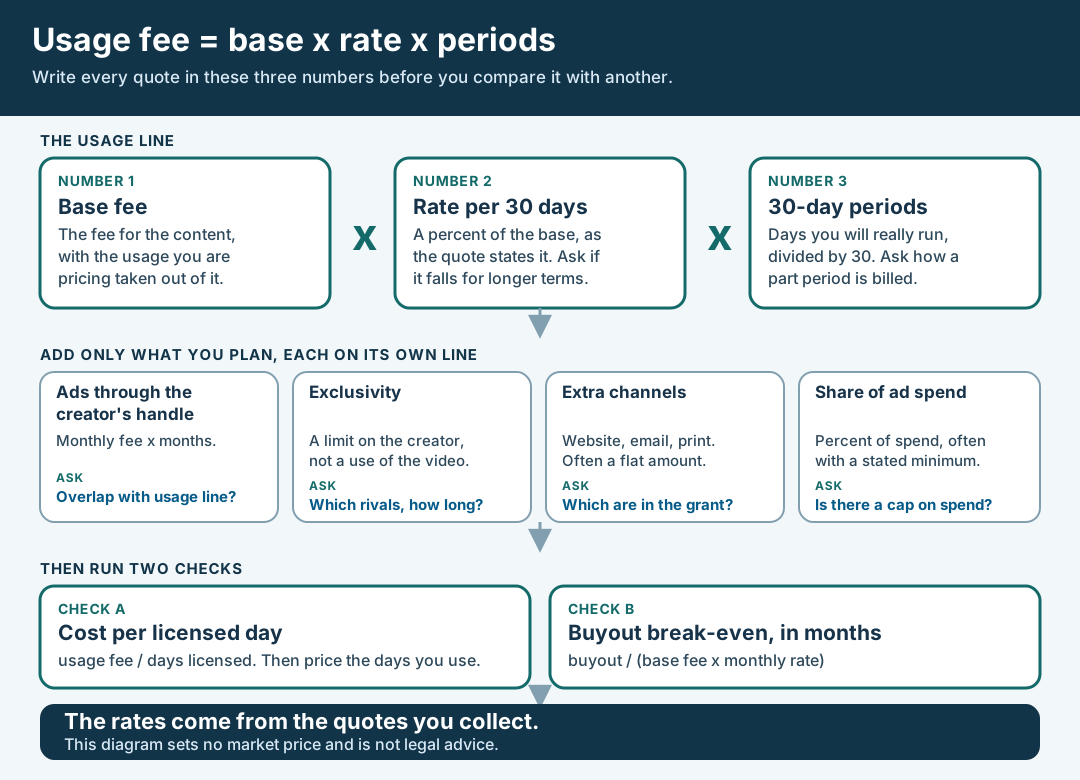
An original editorial diagram. It shows the arithmetic and the questions to ask, not a market rate.
Original visual by Superdirector editorial team. Creation date not recorded.
What the published guides agree on, and where they split
We read four pieces that give a method for pricing usage. All are marketing or advisory content, not surveys. The table shows what each says about the main lines. Percentages are of the creator’s base fee unless noted.
| Source (date shown) | Paid-ad usage | Ads through the creator’s handle | Perpetual or buyout | Method stated |
|---|---|---|---|---|
| impact.com (page undated) | 20% to 50% per month for usage rights in general in its steps; its tier table runs from 0% to 50% for nano creators up to 100% and above for celebrities | A separate boosting fee of 5% to 20% of the brand’s paid ad spend | A premium, no figure given | None cited; draws on two staff interviews |
| Influencer Marketing Hub (updated Apr 30, 2026) | 15% to 25% per 30 days for paid social | 25% to 35% per month | 200% to 300% flat, or 6 to 12 times the monthly fee | Says “real data points we’ve analyzed”, names none |
| Gigapay (Oct 13, 2026) | 15% to 30% per 30 days | 25% to 50% per 30 days | 150% to 300% of base | Compiles other vendors’ figures; conflicts not reconciled |
| Influencer Advisory (published May 3, 2026; updated Oct 28, 2026) | Quotes it reports: 25% for 30 days on a $400 integration; 50% for 30 days on a base of $2,700 to $3,000 | 30% in one reported quote | Examples priced inside the fee, with no separate ratio | Says each number is a term a creator wrote into a quote to it; no sampling described |
Three things follow. First, the structure converges. Influencer Marketing Hub says fees are expressed as a percentage of the base rate per 30-day period or per month, Gigapay calls a percentage of base per 30 days its main model, and impact.com multiplies a monthly add-on by the months. Second, the size splits. Even inside impact.com the text says 20% to 50% while its tier table goes to 125% for macro creators and higher for celebrities, and the page does not explain how the two relate. Third, each source operates in the creator market and none gives a way to check its range, so treat every figure here as an opening position to question.
One detail from Influencer Advisory is worth keeping in view. It says 60 of the 97 quotes it saw that mentioned usage rights named a 30-day window, and lists several creators whose base fee already included 30 days. That is one agency’s collection with no stated selection method, but it explains why a brand and a creator can both say “usage is included” and mean different things.
Separate the base fee from every use of the video
Every percentage in the table is a percentage of something, and the something is not the same in every quote. Influencer Marketing Hub says organic social use is included in the base fee for up to three months and then costs 10% to 15% of the base per month. Influencer Advisory lists creators whose base included 30 days of usage, and one UGC video whose base already included a year of organic use. impact.com treats the base as payment for the content only and prices every use on top. A 25% add-on to a base that already includes 30 days of usage is not comparable with a 25% add-on to a base that includes none.
So the first step is a question, not a calculation: what exactly does the base fee cover, in channels and in days? Get the answer in writing and, if the creator quotes one bundled number, ask for it in two lines: the content with no usage, and the usage. Influencer Marketing Hub also recommends showing usage as a separate line item in the statement of work or budget, which makes later changes visible. If you are comparing a UGC video quote, the UGC price guide covers the other lines inside a base.
Write the use as days, channels and territory
A rate is useless until you know how many periods it multiplies. Write the plan as a start date, an end date and a channel list, count the days, and divide by 30. A run of 90 days is 3 periods. A run of 45 days is 1.5 periods, and the quote has to say whether the half period is billed pro rata or as a full one. On the fictional $800 base used below and a 25% rate, the usage fee for that 45-day run is $300 if the half period is prorated and $400 if it is billed as a full one, so ask rather than assume.
Channels matter because the sources price them as separate uses. Influencer Marketing Hub lists organic reposts, paid social, whitelisting and Spark Ads, email and website banners, and print and out-of-home as distinct entries, with print and out-of-home as a flat fee or a percentage per term. Write down each channel you will really use and leave out the rest. The paid usage term guide shows how to turn a plan into dated scenarios, and the asset rights guide records the signed grant channel by channel. Territory and edit rights belong in the same note, because a quote that says nothing about either has not priced them.
Restate each quote as a rate per 30 days and a cost per licensed day
Quotes arrive in three shapes: a percentage per period, a flat fee for a term, and a total percentage for a term such as “70% for a year”. Convert each into the same two numbers. For a flat fee, the rate per 30 days is the flat fee divided by the base, divided by the number of 30-day periods. For a total percentage, it is the percentage divided by the periods. The cost per licensed day is the usage fee divided by the days licensed.
Fictional exercise: no real brand, creator, fee or result was inspected. A brand receives three quotes for the same $800 base with usage taken out.
| Quote | As written | Rate per 30 days | Usage fee for the term | Cost per licensed day |
|---|---|---|---|---|
| A | 25% of base per 30 days, 90 days | 25% | 3 periods × $200 = $600 | $600 ÷ 90 = $6.67 |
| B | $450 flat for 90 days | $450 ÷ $800 ÷ 3 = 18.75% | $450 | $450 ÷ 90 = $5.00 |
| C | $960 for 12 months (taken as 360 days) | $960 ÷ $800 ÷ 12 = 10% | $960 | $960 ÷ 360 = $2.67 |
Quote C is cheapest per day and the dearest overall. If the brand plans to run the content for 90 days, C costs $510 more than B and $360 more than A. C only wins if the content runs long enough: against A the crossover is $960 ÷ $6.67 = 144 days, and against B it is $960 ÷ $5.00 = 192 days. That is the point of the second number. Cost per licensed day tells you which quote is efficient; the days you will use tell you which one is cheap.
The table also hides an assumption. It treats A and B as if they would keep charging the same rate beyond 90 days, and the reports we read say rates do not behave that way. Influencer Advisory reports a UGC video quoted at +$175 for 3 months, +$300 for 6 months and +$550 for 12 months of paid ads on a $650 CAD base. Gigapay, citing UGC Bloom, lists paid social at 20% to 30% for 30 days, 30% to 45% for 90 days and 70% to 100% for 12 months. Treat a month as 30 days and the monthly rate falls in both.
| Term | Influencer Advisory quote on a $650 CAD base | Per 30 days, as % of base | Gigapay citing UGC Bloom (total % of base) | Per 30 days, as % of base |
|---|---|---|---|---|
| 30 days | Not quoted | — | 20% to 30% | 20% to 30% |
| 3 months (90 days) | +$175 = 26.9% | about 9.0% | 30% to 45% | 10% to 15% |
| 6 months | +$300 = 46.2% | about 7.7% | Not given | — |
| 12 months | +$550 = 84.6% | about 7.1% | 70% to 100% | about 5.8% to 8.3% |
The two sources also sit far apart. The agency’s reported quotes work out at about 7% to 9% of the base per 30 days, inside or below the UGC Bloom figures and below the 15% to 50% ranges in the first table. Neither tells you what your creator will accept. The practical lesson is narrower: do not scale a 30-day rate up to a longer term, and do not prorate a long-term price down to a short one. Ask for the price at the term you want, and ask what each extra 30 days would cost if you extend, in writing, at signing.
Price handle ads, exclusivity, channels and spend share as separate lines
The usage line covers the brand using the content. Four other things get priced beside it, and each is easy to pay for twice.
Ads run through the creator’s handle. Influencer Marketing Hub puts whitelisting and Spark Ads at 25% to 35% of the base per month, Gigapay at 25% to 50% per 30 days, and Influencer Advisory reports one quote at 30%. The line is a monthly fee times the months. None of the sources we read says whether this fee already contains the paid-usage right for the same weeks, so ask. Also keep the contract and the platform apart. TikTok’s Content Suite page says Spark authorization requests default to 365 days, which is a platform setting and not the term you paid for. TikTok: Content Suite and Spark Ads. Meta’s developer page describes a creator accepting a brand’s partnership-ad permission request in Instagram, with statuses such as approved and revoked, and states no duration. Meta: account-level permissioning for partnership ads. Stop the ads when the paid term ends, not when the platform clock does; the guide to stopping creator ads before the term ends covers it.
Exclusivity. This restricts what the creator may do for others, so it is not a use of your video and should not ride inside the usage rate. impact.com says most creators charge 20% to 100% of the base rate, and its worked example applies 50% once for three months. Gigapay, citing InfluencerFee, gives 15% to 30% of deal value for 30 days and 25% to 50% for 90 days. One base is the creator’s rate and the other is the deal, so convert both to dollars before you compare. Name the rivals and the months, or leave exclusivity out.
Extra channels. Influencer Marketing Hub prices email and web banners at 25% to 30% of the base per 30-day cycle. impact.com’s worked example adds a flat $200 for website use on a $500 base. Add a line only for a channel you will use.
A share of ad spend. impact.com says creators typically charge 5% to 20% of the brand’s total paid ad spend for boosting, and Gigapay says 3% to 5% of the media budget is typical. At a fictional $6,000 of spend those ends are $180 and $1,200. Influencer Advisory reports one quote with a $1,500 minimum and 10% of spend. If a quote reads “the greater of $1,500 or 10% of spend”, the percentage only starts to bind above $15,000 of spend ($1,500 ÷ 0.10), and below that the minimum is the price whatever you spend. A percentage of spend is only calculable if you know the spend, so ask for a cap or a flat figure for the plan.
Walk through a fictional total, then remove the overlap
Fictional exercise: no real brand, creator, fee or result was inspected. A brand plans 90 days of paid ads from its own account and 60 of those days as Spark Ads through the creator’s handle. The base with usage taken out is $800. The brand picks two rates inside the cited ranges only so the arithmetic can run: 25% of base per 30 days for usage, and 30% per month for the handle ads.
| Line | Working | Amount | Running total |
|---|---|---|---|
| Base fee, usage excluded | As quoted | $800 | $800 |
| Paid-ad usage, 90 days | $800 × 25% × 3 periods | $600 | $1,400 |
| Handle ads, 60 days | $800 × 30% × 2 months | $480 | $1,880 |
| If the handle fee already holds the usage right for those 60 days | Remove 2 periods × $200 | −$400 | $1,480 |
The unanswered question moves the total by $400, half the base. The rights lines also dominate: $1,080 of the $1,880, or 57%, is usage, against $680 of $1,480, or 46%, once the overlap is removed. Gigapay’s composite budget scenarios put rights at 30% to 50% of a creator budget for nano and micro creators and 60% to 75% for macro creators, but it does not say how those scenarios were built, so use the share only as a prompt to read the rights lines twice, not as a benchmark. The sums predict nothing about a real campaign.
Test the term against a buyout and price the extension now
A buyout, or perpetual use, is priced as a lump against a monthly rate, so the useful question is how many months of the monthly rate it equals. The break-even month is the buyout divided by the base fee times the monthly rate. Using the cited ranges, Influencer Marketing Hub gives 200% to 300% for perpetual use and Gigapay 150% to 300%. The table applies three buyout figures to three monthly rates, with a month taken as 30 days.
| Buyout as % of base | Monthly rate 15% | Monthly rate 25% | Monthly rate 35% |
|---|---|---|---|
| 150% | 10.0 months | 6.0 months | 4.3 months |
| 200% | 13.3 months | 8.0 months | 5.7 months |
| 300% | 20.0 months | 12.0 months | 8.6 months |
Read it this way: at a 25% monthly rate, a buyout at 200% of the base equals eight months of paid usage. If you will run the asset for fewer months than the table shows, the term is cheaper on these assumptions. Because the monthly rate tends to fall with the term, as the ladders above show, the real break-even is later than the table, so the table errs toward recommending the buyout. Gigapay, citing a UGC Bloom worked example, says a 150% perpetual buyout beats 90-day pricing only if the asset stays in use for roughly 338 days, which rests on that example’s 90-day price assumption that we did not check.
Two cautions apply before you choose the lump. Influencer Marketing Hub flags wording such as “in perpetuity” as granting unlimited rights and recommends a separate premium or a fixed-term license instead. And the word buyout does not tell you what changes hands. U.S. copyright law defines a transfer of copyright ownership to include an exclusive license, whether or not it is limited in time or place, and to exclude a nonexclusive license. 17 U.S.C. 101. Other than by operation of law, a transfer is not valid unless it is in a writing signed by the owner of the rights or the owner’s duly authorized agent. 17 U.S.C. 204. Price the lump against what the signed words transfer, and ask counsel; this page does not decide ownership. Influencer Marketing Hub also suggests a reserve of 5% to 10% of media budget for unplanned rights changes, which is cheaper than negotiating an extension while the ad is already earning.
If you are the creator pricing a request
The same arithmetic runs the other way. State your base fee with no usage, name the channels and days the brand asked for, choose a monthly rate you can explain by what they get, and write the result as three numbers so they can see it. Because the published ranges run from 15% to 50%, a rate tied to a stated scope is easier to defend than one copied from a guide. Offer the price for each extra 30 days and say whether the monthly price changes with the term. Put exclusivity, handle ads and extra channels on separate lines, so a brand that wants only one of them can drop the others without renegotiating the whole sum. Your rate card should carry these as fields; the rate card template shows one layout.
What the fee does not settle
A usage fee pays for the right to run the content. It does not make the ad compliant. The FTC’s endorsement Q&A says a company is ultimately responsible for what others do on its behalf, and that a disclosure should be in each ad that would require one if the ad were viewed in isolation. FTC Endorsement Guides: What People Are Asking. When you turn a creator’s post into a paid ad, check the ad version for its disclosure as well as the original post. The disclosure review guide shows how. None of this is legal advice.
Where Superdirector fits
For a few quotes this is a spreadsheet job and the blank worksheet is enough. Superdirector does not publish or set a usage rate, does not know what any creator charges, and is not a creator payment platform. Where it helps is upstream. The UGC campaign planning flow helps you prepare the brief from your product context and selected references, including usage expectations, so every creator is pricing the same channels and days. The usage rights checklist lists what to secure in writing before you post. Review the available workflow and its access terms before requesting work.
How this differs from nearby pages, and what we could not verify
This page teaches one skill: turning a usage quote into comparable arithmetic. The paid usage term guide chooses how long the term should be. The UGC price guide reads a whole video quote as five lines. The rate benchmark guide tests how far a published base rate can be trusted. The asset rights guide records the signed grant. Here those are inputs, and the new decision is what a quoted rate costs for the days you will run it.
Every percentage on this page is vendor or agency guidance, several from sources that cite nothing, and none measures how often a creator accepts a given rate. We found no independent survey of usage-fee levels. impact.com’s page carries no publication date. Meta’s page says nothing about how long a partnership-ad permission lasts, and TikTok’s says nothing about changing an authorization period. We read no Instagram Help Center pages on partnership ads. We make no claim about tax treatment, international law, music licensing inside a video or the price of AI-generated content.