How-To Guide
Which clauses should an influencer agreement settle before the creator posts?
The clauses to put in writing before a creator posts: deliverables, approval, disclosure, usage rights, exclusivity, payment and takedown, with a dated plan.
By the Superdirector editorial team. Statute, FTC, Copyright Office and platform pages read November 1, 2026; template and blog numbers are labelled as practitioner views. Not legal advice.
At a glance
Which clauses should an influencer agreement settle before the creator posts?
Settle seven things in writing: what is delivered and by when, how approval works, who checks the disclosure, what you may do with the content and until when, what the creator may not do for competitors and until when, when money moves, and what happens if something goes wrong. Only a few of these are set outside the contract. The FTC expects clear disclosure and brand monitoring, the Copyright Act requires a signed writing for an exclusive licence and sets narrow tests for work made for hire, and there is no federal rule on exclusivity. Every date, percentage and duration is your choice, and none of the sources we read backs a market norm. This is not legal advice.
- Disclosure is the clause with the most law behind it: the FTC puts responsibility on the brand as well as the creator, and says to guide, monitor and remedy.
- “Work made for hire” is narrow. For a commissioned creator video, a signed licence or assignment is the safer route, and an exclusive grant needs a signed writing.
- Exclusivity, approval windows and payment splits have no sourced market norm. Write dates and let the numbers be yours.
Direct answer
Short answer: settle seven things in writing before the creator posts. What is delivered and by when. How approval works. Who checks the disclosure. What you may do with the content, and until when. The things the creator may not do for competitors, and until when. When money moves. What happens if something goes wrong. Most of those are choices. A few are set by statute or by the FTC, and the useful habit is knowing which is which.
This page is for a brand or agency marketer who has to send a creator an agreement this week and wants the clause list with its sources. It is not legal advice, and it covers US federal law and general US practice. The one state statute we show, California’s, is there to show that local law can change the answer.
We read the FTC Endorsement Guides on eCFR, the FTC’s influencer pages, four sections of the Copyright Act, the Copyright Office’s work-made-for-hire circular, YouTube’s branded-content help page and six practitioner guides and templates. The templates gave numbers. None gave a source for them, so we label every one as a vendor’s.
What is set outside the contract and what is yours to write
Mixing these up is the common mistake. A clause that restates the FTC’s disclosure standard carries outside law. One that says 30 days of exclusivity carries a number somebody picked. The split, as far as the sources we read show it:
| Clause area | Set outside the contract | Left to you |
|---|---|---|
| Disclosure | A material connection must be disclosed clearly and conspicuously under the FTC Endorsement Guides. The Guides are the FTC’s interpretation of the law, not a statute. | Exact wording, placement in each format, who checks, how fast a defect is fixed |
| Brand duties | The Guides say an advertiser should guide, monitor and remedy, and that this is not a safe harbor | Who on your side does it, and what the creator must do when told |
| Ownership | Copyright in a creator’s video stays with the creator unless a work-made-for-hire rule or a signed transfer says otherwise. An exclusive licence or assignment needs a signed writing | Licence or assignment, scope, term, territory, raw files |
| Exclusivity | No federal rule applies today. State and general contract law decide | Category, competitor list, dates, price |
| Approval | An endorsement must reflect the endorser’s honest opinion or experience | Revision rounds, turnaround for each side, what silence means |
| Payment and takedown | Nothing in the sources we read | Every number: deposit, balance, due dates, kill fee, keep-live period |
Name the deliverables, dates and approval rules
Start with what gets made. Name the platform, the format, the number of posts, the posting date or window, the length, the elements that must appear (the product, a link, a code) and the claims the creator must not make. A vague deliverable makes every later clause hard to apply, because dates and payments hang off it.
Then the approval sequence. Three details decide whether it works: how many revision rounds there are, how long each side has to respond, and what silence means. The two vendor templates we read differ on all three. On approval, the Influencer Marketing Hub template lists approval as a clause and leaves every day count as a placeholder. CreatorScore’s template gives numbers: one revision round, requested within 3 business days of a draft, and approval of a draft counts as approval to publish as is. Neither says where its numbers come from, so read them as one vendor’s starting point and not as a norm.
Our suggestion, which no source tests: write the deadline for both sides, say that a missed deadline moves the posting date and does not approve the draft, and name the one person on each side who can sign off. A rule that silence is approval can work, but state it plainly and keep it away from the disclosure check below.
One limit on what an approval round can ask for. Under the Guides an endorsement has to reflect the endorser’s honest opinions, findings, beliefs or experience, and cannot carry a claim that would be deceptive if the brand made it directly (16 CFR 255.1(a)). A brief can ask for a claim you can substantiate. It should not script an opinion or an experience the creator does not hold.
Put the disclosure duty and a check in the contract
Disclosure is the clause with the most outside law behind it, and the one where the brand is exposed along with the creator.
Start with the connection. The Guides say a material connection includes money and free or discounted product, even product unrelated to the one endorsed, whether or not you require an endorsement in return, and that early access, a chance of being paid or a prize can count too (255.5). In the Guides’ example of a golfer paid to post a video, the post is an endorsement if viewers can readily identify the brand, either because it is apparent from the video or because it is tagged or mentioned (Example 5). The FTC’s Q&A says tagging a brand is an endorsement but is not a disclosure.
Then responsibility. An advertiser may be liable for a deceptive endorsement even when the endorser is not, and advertisers should give endorsers guidance, monitor their compliance and take action to remedy non-compliance (255.1(d)). The Guides say good-faith effort on those three is not a safe harbor but should reduce the odds of an enforcement action. Endorsers can be liable for their own statements (255.1(e)), and agencies and similar intermediaries can be liable for hiring and directing endorsers who fail to disclose (255.1(f)). The Q&A, discussing platform tools, says responsibility for the disclosure rests with the influencer and the brand. A contract does not move that. What it does is let you show that you guided, monitored and corrected.
What to write into the agreement:
- Say what the disclosure must look like. The FTC defines “clear and conspicuous” as difficult to miss and easily understandable by ordinary consumers, and says where it should go depends on how the claim is made: in at least the visual portion for a visual claim, at least the audible portion for a spoken one, and both when both are used (255.0(f)).
- Rule out the placements the FTC rejected. In the Guides’ own influencer example, a disclosure only in the profile, behind a “more” link, or in a small, low-contrast platform tool on screen for about five seconds is not clear and conspicuous (Example 9). The Q&A adds that viewers are more likely to miss a disclosure at the end of a video, and that one only at the start of a livestream is likely to be missed because viewers can start watching at any time.
- Name the wording and ban vague labels. Disclosures 101, printed November 2019 and addressed to influencers, says not to use vague terms such as “sp”, “spon” or “collab”. It predates the 2023 revision of the Guides, so read it for the labels and not for who is responsible.
- Do not let a tag or a tool stand in. A brand tag is not a disclosure, and the Q&A says it is always best to add your own disclosure even if a platform offers a tool.
- Name the person who checks. One named person on your side checks the label, the caption and the first seconds before the post goes live, and again after. The Q&A says to monitor an endorser under contract for the length of the contract, so add a clause that obliges the creator to cooperate with the check.
- Set a fix time. The FTC sets no timeline. CreatorScore’s template says 24 hours from notice, without a source. Choose a number you can staff.
- Pay for the work, never for a sentiment. 16 CFR Part 465 bars giving compensation or incentives conditioned on consumer reviews expressing a particular sentiment (465.4). It is written for consumer reviews, so whether it reaches a sponsored post is a legal judgment. The safe contract rule is the plain one: payment is for delivering the post, and never depends on the creator liking the product.
A note on penalties, because people ask. The civil penalty under Section 5(m)(1)(A) of the FTC Act, which covers violations of FTC trade regulation rules such as Part 465, was listed at $53,088 in the eCFR text we read for penalties assessed after January 17, 2025, and a later annual adjustment may exist (16 CFR 1.98). We did not find a per-post fine attached to the Endorsement Guides, which are guidance.
Define ownership and usage as dated scope
Two questions get mixed together here. Who owns the video, and what may you do with it.
Work made for hire is narrower than templates suggest. Under the Copyright Act a commissioned work counts as made for hire only if it falls in one of nine listed categories and the parties sign a written instrument saying it is (17 U.S.C. 101). The Copyright Office’s Circular 30 lists four criteria (the category, a written agreement, an express work-made-for-hire statement and the signatures of all parties) and says a work that fails any one of them is not a work made for hire. Employment is the other route, and for an independent creator who runs their own business it is judged by common-law agency factors such as control, tools, duration and method of pay, not by what the contract calls them. The circular does not say whether a creator’s social video fits a listed category. That is a legal question, and writing “work made for hire” into the agreement does not answer it.
A defined licence, or an assignment, is the usual alternative, and counsel should draft it. Two points explain why the wording matters. First, an assignment or an exclusive licence is a transfer of copyright ownership, and a transfer is not valid unless it is in a writing signed by the owner (17 U.S.C. 204(a)). The definition of transfer covers exclusive licences and leaves out nonexclusive ones (section 101), so the statute is silent on whether a nonexclusive licence needs a writing. Put it in writing anyway, because the scope is what gets argued over. Second, a grant by an author that is not a work made for hire can generally be terminated in a five-year window that opens 35 years after it was signed, with a different start for grants that cover the right of publication (17 U.S.C. 203). That right does not apply to works made for hire. It only matters for a grant you call perpetual, and only on a very long horizon.
Then usage as scope, each line with an end date. Lemni’s usage guide separates a perpetual, non-exclusive licence to repost organically from a time-limited right to run the post as a paid ad, and suggests a 60-day term for paid use in its template while citing 30 to 90. It also says that whitelisting needs dark-posting rights and authorization codes within 48 hours. The mclaw guide gives an example of a $40,000 fee for six posts with usage limited to 90 days of organic use, so later paid use would fall outside the grant. That is the failure to design out: a brand buys organic reposts, a team later boosts the post, and nobody checks the grant.
| Permission | What the agreement should answer |
|---|---|
| Organic repost on brand channels | Which channels, edited or not, and until when |
| Paid ads from the brand’s account | Which platforms, how many days, starting when |
| Whitelisting or partnership ads from the creator’s handle | Dark-posting rights, who generates the authorization code, how fast, and how long it stays valid |
| Editing and cutdowns | Whether the brand may trim, caption, add music or change the voiceover |
| Territory | Where the ads may run |
| Use of the creator’s name and face | In which materials, and for how long |
| Raw files | Whether the creator delivers them, in what format, by what date, and for what use |
On raw files: none of the guides or templates we read addresses raw footage or source files, and the Copyright Office pages cover authorship, not file delivery. If you want the unedited files, say so in the agreement. That is our suggestion and not a sourced rule.
For the fee side of the same question, see usage rights fee calculation. To record the grant after it is signed, see recording channel, term and territory.
Scope exclusivity by category and dates
Exclusivity limits what the creator can earn from other brands for a period, so it should be written narrowly and priced on its own line. The sources we read agree on the shape. Use a category and not a blanket ban. Name the competitors, or at least the category. Run the clock from the publish date, not from signing, and size it to how long the campaign is visible to the creator’s audience (Make Influence). Give it an end date.
Price is where the sources fall apart. The Financial Influencer Network says brands typically pay 20–100% more for exclusivity, on a ladder running from 20–30% extra for 14 to 30 days to 75–100% extra for six months, and cites only “industry benchmarks” with no base amount (FIN). Make Influence says exclusivity should be priced separately and, citing Modash’s compiled examples from creator managers, gives one manager’s 10–15% of the base rate per 30 days in easy categories and about 50% per month in hard ones. Lemni’s usage guide gives two uplift figures that do not agree with each other, 50–100% and 2x to 4x, again without a base. Practitioner pages disagree on durations too, from a few weeks for a single post to a year or more for an ambassador deal. We treat all of it as anecdote. If you need a figure, ask the creator for their exclusivity rate and compare it with what they would lose, not with a table.
On the law, the FTC’s non-compete rule (16 CFR Part 910) is not in effect. A court stopped enforcement on August 20, 2024, the FTC moved to dismiss its appeal in September 2025, and the FTC’s page lists a February 2026 Federal Register notice on removing the rule. So no federal rule governs creator exclusivity today, and state and general contract law decide whether a clause holds. That varies by state, which is one reason to keep the clause narrow and dated.
Tie payment to events you can verify
The templates agree on shape and differ on numbers. CreatorScore’s template pays 50% within 7 days of signing and 50% within 15 days after the last deliverable publishes. The Influencer Marketing Hub template leaves the percentages as placeholders. What the two share is the useful part: a deposit at signature, a balance tied to an event you can verify, and a definition of that event.
“Completion” is the word that causes trouble. It can mean the video was approved, posted, verified live, or the usage window opened. Pick one and write it down. The example below invoices the day after the post is verified live and pays the balance 30 days after the invoice, which is our choice and not a norm.
Two terms the sources cover poorly are a kill fee, which is what the creator keeps if you cancel after work has begun, and late-payment interest. CreatorScore’s template has no kill fee, and no page we read set a standard for either. Put both on the list for counsel, and meanwhile write down what a cancelled project pays at each stage: before the first draft, after approval, after posting.
Add conduct, termination and takedown terms
Conduct. The mclaw guide says not to tie a morals clause to a criminal conviction, because reputational harm arrives long before a case ends, and to use a good-faith determination instead of sole discretion, with the consequences listed: termination, stop using the content, repay, remove (mclaw). A clause that needs a conviction rarely applies, and one that gives sole discretion invites a dispute about whether it was exercised fairly.
Breach. The same guide treats FTC non-compliance as a material breach that allows termination and repayment. CreatorScore’s template pairs a 24-hour fix for FTC issues with a 7-day cure for other breaches. Use numbers you can meet, and make the fix period the same one the disclosure clause names.
Takedown. The CreatorScore template keeps the post live for 90 days. No source we read says how long a post should stay up or when a brand may demand removal, so decide both: a minimum live period, and the grounds on which either side may require removal, such as a legal problem or a claim that turns out to be wrong.
Non-delivery and late delivery. Say what is refunded and what is owed if the creator does not deliver, delivers late, or you cancel. No source sets terms for this, so any numbers are yours.
Platform labels: what we verified and what to check
A platform’s branded-content setting is a tool for the creator’s disclosure and does not replace it. The contract should name the tool and the creator’s own wording both.
YouTube’s help page tells creators to select the paid promotion setting, which adds a disclosure label at the start of the video, and says creators and their partners are responsible for complying with applicable law (YouTube Help). The page shows no date, and we did not test its labels in the live Studio interface. TikTok says commercial content that is not properly disclosed may lose For You feed eligibility (TikTok help, April 2026). We did not verify Meta’s or TikTok’s current branded-content labels and brand obligations for this page, so check the current steps the week you sign. For the post-level check, see verifying the TikTok branded content setting, and for partnership ads and Spark Ads, see the whitelisting setup.
A worked example: one dated schedule
Here is a hypothetical single-video deal as dates. The $4,000 fee, the 50/50 split, the 3 and 2 business-day windows, the 60-day paid licence, the 30-day exclusivity and the 90-day keep-live are drafting choices for the example. They are not market norms and not legal requirements. Business days skip weekends, and no US federal holiday falls inside a business-day window. Exclusivity starts at the post, as Make Influence advises. A brand that also wants a quiet period before the post is asking for a different clause.
| Date | Clause | How the date is set |
|---|---|---|
| Mon, Nov 16, 2026 | Agreement signed, including the exclusive paid-licence terms | Start. A signed writing is needed for an exclusive grant |
| Mon, Nov 23 | $2,000 deposit | Signing plus 7 calendar days |
| Tue, Dec 1 | Draft one due | Fixed date in the schedule |
| Fri, Dec 4 | Brand feedback due | 3 business days: Dec 2, 3 and 4 |
| Wed, Dec 9 | Revised draft due | 3 business days: Dec 7, 8 and 9 |
| Fri, Dec 11 | Final approval due. The clause says what silence means | 2 business days: Dec 10 and 11 |
| Before Mon, Dec 14 | Disclosure check by the named brand owner | Label, caption and first seconds checked before posting |
| Mon, Dec 14 | Post goes live. Paid licence and exclusivity start | 3 calendar days after final approval |
| Tue, Dec 15 | Invoice for the $2,000 balance | The day after the post is verified live |
| Tue, Jan 12, 2027 | Exclusivity ends | 30 days, counting Dec 14 as day one |
| Thu, Jan 14 | Balance due | Net 30 from the Dec 15 invoice |
| Thu, Feb 11 | Paid-ads licence ends | 60 days, counting Dec 14 as day one |
| Sat, Mar 13 | Keep-live minimum ends | 90 days, counting Dec 14 as day one |
The arithmetic: $2,000 plus $2,000 is the $4,000 fee. December 14 to February 11 is 60 days counted inclusively, and December 14 to January 12 is 30. Only two things in the table are set outside the contract: the signed writing for the exclusive licence, and the requirement that the disclosure be clear and conspicuous. Everything else is a negotiated choice. If the creator wants a different split or a shorter approval window, change the numbers and keep the structure.
When enlarged, scroll horizontally to read the diagram.
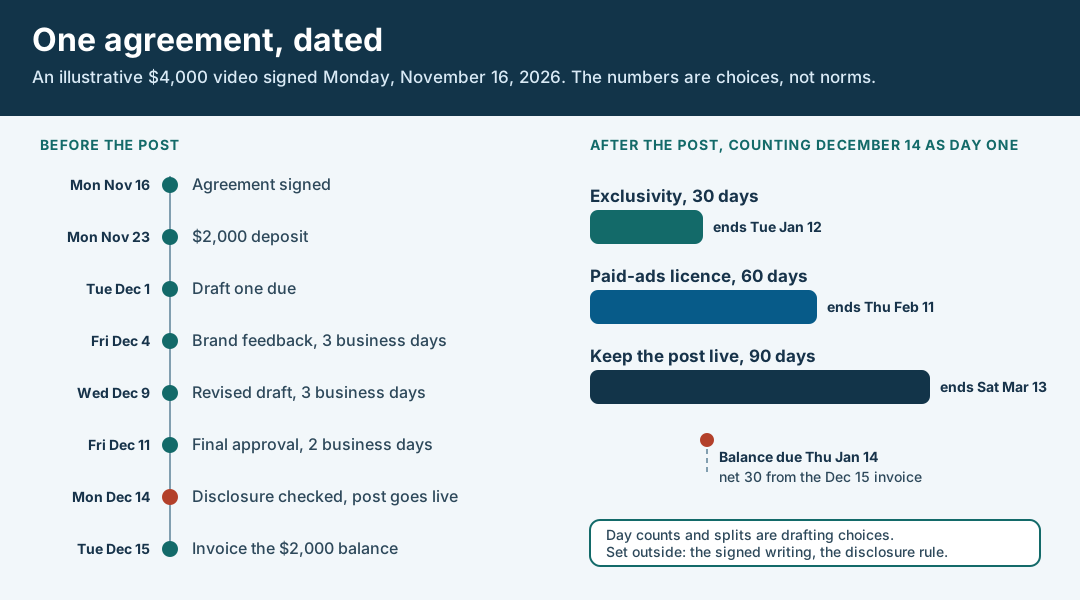
An original editorial diagram of a hypothetical deal. The day counts are choices, not market norms.
Original visual by Superdirector editorial team. Creation date not recorded.
What varies by state, and when to involve counsel
Everything above is US federal. State law decides some of the questions that matter most: whether an exclusivity clause is enforceable, how a morals clause is read, and who may negotiate for a creator. California’s Talent Agencies Act shows how that works. It defines a talent agency as a person who procures, offers or promises to procure, or tries to procure employment or engagements for an artist, and bars carrying on that business without a Labor Commissioner licence (DIR excerpt). Whether an influencer’s manager or agency counts is not answered by the statute text we read, and its list of artists is entertainment-focused. We mention it only because the answer can turn on where the creator or the agency is.
Bring in a lawyer when the deal has an exclusive or perpetual grant or an assignment, when exclusivity is broad or long, when a manager or agency sits across the table, when the creator or the brand is outside the US, when you want a morals clause with remedies, or when the fee is large enough that a dispute would cost more than the review.
Failure modes to design out
- The disclosure sits only in the profile, behind a “more” link, or only in a small platform label. The FTC’s own example calls that not clear and conspicuous.
- The brief says “tag the brand” or “use #collab” and treats it as the disclosure.
- Nobody on the brand side checks the label before and after posting, so the brand cannot show that it monitored or corrected.
- The agreement says “work made for hire” and the team assumes it owns the video. If the category or signature tests fail, it does not.
- An exclusive paid-media licence is agreed by email or direct message and never signed.
- Usage is left as “perpetual, all media”, or has no term, so nobody knows when paid ads must stop.
- Exclusivity runs from signing, or has no named competitors, so the creator is blocked far longer than the campaign is visible.
- The morals clause needs a conviction or gives sole discretion.
- Approval rounds have no deadline and no rule for silence, so the posting date slips and the payment trigger is unclear. This and the next two are our reading and have no source.
- Paid use continues after the licence end date because nobody owns that date.
- The payment trigger is “completion” and nobody defined it.
Limits and nearby pages
Limits of what we read. This is not legal advice and it is not a template. The numbers on approval, payment, exclusivity and keep-live come from vendor templates and blog posts that gave no sources, and they disagree with each other. Neither the FTC’s Q&A nor its hub page shows a publication date, and two of the Q&A lines we rely on reached us as fragments. We did not verify Meta’s or TikTok’s branded-content tools, and we did not test YouTube’s Studio labels. Since we read the eCFR text, the penalty figure may have been adjusted. The Cornell Legal Information Institute hosts the Copyright Act text we cite and is not the official source, though it reproduces it. Whether a short social video falls into one of the nine work-made-for-hire categories is not answered by the Copyright Office circular.
For the checklist version of the usage terms, see the usage rights checklist. To review a post against the disclosure you asked for, use reviewing a creator’s disclosure.