How-To Guide
What should a brand check in a creator's media kit before hiring?
Verify a creator's media kit in five checks: each number's date, median views against followers, the audience report, bought signals, paid results.
By the Superdirector editorial team. Platform help pages, 16 CFR 465 and media kit guides read November 3, 2026.
At a glance
What should a brand check in an influencer's media kit before hiring them?
Ask for the screen behind each number and check five things: the date and definition of the metric, the median views of recent posts against followers, the platform's audience report for your market, follower growth over time, and whether results were organic, paid or old. The five guides we read that rank for media kit searches are written for creators, and none gives a brand a procedure for testing a kit, so this page supplies the checks. A mismatch is a question to ask, not a verdict.
- Ask for platform, metric, period and date captured for every figure.
- Compare the median of about the last 20 posts, not the average, with followers.
- YouTube's Top geographies report ranks countries by watch time, not by viewers.
Direct answer
Short answer: treat every number in a media kit as a claim, and ask for the screen it came from. Check five things: the date and definition of each metric, typical views against followers, the audience report for the market you sell in, signs that numbers were bought, and whether the results are organic, paid or old.
This is for a brand or agency that has a kit in hand and a price to decide. The pages that rank for media kit searches are written for the other side of the table. We read five in full, from Storydoc, CreatorsJet, Buffer, Influencer Fee and Hootsuite, and each tells the creator what to put in. None of them gives a brand a procedure for testing the numbers. Influencer Fee says plainly that “brands verify metrics” without saying how. Buffer quotes a Modash marketer naming engagement rate, average views and comment quality as indicators, and Hootsuite calls engagement rate a sign that followers were not bought, but both say it as advice on what a creator should show. The one brand-side action is Buffer’s note that testimonials allow a reference check.
This page does not set a pass mark. We found no source that gives a normal ratio of views to followers, so we give none. Scope: the metric definitions quoted here are YouTube’s, the only platform help pages we could read. For Instagram and TikTok the page gives the checks but no definitions; ask for the creator’s own dashboard screen with its labels visible (see the section on what this page could not verify).
What media kit guides show, and what they leave out
The example galleries are useful for one thing: seeing how a creator chooses to present themselves. This page links no example kits, because the kits in those galleries are the creators’ and publishers’ own marketing documents, which a brand cannot check from the gallery. CreatorsJet catalogues kits by creator, publisher and company type (its title promises 32 examples) and praises one publisher kit because it “separates print, digital, social and video figures, with sources and reporting periods.” That is the habit to ask every creator for. A figure with a source and a period can be checked. A figure without them cannot.
The same guides show why a brand should not stop at the layout. Influencer Fee tells creators to include “two to four screenshots or thumbnails of your highest-performing posts,” and a few lines later tells them to pick examples that are not “your one exceptional viral outlier.” A kit built on the first instruction will flatter the creator, and the brand has to build the second view itself.
Buffer quotes a creator-community founder saying testimonials let a brand “do a reference check.” That is the one brand-side action we found in the five pages. The steps below turn it into a routine.
When enlarged, scroll horizontally to read the diagram.
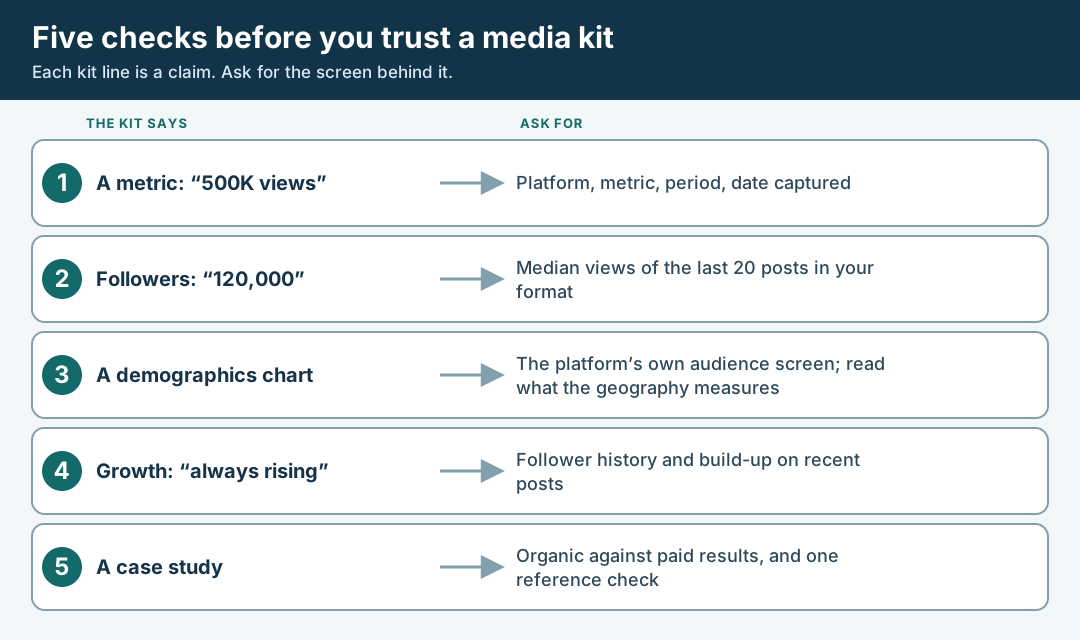
An original editorial diagram. It lists what to ask for, not a pass mark or a market figure.
Original visual by Superdirector editorial team. Creation date not recorded.
Ask for each number's date and definition
Write one line per metric before you compare anything: platform, metric name, period, date captured. “500K views” is not a number until it has those four.
- Date captured. Influencer Fee tells creators to refresh analytics screenshots every 60 to 90 days, and Buffer says to refresh stats every 3 to 6 months. Both are advice to creators, not rules, but a screenshot or stat older than that window is a fair reason to ask for a new one.
- What counts as a view. YouTube’s help page dates a change to August 24, 2026: a view is now counted “the moment a video starts to play”, on Shorts, long-form videos and live streams. The same page says YouTube Partner Program earnings will still be based on “engaged views” and “engaged watch hours”, so YouTube now describes more than one basis for a view. It does not say how the earlier public count was defined, so we cannot say how they differ. Ask which date the screen shows.
- Whether the figure is final. YouTube’s help page says it “may temporarily slow down, freeze, or change” a metric count and discard low-quality playbacks, and that its Realtime activity “might not match” the watch-page number. A screenshot of a video that went live yesterday can still move.
- Which unit. YouTube’s Audience tab reports monthly audience as unique viewers over the last 28 days, and defines unique reach as an “estimated total number of individual people who saw your video or channel,” and says it accounts for shared viewing on devices like YouTube TV and the main YouTube app on TV. Views, viewers and followers are three different counts. Write down which one the kit uses.
- Instagram and TikTok. We could not read their help pages, so we give no definitions for them. Ask the creator for the dashboard screen itself with its labels visible, and write the label down as it appears. Do not assume their “views”, “reach” and “accounts reached” match YouTube’s.
Treat age the same way for every figure: if the date is older than you are comfortable with, ask for the screen again before you negotiate, and cover every account the creator would post on, not just the biggest.
Compare typical views with followers
Followers say how many accounts chose to follow. What a brand buys is the audience that actually shows up for a post.
So ask for the view counts of the creator’s last 20 posts of the format you want (the 20 is our working choice, not a sourced figure), then take the median. One viral post cannot lift a median, and a dormant account cannot hide behind a big follower count. A kit that quotes an average can hide the one big post inside it. The average views guide shows the arithmetic with a fictional sample.
| Fictional kit line | What to ask for | What the answer tells you |
|---|---|---|
| “120,000 followers” | Screen of the follower count with the date | The count the creator stands behind today |
| “Average 18,000 views per Reel” | View counts of the last 20 Reels, including the weak ones | In this fictional sample the median is 9,000, so the 18,000 average is twice the median and leans on a few posts |
| Median 9,000 views on 120,000 followers | Nothing more; this is arithmetic | 9,000 is 7.5% of followers. It is a description, not a verdict; the right bar depends on your campaign |
Set the bar yourself, from the views the placement must deliver for the price you can pay. The worked example above is fictional. No real creator, kit or number was used. If a count is missing or unreadable, treat it as unverified, not as a rejection, and ask again before you decide.
Match the audience report to your market
Hootsuite says brands care most about “[your] reach, engagement, and audience demographics,” so ask for the demographics panel. Ask for the platform’s own audience screen behind it, not a redrawn chart: age range, gender and top countries, with the date.
Read the label on the geography. YouTube’s Top geographies report “shows you which geographies have the most watch time for your channel,” which is a share of watch time, not a share of people, and YouTube warns that geography data “may be limited” (see its audience help page). A country share taken from that report describes watch time, not people. Other platforms label their reports differently, so read the label on each. The partial geography guide covers what to do with an incomplete report.
Ask for the audience report before you discuss a price, and ask again if the first one is partial. If the audience sits mostly outside the market you sell in, that is a reason to ask what the creator can show for your market, not an automatic no.
Look for signs the numbers were bought
The FTC’s rule on fake indicators (16 CFR 465.8) covers someone who purchases or procures fake indicators they knew or should have known were fake and that materially misrepresent their influence or importance for a commercial purpose, so it is a reason for care, not a test you can run on a kit. The practical check is a history, not a snapshot. Ask for follower growth over time and the build-up of views on recent posts. A smooth climb needs no explanation. A jump that stays flat afterwards, with no post behind it, is worth a question.
- Engagement per follower against similar accounts. The fake follower check divides median likes plus comments by followers for the account and for three similar peers, and asks for more when the account sits below half the peer median. That page calls the half-of-peers line its own editorial choice, not a researched threshold.
- Comment quality. The same page counts generic comments (only emoji, or one-to-three-word remarks that fit under any post) and compares the share with the peers, because generic comments are normal in a real audience and only the comparison means anything.
- Audience report against the comments. Our suggestion, not a sourced test: if the audience screen puts most followers in one country and the comments come mostly from another place or language, ask the creator to explain it.
- A thin follower sample. The same page looks at 30 followers for accounts with no posts and no photo and compares that share with the peers. It does not clear an account that passes, because bought accounts can copy real profiles.
YouTube adds a limit from its side: it discards low-quality playbacks and may adjust a count afterwards, so a view figure that later drops is not always the creator’s doing. Ask before you conclude.
Separate organic, paid and old results
A kit’s case study usually shows the best result of the best campaign. Pull three things apart before you use it.
- Organic against paid. Ask which report a quoted number came from, and ask for the platform’s traffic or reach breakdown, where it offers one, that separates views from paid placement from the rest. Organic views are the fairer base for an ordinary post, because paid views come from placement someone paid for. The organic and paid results guide shows how to split the two.
- Posted against shown. A video the creator never posted on their own account has no reach of its own to measure, which is why a UGC sample (a short brand-style video a creator makes for a brand) is evidence of craft and not of audience.
- Claimed against checkable. CreatorsJet tells kit makers to “only list partnerships you actually had.” You can test that: open the brand’s account or the tagged post, and use the reference check Buffer describes by asking the past brand contact one question about delivery and one about results.
The YouTube shortlist guide shows how to record view metrics from several channels on the same page so the comparison stays fair.
What this page could not verify
When we tried, Instagram’s help center, Meta’s policy pages and TikTok’s analytics page gave us no usable text, so we quote no Instagram or TikTok definition and name no menu path. If you are buying on either, this page gives you the five checks but not their metric definitions: ask the creator to show their own dashboard and read the label on it. We also do not know how often kits are inflated; none of our sources measures it, and we have no data from our own campaigns that we can publish. When the kit checks out, price the creator from the rate card and put the agreed terms in a one-post contract. Platform pages were read on the evening of November 3, 2026 (US Pacific time) and can change.