How-To Guide
What an outgoing agency should hand a client while creator posts and rights are still live
Give a client the signed scope, live posts, rights, platform authorizations and open creator deliverables as sourced rows, with consent noted and no new fee.
What must an outgoing agency hand to a client when creator posts, usage rights and unpaid deliverables are still active?
Hand over one packet built from three sourced ledgers: the live posts, the rights and platform authorizations, and the open deliverables with their payment lines copied from the signed documents. Each row names its source, its observed state and date, who controls it now and who will after handover. Check what may be shared about each creator, have the client sign a receipt, and list every unknown row with an owner. Do not calculate a new fee, balance or valuation in the packet.
- A post list is not a rights record, and a rights record is not a platform authorization.
- Copy payment lines from the signed documents; the packet never recalculates one.
- A row you cannot source is written as unknown with a named client owner.
Direct answer
Short answer: hand over one packet with three ledgers, each row tied to a source. The first ledger lists the live posts: the address, the date you last saw each one public and who controls the account it sits on. The second lists the rights and platform authorizations: each granted right quoted from the signed words, and each permission with the account that holds it and its end date as observed. The third lists the open deliverables and payment lines, copied from the signed documents with their status. Then record what may be shared about each creator, have the client sign for the packet, and list every row you could not source as unknown, with the client person who will find out.
This is for an agency that is leaving a creator campaign while posts are still public, paid use may still be running and some promised items are not yet delivered. The decision is narrow: which facts must move to the client, and how to write them so nothing is invented. The packet moves facts. It does not set a new fee, price the remaining work, decide who owns a right or take over a contract. Those belong to the people who signed the documents and to counsel.
The reason to be this literal is that responsibility does not leave with the agency. The FTC’s endorsement Q&A says that handing part of a promotional program to an outside company does not relieve the advertiser of its responsibility, and that advertisers need reasonable programs to train and monitor the people who promote for them. FTC Endorsement Guides: What People Are Asking. A client who inherits live posts therefore needs enough to keep monitoring them. Use the blank open-obligations handover card, the CSV register and the handover map to hold the packet; all three are blank and contain no creator, fee or result.
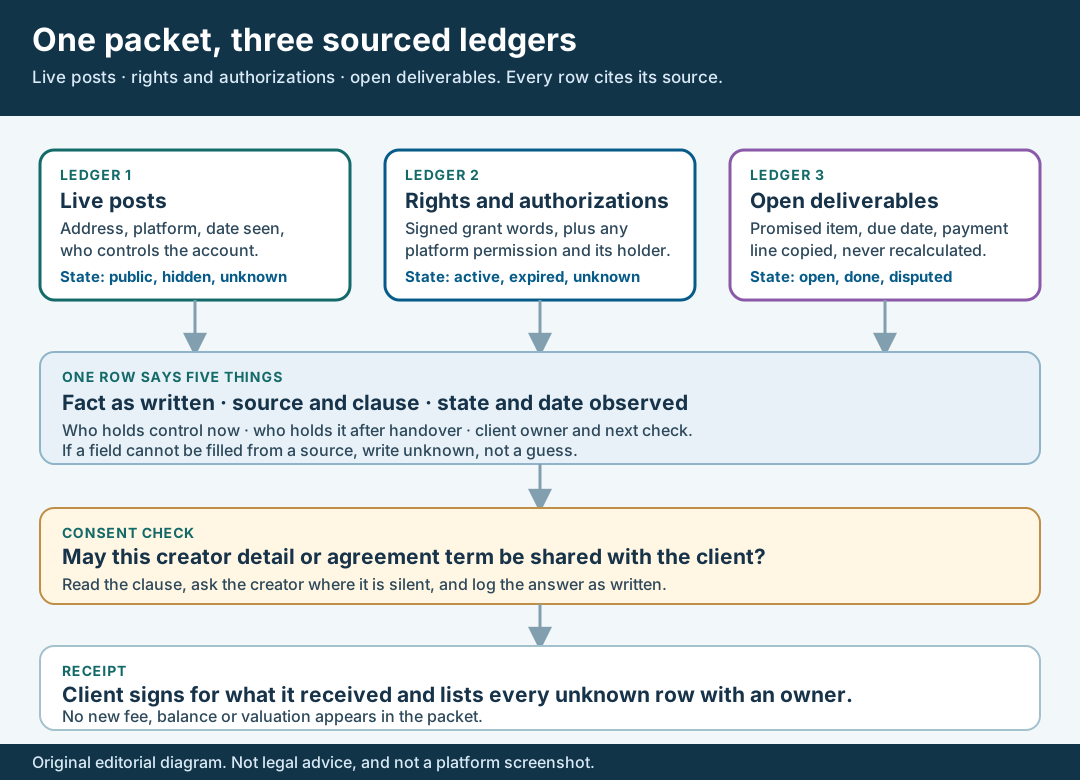
An original editorial map. Every row cites a source, and anything unsourced is written as unknown.
Open the blank handover card (HTML)Download the blank handover register (CSV)
 Superdirector
Make it work for your brand
Find it. Remake it. Post it. Superdirector turns the viral formats in your niche into your brand's carousels, X posts and video scripts, and keeps the calendar full.
Pin the executed scope and the handover date
Start by collecting the signed documents themselves: the agency’s agreement with the client, and each creator’s agreement or accepted brief. A summary email is not the scope. For each document record its name, version, signed date and who signed for whom. If a creator’s agreement is with the agency and not the client, write that down plainly; it is one of the facts the client most needs and one this page cannot resolve for you.
Then record what is missing: a document referred to but never found, an unsigned draft, an amendment mentioned in a message but not attached. List these as gaps rather than filling them from memory. Where an amendment exists only in a thread, quote the message and its date and mark it as not yet a signed change. If you are unsure that the person who agreed for a creator could speak for them, the manager authority check is the place to settle it before the packet relies on that agreement.
Finally, fix one handover date, with time and time zone, and say that every state in the packet is true as of that moment. Posts get edited, authorizations expire and deliverables arrive late. A packet with no date cannot be checked, and a client who finds a different state next week needs to know whether the packet was wrong or the world moved. If your own team already split work between agency and creator, the scope table guide is the input to this step; here you reuse its rows rather than building them again.
List every live post and what is attached to it
Give each public post one row: the full address, the platform, the creator’s account, the date and time you last saw it public, and whether you were signed in or out. A post you have not opened recently gets the date you last did, not today’s date. If a post is hidden, restricted or removed, say so with the date; do not drop the row, because the client may need to ask why.
Next to each post, write who controls the account it sits on. For a creator’s own account that is the creator. For an account the agency set up or administers on a client’s behalf, name the agency person who holds it, because that access is about to change. For a client channel the agency has been running, the YouTube offboarding guide covers proving the client’s control before access is removed. This page is about creator posts and the obligations around them, and it points there for the channel mechanics.
Add the last approved version if one exists, and a pointer to your capture history. The client should be able to see what was approved without asking you. If a post differs from its approved version, say so and link the comparison; do not decide in the packet whether the difference is acceptable. A post with no approval record gets “no approval record found”, which is a fact and not an accusation.
Carry open deliverables and payments without repricing
List each unfinished item exactly as the signed document names it: the item, the due date, the acceptance condition and its status. Status words stay plain: open, delivered and awaiting review, accepted, disputed or unknown. A deliverable you consider late is still “open” with its due date beside it; the client can read the date. The incomplete-deliverable guide gives the wording for reporting a gap without calling it a verdict.
For each item, copy the payment line from the document, such as a deposit, a balance or a rule tying payment to acceptance, with its clause number, and attach the receipt or invoice reference for any payment actually made. Do not calculate a remaining amount, prorate a fee for work the agency will not finish, or add a transition charge. If the documents do not say what happens to money when the agency leaves, write “not addressed in the signed documents” and leave the resolution to the parties. The deposit and balance guide explains why a balance is due only after its acceptance event; the same discipline keeps the packet from stating a number nobody agreed to.
Close this ledger with ads that are still running on creator posts. If paid use is live, the client needs to know the term it runs under and the date it ends, because stopping or renewing it becomes the client’s decision. The guide to stopping creator ads before the term ends covers that moment. In the packet, give each live ad its post, its term as quoted and its end date as observed, with an owner on the client side.
Walk through a fictional handover
Fictional exercise: no real agency, client, creator, fee or result was inspected. Agency A is leaving Brand B’s campaign on a stated date. Three made-up creators, C1, C2 and C3, have agreements with the agency, and Brand B is not a party to any of them. The agency finds all three signed agreements and an unsigned amendment for C2 that exists only in a message thread, so it logs the amendment as a gap and quotes the thread.
| Row | Source and quoted fact | State on handover date | Holder now → after |
|---|---|---|---|
| C1 post (live) | Agreement clause 3: one video. Post public, last seen on the handover date, signed out | Public | Creator’s own account → unchanged |
| C1 right | Clause 6 grant quoted in full; territory is silent | Territory silent | Brand B to ask → not decided |
| C2 platform authorization | Authorization end date as observed in the agency’s ad account | Active, ends on the stated date | Agency ad account → not decided; effect of removal unknown |
| C2 deliverable | Second video named in clause 4; amendment unsigned, quoted from thread | Open | Agency → Brand B owner named |
| C3 deliverable and payment | Clause 5 payment line copied as written; receipt reference for the deposit only | Delivered, awaiting review | Agency → Brand B owner named; payment line not recalculated |
Agency A then notes that it holds C3’s shipping address and a private rate in the agreement. It does not put either in the packet until the sharing check in the last step is done. Brand B’s receipt lists the C2 authorization effect, the C1 territory and the C2 amendment as unknown, each with a Brand B owner. The scenario predicts nothing about any real campaign.
Check consent, hand over and keep a receipt
Before anything leaves the agency, check what may be shared about each creator. For every creator detail you plan to include, such as an email address, a mailing address, a private rate or a clause the agreement marks confidential, read the agreement for a clause on sharing or confidentiality and quote it. Where the agreement is silent, ask the creator in writing what may be passed to the client, and log the reply as written with its date. If the reply is no, or has not come, the packet lists the item, says it is held back and names who will ask again. Whether the client may step into an agency’s agreement is a legal question this page does not decide; send it to counsel.
Then hand over the packet as one dated set: the pinned documents and their gaps, the three ledgers, the consent log and the list of unknown rows. Keep the agency’s own working copy unchanged. If the client later asks about a row, you can show what you handed over and what its source said at the time. Do not attach credentials or authorization codes to the packet; each platform’s controls let the authorized person grant access or generate a code from their own account.
Finish with a receipt. The client’s named person signs and dates that they received the packet as of the handover date, and the receipt lists each unknown row with its client owner and next check date. A receipt is not acceptance that the contents are right. It records what was received, so a later difference between the packet and the world is a difference in dates and not an argument about what the agency said. Set a short follow-up for the unknown rows, and send anything that turns on the meaning of a contract to the people who can decide it.
How this differs from nearby pages
This page produces a handover packet across creators: live posts, rights, authorizations and open deliverables, each sourced and dated, with consent noted. It does not teach each underlying record. The YouTube agency offboarding guide is about proving a client controls one YouTube channel before agency access is removed. The scope table guide sorts agency work from a creator’s deliverables inside two signed documents. The asset rights guide records one grant per asset, and the Spark authorization log tracks expiry per post. Here those records are inputs, and the new decision is what to transfer, what to hold back and what to mark unknown.
This page does not decide who owns a right, whether a client can take over an agency’s agreement, what is owed to the agency or a creator after the exit, or whether any post complies with advertising rules. It also does not say how long to keep the packet. We did not find a retention period in the sources we read, so set it from your agreement, your records policy and counsel. Nothing here measures how often handovers go wrong or what they cost, and no such figure is claimed. We could not load Instagram’s Help Center pages on partnership-ad permissions or TikTok’s Business API documentation on managing post authorization, so we state nothing from them.