How-To Guide
How a report should separate a creator’s deposit from the final balance due after accepted work
Quote the payment terms, record the acceptance event, match each payment to a receipt and show the balance as due only after the event the contract names.
How should a report distinguish a creator deposit from a final balance due after accepted work?
Report each payment as three separate facts: what the signed clause says triggers it, what event you actually observed, and what the payment record shows. A deposit follows its own trigger and its own receipt. A final balance that depends on acceptance reads “not yet due” until you can point to a dated acceptance event, then shows a due date calculated from that event and the clause’s due period, and reads “paid” only when a settled receipt has been seen. A payment in flight is not a payment received, and a payment never proves acceptance.
- Quote the clause for each payment line instead of summarizing it.
- Keep the acceptance event, its version and its date apart from every payment date.
- Re-check each payment’s status on the report date and add refunds or disputes as new dated lines.
Direct answer
Short answer: a report should show every creator payment as three separate facts, never folded into one status word. The first is what the signed terms say: label, amount or formula, trigger, whose acceptance counts and due period. The second is the event you observed: who accepted which version of the work, and when. The third is the payment record: receipt, reference, status on a capture date, amount received and any later refund or dispute. A deposit follows its own trigger and receipt. The final balance depends on acceptance, so it reads not yet due until that event exists.
This is for an agency or brand marketer who reports creator spend to a client or finance lead and must say, for each creator, what has been paid, what is owed and why. The decision is narrow: how to label each line so the report claims only what its evidence shows. Whether a deposit can be refunded, whether work should be accepted and whether a balance is legally owed belong to your agreement, counsel and finance team.
The pattern to avoid is a single “payment status” column that says paid, pending or overdue. It hides which clause applied, which event started the clock and whether money arrived. Use the blank payment ledger card, the CSV register and the ledger map to keep the facts in separate fields, one row per payment.
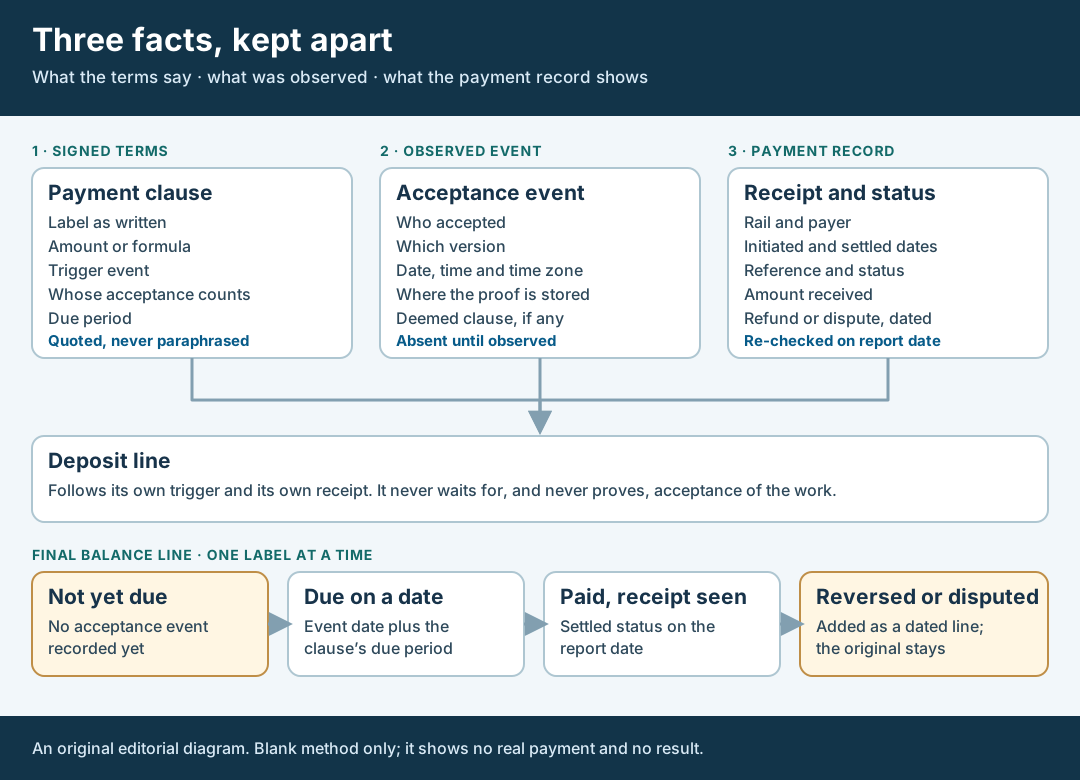
An original editorial map. A balance is not yet due until an acceptance event is recorded, and a payment is paid only when a settled receipt has been seen.
Open the blank payment ledger card (HTML)Download the blank payment ledger register (CSV)
 Superdirector
Make it work for your brand
Find it. Remake it. Post it. Superdirector turns the viral formats in your niche into your brand's carousels, X posts and video scripts, and keeps the calendar full.
Quote the payment terms exactly as signed
Start with the signed agreement, not the invoice or the thread where amounts were discussed. For each payment it describes, paste the clause verbatim, then fill the fields the clause answers: the label, the amount or formula with currency, the trigger, whose acceptance counts if acceptance is involved, and the due period. Where the clause is silent, write “not stated”. A blank filled from memory becomes your own term, and the report then states something nobody signed.
Keep the agreement’s own label for each line. If it says “deposit”, the report says deposit; if it says “advance” or “first installment”, use that. The words are not interchangeable in every agreement, and this page does not claim they are. A payment tied to signing or a start date has a trigger you can read off the agreement. A payment tied to acceptance has a trigger that exists only after somebody acts.
Record the agreement version and signing date on the line, and open a new row if the terms are amended in writing instead of editing the old one. Stripe’s overview of partial payments makes the same point from the billing side: partial payments are acceptable when they are part of the contract from the start, and billing systems track balances accurately but do not record changes to payment terms. Stripe: partial payments. So an invoice or payment dashboard cannot be your record of what was agreed; the ledger carries the terms, with their version.
Also copy any language about what happens to a payment if the work is not delivered or accepted, without interpreting it. If the agreement is silent, write “not stated” and send the question to counsel. For several fee lines per creator, the fee ledger guide ties each fee to its own clause. This page starts one step later, at how the report shows each payment’s state.
Name the acceptance event that starts the balance
An acceptance event is a dated, observable act by the person the clause names, saying that a specific deliverable version is accepted: an approval message, a signed form or an approval in a review tool. Record who, what they said or did, which version, the date, time and time zone, and where the proof is stored. If the agreement says whose acceptance counts, check that the person who acted is that person. A creator’s own satisfaction or a client comment the agreement never mentions is context, not the event.
Several things get mistaken for acceptance, so keep them in their own fields. Delivery is when the creator handed over the work, posting is when it went live, invoice date is when somebody asked for money and payment is when money moved. None shows that the named person accepted the work. If the agreement defines one of them as the trigger, quote that clause and treat the event as observed on that date. Do not let the report reach that conclusion by default.
Version matters. If a first cut was delivered, changes were requested and a second cut followed, approval of the first does not cover the second. Record the version in the event row and compare it with the version actually delivered. The approved-cut receipt guide covers fingerprinting the file and recording who approved which parts; use its output as the evidence column here.
Some agreements treat silence as acceptance after a stated period. If yours does, quote the clause, record the delivery date it counts from, the date the period ended and whether any objection arrived. Label the result deemed under the quoted clause, not “approved”. If there is no such clause, silence is an open question and the balance waits. Where the creator accepts some deliverables and declines others, the clause decides whether the balance splits; if it is silent, write “unclear” and follow the partial-acceptance guide.
Match each payment to a receipt and its status
Give every payment its own row, separate from the acceptance event. Record the rail and payer, when it was initiated, when it was settled if you have seen that, the receipt or reference ID, the status exactly as the payment system shows it, the date you captured that status, and the amount received with currency. A bank reference, a provider transaction ID and an invoice marked paid are different kinds of evidence, so say which you hold.
A payment status is a fact with a date on it. Stripe’s documentation says a payment can sit in a processing state when it uses an asynchronous method such as a bank debit, which can take up to a few days, and that a succeeded status means the payment flow is complete and the funds are in the account. Stripe: payment intent lifecycle. That is one provider’s vocabulary, and we did not read other providers’ status pages. Use it to see why “sent” and “received” need separate fields, and take the words for any other rail from that rail’s own documentation.
A status can also change after it looks final. Stripe’s status documentation says refunds, disputes and their outcomes are reflected on the Charge and may change what the Dashboard shows even though the PaymentIntent remains succeeded, and that edge cases can affect the Dashboard mapping, so the API or inspector gives the authoritative state. Stripe: payment status updates. The practical rule for a report is to re-check each payment on the report date and put the capture time beside it. If a refund or dispute appears, add it as a new dated line. Never overwrite the original payment row, because the report has to be able to say what was true on each date.
Record any difference between the clause amount and the amount received as an observation only. Fees, currency conversion and rounding could each explain a gap, but the ledger does not know which. Write both numbers, leave the explanation empty and ask finance or the creator. If you show a total, make it the sum of settled receipts you have seen, listed line by line, never the sum of clause amounts, which reports what was promised as though it had been paid.
Label each report line by what it proves
Build the report from the three kinds of rows. Each line gets one label from a short fixed list, and each label has a rule about the evidence it needs. The table is our proposed label set, an editorial convention and not a platform feature or standard.
| Report line label | Evidence it needs | What it proves | What it does not prove |
|---|---|---|---|
| Terms quoted | The signed clause, its version and date | What the agreement says about this payment | That any event has happened or any money has moved |
| Deposit initiated, not settled | A reference and a status of in-flight or pending on a capture date | That a payment was started | That the creator has the money |
| Deposit paid, receipt seen | A settled receipt or status, with capture date and amount received | That money arrived as of the capture date | That the work was accepted, or that the amount matches the clause |
| Acceptance recorded | Who, what version, when and where the proof is stored | That the named person accepted that version on that date | That any payment was made or is yet payable under another clause |
| Balance not yet due | A quoted clause that depends on acceptance, and no event observed | That the report is waiting for an event, and whose action is pending | That the creator is late, or that the work will be accepted |
| Balance due on a date | The acceptance event, the quoted due period and the arithmetic | That, under the quoted terms, payment falls due on that date | That the balance is overdue, or that no dispute exists |
| Balance paid, receipt seen | A settled receipt, with capture date and amount received | That money arrived as of the capture date | That nothing will be reversed later |
| Payment reversed or disputed | A dated refund or dispute record, linked to the original payment row | That something changed after the original payment | Who is right, or what the agreement requires next |
| Unresolved, question open | The question, who it went to and the date | That the report is not guessing | Anything about the answer |
Two habits keep the labels honest. A line never borrows evidence from a different line: the deposit’s receipt does not support “balance not yet due”. And a line never carries two labels: an unsettled payment is initiated, not settled, not “paid, pending”. If you cannot tell, use unresolved and write the question. A few visible unresolved lines serve a client better than a report where every line looks settled.
Mark the balance due only after the event
The balance line has one rule: the due date is calculated, never assumed. Take the date of the acceptance event, add the clause’s due period and write the arithmetic in the row. If the clause counts business days or names a day of the month, quote those words and compute from them. With no acceptance event in the ledger, the line reads balance not yet due, followed by what is pending and from whom, such as “waiting for acceptance of version 2 by the person named in the clause.”
Use overdue only when a quoted clause, a dated acceptance event and a calculated due date that has passed are all in the ledger and no settled receipt has been seen. Even then, say “no settled receipt seen as of the capture date”. If the due date has passed and a payment is in flight, the line is initiated, not settled, neither overdue nor paid.
Sometimes money moves before the event. Do not delete or move that payment. Record it with its own date and receipt, and let the balance line show that a payment matching the clause amount was seen before any acceptance event. Whether that was permitted is for the agreement to say. If content was posted without a recorded acceptance, the post is an observed fact in its own row and the balance stays not yet due unless the clause makes posting the trigger.
Finally, freeze each report with a snapshot date and an owner. Re-run the capture for every open payment before the report goes out, and state the date so a reader knows when the statuses were true. The next report starts from the last ledger and adds rows; it does not rewrite old ones, which keeps every earlier report reproducible.
Walk through a fictional creator payment
This example is invented to show the method. It uses a fictional brand, a fictional creator and symbolic amounts, and reports no real payment or result. Suppose “Northwind Mug Co.” signs with “Creator K” an agreement with two clauses. The first, labeled “deposit”, is payable on a stated start date. The second, labeled “final balance”, is payable a stated number of days after the brand’s named reviewer accepts the final video. Call the amounts Amount D and Amount B, and the due period in the second clause ten days.
| Day | What happened (fictional) | Ledger row it belongs in | Report line on Day 20 |
|---|---|---|---|
| 0 | Agreement version 1 signed | Terms quoted, both clauses, verbatim | Terms quoted |
| 2 | Deposit sent by bank transfer; the bank shows a reference | Payment row: initiated Day 2, settled Day 3 seen on capture, amount received equals Amount D | Deposit paid, receipt seen |
| 12 | First cut delivered | Delivery noted as context, not as acceptance | No line change |
| 14 | Reviewer asks for changes to the first cut | Acceptance row stays empty; the request is kept as a note | Balance not yet due |
| 16 | Second cut delivered | New version recorded as version 2 | Balance not yet due |
| 17 | The named reviewer writes that version 2 is approved | Acceptance row: who, version 2, Day 17, proof location | Acceptance recorded |
| 17 plus 10 days | Calculated from the quoted clause | Balance row: due Day 27, arithmetic written out | Balance due on a date (Day 27) |
On Day 20 the report shows the deposit as paid, receipt seen, with the capture time beside it, and the balance as due on Day 27, because the acceptance event exists and the arithmetic comes from the quoted clause. Run on Day 15, it would read not yet due, waiting for acceptance of version 2. Delivery and posting are never treated as acceptance. If Northwind had sent Amount B on Day 18 by a method showing an in-flight status, the line would read initiated, not settled until a settled receipt was seen. Nothing here is a real result; the days and wording are invented to show where each fact is stored.
What this page does not decide
This method separates a deposit from an acceptance-dependent balance in a report. It does not decide whether a deposit is refundable, whether silence is acceptance, whether late fees apply, how a payment is treated for tax or accounting, or whether anyone has breached an agreement. Send those to counsel and finance with the quoted clause and dated rows attached. This article gives no legal, tax or accounting advice, and its examples are fictional.
Several existing pages sit next to this one. The fee ledger guide ties a production fee and a posting fee to separate clauses, triggers and proofs; this page starts after those clauses exist and decides how a report labels a payment’s state and when a balance counts as due. The approved-cut receipt guide proves which file was approved; this page takes that proof as input and uses the acceptance date to start a payment clock. The partial-acceptance guide resolves a declined deliverable; this page only shows how the unresolved state appears in a payment report. For quote comparison, see the bundle quote guide.
Our sources limit what we can say. The Stripe pages describe Stripe’s own payment states and its overview of partial payments. They say nothing about creator agreements, and we did not read other providers’ status documentation. A PayPal help page on partial payments would not load for us, so we make no claim from it. We found no data on how often creator payments are disputed or paid early. The label set here is an editorial convention, not an accounting standard.