How-To Guide
When creator outreach gets few replies, is the roster or the ask the problem?
Freeze one cohort, drop unreachable recipients, fill a roster-by-message grid with counts, read it for roster, ask or neither, then change one cause.
By the Superdirector editorial team. Google, YouTube and FTC pages reviewed October 30, 2026.
At a glance
When creator outreach gets few replies, how can a team separate a poor roster from a weak ask?
Freeze the cohort and the exact message versions, then split the roster on one written attribute and make the versions differ in one element. Remove recipients who could not have received the message, then fill a grid of roster segments by message versions with counts only: sent, reachable, replied in any way, declined. Replies clustered in one row point toward the roster or its route, replies split by version inside a row point toward the ask, and low counts everywhere mean neither is isolated. Change one cause and write the expected read before sending again.
- Rows are roster segments, columns are message versions, cells hold counts.
- Silence is a count, not a verdict, and an unreachable recipient is not a no.
- Change one cause at a time and keep the earlier cohort frozen.
Direct answer
Short answer: build a two-by-two grid before you decide anything. The rows are roster segments, split by one attribute you wrote down before sending. The columns are message versions, which differ in one stated element. Each cell holds only counts: how many were sent, how many were reachable, how many replied in any way and how many declined or asked you to stop. Take out the recipients who could not have received the message, then read the grid. Replies that sit in one row point toward the roster or the route you used to reach it. Replies that split by column inside each row point toward the ask. Few replies in every cell mean neither cause has been isolated. Then change one cause and write down what you will count as a result before you send again.
This is for an agency or brand sourcer whose creator outreach drew few replies and who is about to rewrite the message, replace the roster or do both at once. The decision is narrow: which one cause to change next, and what the counts can honestly say about it. It does not say what a good reply rate is, how many creators to contact or what to offer. We have no verified benchmark for any of those, so the card leaves every number blank and the examples here are fictional.
The reason to use a grid is that a low reply count has at least three explanations at once: the people you picked, the words you sent and whether the message reached anyone. Changing the roster and the message together makes any later improvement impossible to attribute. Use the blank diagnostic card, the CSV register and the diagnostic grid map to keep the cohort, the versions and the counts in one place.
Freeze the cohort and each message version
Start from a record you own: the cohort you actually messaged and the exact messages you sent. Write down the cohort name, the date you froze it and who is in it. Paste each message version word for word, with its subject line if it had one, and note the sender account, the route and the send date for every recipient. A paraphrase of what you sent is your memory of the message, and you will later diagnose the memory instead of the message.
Then write the segment rule. A roster is a list of people, so it only becomes testable when you split it on a single attribute that you can check from public material and that you chose before you saw any replies. The attribute might be how the creator’s recent public work relates to your product task, which platform you reached them on, or whether they publish a business contact. Pick one. If you split on two attributes at once, a difference between rows could come from either of them. Write the rule in one sentence so a colleague could assign any recipient to a row without asking you.
Next, write down what differs between the message versions, and keep it to one element: the opening line, the stated task, whether the first message names a scope, the length, or the call to action. Everything else stays identical. If the two messages differ in three ways, the grid can show that the versions behaved differently but not which difference mattered. Also record anything you cannot hold equal, such as send dates or the sending account, because the grid will not remove those differences for you; it will only keep them visible.
Freeze the record where your team does not overwrite it, and give any later message a new version with its own date instead of editing version A.
Remove recipients who could not have received it
A recipient who never received the message tells you nothing about the roster or the ask. Before you count replies, go through the cohort and mark each recipient reachable, not reachable or cannot tell, and write the evidence beside the mark. A bounce notice is evidence that an address failed. A missing address is evidence that you had no route. A message that went out with no error is not evidence that anyone saw it.
On YouTube, Google’s help page says you can only view a channel’s email address if the channel owner has provided one. YouTube Help: business inquiry emails. When no address is shown, the honest entry is “no email route found on that date”, and the recipient should leave the reply count rather than sit in it as a silent no. Instagram’s Help Center has pages about message requests and the controls an account owner has over them, but we could not load its text while preparing this article, so we make no claim about where a first message from an account the creator does not follow lands or what the sender can see. Treat it as unknown, check the platform’s current page and record what you found and when.
Email adds a separate way to fail: the message can arrive at a spam folder. Google’s Gmail sender guidelines list authentication requirements for senders, extra ones for senders of more than 5,000 messages a day to Gmail accounts, and advice to send email only to people who want to get messages from you. They also point to Postmaster Tools for monitoring spam rate and reasons messages might not be delivered. Email sender guidelines - Gmail Help. We did not check what that tool shows for a small cold-outreach sender, so we do not say it will show you anything for a few dozen messages. A message can fail to arrive for reasons unrelated to the roster or the wording.
Keep cannot tell recipients in the grid as their own count instead of quietly moving them into either side. If most of a row is unknown, say so on the card: the row cannot support a reading about the roster. If every recipient on one route is unreachable, the finding is about the route, and the right next step may be to find another one before changing anything about the message.
Count the grid cell by cell
Now fill the grid. Each cell is one roster segment crossed with one message version. For each cell write four counts: how many were sent, how many were reachable, how many gave a reply of any kind, and how many of those replies were a decline or a request to stop. Write them as “n of m” and leave percentages off. With only a few recipients in a cell, one reply moves a percentage a long way, and a percentage invites a comparison the counts cannot carry. The small-test guide covers what ranges and counts can and cannot say when a test is small.
Define a reply of any kind broadly: an answer, a question, a request for different terms, a pass to a manager or a polite no all count. A reply is the creator’s own words. An automatic reply and a delivery failure do not count as replies. Keep each reply’s text verbatim in the register. A reply from someone speaking for the creator goes to the manager authority check before you read it as the creator’s answer.
Keep declines and opt-outs as a separate count and honor them. The FTC’s CAN-SPAM compliance guide says the law covers all commercial messages with no exception for business-to-business email, that you must honor a recipient’s opt-out request within 10 business days, and that subject lines must not be deceptive. CAN-SPAM Act: A Compliance Guide for Business. Whether a given outreach message is a commercial message under that law is a legal question this page does not answer. The diagnostic point is plain: someone who asked you to stop is not a recipient to test the next version on. Remove them from every later cohort and record the date.
| Cell | Counts to record | What the count cannot show |
|---|---|---|
| Sent | Messages that left your account, by segment and version | Whether anyone saw them |
| Reachable | Recipients with a working route and no failure notice | That the message reached an inbox the creator reads |
| Replied, any kind | Answers, questions, passes, declines, in the creator’s words | Why the others stayed silent |
| Declined or opted out | Replies that refuse or ask you to stop | Whether a no was about the roster, the ask or timing |
The diagnostic grid map shows where each count goes. If a count is not in your own records, write “not recorded” and keep it out of the reading.
When enlarged, scroll horizontally to read the diagram.
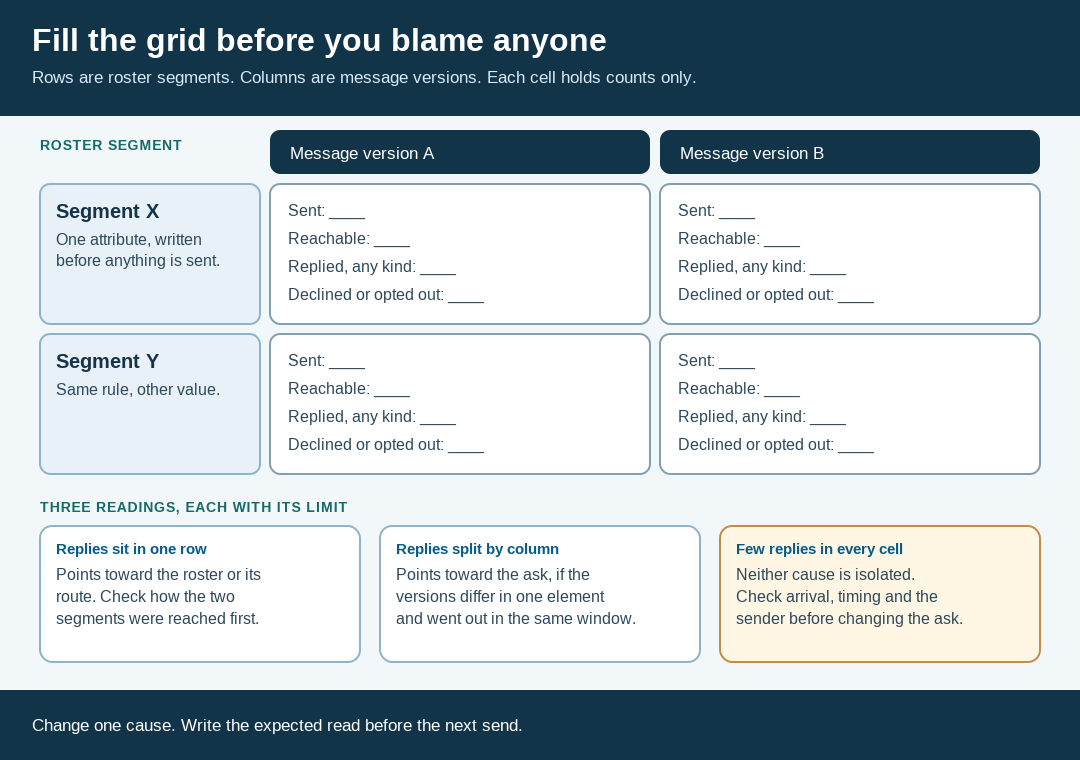
An original editorial grid. Each cell holds counts only, and each reading carries its limit.
Original visual by Superdirector editorial team. Creation date not recorded.
Read the grid for roster, ask or neither
Read the grid in a fixed order and write each reading down with its limit. First, compare the rows. If replies sit mostly in one row and the two message versions behaved alike inside it, the pattern points toward the roster or the route you used to reach that segment. Second, compare the columns inside each row. If the same segment replied more to one version than the other, the pattern points toward the ask, provided the versions differed in one element and went out in the same window. Third, if every cell is low, you have not isolated either cause. That is a finding too: look at arrival, send timing and the sender account before you rewrite anything.
Each reading has a limit that belongs in the same note. The grid does not remove differences you did not control, such as the sender, the day of the week or the size of a segment. It cannot separate roster fit from reachability when the segments were reached by different routes, and with a handful of recipients per cell, a difference of one reply is not a pattern. Sort each reading as observed in these counts, consistent with a cause or cannot say, and use the third whenever the counts are too small to separate the explanations.
Resist two shortcuts. Silence is not a verdict on the ask, because a creator may never have seen it or may not use that route for business. And a single reply is not proof that a segment works; it shows that one person answered one message on one date. To reopen a creator who declined, use the dated-evidence route in the declined-creator guide, not a resend.
Walk through a fictional grid
Fictional exercise: no real brand, creator, campaign or result was inspected, and the counts below are invented only to show the method. A made-up brand, Brand A, froze a cohort of 16 creators. The segment rule, written before sending, split them by one attribute: Segment X had recent public work that showed the buyer task, and Segment Y did not. Each segment was split evenly between message version A and version B, 4 recipients per cell. The two versions differed in one element only: version B named the buyer task in its first sentence, and version A did not. All 16 went out on the same day from the same sender account.
Reachability came first. In the cell for Segment Y and version A, one address returned a failure notice, so that cell counted 3 reachable of 4 sent; every other cell counted 4 of 4. Replies of any kind were: Segment X with version A, 1; Segment X with version B, 1; Segment Y with version A, 0; Segment Y with version B, 0. None of the replies was a decline.
The reading is careful. Both replies sit in Segment X, one per version, so the grid points toward the roster or its route more than toward the ask, since version B did not draw more than version A inside Segment X. But two replies in sixteen messages are too few to separate the explanations. The honest sort is consistent with a roster difference, cannot say how large. The scenario predicts nothing about any real creator, segment or message.
Brand A’s next move follows from that reading. It does not rewrite both messages. It picks one cause, such as adding more Segment X creators with the same version A, and writes the expected read before sending: “we will count replies of any kind per reachable recipient, and compare them with this grid.” The earlier cohort stays frozen as it was.
Change one cause and write the read first
Pick one cause to change and say which one it is: the roster (a different segment, more of the same segment, or a better route to it), the ask (one element of the message) or the delivery (the route, the sender or the timing). Changing two at once repeats the original problem. If the grid pointed toward the roster, change the roster and keep message version A. If it pointed toward the ask, keep the better segment and change one element of the better version. If it pointed toward neither, change delivery first, because a message that does not arrive tests nothing.
Then write the read before you send. Record what you will count, over which recipients, in which window and what each outcome would lead you to do. Writing it in advance stops you from choosing the comparison after you have seen the replies. The next-test guide uses the same one-change discipline for a campaign that has already run.
Finally, close the loop in the file. Record the opt-outs you honored with their dates, the single change, the written read and the next send date and owner. The new cohort gets its own freeze, its own versions and its own grid. Keep the old grid beside the new one so anyone can see what changed.
How this page differs from nearby pages
This page separates roster, ask and delivery as causes of a low reply count, using a grid of owned counts. It does not tell you when to stop messaging an unanswered recipient; that is the stop rule guide, which fixes touches and spacing for one sequence. It does not interpret a finished campaign’s results; the next-test guide starts after a campaign underdelivers and checks its measurement. It does not teach how to read small counts in general; the small-test guide does. The diagnostic grid is the new part: one frozen cohort, one segment rule, one differing message element and counts that stay counts.
Other pages sit next to this one. How to pick who goes on a roster in the first place is in the shortlist guide and the sourcing route guide. How to ask a creator to test an opening claim in their own work is in the hook test request guide. If two contacts both claim to speak for a creator, use the conflicting contacts guide. If a point turns on law or your agreement, send it to counsel.
Nothing here measures typical reply rates, how many recipients a cell needs, how often a roster rather than a message explains low replies or how any platform treats a first message; those numbers are not claimed. We did not read Instagram’s message-request help text and make no statement about it.