How-To Guide
What an agency should do when two contacts both say they manage the same creator
Hold promises and payments, log both claims, ask each contact the same question and release terms only on the creator’s own answer.
How should an agency resolve two contacts who both claim to manage the same creator?
Hold every promise and payment, log both claims exactly as written, and ask both contacts the same written question about which terms they may agree. Then ask the creator directly, through a route neither contact supplied, whom to work with and for which terms, and who should receive payment. Release each term only to the contact the creator names for it, and keep everything else held with a next-check date. A title, a signature or a confident tone is what a contact wrote about themselves, not a confirmation.
- Hold promises and payments before anything else.
- Treat each title as what the sender said, not as a fact.
- Release by term, on the creator’s own words, to the contact named.
Direct answer
Short answer: when two people each say they manage the same creator, stop promising and paying until the creator has spoken through a route neither contact gave you. Log both claims exactly as written, ask both the same question, put one short question to the creator, and release only the terms the creator names, to the contact the creator names. Where the creator has not answered, the hold stays. Use the blank conflicting contacts card, the CSV register and the verification tree to keep it in one place.
This is for an agency or brand marketer whose outreach thread now has two senders, each saying they handle brand deals for the same creator account. The decision is narrow: who may receive a promise or a payment, and on whose word. A promise sent to the wrong person can commit you to terms the creator never saw. A payment sent to the wrong person is hard to put right. Neither mistake is fixed by a polite apology afterward, so the cheap move is to pause before either happens.
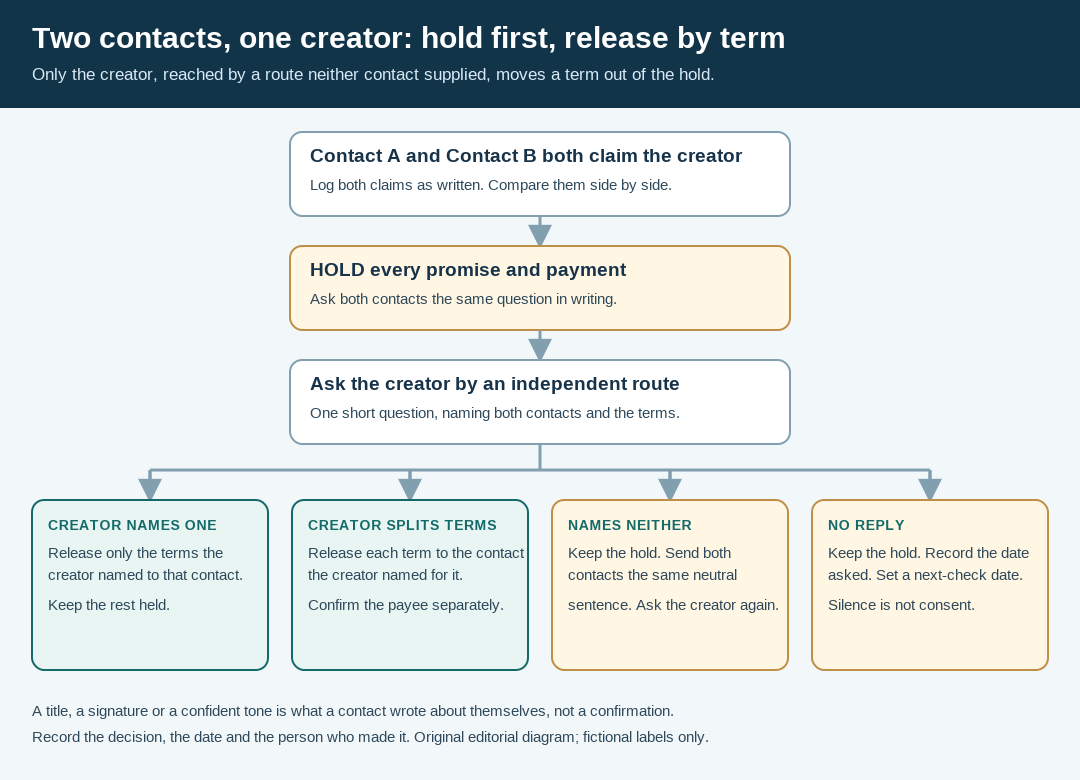
An original editorial tree. Only the creator, reached by an independent route, moves a term out of the hold.
Open the blank conflicting contacts card (HTML)Download the blank contacts register (CSV)
 Superdirector
Make it work for your brand
Find it. Remake it. Post it. Superdirector turns the viral formats in your niche into your brand's carousels, X posts and video scripts, and keeps the calendar full.
Hold every promise and payment, then log both claims
Put the hold in writing for your own team first: no price, scope, date, usage or payment statement goes to either contact until this card is closed. Say who else is affected, such as whoever handles contracts and whoever releases payments, so a colleague does not reply to the second contact out of habit. The hold covers what you promise and what you pay. It does not stop you from answering politely that you are confirming who to work with.
A short, neutral holding line works for both contacts and says nothing about the other one: “Thanks for writing. We are confirming the right point of contact for this creator and will come back to you.” Send the same sentence to each, and do not mention the other contact’s name, address or claim. Naming one to the other can leak a creator’s business and can start an argument you then have to referee.
Next, log both claims on the card. For each contact, save the first message in the thread with its date, time and time zone, the sender’s name and address exactly as written, and the sentence in which they say what they are and who they act for. Quote the words; do not summarize them. “I manage Creator Q” and “I help Creator Q with partnerships” are different statements, and you will want the exact one later. Note which address you wrote to first and which contact replied to your message, because that sequence is evidence only you hold.
Open the creator’s account yourself and write down the exact profile address, platform, handle and the date and time of your visit. Everything on the card hangs on this account, so a contact’s link is not a substitute for reaching it by a route you found independently. Record any contact route the account itself shows. As one documented example, YouTube’s Help page on business inquiry emails says a viewer opens the channel’s About section and selects “View email address”, and that you can only view an address if the channel owner has provided one. YouTube Help: Business Inquiry Emails. A visible address is a path the owner chose to show; a missing one tells you only that none is shown there.
Compare the two claims side by side
Lay the two claims in one table before you decide anything. The point is to see where they actually conflict, because the conflict is often narrower than the first two messages suggest. Two contacts may both be right about different things: one may handle brand deals and the other speaking requests, or one may be a former manager whose message was already in motion. Fill each cell with a quote or the word “blank”.
| Field | Contact A | Contact B | How to record it |
|---|---|---|---|
| Role claimed | Quote | Quote | Copy the exact words; do not normalize “agent” and “manager” |
| Acts for | Quote | Quote | Creator only, an agency, a company, or not stated |
| Terms they say they may agree | Quote | Quote | List by term: price, scope, dates, usage, exclusivity, payment |
| Payee or address given | Quote | Quote | Copy it as written; do not act on it yet |
| Contact route given for the creator | Quote | Quote | These are routes the contacts supplied, so they cannot confirm the other |
| Blank on purpose | What A did not say | What B did not say | Blanks are information; fill them only from something written |
Read across the rows. If both contacts claim the same terms, the conflict is total and the creator has to resolve it. If their terms differ, the conflict may only be about who handles which term, and the creator’s answer may split the work. If one contact gives a payee and the other does not, note it, but do not treat the difference as a finding. It is simply a question the creator should answer in their own words.
Keep platform roles out of this comparison. A role on a channel describes what someone can do in the platform’s tools, and it does not settle who may agree a commercial deal. YouTube’s channel permissions page lists what each Studio role can do. It says the Owner role can manage permissions and cannot transfer ownership to other users, the Manager role can manage permissions in YouTube Studio, and the Editor role cannot manage permissions. YouTube Help: Channel permissions. Read that as a reminder that access to an account and authority to agree a deal are different questions on at least that platform, and that this page does not tell you which of your two contacts, if either, holds a role.
Ask each contact the same question in writing
Send each contact the identical message, one at a time, from the same sender, and keep the wording free of accusation. A workable version: “To move forward we need to be sure we agree terms with the right person. Please tell us in writing (1) which of these terms you can agree for Creator Q: price, scope, dates, usage rights, exclusivity, payment; (2) which need Creator Q’s own answer; and (3) how Creator Q prefers to confirm a deal with a brand.” Listing the terms matters. “Do you have authority?” invites a yes, while a list invites answers you can quote.
Two things this message deliberately leaves out. It does not name the other contact, and it does not ask for contracts or private papers. You are asking what each says they can agree, and you are keeping the answer as a statement. If a contact volunteers a document, save it with the date you received it and label it as what that contact provided. Whether a document is valid or binds anyone is a legal question for counsel, and this page does not judge it.
Record each answer as written with the date and time zone it arrived. If a contact refuses to answer, record the refusal and the reason given, and carry on; a refusal is a fact about the process and nothing more. If a contact’s answer changes your earlier table, add a dated line rather than overwriting the first version. The history of what each person said is part of the evidence.
Reach the creator by a route neither contact supplied
This is the step that resolves most cases. Put one short question to the creator through a route that neither contact supplied: a contact path the creator’s own account shows, or an earlier thread you started yourself with an address you found independently. A route that arrived inside either contact’s message cannot test that contact, and cannot choose between them.
Name both contacts and the terms in the question, and make it easy to answer in a line: “Two people have written to us about a brand collaboration with your account: A, at [address], and B, at [address]. Which of them, if either, should we work with, and for which of these terms: price, scope, dates, usage rights, exclusivity, payment? Who should receive payment?” Say it once, in plain language, with no hint of which contact you favor, and tell the creator you are holding all terms until they reply.
Save the reply exactly as written with the date, time and time zone received, and record the route it came through. If the creator’s reply is relayed by a contact, treat it as that contact’s statement of the creator’s answer, not as the creator’s own. If the creator replies from an address you have not seen, say so on the card, and ask a second, shorter question through the original route to confirm it was them.
Be careful with contact and payment details in particular. The FTC’s consumer page on business impersonator scams tells people who get an unexpected message that seems to come from a business not to click its links and not to call the phone numbers it gives. FTC: Business Impersonator Scams. That page does not address verifying a payee; our own habit, built on its advice about links and numbers, is that contact details and payment details inside a claim are not checked by that same claim. We are not saying that either of your contacts is a scammer. A payee should be confirmed by the creator’s own words through your independent route, not by repeating the address in either contact’s message.
If the creator does not reply, write down the date you asked, the date you chased and that no reply was received. An unanswered question is a fact about the process, and it should not be turned into an assumption that either contact is right. Keep the hold, set a next-check date and tell both contacts the same neutral sentence: you are still confirming the point of contact.
Walk through a fictional conflict
Fictional exercise: no real brand, creator, manager, campaign or result was inspected. A made-up agency, Agency A, wrote to the business address shown on Creator Q’s public channel. Two days later a person at Studio Z replied, “I manage Creator Q and handle all brand deals.” The next day a person at Studio Y wrote, from a different address, “I am Creator Q’s manager. Please send everything to me.” Studio Y also gave a payee name.
Agency A places the hold and tells its contracts colleague that nothing goes to either address. It sends each studio the same holding line and then the same three-part question. Studio Z answers that price, scope and dates are theirs to agree and that rights need Creator Q. Studio Y answers that it agrees everything, and repeats its payee. The agency enters both quotes in the table and notes that the two claims overlap on price, scope and dates.
Agency A then writes once to the address on Creator Q’s channel, names both studios and lists the terms. Suppose Creator Q replies, “Studio Z handles price and dates for this one. Studio Y worked with me earlier and does not any more. Send payment to me directly.” The agency pastes the reply as written. It releases price and dates to Studio Z, keeps scope, rights and exclusivity on hold because the reply does not name them, and asks one more question about the payee’s details through the same route. Studio Y gets a courteous note that the agency is working with the contact the creator named. The scenario predicts nothing about any real creator or manager.
Release terms one at a time, or keep the hold
Close the card with one decision per term, taken from the creator’s answer and from nothing else. Use the tree: if the creator names one contact for named terms, release only those terms to that contact. If the creator splits the terms between both, release each to the contact named for it. If the creator names neither or says something you did not expect, keep the hold and ask again. If there is no reply, keep the hold. The verification tree shows the four outcomes.
Release by term, not by contact. “Studio Z is the manager” is too broad to act on; “Creator Q says Studio Z may agree price and dates” is something you can quote next month. Each released term gets the creator’s quote beside it, the date and the name of the person who decided. Terms the creator did not mention stay held, with an open question that would release them and a name for who will ask it. A hold with a named question is a plan; a hold with no question tends to become an assumption.
Treat payment as its own term. Even when the creator has named a contact for the deal, the payee should be stated by the creator, in their own words, through your independent route, before any payment is made. If the payee in the creator’s reply differs from what a contact gave, the creator’s reply wins on the card, and you tell the contact only that payment details are confirmed with the creator directly.
Set a next-check date for every held term and for every released term, because arrangements between creators and their representatives can change. A confirmation for this campaign is not a standing instruction for the next. Keep the whole record together: both first messages, the table, each contact’s written answer, the dated account visit, the creator’s reply as written, the decision for each term and the next-check date. This page does not state how long to keep it, because the sources we read gave no period; set that from your agreement, your records policy and counsel.
What this page does not decide
This method decides who may receive a promise or a payment while two contacts claim the same creator, and on whose word. It does not tell you whether either contact is genuine, whether any document is valid, whether a manager may bind a creator under the law that applies, or what to put in your agreement. Those questions are for counsel. It also does not say the creator must be contacted in every case; it says at least one confirmation should arrive by a route you did not receive from the people whose claims you are testing.
Other pages sit next to this one and cover different decisions. The manager authority guide is the closest: it covers one manager and labels each term confirmed, stated or unknown, while this page covers two competing claimants, a hold on promises and payments and a release by term. The account proof guide matches a published post to the account in an agreement, which happens after posting. The YouTube agency offboarding guide proves a client’s control of a channel before an agency’s access is removed, which concerns a client channel and not a creator’s representatives.
The artifact here is a verification tree with a hold at the top and four outcomes, with a card to log two contacts in parallel. Nothing in this article measures how often creators have competing contacts, how often either is mistaken or how any approach affects deal outcomes. Those numbers are not available to us and are not claimed. We also did not verify what Instagram or TikTok show for contact details. The page is an editorial method for keeping two claims, an independent confirmation and an account observation apart, so each decision rests on its own evidence.