How-To Guide
When a creator marketplace is worth using for a narrow niche campaign
Test a creator marketplace and manual search against one written brief in equal time boxes, then pick the route that shows your decisive attribute.
By the Superdirector editorial team. TikTok, Meta, YouTube and FTC pages reviewed October 30, 2026.
At a glance
When is a creator marketplace worth using for a narrow niche campaign?
A marketplace is worth a time-boxed try when your brief's attributes can be searched or filtered inside it, and when you can read its current terms on its own pages. It is not a shortcut when the decisive attribute is something only a creator's own work shows. Write the brief as testable filters, run an equal time-boxed sample through the marketplace and through manual search, compare what each showed, and choose one route for the next block with a written switch condition. Neither route proves a creator will perform.
- Name one decisive attribute a reviewer can see in a creator's own work.
- Give the marketplace and manual search the same time box and the same questions.
- Write the switch condition before the next block starts.
Direct answer
Short answer: use a creator marketplace for a narrow niche brief when the attributes your brief needs can actually be searched or filtered in it, and verify that by running a time-boxed sample of the marketplace beside an equal sample of manual search. Do not decide from the tool’s reputation. Decide from what each sample showed for one written brief: whether the decisive attribute was visible in a creator’s own work, whether you could find a way to contact the creator, and what stayed unknown.
This is for an agency or brand sourcer who has one real brief with a narrow audience and has to decide where to spend the first block of sourcing time. The decision is which route to try first, and what would make you switch. It does not decide which creators to hire, what to pay, or whether a particular marketplace is good. It also does not claim that marketplaces are faster, cheaper or slower than manual work, because we have no measured figure for that and the answer depends on your brief.
A narrow niche stresses both routes in different ways. A marketplace can only filter on fields it holds, and a niche is often defined by something no field captures. Manual search can find that thing, but it costs your own minutes and gives you no ready contact route. Use the blank sourcing-route card, the CSV register and the route map to run the comparison and keep the answer.
Write the brief as filters you can test
Start with the brief, not the tool. Write the decisive attribute in terms a reviewer could confirm by looking at or listening to a creator’s own work. “Creators our audience trusts” cannot be confirmed. “Shows a left-handed crochet technique on camera” can. If you cannot phrase it as something visible or audible, the brief is not ready to source against, and no route will fix that.
Then list the supporting requirements and sort each one by how it can be checked. Language and platform are usually stated. Country or region might be a profile field or might need a look at the work. Audience facts may sit in a creator’s own analytics that you cannot see without them. Write beside each one whether it is a field, a keyword you could search, or something you only see by opening the work. That sort is the whole of this step, and it is what you will hold up against each tool.
Also write down what you are not deciding here. Rates, usage rights and fit for the product belong to later steps. Keep the brief id, the date and the product version at the top of the card, so that a later reader can tell which brief the sample was run against. If the brief changes, start a new card, because a comparison against an old brief tells you nothing about the new one.
Read what the marketplace lets you search
Open the marketplace’s own help page and read it before you open the tool, then write the date you read it. Marketplaces change, and a claim copied from an old post is not a record. For each brief attribute from the previous step, mark one of three things: filterable, searchable by keyword or not available. Where the page is silent, write “not stated on the page I read” rather than guessing.
Here is what three first-party pages say, as of the dates we read them. TikTok One’s creator-discovery guide, updated June 2026, says a keyword search returns creators who have posted content with that keyword, and lists filters for creator details, audience details and performance metrics such as median video views and engagement rate. It says a creator’s profile shows recent organic and sponsored videos, that advertisers can add creators to a shortlist, and that an invitation to a project carries a message with the proposed offer. It also says an AI-assisted search described there is available only to select customers, so do not assume your account has it.
Meta’s February 2024 announcement says brands join the Instagram creator marketplace through Meta Business Suite, can search by creator and audience attributes, can see creators who have expressed interest, and can review portfolios. It says brands can message creators directly or send one project to several creators. That post is dated, and it states a plan to invite creators and brands in named countries over the following weeks. We did not verify which accounts or countries have access today, so check availability for your own account instead of relying on the post.
YouTube’s Creator Partnerships help page says creators must be at least 18, be in the YouTube Partner Program, be in a supported country or region and have no active Community Guidelines strikes to have access to the Creator Partnerships tab. It says eligible creators are discoverable to brands, can set desired rates and add a manager’s email, and mark interest or not interest for each inquiry. It says deals are negotiated and signed directly with the brand, which pays the creator. It also says creators can opt out of search recommendations and outreach. The practical consequence for sourcing: the pool is limited to eligible creators in listed regions who have not opted out, so a niche creator outside that pool will never appear there.
None of these pages gives a fee schedule we could verify, and none says how many creators in your niche are present. Record fees and terms as not stated on the page I read unless you have read them yourself on a current page. Mark who contracts with whom, as each page states it, because that affects who holds the relationship afterwards. If the marketplace route would put a third party between you and the creator, the manager check in the manager authority guide still applies.
Time-box a manual sample of the same brief
Now run the other route against the same brief. Set a time box in minutes before you start and write it on the card. Pick a block you can repeat for both routes, for example the same number of minutes for each. The number is yours to set. It is not a benchmark, and no figure here predicts how long sourcing takes for any brief.
For manual search, search the platform directly for the decisive attribute, not for a category label. Open candidate works and record the work URL, the date you opened it and whether the decisive attribute was seen, not seen or unclear. A bio or tag is a lead only. Then look for a contact route and write down where you found it, or write “unknown.” A business email on a public profile, a manager’s address or a form are different routes, so name which one.
Run the marketplace sample the same way. Within the same minutes, use its search for your decisive attribute, open the same kind of candidate work from the portfolio and record the same fields. Write the minutes you actually used for each route next to the time box, since a route that stopped early or ran over is itself a fact. Keep creator names, private notes and any screenshots in your own workspace, and capture only what is publicly visible or what the tool shows your own account.
Resist two shortcuts. First, do not count marketplace results you did not open. A list of creators is a list of leads until a reviewer has seen the decisive attribute in the work. Second, do not reuse a manual sample from an older brief. The comparison is only fair when both routes were pointed at the same brief on the same card.
Compare both samples on the same questions
Judge both routes on three questions only, and answer them in the same words for each. Was the decisive attribute seen in a candidate’s own work, and in how many opened candidates? Is a contact route known for those candidates, and what is it? What remains unknown that would change the decision? The route map shows how the two samples feed one comparison.
| Question | Marketplace sample | Manual sample | How to record it |
|---|---|---|---|
| Decisive attribute seen? | Candidates opened from its search, each marked seen, not seen or unclear | Candidates opened from a direct search, marked the same way | Counts of opened candidates, not of listed ones |
| Contact route known? | Whether the tool lets you invite or message, and on what terms its page states | Where you found an address or form, or unknown | Name the route; “unknown” is a valid entry |
| Filters carried the brief? | Which brief attributes were filterable and which needed a look | Not applicable; all checks are by eye | List the attributes the tool could not carry |
| Terms and who contracts | As the tool’s own page states them, dated | Your own terms with the creator or manager | Write “not stated on the page I read” where true |
| What remains unknown | Fees, availability, who is not in the pool | Audience facts, availability, rights | One line each; do not fill unknowns with guesses |
Read the table for what it leaves out. It does not rank the two routes in general and it does not say which finds more creators, because that depends on the brief and we have no measured figure. It also does not treat a high count of opened candidates as a good result. The useful question is how many of the opened candidates showed the attribute, and a route that opened many but saw the attribute in few is telling you something about that route for this brief.
Once a candidate looks promising on this table, judge their work against the buyer’s task with the buyer-task shortlist method. If you are comparing YouTube metrics later, that is a different question, covered in the YouTube metrics worksheet, and it should not be pulled forward into this step.
When enlarged, scroll horizontally to read the diagram.
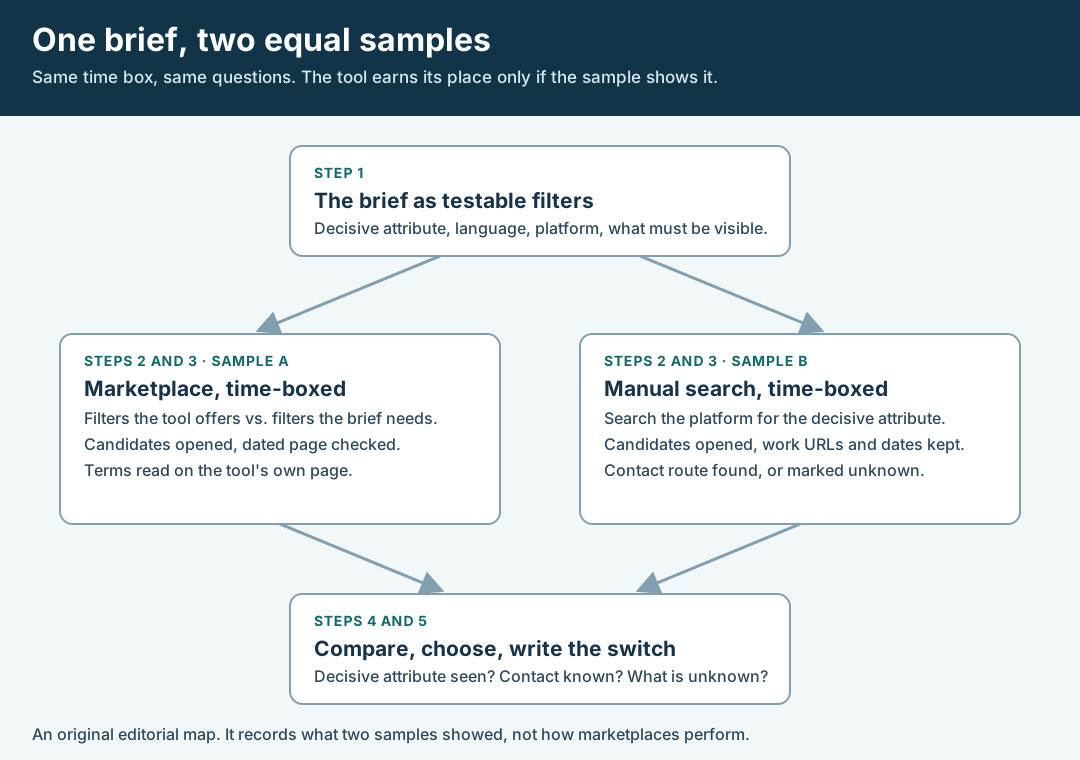
An original editorial map. Both routes get the same time box and the same questions.
Original visual by Superdirector editorial team. Creation date not recorded.
Walk through a fictional brief
Fictional exercise: no real brand, creator, marketplace result or timing was inspected. A made-up brand, Brand A, sells a left-handed crochet hook set. Its brief names one decisive attribute: the creator’s own tutorial shows a left-handed technique on camera. Supporting requirements are English narration and a short-video platform. The sourcer sorts them: language and platform are fields or easy to see, country is a profile field, and the decisive attribute is something only the work shows.
Reading a marketplace’s help page, the sourcer finds that it describes keyword search and portfolio review. So the marketplace can plausibly carry language and platform as filters and the decisive attribute as a keyword lead, but not as a filter. The card records exactly that, with the date. The sourcer then sets the same time box for each route, which in this exercise is a blank to fill in with the number of minutes the real person chooses.
At the end of each block the card has blanks for opened candidates, for how many showed the attribute and for contact routes. Suppose, for the exercise only, that the marketplace sample gave a short list with contact built in but few opened candidates showing the technique, while the manual sample gave fewer but clearer examples with no contact route yet. Those are invented shapes, not results from anything real. The decision the card supports is a split: use the marketplace to gather leads and an invitation route, and use manual review to confirm the attribute, with a written switch condition such as “if fewer than the number we set show the technique after the next block, move the whole block to manual search.”
Choose a route and write the switch condition
Close the card with one route for the next block, the name of the person who chose it and the date. The choices are marketplace, manual, or both with the work split by task. Say why in one line that points to the comparison, for example “the decisive attribute was filterable in the tool” or “the tool could not carry the attribute, so every candidate needed a manual look.”
Then write the switch condition before the next block begins. It is a specific observation that would make you change route, such as a number of opened candidates showing the attribute that you set in advance, a terms question the tool’s own page could not answer, or a contact route that never appeared. Writing it first stops the choice from drifting toward whichever route you happened to enjoy. A condition written after the fact is only a justification.
Remember what neither route settles. A marketplace listing and a manual find both leave audience, availability, rights and price open. The FTC’s endorsement guidance says delegating part of a promotional program to an outside company does not relieve the advertiser of its responsibility. FTC Endorsement Guides: What People Are Asking holds the text. That page is about outside companies in general and we are not saying it addresses marketplaces specifically, so treat it only as a reason to keep your own review and monitoring steps whichever route found the creator.
What this page does not decide
This page decides where to look first for one brief. The closest existing page is the buyer-task shortlist method, which starts after you already have candidates and shows how to judge their work against a buyer’s task. This page is upstream of it: it compares two ways of getting candidates and does not review any candidate’s work. The 100-point vetting rubric scores broad account signals of a creator you are already considering. This page scores no creator.
A third neighbor is the manager authority guide, which checks who can speak for a creator account once you have a contact. This page mentions it only because a marketplace route can add a third party. Our YouTube metrics worksheet compares metric definitions and has no sourcing step. If your question is which tools exist, our best-tools comparison of influencer platforms is a different kind of page. This one tests a route against a brief and recommends no product.
Nothing here measures how many creators a marketplace holds in your niche, how quickly any route finds them, what any marketplace costs or how creators found by either route perform. We did not verify any marketplace’s fees, terms or current availability, and the Meta page we cite is dated February 2024. The page is an editorial method for putting two routes through the same time box and the same three questions, so the choice rests on what each sample showed. Questions about law or contract terms go to counsel.