How-To Guide
How to compare one sponsored post with the creator’s usual posts without claiming the sponsorship caused the difference
Set one sponsored post beside the same creator’s dated usual posts, read one metric the same way, and report its position without naming a cause.
By the Superdirector editorial team. YouTube, TikTok and FTC pages reviewed October 30, 2026.
At a glance
How should a sponsor compare one sponsored post with a creator’s usual content?
Compare the post only with the same creator’s other posts of the same format, using one metric as the platform labels it, read on the same date, with each post’s age and any paid or sponsor label recorded. Choose the usual set by a rule written before you look, keep the sponsored post out of it, then report the sponsored post’s rank and whether it sits above, inside or below the creator’s own range. Stop there. The comparison gives context for one post and cannot show that the sponsorship caused any difference.
- Write the metric, format, set rule and read date before opening any number.
- Rank the sponsored post among the creator’s own posts; do not use another creator’s numbers as the yardstick.
- Report the position and the other differences you saw, never a cause.
Direct answer
Short answer: compare the sponsored post with the same creator’s own other posts, and report where it sits, not why. Pick one metric exactly as the platform labels it, one format and one read date. Build the creator’s usual set by a rule you write before you look, leave the sponsored post out of it, read every post the same way, and then say whether the sponsored post is above, inside or below the creator’s own range, or that it cannot be placed. The finished sentence names a date, a metric, a rank and a rule, and nothing about cause.
This is for a sponsor, agency or analyst who has one sponsored post and wants context: was this post unusual for this creator? The decision is small and specific: how to describe one post’s position among the creator’s own posts without a causal leap. It is not a benchmark against other creators, a forecast for the next post or a verdict on whether the sponsorship worked. Those questions need different evidence, and the boundary section below says where they live.
The reason for the discipline is that two posts from one creator already differ in many ways before sponsorship enters. A sponsored post may cover a different topic, go out at a different time, carry different production effort or be amplified with paid spend. A simple “higher than usual” invites readers to attach the sponsorship as the reason. The comparison card, the blank CSV register and the comparison map keep the comparison honest by forcing the other differences onto the page.
Fix the metric, format and read date first
Before you open a single number, write down three choices and one link. The first choice is one metric, named exactly as the platform labels it. Do not combine “views”, “reach” and “impressions” into a loose idea of attention, because each platform defines its own terms and they are not interchangeable. The second choice is one format: compare a short vertical video with other short vertical videos, not with a long upload or a still image. The third is one read date and time with its time zone, the same for every post. The link is the platform’s own definition page for that metric, with the date you read it.
The definition link is not decoration. Definitions change. YouTube’s help page on how engagement metrics are counted says that, starting August 24, 2026, views are counted from the moment a video starts to play across all formats, including Shorts, and that its Partner Program earnings still rest on “engaged views”. YouTube Help: how engagement metrics are counted. The same page says its systems need some time to work out which views, likes and subscriptions are legitimate, that it may discard low-quality playbacks, and that on some videos a metric count “might seem frozen” or not show the numbers you expect. Read together, that means a creator’s older and newer posts can sit on either side of a counting change, and a very recent post’s number may not yet show what you expect. We make that point about YouTube only, from that page.
We did not load a working Instagram or TikTok definition page for views while preparing this article, so we state nothing about how those platforms count views or how a count behaves over time. Treat that as unknown for your own read: open the platform’s current help page, record its address and the date you read it, and write what the label means in that page’s words. If you cannot find a definition, record “definition not found” on the card. The card then says plainly that the metric’s meaning is unconfirmed, which is more useful to a reader than a confident number with no definition behind it.
List the creator’s usual posts by a written rule
The creator’s usual posts are your yardstick, so choose them with a rule, not a feeling. Write the rule on the card before you look at any metric: how far back the window goes, which format qualifies, how many of the most recent qualifying posts you will take, and what you do with posts that need a judgment call. A rule written after the numbers are visible tends to include the posts that make the story tidy. A rule written before cannot be bent that way, and a second reviewer can apply it and reach the same list.
Decide the judgment calls in advance and log them. Other sponsored posts: either include them or exclude them, but say which. Including them makes the yardstick “this creator’s posts, sponsored or not”, while excluding them makes it “this creator’s unsponsored posts”. Boosted or promoted posts: the public page may not show paid amplification, so record “unknown” rather than assuming none. Posts that sit on a notable event: note the event and say whether the rule keeps the post. Whatever you choose, never delete a post silently. Keep a line for each post you left out, with the address and the reason, so a reader can see what the rule removed.
TikTok’s guide to finding creators in TikTok One lists a creator’s content portfolio as an area to review and says to watch recent organic and sponsored videos to assess content style, quality and brand alignment. TikTok One: find creators. That page supports looking at both kinds of posts. It does not say how to build a comparison set, how many posts to use or how to interpret a gap, and this page does not claim that it does. The set-building rule above is our editorial method. If you are still choosing which creators to consider at all, start with the shortlist guide and come back here once a creator has a sponsored post to place.
Read every post the same way on the same day
Now read the numbers. For every post, including the sponsored one, record the metric value as read, the time and date of the read with its time zone, the post’s publication date and time and therefore its age at the read, the source of the number and any paid or sponsor label you can see. Read them in one sitting, so the metric has had the same calendar time to move for every post. Where you cannot, record the difference rather than hide it.
Age at read matters because a post’s counter keeps moving after it goes live, at a pace that differs by platform and by post. A fair comparison puts posts of similar age side by side. When the usual posts are months old and the sponsored post is three days old, a lower count on the new post says little: it may not have finished accumulating. When the sponsored post is older than every usual post, the opposite problem applies. You can reduce the mismatch by choosing usual posts of similar age by rule, or by stating the age gap beside the result. Do not adjust the numbers with a formula you invented. A recorded difference is honest, while an invented correction implies precision you do not have.
Be careful with the platform’s own comparison tools. YouTube’s Advanced Mode help page says a creator can compare data across content, date ranges and metrics by choosing “Add Comparison”, can compare groups or playlists to see which content pillar or format performs best, and can filter by content type to see how Shorts perform. YouTube Help: Advanced Mode. That describes a view inside the creator’s own YouTube Studio, which a sponsor sees only if the creator shares a screenshot or export. It also describes the creator’s comparison of their own content, so it does not turn a public number into a like-for-like benchmark. If the creator supplies such a view, copy its filters and date range onto the card, mark the source “creator screenshot” or “creator export”, and keep every post inside that one source.
Record the other differences as you go, in the same row. For each post, note the topic in a few words, whether a person or product appears, whether it ties to an event or season and whether it carries any paid-partnership or sponsor label. The FTC’s influencer guide, dated November 2019, says an influencer should make a “material connection” with a brand clear, including a payment or free product. FTC Disclosures 101 for Social Media Influencers. That is why a sponsor label is worth recording on each row: it is the visible trace of a connection, and a usual post that carries one may belong in a different part of your rule than one that does not. It does not tell you whether a given disclosure is adequate, which is a separate check on the disclosure page.
Place the sponsored post in the creator’s own range
With every value on the card, do two plain things. First, rank the sponsored post among the usual set: write “rank k of n”, where n counts the sponsored post and the usual posts together. Second, place it against the usual range, meaning the lowest and highest values among the usual posts alone. Write one of four results: above the range, inside the range, below the range or cannot place. “Cannot place” applies when the set is too small to say anything, when sources or ages cannot be reconciled or when the metric’s definition is unconfirmed. It is a legitimate result and often the honest one.
| Result | What you may say | What you may not say |
|---|---|---|
| Above the range | On the read date, this post’s value was higher than every usual post in the set | That the sponsorship raised it, or that the next sponsored post will do the same |
| Inside the range | On the read date, this post’s value fell within the values the usual posts already show | That the sponsorship made no difference, or that the creator’s audience ignored it |
| Below the range | On the read date, this post’s value was lower than every usual post in the set | That the sponsorship hurt it, or that the creator underdelivered |
| Cannot place | The set, sources or definitions do not support a placement, and here is why | Any ranking, or a guess dressed as a result |
Keep the range plain: the lowest and highest value among the usual posts. Avoid a calculated “average” or “typical value” unless your reader needs one, and if you give one, say how you computed it and from which posts. A single viral post inside the set can pull an average far from what most posts do, and a reader may not know that. If one usual post is far from the rest, keep it in the set by your rule and say so, or exclude it by a rule you wrote earlier. The viral post fit guide covers when an exceptionally high-reach post should count at all.
When enlarged, scroll horizontally to read the diagram.
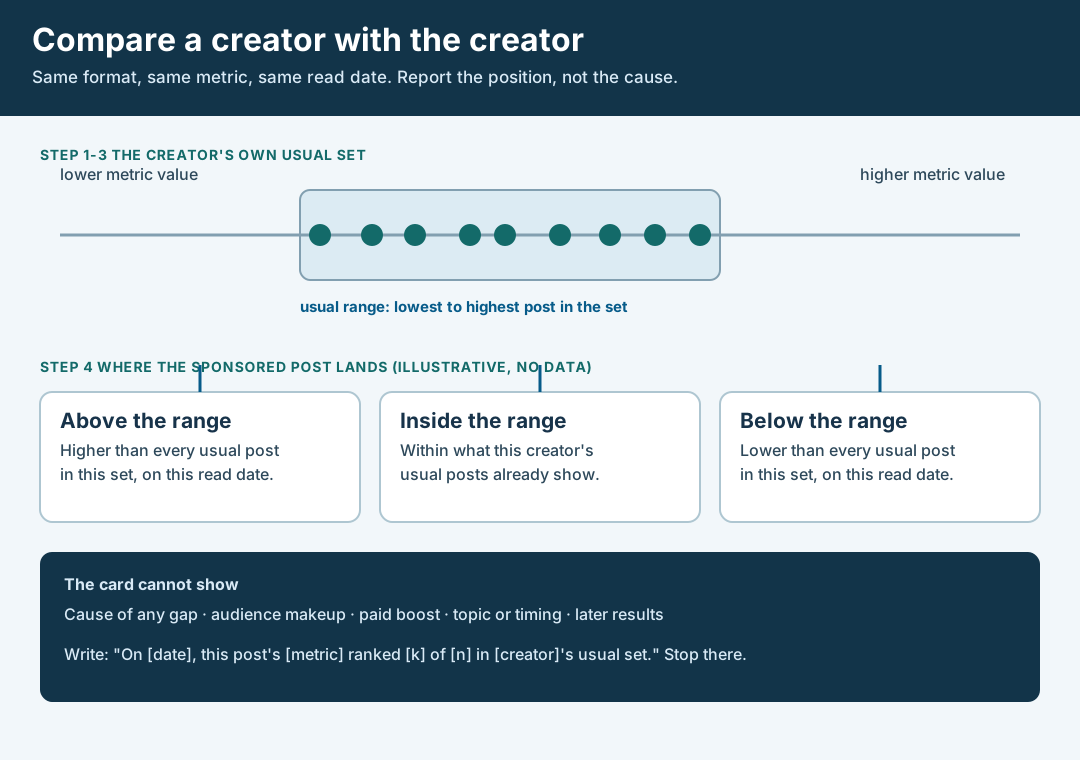
An original editorial map with illustrative positions and no data. The comparison reports a position, not a cause.
Original visual by Superdirector editorial team. Creation date not recorded.
Walk through a fictional comparison
Fictional exercise: no real brand, creator, post or number was inspected, and the numbers below are not shown on purpose. Brand A sponsored one short vertical video from Creator R. The analyst writes the rule first: the metric is “views” as Platform P labels it, the format is short vertical video, the set is Creator R’s eight most recent short vertical videos before the sponsored one, other sponsored posts are excluded and logged, and the read is made in one sitting on a single date. The analyst saves the address of Platform P’s definition page and the date it was read.
The log shows two posts left out: one carried a sponsor label, and one was a different format. Seven of the eight remaining usual posts are about three weeks old or more. The eighth was published four days before the sponsored post. The sponsored post is five days old at the read. The analyst notes the age gap beside the result because the sponsored post is far younger than most of the set. The analyst also notes that two usual posts show a different topic from the others, and that the paid status of every post is “unknown” because the public pages do not show it.
Suppose the sponsored post ranks third of nine and lands inside the usual range. The report says so: “On the read date, the sponsored post’s views ranked 3 of 9 among Creator R’s sponsored post and eight usual short videos, inside the usual range, with an age gap noted.” Suppose instead the sponsored post had landed above the range. The sentence would change only in position. Neither sentence says why, and neither says anything about the next post. The exercise predicts nothing about any real creator.
Write the position without a cause
The last step is the sentence. Use a fixed form: “On [read date], this post’s [metric, as labelled] ranked [k] of [n] among [creator]’s [format] posts, [above, inside or below] the usual range of [set rule].” Follow it with a short list of differences that could also explain the position, taken from your card: post age, topic, timing, any boost, another sponsor on a usual post, a difference in source, a counting-rule change inside the window. The list is the card’s main protection against a reader supplying a cause of their own.
Check each word of the sentence for a hidden cause. Words such as “lifted”, “boosted”, “drove”, “dragged down” and “because” all assert a cause, and words such as “outperformed” and “underperformed” imply one even though they sound like measurement. “Ranked”, “sat above”, “sat inside” and “sat below” describe only a position. If a client asks whether the sponsorship worked, the card’s honest answer is that this comparison does not answer it, and it can say what evidence would be needed before anyone tried, for example the creator’s own analytics for the post, the destination’s measured results, or a next test designed to separate the factors. The next test guide turns an unclear result into one bounded follow-up.
What this page does not decide
This method places one post among the same creator’s other posts on one date. It does not rank a creator against other creators, set a market benchmark, estimate what a sponsored post is worth or establish that a sponsorship raised or lowered anything. We cite no benchmark here, because we found no source that supports one for this question, and every number in the worked example is deliberately absent.
It differs from nearby pages. The viral post fit guide decides whether an unusually high-reach post should count when judging a creator’s fit, and it concerns a creator’s own outlier rather than a sponsored post. The format repeatability guide asks whether a creator regularly makes a proposed format before you sponsor it, so it comes before a sponsored post exists. The organic and paid results guide separates a post’s organic and paid delivery after a boost. The views and visits diagnostic follows views toward visits on your own site. This page produces a different artifact, a within-creator comparison card with a no-cause report sentence, and it uses the others only as places to go next.
If your question is whether the account that published the post is the contracted one, use the account proof guide first, because a comparison on the wrong account answers nothing. If a point turns on law, such as what a disclosure must say, send it to counsel instead of settling it from a worksheet. We did not verify Instagram or TikTok view definitions for this article and make no claim about them. This is an editorial method for keeping a creator’s own dated numbers, their definitions and their differences on the page, so that a claim about one post rests on evidence the reader can see.