How-To Guide
How do you scale influencer marketing without losing control?
Scale influencer marketing with one brief, one agreement, one record per post and a check of every live post. Includes a stage table and a register.
By the Superdirector editorial team. The FTC Endorsement Guides (16 CFR Part 255 on eCFR), FTC Disclosures 101, the U.S. Copyright Office, and pages from GRIN, CreatorIQ, Meltwater and The Influencer Marketing Factory read November 6, 2026.
At a glance
How do you scale influencer marketing without losing control?
Fix four things before you add creators: one brief template, one agreement with fixed clauses, one record per creator and per post, and a check of every live post against the brief and the disclosure rules. Grow in batches small enough that each post is checked within a week, and only take a bigger batch once the last was checked on time.
- The FTC's Endorsement Guides expect advertisers to give creators guidance, monitor compliance and fix problems.
- Programs break when the work stops fitting in one person's head, not at a set creator count.
- Each repeat job gets its own agreement period, so old terms and rights do not carry over by silence.
Make four things standard before you add creators
You scale influencer marketing without losing control by fixing four things before you add more creators: one brief template, one agreement with the same clauses for every deal, one record per creator and per post, and one check of every live post against the brief and the disclosure rules. Then grow in batches small enough that someone can still check each post within a week, and only take on a bigger batch once the last one was checked on time.
Control here has a legal meaning as well as a practical one. The FTC's Endorsement Guides, published in the Code of Federal Regulations at 16 CFR Part 255, say a brand can answer for a misleading creator post even when the creator is not held responsible, and that brands should do three things: give creators guidance, monitor their compliance, and act to fix and prevent problems. A program that grows past what you can check is a program you no longer control.
This page is for an in-house team or agency moving from a few creator deals to a standing program. It covers what to standardize, what breaks as you grow, and the record that holds it together. You can copy the control register as a starting sheet.
When enlarged, scroll horizontally to read the diagram.
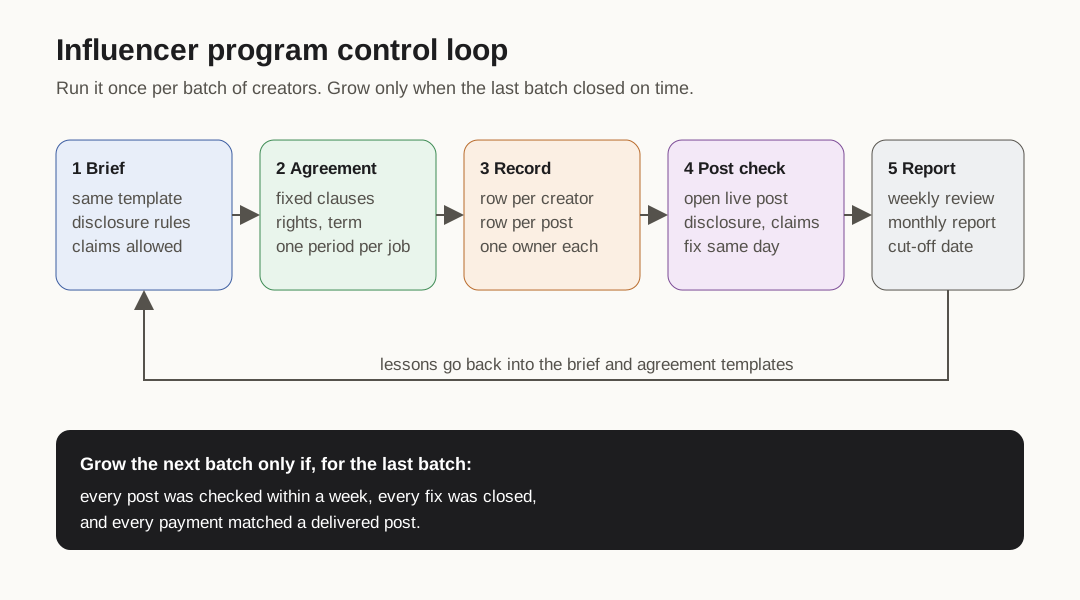
Original diagram. Each batch runs the loop once; lessons go back into the templates.
Original visual by Superdirector editorial team. Creation date not recorded.
What breaks as the program grows
Most programs do not fail at a particular creator count. They fail when the work stops fitting in one person's head. The stages below are described by what changes, because no source we read gives a reliable roster size for each one.
| Stage | What still works | What breaks first | Fix before moving on |
|---|---|---|---|
| One owner, a few creators | Briefs in email, terms agreed in DMs, one person remembers everything | Nothing visible yet; the risk is that nothing is written down | Write the brief and agreement templates now, while deals are simple |
| Two or more people working creators | A shared sheet | Two people promise different things to the same creator; status cells go stale | One owner per creator, one row per creator, status changed only by that owner |
| Several campaigns at once | Templates exist | Posts go live unchecked; nobody knows which usage rights are still active | A post log with a check date per post, and rights end dates in the record |
| Repeat creators and paid usage | Relationships are good | Old terms carry into new work by silence; ads run after rights expire | A new agreement period for each new job; ads stopped before the rights end date |
| Agency or several brands | Reporting exists | Reports disagree with the post log; disclosure is assumed, not checked | One record that the report is built from, and a disclosure check you can show |
If your program sits in the third row with second-row tools, the fix is usually a better record and a weekly check, not more people.
Use one brief and one agreement
The brief is where the FTC's first duty, guidance, actually happens. The Influencer Marketing Factory says the brief is where the brand sets how creators disclose, down to the agreed partner hashtag. A brief template that every creator receives means every creator hears the same rules.
- What the post must show and say, and the claims it must not make. The FTC's guide for influencers says creators cannot make claims that would need proof the advertiser does not have, and cannot call a product terrific if they thought it was terrible.
- How to disclose on each platform: with the endorsement, inside the video for video, and repeated during a live stream. The same FTC guide says a platform's own disclosure tool should not be assumed to be enough.
- Deliverables, posting window and the review step before posting.
- Who to contact with questions, and how fast they will get an answer.
The agreement should use the same clauses every time, with only the blanks changing: deliverables, dates, fee or product, payment timing, disclosure, revision rounds, and usage rights. Usage rights need care at scale. The U.S. Copyright Office says the person who creates and fixes an original work is its author and owner, and that the owner can authorize others to use it. Treat each creator's video as theirs unless the agreement grants or assigns you rights, and write the channels, term and territory into each deal. Our list of influencer agreement clauses to settle before a creator posts has the full set.
Gifted deals belong in the same system. The Endorsement Guides count free or discounted products as a material connection whether or not you require a post in return, so a gifted creator needs the brief and the disclosure rules too.
Keep one record per creator and per post
A program you can control has one place where the truth lives. It needs two linked tables: one row per creator and one row per post. The creator row says who owns the relationship, what stage it is at, and which agreement is current. The post row says what went live, when, whether it was checked, and what rights apply to it.
A shared sheet does this well while one or two people edit it. Our influencer marketing spreadsheet is a good start. Move to a creator CRM when the sheet can no longer tell you who said what to a creator, or which contract is current. That is the job these tools are sold on: GRIN describes keeping every message with a creator in one place and sorting creators by relationship stage; Meltwater puts briefs, approvals, contracts and negotiation in one workflow and archives Instagram Stories after they disappear; CreatorIQ offers role-based access for several users. Pick on whether the tool holds your two tables cleanly, not on its creator database size.
| Field | Lives on | Why you need it at scale |
|---|---|---|
| Relationship owner | Creator row | One person speaks for the brand to each creator |
| Stage | Creator row | Contacted, in talks, agreed, live, paid, closed |
| Current agreement and period | Creator row | Stops old terms from carrying into new work |
| Post URL and live date | Post row | What you will check and report on |
| Disclosure checked (date, by whom) | Post row | Your record of monitoring |
| Claims checked against brief | Post row | Catches claims you cannot support |
| Usage rights end date | Post row | Stops ads before the right runs out |
| Payment status | Post row | Ties money to delivered work |
The control register lays these fields out as columns you can paste into any sheet or import into a CRM.
Check every live post
Monitoring is the duty most programs drop first as they grow. The Endorsement Guides say an advertiser should have reasonable procedures to monitor an influencer's posts for compliance and should follow them. Their own example is useful: an influencer who discloses a paid deal only on their profile page has not made a clear disclosure, because people seeing the paid posts could easily miss it.
- Open the live post from the creator's account, not from a screenshot.
- Confirm the disclosure sits with the endorsement: in the caption's opening words for a feed post, on screen and in speech for a video, and repeated in a live stream.
- Read every product claim against the brief. Anything the brief did not allow goes back to the creator.
- Record the date, the checker and the result on the post row.
- If something is wrong, ask the creator to fix it the same day and note the fix. The Guides call this remedial action.
Monitoring matters because disclosure gaps are common. In The Influencer Marketing Factory's own analysis of 105,939 Instagram collaboration posts, only 29% were properly disclosed. We have not checked that sample, but it is a reason to check your own posts. Our guide to checking the disclosure on one live post, caption and video goes through it step by step.
If you are an agency, the same rules reach you. Under the Guides, an agency or similar go-between can also be held responsible: for misleading posts it helps make or distribute, and for hiring and directing creators who leave out the disclosure.
Treat each repeat job as a new agreement
Repeat creators are where control slips quietly. The second job often starts with a message like "same as last time?", and the old terms carry over without anyone deciding they should. Give each new job its own agreement period: its own deliverables, dates, fee and rights. The earlier period stays settled, and nothing from it renews unless the new agreement says so.
- Close the last period first: delivered, checked, paid, rights end date recorded.
- Decide whether the creator earned a repeat on the record, not on memory. Our page on deciding a renewal after missed deliverables covers the hard case.
- Restate usage rights for the new work. Rights to the first video do not cover the second.
- Stop any ads that use older work before its rights end. See ending paid use of a creator video on time.
Report on a fixed cadence
Pick a weekly review and a monthly report, and build both from the same record. The weekly review is operational: posts due, posts live but unchecked, fixes outstanding, payments due, rights ending in the next month. The monthly report is for decisions: what each creator delivered, what it cost, and what you will change.
Platform numbers keep moving after a post goes live, and tools refresh on their own schedules; CreatorIQ, for example, says its metrics refresh every eight hours. Set a cut-off date for each report and note any late data separately. Our guide to freezing a creator campaign report when platform data arrives late shows one way to do it.
Grow in batches you can still check
Add creators in batches, and size each batch by your checking capacity, not by your budget. A simple rule: take on the next batch only when every post from the last one was checked within a week of going live, every fix was closed, and every payment matched a delivered post. If that slipped, the next step is a better record or more reviewer time, not more creators.
- Before the batch: brief and agreement templates current, owners assigned, rows created.
- During: each post checked and logged, fixes requested the same day.
- After: period closed, report frozen, lessons written into the brief template.
Each lesson goes back into the templates, so the next batch starts with a better brief and the same rules.