How-To Guide
How does a small business start a brand ambassador program?
How a small business starts a brand ambassador program: invite customers first, pick one reward, use one-page terms, a code per person and FTC disclosure.
By the Superdirector editorial team. FTC, eCFR, IRS and Shopify pages and ambassador guides read November 6, 2026.
At a glance
How does a small business start a brand ambassador program?
Start with people who already like your product. Invite five to fifteen customers or small creators who post about you, offer one reward you can keep giving (product, a personal discount code, commission or early access), write the terms on one page, give each person a code and disclosure wording with your brand name, and review posts and sales every month before inviting more.
- Customers who already tag you make the best first ambassadors.
- The FTC lists '[Brand] Ambassador' as an option on space-limited platforms; a bare 'ambassador' is too vague.
- One code per ambassador turns the program into a monthly count of sales.
How a small business starts an ambassador program
Start with people who already like what you sell. Invite five to fifteen customers or small creators who already post about you, offer one reward you can afford every month (free product, a personal discount code, a commission on sales or early access), write the terms on one page, give each person their own code so you can count sales, and review the group every month. Add more ambassadors only once the first group is selling.
That is smaller than most guides suggest, on purpose. A founder can talk to fifteen people, ship their product and check their posts; a program of a few hundred usually needs software and someone to run it. The one-page agreement outline below gives you the terms to send.
Ambassador, influencer or affiliate: what you are setting up
Influencity puts the difference in one line: influencers typically promote a brand for a short time through paid content, while ambassadors build a long-term connection. Ambassadors can be loyal customers, creators, experts, employees or community leaders. LoudCrowd adds that they usually get perks, free products or commissions in return for spreading the word and driving sales.
| Ambassador | Paid influencer post | Affiliate | |
|---|---|---|---|
| Relationship | Ongoing, months | One campaign | Ongoing, often hands-off |
| Who | Customers and fans first | Creators with a reach you want | Anyone with an audience or site |
| Usual reward | Product, perks, code, commission | A fee, sometimes plus product | Commission on tracked sales |
| What you ask | Regular posts or referrals, as agreed | A defined post by a date | Nothing beyond sharing the link |
Many small programs mix the three: product for everyone, a code with commission for those who sell, and a paid post now and then for the ambassador whose content does best.
When enlarged, scroll horizontally to read the diagram.
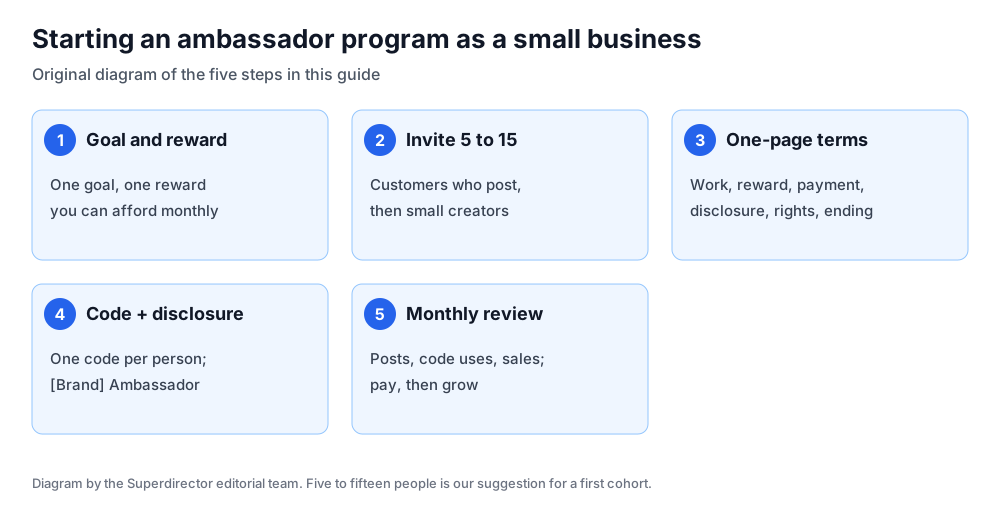
Original diagram of the steps in this guide. Five to fifteen people is our suggestion for a first group.
Original visual by Superdirector editorial team. Creation date not recorded.
Decide what the program is for and what you can give
Choose one goal for the first three months. If it is sales, reward with commission on code sales. If it is content you can reuse, reward with product and ask for permission to repost. If it is local word of mouth, reward with early access and events. Then pick rewards you can keep giving; an ambassador who stops getting anything stops posting.
Large brands show how wide the choice is. Modash's examples list what programs give: free products and gym access at Gymshark, an hourly wage for Red Bull's student marketeers, free products, discounts and commission at Wild, and gift vouchers at Boohoo.
| Reward | What it costs you | Best for |
|---|---|---|
| Free product | Product at your cost plus postage | Content and reviews |
| Personal discount code for their followers | The discount, only when a follower buys | Sales you can count |
| Commission on code sales | A share of each sale, paid after it happens | Ambassadors who sell |
| Early access or events | Little cash; your time | Community and loyalty |
| Cash per post | A fee, paid whether or not it sells | Later, for proven ambassadors |
Invite customers first, then a few small creators
Your first ambassadors are usually already in your orders and comments. Look for repeat buyers, people who tagged you without being asked, reviewers who added photos and followers who answer other people's questions about you. Message them personally, say what the program is, what they get and what you hope they will do, and that they can say no.
Then add a few small creators whose recent posts already cover your category and whose comments come from the buyers you want. A free seeding round is a good way to find them: send product with no obligation, and invite the people who post. Our guide to getting influencers to promote a product for free covers that first contact. Five to fifteen people is our suggestion for the first group.
Write the terms on one page
Write the program down before anyone posts. Sprintlaw's agreement checklist lists the core terms: scope of work, content guidelines and approval, compensation and payment timing, term and termination, and who owns the content. For a small program those fit on one page:
| Clause | What to write |
|---|---|
| Parties and start date | Your business and the ambassador, with the date the program starts |
| What the ambassador does | Platforms, number of posts or referrals per month, any events |
| What the ambassador gets | Product, discount for followers, commission, early access; how commission is counted |
| When you pay | Timing and method; only for posts that went live |
| Disclosure | Every post says the relationship clearly, near the start, with the brand name |
| Claims | Only claims the brand can back up; no health or results promises |
| Content rights | Whether the brand may reuse posts, where and for how long |
| Approval | Whether posts need review first and how far ahead |
| Ending it | Notice period and what happens to unpaid commission |
| Tax details (cash or commission only) | Collect a W-9 from US ambassadors you pay as independent contractors; check 1099-NEC rules |
The outline as a spreadsheet adds example wording for each clause, such as Sprintlaw's sample of 30 days' notice to end and 48 hours for approval. It is a starting checklist, not legal advice; have a lawyer review terms that include cash, exclusivity or regulated products.
Give each ambassador a code and a disclosure line
Give every ambassador their own code. Shopify's discount settings can create a value, percentage, buy X get Y or free shipping code, and most stores can do the same. One code per person turns 'is this working' into a count of orders per ambassador.
Disclosure comes with the code. The FTC's guide for influencers says that if a brand gives you free or discounted products or other perks and you mention one of its products, you should disclose it, and it names 'Acme Ambassador' or 'AcmePartner' (with your brand in place of Acme) as options on space-limited platforms such as X, while a stand-alone 'ambassador' or 'thanks' is too vague. A disclosure only in the bio is likely to be missed. The brand has duties too: the FTC answers that advertisers need reasonable programs to train and monitor their network, and its Endorsement Guides say an advertiser can be liable even when the endorser is not.
Review every month and keep the ones who sell
Once a month, line up each ambassador's posts, code uses and sales, and check that every post carried a clear disclosure. Pay what is owed for the month, thank people who posted, and ask anyone who missed a disclosure to fix it. After three months, keep the ambassadors whose codes sell or whose posts you reuse, part kindly with the rest, and invite the next group.
If you pay ambassadors cash or commission in the US and they work as independent contractors, not employees, the IRS says to have them complete Form W-9 and to keep it for four years, and payments for their services that reach the reporting threshold in a year go on Form 1099-NEC. When Superdirector runs creator campaigns for its own brands, it pays only after the post is live and checked, with nothing upfront; that is our practice, not a rule for everyone.
Where Superdirector fits
Superdirector, which publishes this guide, helps with the creator half of the list. Its creator search shows each creator's match score, followers, region and any contact method it found, and saves the research without contacting anyone; inviting, shipping and paying ambassadors stay with you. It also remakes posts that are working in your niche as carousels and X posts for your own account. AI video and full autopilot are coming soon. See how it works.