How-To Guide
What is a video brief? See the same video as a brief, script and storyboard
Understand what a video brief decides, how it differs from a script and storyboard, and who resolves each decision in one original fictional library example.
By the Superdirector editorial team. Seven first-party sources read 5 November 2026; the library example and diagram are original and fictional.
At a glance
What is a video brief, and how is it different from a script or storyboard?
A video brief is a shared description of the video’s job: its audience, purpose, main message, intended use and practical scope. A script develops the words and sequence; a storyboard develops the planned visuals. The same fictional library video below appears in all three forms, so you can see what each decides and what it still leaves open.
- You can discuss a video without a finished script; confirm what development work the supplier includes.
- A drawing, an agreed brief and a delivery contract answer different questions.
- The example is fictional; no production outcome or universal document sequence is claimed.
The brief decides the job; the other documents develop the video
A video brief is the shared description of the video you want to commission: why it exists, who it serves, what it needs to communicate and the practical boundaries. It gives a maker enough context to respond with an approach, questions and a workable scope. A script develops the words and sequence; a storyboard develops how moments are seen.
| Document | Main question it answers | What you would expect to see |
|---|---|---|
| Video brief | What job should this video do, and within what scope? | Audience, purpose, main message, intended use, outputs, known constraints, resources, dates and decision owners. |
| Video script / AV script | What happens and what is heard, in what order? | Spoken lines or interview prompts, on-screen text, visual actions and sound directions. An audio/visual script can place the two alongside each other. |
| Storyboard | How will the planned moments look and connect? | Ordered visual panels, framing, action and explanatory notes. Rough sketches can be enough to discuss the idea. |
| Shot list | Which shots must the crew capture? | The required images, actions and setups to cover the planned video. |
| Production schedule | When, where and with whom will the shoot run? | The agreed order and timing of filming, with locations and people’s availability. |
Adobe’s script guide distinguishes words and structure from the visual mapping of scenes and shots. StudioBinder describes storyboard panels as visual representations in scene/story order, with notes or annotations. These are useful distinctions, rather than rules that every project needs separate files or polished drawings.
Names overlap. A supplier may call the combined request a creative brief, video project brief or production brief. Ask what decisions the document records and what work the supplier expects to develop. The label alone does not tell you whether the scope includes a concept, a script, storyboards, filming or editing.
You can start a conversation without a finished script
Conceptavision uses the client’s brief to develop a production plan and quote. Sunday Treat says a new client does not need a concept, script or shot list to begin. Darkroom similarly treats the brief as a communication aid and asks clients to identify whether existing concept/script work is approved. These are the producers’ stated approaches, not terms guaranteed by every supplier.
Send what you know: the audience, the problem the video addresses, intended use, likely delivery date and the important constraints. Mark unknowns plainly. Ask whether concept, script and storyboard development are included in the proposed work and who is expected to supply them. An agency cannot infer from “we need a video” whether it is developing an idea or just editing your footage.
An existing script does not make the brief unnecessary. It may still leave open the intended audience, the exact outputs, where the film runs, what rights are needed or whose facts are current. Conversely, an agreed brief is not proof that the script or visual approach has also been accepted. Keep those decisions identifiable even if they live in the same shared document.
One example, beginning with the brief
Consider a fictional community library making a short reservation-pickup explainer. The library, people and policy below are invented teaching material; a real library would need to verify its actual process. There is no measured outcome or recommended universal duration.
| Brief decision | Example answer |
|---|---|
| Audience / problem | Members who have received a pickup notice but are unsure what to bring or where to go. |
| Purpose / main message | Explain the collection step: bring the pickup notice to the desk to collect the reserved book. This is an assumed policy for the example. |
| Intended use / outputs | One approximately 30-second vertical video for the library’s named social account, with legible captions. If a second export without burned-in captions is needed, agree it separately and state whether logos, other graphics and audio remain. Confirm the exact file requirements. |
| Known production inputs | A staff member, an agreed quiet desk area, a generic book and an invented notice. No real patron data appears on screen. Availability and permissions still need confirmation. |
| What remains open | Who films; exact spoken lines; whether the desk needs an additional close-up; actual shoot window and final delivery date. Producer and library contact resolve these in the scope discussion. |
| Decision owners | Library contact confirms the audience and requirement; service lead verifies the pickup process and current hours; maker proposes the treatment and delivery plan. One contact consolidates feedback. |
This brief has not yet prescribed every sentence or shot. It has identified the job and the facts the production depends on. A storyboard that looks attractive but directs members to the wrong desk would fail this job. A perfectly accurate spoken line that is impossible to hear also needs work. The different documents help the team see those different problems.
The script turns that job into words and actions
Here is a deliberately short audio/visual draft for the same fictional video. It is an example of a script, not a completed timed recording. Read the actual delivery aloud and adjust it to the agreed length.
| Moment | Audio / words | Visual direction |
|---|---|---|
| The notice | “Your reserved book is ready to collect.” | Show an invented pickup notice. Keep the relevant message legible and no personal data visible. |
| The collection | “Bring your pickup notice to the desk. Our team will find your reserved book.” | Show the notice at the desk, followed by a staff member handing over a book. The service lead checks this assumed process. |
| The next step | “Check the library’s current opening hours before you travel.” | Show a clear end card pointing to the actual current hours page when the real project supplies it. |
The brief supplies the purpose and identifies the process that the service lead still needs to verify; the script chooses this sequence and these words. The maker could propose a different opening or a demonstration with less speech while retaining the agreed message. A new claim about faster service would require a new factual basis; it is not just a livelier line.
HolaBrief places a script-with-shot-ideas stage among its production milestones. Adobe recommends adding visual/audio cues and refining the script, including reading aloud. Neither a blank milestone nor a plausible word count proves a recording fits its duration. Interview-led and observational videos may instead use questions, an outline and a factual coverage plan rather than lines for someone to recite.
The storyboard makes visual choices visible
The original diagram below maps those same three moments into planned frames. Its simple shapes are not footage, product screens or images of a real library. The point is to discuss what a viewer sees and whether the information survives the proposed framing.
| Planned panel | Question it makes discussable |
|---|---|
| 1. Pickup notice | Is the needed message readable? Is the notice invented or permission-cleared? Can it be seen long enough in the actual cut? |
| 2. Notice and book at the desk | Can the viewer understand the handoff? Are we showing the actual permitted process? Does the camera position reveal another patron’s information? |
| 3. Opening-hours direction | Is the destination current and legible? Does the card remain usable under the actual account interface and caption treatment? |
A storyboard can reveal a visual problem that a written line leaves hidden. It still does not prove that a location is available, a person has agreed to appear, music is licensed or a promised action is possible. Move the agreed shots and logistics into the actual production plan. A rough sketch can clarify a simple scene; some productions need more detailed boards or an animatic, while others can work from a shot plan and an outline.
When enlarged, scroll horizontally to read the diagram.
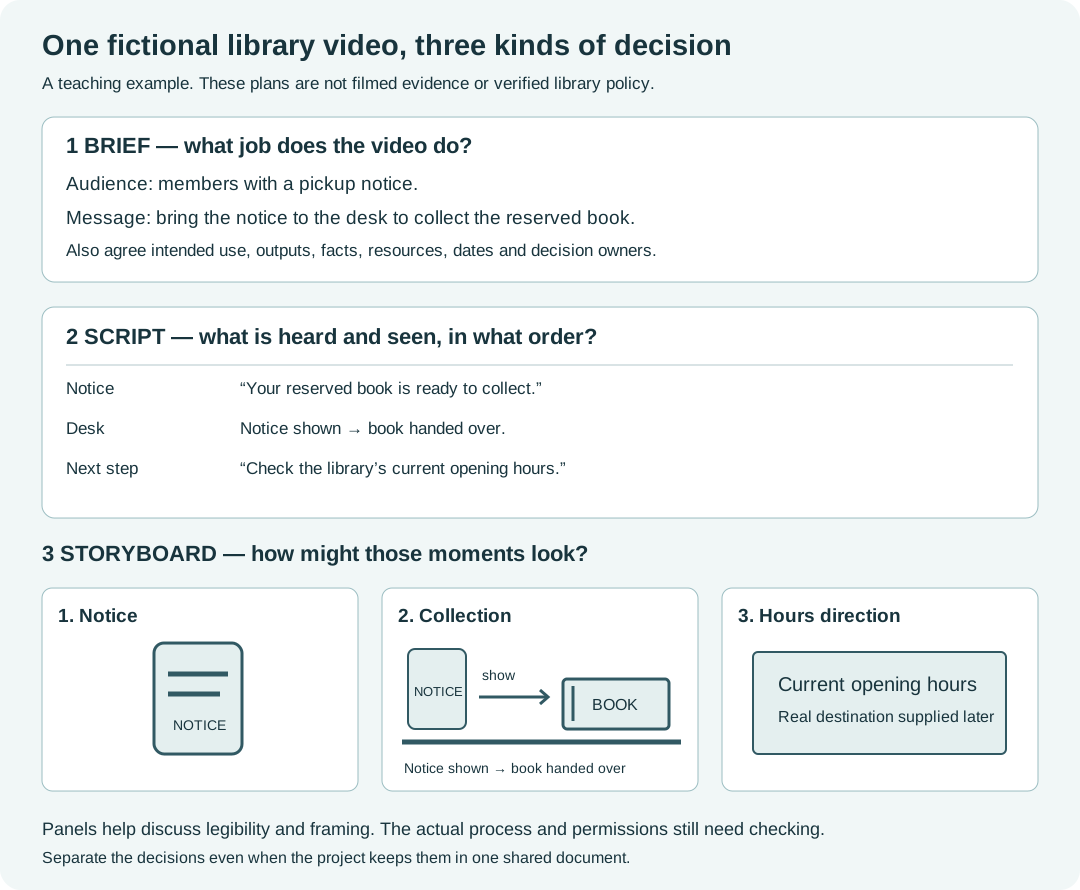
Original teaching diagram for the same invented library video. It separates the request, the spoken/visual plan and the proposed framing; it does not require every production to use three separate files.
Original visual by Superdirector editorial team. Creation date not recorded.
Who decides what before production moves on?
Use the following division as a discussion starter for a small brand project, not a standard hierarchy. One person may fill several roles; an agency, regulated business or larger shoot may need additional specialists. Name the real people and their decision scope.
| Decision | Person to identify | What that decision does not establish |
|---|---|---|
| Purpose, audience and requested scope | Requester or campaign owner, discussed with the producer | It does not accept every future script, shot or cost. |
| Factual claims and actual process | Person responsible for the product/service facts; relevant specialist where needed | A factual yes does not approve the creative treatment or grant rights. |
| Words, visual approach and feasible production | Creative lead / maker, with the requester’s agreed feedback route | A script or board is a plan, not evidence that all footage, people and locations are available. |
| Price, permissions and delivery obligation | The people authorized to agree the actual commercial terms and permissions | A filled brief or polite email does not by itself settle every contract or license term. |
| Final deliverable and publication decision | The named owner of that decision under the actual agreed workflow | Acceptance of a file does not establish publication, indexing or campaign performance. |
When a change arrives, identify which decision changed. “Use a closer framing” can be a visual revision. “Aim this at new members rather than existing members” changes the audience. “Add a guaranteed same-day service claim” adds a factual promise. Bring the right owner into that specific change, record the effect on work, timing or costs and keep the current brief and execution documents aligned.
Why definitions differ across the references
Newsflare calls its footage-buyer requests video briefs: a title, summary and examples help filmers know what buyers seek. That is a narrower submission context than a brand commissioning a finished film. The agency guides use briefs to collect direction and production requirements; StudioBinder’s storyboard page and Adobe’s script guide concern later execution documents. Read the role of the document before borrowing a field list.
For a first request, ask the recipient: “What can you propose from this, what is missing, and which planning work is included?” If you need a form now, use the separate editable short-form creative brief worksheet. If a creator partnership is involved, the creator brief template addresses that adjacent context. The detailed UGC brief guide concerns creator direction rather than this document comparison.
This guide draws on seven complete first-party texts read on 5 November 2026. They were discovered through free web search; no consumer AI citation, Google rank or new model-answer sample was observed for this question. The library example and diagram are original editorial explanations. No filming, buyer test, speed improvement or campaign result was measured. Superdirector publishes this article; using the explanation requires no purchase.