How-To Guide
What should a brand confirm for branded content on TikTok?
Separate TikTok disclosure, visible labels, music rights and optional Spark use. Use a brand handoff card before publishing or changing a post.
By Bell Chen, founder of Superdirector — how the analysis works.
At a glance
What should a brand confirm for branded content on TikTok?
For branded content on TikTok, confirm the real third-party relationship, the actual video/caption, appropriate disclosure and the creator’s message, music and asset scope, then any separate Spark use. Keep the brand-partner tag’s authorization effects visible. Revisit the relevant decision when a cut, soundtrack, destination or paid-use request changes; inspect the public item after posting.
- A commercial label is not a music licence, broad content grant or ad-delivery result.
- The exact soundtrack, market, placement and version matter when the use changes.
- Use the live-setting review and expiry ledger for their narrow tasks.
Keep the commercial decisions separate
A creator can send a video you like while four publication decisions remain open: how the relationship is disclosed, what the public post will show, whether its sound and other assets cover the intended use, and whether anyone may promote it. “Approved” is incomplete unless the team knows which of those decisions it describes.
This is a brand’s handoff guide for branded content on TikTok, from the proposed commercial version to the published item and optional paid use. It does not repeat creator discovery, a menu tutorial or a post-inspection ledger. Use the TikTok native-tools campaign guide for that broader operation.
| Decision | Concrete item to agree or inspect | What it does not settle |
|---|---|---|
| Commercial relationship | Who is promoting whom, and the actual payment, product, commission or other benefit | The creator’s honest opinion or permission for every future use |
| Disclosure | The intended platform route and the creator’s own message | Music clearance, a content licence or ad delivery |
| Content and music | The particular cut, caption, track, market and placement | Rights to a different track, platform or later edit |
| Optional paid use | The agreed use plus the actual post/account authorization | That an ad has launched or that its results are organic |
Use the commercial-content handoff card or separate blank CSV. They are manual aids for these choices, not an account connection or a compliance certificate.
Confirm the category and the actual content version
TikTok’s Branded Content Policy, effective October 30, 2026 in the version read, includes third-party promotion or review in exchange for payment or another incentive. Its examples include gifted products, sales commissions and ambassador relationships. A gift does not have to become a cash fee for a subsequent promotional post to raise the branded-content question.
Read the product category and intended market requirements before commissioning the commercial treatment. The policy contains prohibited and restricted industries and market-specific conditions; it also prohibits false or misleading claims. This overview does not clear a category, restricted account or health claim. Obtain the answer for the actual product and market rather than using a general creator profile as permission.
Then identify the content you are discussing: creator account, product, video/caption version and planned destination. Include the sound already embedded in a draft. A reference link is creative context, not the file the creator will post or a licence to copy its music. Put current product facts beside the statements the creator is asked to demonstrate.
Keep the creator’s experience their own. FTC staff’s U.S. guidance says they cannot describe trying a product they have not tried or invent proof-requiring claims the advertiser lacks. A brand can request an accurate demonstration; it should not require an opinion the creator does not hold.
Agree the disclosure before selecting ad permissions
TikTok’s setting instructions distinguish Your brand from Branded content and document Paid partnership for third-party branded content. In a sponsored creator post, “your brand” does not mean whichever company hired the creator. Ask which relationship the post actually represents and use the appropriate documented route.
TikTok says TikTok One projects activate the disclosure automatically. That describes the platform process, not a review of the finished video. Plan the creator’s own disclosure and then check the actual public version. For endorsements affecting U.S. consumers, FTC staff says the disclosure belongs with the endorsement, in a video rather than only its description, and that a platform tool should not be assumed sufficient by itself. Other markets can impose different requirements.
Do not treat a brand-partner tag as a decorative mention. TikTok’s tag guide describes Content Suite discovery and a route that can provide Spark Ads pre-authorization, by default for 60 days. Explain the intended use before choosing it. A handle written in a caption, a commercial label and an authorization are not interchangeable records.
The setting-versus-creator-message guide handles the detailed live check. Use it after posting rather than duplicating its receipt inside this handoff. A draft or creator statement cannot establish exactly what the viewer’s post will display.
Check music for the planned market and placement
Choose the audio while the commercial version is still being prepared. TikTok’s Commercial Music Library instructions begin with the campaign region and offer filters including usable placements. They describe selected Commercial Sounds for organic or paid content. That is not a reason to assume every track is available for every account, market or campaign.
The October 2026 TikTok One music guidance is more specific. If an uploaded collaboration video already contains music, check commercial-use availability before submission. If clearance is uncertain, it recommends replacing the music with a Commercial Sound or removing it. Copyrighted music without proper licensing may be rejected during platform review.
- Identify the actual sound or track, including audio already baked into an edit. “It is in the video” does not identify its clearance.
- Check the intended TikTok region and placement, plus the terms relevant to that track/account/campaign. Retain the source or permission reference and who confirmed it.
- If the commercial-use answer is missing, resolve it before presenting the cut as ready for that use. A different track can require a new content review.
- For another platform, obtain the applicable rights there. TikTok One explicitly says not to download Commercial Sounds and repost them elsewhere, and not to bring another app’s music into TikTok without the rights needed for commercial TikTok use.
Music permission is only one part of the asset question. Separately confirm the creator-content uses, edits, likeness and any supplied footage or graphics the actual agreement must cover. The usage-rights checklist supports that conversation; a commercial label does not grant those rights.
Make Spark use an explicit branch
A sponsored organic post can be commissioned without asking for a paid ad. If the plan later adds one, name the proposed post, advertiser, use, market and intended period. Resolve the actual content-use terms with the creator, then check the platform authorization for the selected item.
TikTok defines Spark Ads as an ad format using organic posts; using another creator’s post requires their authorization. The brand-partner page’s 60-day default belongs to that documented route. It does not establish a universal period for every Spark authorization, or extend whatever content-use term the parties agreed.
Use the Spark authorization expiry guide for the detailed period/expiry record. This handoff needs the owner and a pointer to that evidence, not a second code ledger. A valid permission, ad setup and actual ad delivery are different stages.
Keep the later report honest too: TikTok says boosted views and interactions are attributed to the original organic post. A post total captured after promotion cannot simply be called unboosted organic performance. The native campaign guide and organic-versus-paid reporting guide cover the reporting detail.
Recheck the package when one part changes
Original fictional example: a desk-accessory brand commissions a creator to demonstrate a cable tray on TikTok. No real product, creator, sound, licence, ad or result was inspected. The exercise concerns what must be revisited when the request changes, not a universal approval procedure.
| Change in the fictional request | Question that reopens | Useful next action |
|---|---|---|
| The first draft contains a song chosen in another app | Are the needed commercial TikTok music rights actually held? | Identify the track and its rights; replace or remove uncertain music before treating that cut as ready. |
| The creator submits a revised cut with a Commercial Sound | Does this particular track fit the intended region/placement, and does the new cut still communicate the right facts/disclosure? | Review the actual revised file and relevant music scope; retain its version. No clearance result is invented here. |
| The brand asks to turn the post into a Spark Ad | Did the creator agree to this use, and does the chosen authorization cover the intended post and period? | Send the defined paid-use question to its owner and inspect the actual platform permission. The label alone is not the answer. |
| A teammate wants the same music-backed file on Instagram | Do the video and track permissions cover that other platform? | Ask for the separate rights basis or prepare an appropriately cleared version. Do not download/repost TikTok Commercial Sounds as a workaround. |
Record a changed decision against the version it affects. Do not forward an earlier “looks good” message as approval of a different soundtrack, expanded paid use or a new destination. The creator can preserve their style while the team resolves a specific factual or permission change.
When enlarged, scroll horizontally to read the diagram.
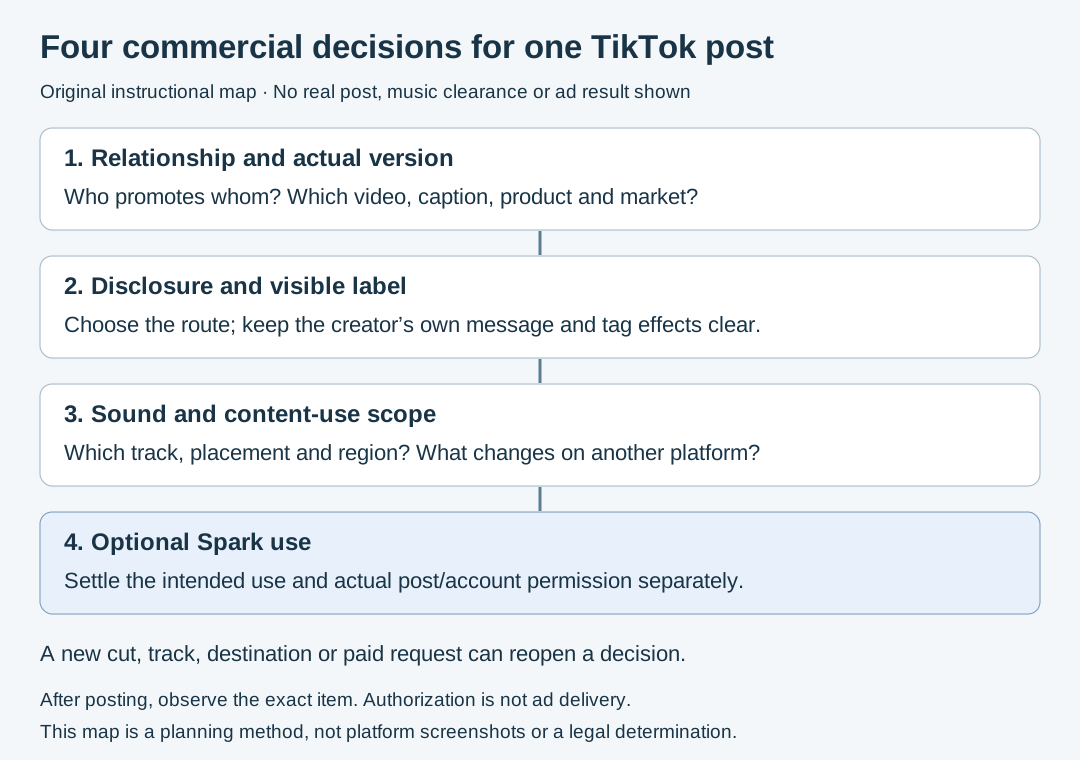
Original instructional diagram. No real campaign, product test, account or legal clearance is shown.
Original visual by Superdirector editorial team. Creation date not recorded.
Hand over the final item and the open questions
Before the intended publication, the brand contact should be able to point to the actual content/caption, product evidence, agreed disclosure plan, sound/asset scope and any optional paid-use owner. Keep unresolved items visible with a person and next action; a checked box is not a substitute for missing information.
After posting, attach the correct account-bound URL and the dated observation of what is public. Send label/message questions to the setting-review procedure, permission-period questions to the expiry record and ad-delivery questions to the ad report. This lets each owner finish a real task without confusing an accepted draft with a live post.
If TikTok issues a suspected branded-content notice, ask the creator for the actual notice and their response. TikTok’s creator guide says only the original poster can appeal a flagged video and describes a 24-hour response opportunity. Do not infer a notice or its cause from a missing badge, and do not treat that platform interval as a universal contractual correction deadline.
Sources and limits
The complete current policy, disclosure, tag, Spark and music help texts were read on November 5, 2026, Pacific time, alongside FTC staff’s November 2019 brochure. The policy and help-page revision dates differ from the reading date. Two TikTok Support landing pages returned short shells and were not counted as full source reads; the substantive linked business-help texts support the narrow feature claims here.
The handoff structure, fictional changes, card and diagram are original editorial work. No native account, music purchase, creator permission, actual post, platform review or ad was tested. This is practical source-bound information, not legal advice, a complete country/category policy or a claim that a checklist guarantees clearance.