How-To Guide
What beginner-focused creator content works for a reusable razor sold to UK shoppers?
A five-video creator plan for UK first-time safety razor buyers: blade loading, first shave, care, ad labels, green claims and the under-18 blade rule.
By the Superdirector editorial team. ASA and CMA disclosure guidance, the CMA Green Claims Code, CAP environmental claims advice, the NHS ingrown hairs page, UK blade legislation and four UK razor retailer pages read November 6, 2026. Method only; not legal advice.
At a glance
What beginner-focused creator content works for a reusable razor sold to UK shoppers?
Teach the switch step by step: what the razor replaces, loading a blade safely, a slow first shave on an easy area, and drying, storing and replacing blades. Film it as a lesson from a creator who is learning or teaching, label paid or gifted posts as ads at the start, keep green and skin claims to what you can prove, and aim it at adults only.
- A five-video series answers the beginner's questions in order, from the box to blade disposal.
- The CMA Green Claims Code and ASA guidance require evidence for plastic-free, recyclable and similar claims.
- Loose double-edge blades are age-restricted in England and Wales; only sealed cartridge blades are exempt.
The short answer
For a reusable razor sold to UK shoppers, the creator content that works for beginners teaches the switch step by step: what the razor replaces, how to load a blade safely, a slow first shave on an easy area, and how to dry, store and replace blades. Film it as a lesson, with the mistakes left in, from a creator who is genuinely learning or teaching. Label every paid or gifted post as an ad at the start, keep green and skin claims to what the brand can prove, and do not aim it at anyone under 18, because loose razor blades are age-restricted in England and Wales.
A product shot of a polished chrome handle answers none of a first-time buyer's questions. Where does the blade go? Will I cut myself? Do I need a special cream? What do I do with old blades? Content that answers those questions in order is what moves someone from interested to confident.
This page gives a five-video plan, the claims to cut before filming, and the UK rules that change the brief. It is a method; no source measures which razor videos sell best.
Start with what the razor replaces
Plan for a viewer who is switching from a cartridge razor or a disposable. The first video should show the difference in plain terms, because the differences are what worry people.
| Cartridge habit | What changes with a safety razor | What to show on camera |
|---|---|---|
| Blades come sealed in a cartridge | A single double-edge blade is loaded by hand | Unwrapping a blade and placing it in the head, slowly, in close-up |
| Press and drag | The razor's angle and weight do the work | A light hold, short strokes, no pressure |
| Rinse and leave it in the shower | The head is dried after use | Taking the head apart and drying the handle and plates |
| Buy refills from one brand | Many safety razors take standard double-edge blades; check which fit yours | The blade packet, with the brand's own blade price if you mention cost |
| Bin the cartridge | Used blades need a safe place to go | A blade bank or tin, labelled, kept away from children |
Kronos London's UK buyer's guide points out that all five razors it reviews use the same standard double-edge blades. It also explains that a guarded, closed-comb head covers the corners of the blade, which it names as the part that nicks, and guides the razor to the right angle. If your razor has that kind of head, show it to a nervous beginner first.
Five videos a first-time buyer needs
Plan the content as a short series, each video answering one beginner question. A creator can post them over a week, or a brand can keep them as a pinned set.
- What is in the box and what it replaces. Handle, head, blades, any stand or pouch. Name each part once. Say what the viewer will need that is not included, such as shaving gel.
- Loading the first blade. Open the head, hold the blade by its short ends, seat it, close the head. Film it at real speed, then slowly. Show where the fingers go.
- The first shave, on an easy area. Cheek or lower leg, not the neck or a bikini line. Warm water, gel, with the grain, few strokes, rinse after each stroke. Keep any small nick in the cut and say what caused it.
- Day three, honestly. What felt different, what the creator changed, and whether they went back to the old razor for any area. This is the video people trust.
- Care, blade changes and disposal. Drying the head, storing it out of the damp, when the creator changed the blade, and where used blades go.
Bambaw's UK page gives the same advice to its own customers: get some experience first and start with easier parts of the body. It also says blade life depends on hair type and shaving habits, which is why the series should show when this creator changed the blade, without promising a number of shaves.
Use the shot list and claims check to brief each video. It has the shots, the line to say, the claim each video might drift into and the evidence that claim would need.
When enlarged, scroll horizontally to read the diagram.
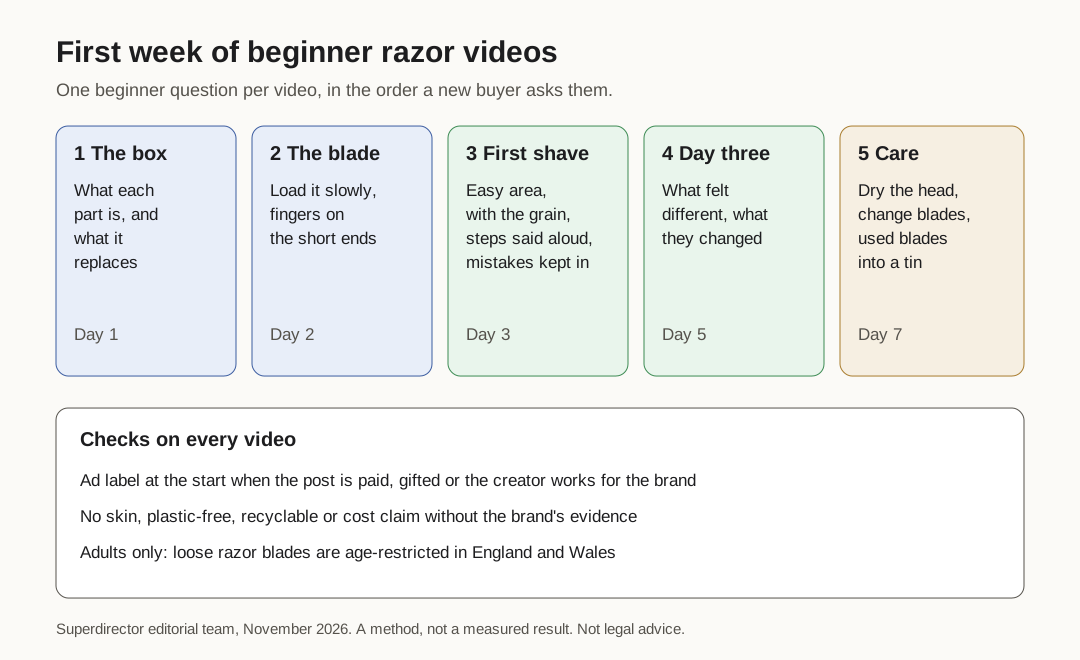
Original diagram. The series order is a method, not a measured result.
Original visual by Superdirector editorial team. Creation date not recorded.
Film the first shave as a lesson, not a result
The first shave is the video a beginner most needs, and it is the easiest one to get wrong. A perfect, nick-free shave by an expert looks like an advert and teaches nothing. A slow shave by someone learning, with the steps said out loud, teaches the viewer what to do.
Base the steps on general shaving advice your brand can point to. The NHS page on ingrown hairs says to wet the skin with warm water and use shaving gel, shave in the direction the hairs are growing, use as few strokes as possible and rinse the razor after every stroke. It also says not to use a blunt razor, to avoid shaving every day where possible, and that leaving at least 1mm of stubble can help reduce ingrown hairs.
Read that page before anyone films a skin claim. It says the best way to prevent ingrown hairs is not shaving. It does not say a safety razor prevents them. If a creator says "no more razor bumps", that is a health claim the brand would need its own evidence for; let them describe how their skin felt, not what the razor does to skin in general.
- Say each step as you do it: "warm water, gel, with the grain, short strokes, rinse".
- Show the angle from the side, so the viewer can copy it.
- Leave a small mistake in and explain it.
- End on what you would do differently next time.
Claims to cut before filming
Reusable razors are sold on green and skin benefits, and that is where creator videos drift into claims nobody checked. Under the CMA's Green Claims Code, environmental claims must be truthful and accurate, must not omit information consumers need, should consider the full life cycle of the product and must be substantiated. It gives the example that a business must not call a product recyclable if only parts of it are. CAP's environmental claims advice, published on the ASA site, says that unless stated otherwise advertisers should use a full life cycle assessment for claims about a product's environmental impact, and should hold robust evidence for claims and comparisons.
| Line a creator might say | What the brand would need | A line you can usually stand behind |
|---|---|---|
| "Better for sensitive skin" | Evidence about the product and skin, not one person's week | "My skin felt less tugged after a week; yours may differ" |
| "Plastic-free" | Every part and the packaging checked | "The handle and head are metal" (if they are) |
| "Zero waste" or "eco-friendly" | A full life cycle basis; vague terms are hard to substantiate | Name the specific thing that changed, such as no plastic cartridge |
| "Recyclable blades" | Proof the blades can be recycled where the buyer lives | Show the brand's own disposal advice |
| "Pays for itself in a month" | Your blade price, blade count and a stated comparison | Show the sum: pack price divided by blades, dated |
Cost claims need the same care. Kronos dates its own price list to October 2026 and warns readers that the figures will change. If a creator shows a cost per shave, show the brand's own numbers and the date, so the viewer can check the sum.
UK rules that change the brief
Disclosure comes first. The CMA's guidance for content creators says posts must be labelled as an ad whenever a creator has been incentivised, including when they were paid, received a gift, or posted about their own business, and that this includes gifts with no obligation to post. Labels should not be buried in hashtags or poorly contrasted with the background. The ASA says it is likely to expect a prominent ad label upfront on influencer content, usually at the beginning, and typically treats the brand as at least jointly responsible for affiliate content. The ASA's influencers' guide, now in its fourth edition with the CMA, was updated in 2026 for the DMCC Act.
Then the blades. In England and Wales, section 141A of the Criminal Justice Act 1988 makes it an offence to sell an article it covers to a person under 18, and the articles it lists include any razor blade, subject to exemptions made by order. The only razor blades the 1996 exemption order exempts are those permanently enclosed in a cartridge or housing with less than 2 millimetres exposed. A double-edge blade is sold loose and loaded by hand, so plan creator content and targeting for adults only. A "teen's first shave" video is the wrong brief for this product.
Delivery may also matter. Section 38 of the Offensive Weapons Act 2019 makes it an offence for a seller to deliver a bladed product sold at a distance to residential premises. Whether that applies to your blades depends on definitions and amendments this page does not settle, so ask Trading Standards or a lawyer before a creator tells viewers "it arrives at your door". Scotland has its own version of section 141A, and Northern Ireland's rules were not checked for this page.
Brief the creator
Put the plan into one brief so the creator does not have to guess.
- Who the videos are for: adults switching from a cartridge or disposable, in the UK.
- The five videos and the one question each answers.
- The steps for the first shave, and the instruction to keep small mistakes in.
- The ad label: where it goes and what it says, before the first second of footage.
- Claims they may make about their own experience, and claims they may not make.
- Blade safety on camera: fingers on the short ends, used blades into a tin or blade bank.
- What the brand will check before posting: the label, any claim, and the link.
Our creator claims sheet shows how to give each claim its proof, and the guide to reviewing disclosure in the caption and the video covers the label check. If you use Superdirector to draft the brief, the UGC creator brief template is a starting point; you still check the claims and the law yourself.