How-To Guide
Check recent creator sponsor categories without treating every post as paid
Classify creator sponsorships by source, date and product. Separate disclosed deals from ambiguous mentions before applying a campaign competitor rule.
By the Superdirector editorial team. FTC and platform sources reviewed October 29, 2026. Public post sample is limited to two creator-disclosed videos.
At a glance
How can a team check recent sponsor categories without assuming every creator post is paid?
Declare the campaign’s product category, competitor rule and review window. For each exact public post, record the date, source, visible relationship wording and featured product. Put explicit sponsorship, another disclosed connection, ambiguous brand mention and no observed cue in separate states. Map the featured product to a category, then ask the creator about live terms only if an overlap would matter to the proposed campaign.
- An explicit named sponsor on a dated post supports that post-specific relationship, not a complete account history.
- A tag, link or absent label leaves the payment and private-contract question unresolved.
- Category overlap matters only against the proposed campaign’s exact product, dates and written competitor rule.
A creator can mention a product because they bought it, received a gift, have an affiliate arrangement, own the brand, or are making a sponsored post. Those are different relationships. A brand choosing a creator needs a narrower answer: which recent, source-confirmed commercial relationships overlap our proposed campaign category and dates? A post with no visible disclosure does not prove that it was unpaid, and a product mention alone does not prove a paid deal.
This guide gives a bounded review method and a blank sponsor-history card, CSV record, and evidence-to-decision diagram. It includes two dated, explicitly disclosed public YouTube posts as a small teaching sample. They are not a complete audit of that creator, a fee estimate, an exclusivity finding, or an accusation about any other post.
Direct answer: establish the relationship before the category conflict
Choose the proposed campaign’s exact product category, named competitors if any, and planned period. Then inspect a declared recent window of the creator’s public posts, recording each exact URL, publication date, observed label or disclosure, brand, product, and evidence checked at a time. Separate explicit third-party sponsorship, another disclosed connection whose terms are unclear, brand mention with relationship unknown, and no relevant cue in the surface inspected. Only the first two support a classified disclosed relationship. An ambiguous cue is a lead to investigate, not a confirmed sponsor or paid-post count.
The FTC’s current Endorsement Guides Q&A says that some creators are paid for recommendations while others have no connection to the marketers they mention. The FTC also explains that a material connection can be money, a gift, an employment or family relationship, or another benefit. Its guidance informs how to read disclosures; it does not turn a public reviewer into an investigator of a creator’s private contracts. Record the evidence and ask the creator about any overlap that would actually matter to the proposed deal.
Define the campaign’s conflict rule first
“Has worked with a tech brand” is too broad to decide whether a creator fits a storage-device campaign. Before reviewing posts, write the client’s proposed product, direct competitor set, adjacent categories that need discussion, campaign dates, and any proposed exclusivity in the actual brief. The same public post can matter differently to a laptop maker, a network-attached-storage seller, and a cloud-backup service. If the brief has no exclusivity or competitor rule, do not invent one after finding a sponsor.
Set the lookback to match the decision, for example the period likely to cover an active campaign or the client’s requested recency window. Record its start and end dates and the surfaces actually read. The FTC guidance cited here does not prescribe a lookback for a buyer’s sponsor-history review; it addresses disclosure of connections in endorsements. A 30-, 60- or 90-day sample is a business review choice, not a legal cutoff or proof that older relationships ended. If the proposed agreement asks for a longer restriction, review that period and confirm live commitments with the creator.
The output is a question for the deal owner, not an automated fraud score. A directly overlapping disclosed sponsor may justify asking whether an exclusivity obligation remains in force. It does not by itself prove that the creator cannot work with the client. A category that is merely adjacent should be named as adjacent and assessed against the written campaign rule.
Read public cues in four evidence states
| Observed public cue | What the team can record | What remains unknown |
|---|---|---|
| Creator explicitly says a named brand sponsored the exact post, or a platform label and post identify the brand | Disclosed sponsor for that post; exact brand and product category if a primary product source supports it. | Fee, term, exclusivity, other private obligations and whether other posts were sponsored. |
| Gift, affiliate relationship or other connection is clearly disclosed | Disclosed material connection; preserve the creator’s exact words and classify the product. | Whether the post was a cash sponsorship or whether the connection is still active. |
| Brand tag, product appearance, store link or personalized code without a clear relationship statement | Commercial cue or brand mention; inspect the full post and ask if it matters to the campaign. | Whether compensation, a gift, affiliate commission or no relationship explains the cue. |
| No disclosure or brand cue in the specific surface checked | “No relevant cue observed in [surface] at [time].” | Whether another surface, video segment, unavailable post or private arrangement contains relevant evidence. |
The FTC notes that a personalized discount code probably tells consumers some relationship exists, but does not necessarily make a financial relationship clear. It also says a plain “thank you” to a brand need not mean the creator received something. A team doing category history should preserve these distinctions rather than promoting every code or thank-you to “paid sponsor.” FTC Q&A on codes and thanks.
Platform labels add another surface, not a universal database of all deals. YouTube Help says the creator selects the paid-promotion option for branded content, sponsorships, endorsements or other commercial relationships; the viewer label appears at the beginning of the video. TikTok’s creator guidance distinguishes Paid partnership for third-party branded content from Promotional content for a creator’s own business. Meta’s Instagram partnership description describes partnership ads as made either by boosting organic content, including branded content with the paid partnership label, or by creating new ads in Ads Manager. Record the platform and exact label; do not translate every label into the same cash-deal category. Tie brand identity to a supported post-specific source rather than to a platform label alone.
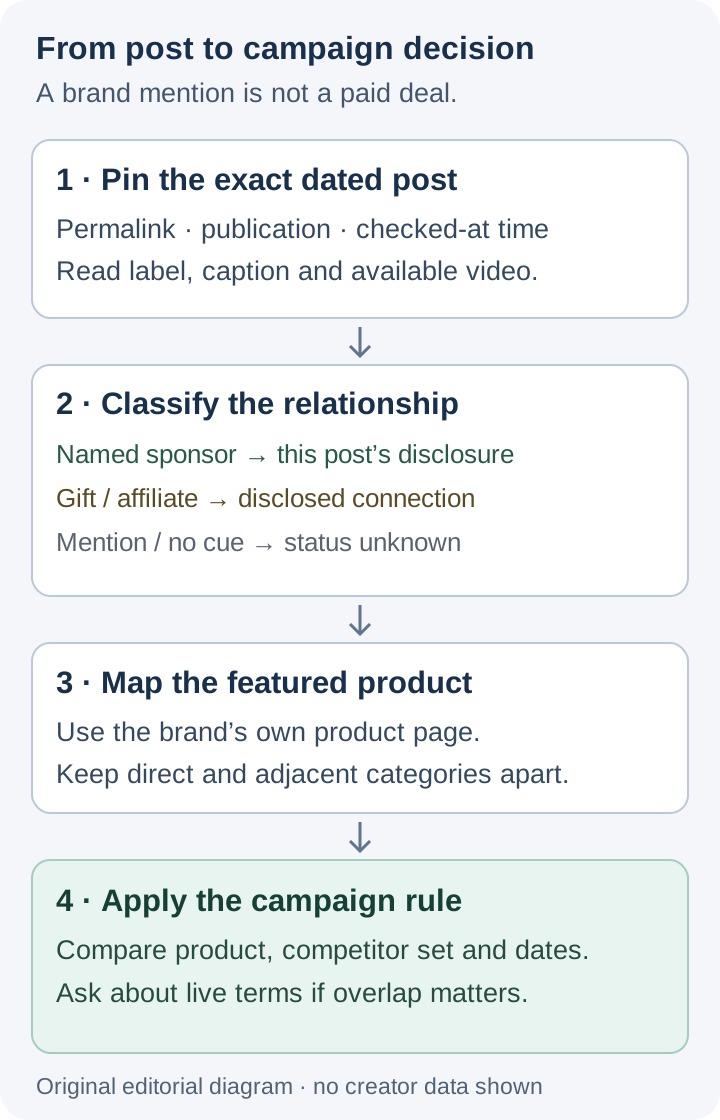
A disclosed post starts a category question; a brand mention alone does not establish a paid deal. Original decision diagram with no creator data.
Original visual by Superdirector editorial team. Created 2026-10-29.
Inspect a dated, explicit two-post sample
These two public pages show what an explicit relationship entry looks like. Both are Linus Tech Tips YouTube uploads; we checked each page’s publication metadata and the channel-published description on October 29, 2026 UTC. We did not inspect every channel upload, private deal, video playback or on-screen label.
| Exact public post | Dated creator disclosure | Source-bound category reading |
|---|---|---|
| *NVIDIA RTX Spark 7 Good and Bad Things*, published October 15, 2026 | Description says, “Thanks MSI for sponsoring this short!” | The description names an MSI Prestige N16 Flip AI+; MSI identifies it as a laptop/2-in-1 PC. Record MSI and laptop/computing hardware for this post. |
| *There’s a Secret (Better) Netflix for Millionaires*, published October 22, 2026 | Description says, “Thanks to UGREEN for sponsoring this video!” and identifies the DXP6800 Ultra. | UGREEN identifies the DXP6800 Ultra as NAS storage. Record UGREEN and network storage hardware for this post. |
The date and self-disclosure support two specific sponsor-observation rows. They do not establish the fee, whether a product was also supplied, how long either arrangement lasted, whether any category was exclusive, or what proportion of the creator’s recent posts were sponsored. We also cannot assign every other post to “organic” from the absence of a disclosure in this two-post sample. If an agency needs a complete recent history for a real deal, it must finish and date the declared window, including unavailable posts and any source surfaces it could not read.
The point of a public sample is the join between evidence and category. Use the creator’s own post for the relationship wording and the brand’s own product page to avoid categorizing a whole company from one featured product. A broad label such as “technology sponsor” would hide the difference between a laptop and network storage.
Turn the history into one campaign decision
Suppose, hypothetically, a network-storage brand plans a November creator campaign. The October 22 UGREEN NAS sponsor observation is a relevant category overlap. The October 15 MSI laptop observation is adjacent computing hardware, not automatically the same direct product category. The team should write the client’s actual competitor rule, show the two post URLs and dates, and ask the creator whether any current category exclusivity or content commitment intersects the proposed November work. No public post can answer that private-term question.
The decision record can then say one of three things: no observed overlap under the written rule, overlap needs the creator’s terms or client direction, or confirmed conflict with the planned campaign. “No observed overlap” is bounded to the reviewed window and sources; it is not a clean bill for the creator’s entire history. A confirmed conflict needs the relevant term or an authorized party’s answer, not a guessed duration. If the categories overlap but there is no exclusivity, the brand may still care about differentiation or timing; that is a commercial decision to record explicitly.
For a real campaign, do not contact a creator just to fill a generic database. Ask only the questions the written brief makes consequential: which competitor categories are restricted, from when to when, on which platform or format, and whether the proposed creative or usage right collides with an existing commitment. Keep contract terms and creator responses in the authorized campaign record, not a public worksheet.
Run a repeatable sponsor-history pass
- Freeze the proposed deal question. Name the client product, direct and adjacent categories, competitor set, planned dates, and any written exclusivity. Decide which answer would change the creator choice.
- Declare the review window and surfaces. List the creator’s exact public accounts and the date range. Count posts inspected and note missing, private, deleted, restricted or unreviewed surfaces. Do not silently call a partial sample “all recent posts.”
- Read each post at source. Keep the exact post URL, publication date, checked-at timestamp, visible label, description/caption or clearly viewed in-video disclosure, and brand-specific wording. A search result or sponsor database can lead you to a post, but the post is the evidence.
- Classify the relationship narrowly. Use the four evidence states above. Preserve the creator’s wording. A gift, affiliate code, paid-promotion label and explicit named sponsor are not interchangeable financial facts.
- Map the featured product, then decide. Use a primary brand product page for category, compare it with the brief, and record one source-bound result. Ask about live terms only where the possible overlap would change the campaign.
The blank sponsor-history card makes the post-to-category-to-campaign chain printable. The header-only CSV lets an authorized team keep one row per observed post and a separate decision field. The diagram keeps an ambiguous brand mention out of the confirmed-sponsor lane. None of these assets contains a creator’s data.
Sources and limits
The FTC Endorsement Guides Q&A, FTC Disclosures 101, YouTube’s branded-content guidance, TikTok’s disclosure setting, and Meta’s Instagram partnership description were reviewed October 29, 2026. The two linked creator pages and MSI/UGREEN product pages supplied the dated example. The four-state register, hypothetical November decision and assets are original editorial methods. This article makes no finding about any creator’s compliance, private contract, total sponsor count, fees or current availability.