How-To Guide
How should a brand ask a creator for a collaboration on Instagram?
Choose the creator’s contact route, write a clear five-line brand pitch, follow up once where permitted, and turn interest into specific written terms.
By Bell Chen, founder of Superdirector — how the analysis works.
At a glance
How should a brand ask a creator for a collaboration on Instagram?
Use the creator’s stated partnership contact route, identify your brand and a real reason for the fit, describe the paid work, gift or affiliate offer, and ask one easy next question. If an appropriate route permits it, consider one short follow-up around one to two weeks later. A refusal ends the pitch; interest starts a separate discussion of scope, fee, rights and timing.
- This is brand-to-creator first contact; a native Instagram Collab invitation is a different task.
- A genuine gift carries no hidden posting requirement; state required work and compensation clearly.
- Respect contact preferences and message controls, and record the response so teammates do not repeat a declined ask.
Choose the request you are actually making
To ask for a collaboration on Instagram, start with a business proposal the creator can understand in one reading. Identify your brand, explain why their actual work fits, state whether you mean paid work, a gift or an affiliate arrangement, and ask one manageable question. The useful result of the first message is an informed reply, not a promised post.
This guide is for a brand contacting a creator. If you are a creator pitching a brand, the responsibilities and information you supply are different. If the project is already agreed and your problem is the native co-author invitation, go to verify Instagram Collab post delivery. A reply to a pitch does not settle deliverables, content rights or ad permission.
| What you mean | State it plainly | What is still separate |
|---|---|---|
| Paid creator work | The format, broad topic, intended period and that there is a fee | The quote, scope, written terms and actual delivery |
| A genuine gift | The product and that no post is expected, when that is true | Permission to send the parcel and any later endorsement disclosure |
| Affiliate participation | That compensation depends on the stated commission arrangement | The rate, tracking, conditions and whether any content is required |
| A co-authored post already agreed | The existing project and the account that should participate | The native invitation and confirmation that the agreed post is actually delivered |
Choose one of these before writing. “Gifted collaboration” is unclear if you expect a Reel by Friday. If a post is required, describe the work and compensation honestly; if the gift is unconditional, do not attach an unstated obligation to it.
Use the creator’s stated business contact route
Read the current bio, linked contact page and any collaboration instructions. If the creator lists a business email or manager for partnerships, use that route. If they invite DMs, write a concise DM. Where no preference is stated, use an available public business contact or a permitted DM; this page gives no basis for guessing private addresses or working around a closed inbox.
Statusphere’s outreach guide makes the creator’s contact preference part of the email-versus-DM decision. We adopt that choice, rather than assuming every creator checks one channel more often. A public address is a contact route, not a universal finding that every message is lawful or wanted.
Make your own sender easy to check: use the real brand account, a recognizable person and a coherent public website or profile. Reference the creator’s actual post or portfolio item. Do not claim to have followed them for years if you just discovered them, manufacture familiarity or leave a public “check your DMs” trail to force attention.
Meta’s messaging explanation says requests to someone who does not follow or is not connected to you are limited to text, with images, video and voice notes unavailable until the request is accepted. Account settings and protections can also restrict contact. Write a complete text introduction; do not make an unsolicited attachment essential to understanding it. If Instagram prevents a request or further messages, respect that boundary.
Where the brand and creator have access, Meta describes Creator Marketplace as another route: brands join through Meta Business Suite, and creators receive partnership messages in a dedicated folder. Projects can carry requirements and a rate. Check the access actually available to the accounts involved; this is a documented route, not a tested account walkthrough or a promise of eligibility. This guide covers adult professional creator contact; it does not advise bypassing restrictions protecting teens.
Write one short pitch with five useful lines
Use five lines as a writing aid, not a performance formula or a platform limit. Each line earns its place by answering a question the recipient would otherwise have to ask. Keep the message readable on a phone; the creator can ask for the full brief if interested.
| Line | Question it answers | What to include |
|---|---|---|
| 1. Sender | Who is asking? | Your real name, role or relationship to the named brand |
| 2. Fit | Why this creator? | One specific observed piece of work and its relevant detail |
| 3. Proposal | What work or offer do you mean? | Paid work, unconditional gift or affiliate arrangement, stated accurately |
| 4. Scope | How much and when? | The intended format and period; say when timing is still provisional |
| 5. Next step | What answer do you need now? | One clear interest or availability question, with room to decline |
Original fictional worked example: the brand sells travel pouches; the creator has a packing-layout video you actually watched. This is teaching copy, not a sent message or a rate benchmark.
Hi [Name], I’m [Sender] from [Brand], which makes travel pouches.
Your [named video] made the packing layout easy to understand.
We’re considering a paid Instagram Reel showing that kind of use.
The intended window is [dates, or clearly stated provisional timing].
Would you be open to a short outline and a conversation about your availability and rate?
Only use that observation if it is true. The note names paid work without pretending the creator has accepted, withholding that payment is conditional or inventing a fee. If you have an authorized budget range and enough scope to make it meaningful, you can state its currency and basis. There is no need to pretend a number is confidential as a universal negotiating rule.
For a gift, change the proposal and scope explicitly: “We would like to offer [Product] as a gift, with no expectation to post. Would you like to receive it?” Use that only when no deliverable is required. Ask for the agreed fulfilment details after the creator accepts; do not turn a first pitch into a demand for a home address.
For email, use an honest subject such as “[Brand] — paid Reel inquiry for [window]” when that is the actual proposal. The outreach email template provides longer fill-ins. This page’s task is choosing and checking the first approach, rather than supplying another template library.
Use the first-contact card or blank CSV to retain the stated route, five lines and one follow-up decision. These are manual, local aids with no account connection, sending or automatic saving.
Choose one response path and a clear stopping point
Record the date, exact recipient and route you used. A quiet inbox is an unknown outcome: you do not know whether the person saw the message, is available or wants the work. Avoid treating “sent” or an assumed open as agreement.
| What happens | Your next action | When to stop |
|---|---|---|
| The creator expresses interest | Answer the actual question; offer the outline and agree where to continue | Do not treat interest as acceptance of scope, price or rights |
| They decline or ask you to stop | Acknowledge if appropriate and record the refusal so another teammate does not repeat the ask | End this pitch; do not switch account or channel to pursue the same refusal |
| There is no reply and the route permits another message | Consider one brief follow-up in the same appropriate conversation | After that unanswered check-in, close the attempt |
| The inbox or request controls prevent another message | Respect the restriction and leave the attempt closed | Do not use another identity or an unsolicited public comment to get around it |
Our editorial default is one follow-up around one to two weeks later, if the route permits it and there is no refusal or stop request. Statusphere suggests a week or two; Sked Social suggests at least two weeks in its brand-pitch discussion. These are practitioner recommendations, not a measured best time, a rule of Instagram or a guarantee of a reply. Use the creator’s stated timeline when they give one; a later date they ask you to use is an agreed conversation, not an unanswered chase.
A check-in can simply identify the earlier inquiry and ask whether it is relevant. If the proposed window has passed, close it rather than manufacturing urgency. After one unanswered follow-up, move on. Genuine public appreciation of someone’s work is fine on its own; it should not become a substitute channel for pressuring them about a private proposal.
For commercial email in the United States, the FTC’s CAN-SPAM guide explains that the law extends beyond bulk mail and makes no business-to-business exception. Its requirements include accurate sender details, a truthful subject, ad identification, a valid postal address and a clear way to opt out. The primary purpose of the particular message matters. Resolve the rules applicable to your actual email and markets; these short writing examples are not a complete legal footer or permission to send.
When enlarged, scroll horizontally to read the diagram.
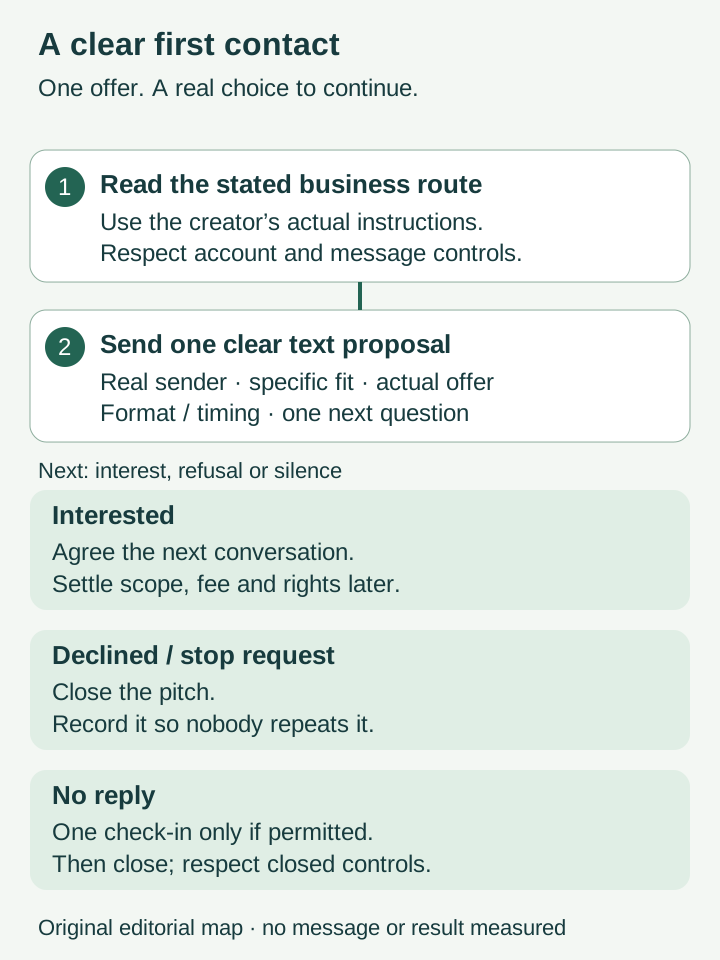
Original editorial decision map. A response is a conversation outcome, not a signed deal.
Original visual by Superdirector editorial team. Creation date not recorded.
Turn interest into a specific work conversation
When a creator replies, read what they actually said. “Send details” means you may send the relevant outline; it does not establish an agreed rate, a posting date, a product endorsement or a license. Continue through the route you agree with them and retain the actual words.
- Send the supported product facts, intended format, provisional or firm timing and the work you want discussed.
- Confirm whether the proposal includes a post on their account, delivery of an asset, or both. A video file and access to an audience are different purchases.
- Agree compensation, revisions, rights, disclosure responsibilities and payment terms in writing before the relevant work starts. Use the creator brief and agreement guide for those details.
A later public endorsement has its own disclosure duties. FTC staff guidance explains that payment or a free product can be a material connection, and that a product mention after a gift can need disclosure even when no mention was requested. It also warns that “collab” alone is vague. Calling the private message a collaboration is ordinary project language; it does not make that word an adequate audience-facing disclosure.
Keep the initial outcome modest and useful: the right person understood the offer and could choose whether to continue. The complete influencer hiring guide carries an interested conversation through the later handoffs.
Sources, method and limits
We read the complete current texts of the Sked Social, GRIN and Statusphere outreach references on November 5, 2026, plus Meta’s marketplace and messaging explanations and the FTC texts linked above. The practitioner pages contain competing follow-up recommendations and older performance claims; we use their broad structures and contact-preference reasoning without adopting response-rate promises or public-comment nudges.
A retained November 3 searched answer to “how to ask for collaboration on instagram” cited Sked Social inline; GRIN and Statusphere were in its source list. A separate Gemini answer mixed partnership pitches and the native Collab feature. Those observations do not establish demand specifically from brands, current rankings or exposure of this article’s exact FAQ. Current search volume remains unverified.
Source text and stored HTML structure were examined. Source images, phone layouts, private inboxes and live account flows were not inspected. The worked message, route diagram and manual card are original editorial material; no message was sent and no reply or campaign result was measured. Superdirector publishes this guide.