How-To Guide
How should a brand run an influencer campaign on YouTube?
Plan a YouTube creator campaign with a defined format, truthful brief, usable link route, checked disclosure, separate brand access and source-bound reports.
By the Superdirector editorial team.
At a glance
How should a brand run an influencer campaign on YouTube?
Choose the viewer’s question and the creator video format, inspect relevant work, and agree the actual publication, files, rights, disclosure, payment and report owners. Review the exact video and verify the live account-bound post and destination. Treat optional brand partner access as a metrics-and-boosting permission, and any actual paid ad campaign as separate work. Read each reported result under its real metric, window and organic/paid scope.
- A sponsored integration, dedicated video, Short and creator-delivered ad-read need their actual scope and destination route.
- A platform disclosure label, contractual license, brand access and an ad launch are different records.
- Public views, Engaged views, ad-report views, unique viewers and sales do not share one meaning.
Choose the job and the video format
YouTube influencer marketing is a brand commissioning a creator’s work for the audience and use stated in the deal. Begin with the viewer’s question and the exact publication you need, then keep the creator’s fee, optional content reuse, optional paid amplification and measurement separate. A sponsored upload is not automatically an ad campaign.
Original fictional project: a brand sells a watercolor-brush storage roll. It wants viewers to understand how its actual pockets fit the brushes they own. The product owner must verify dimensions and the demonstration. No real creator, product test, fee, upload or result is described in this example.
| Format you might commission | Useful brief question | What to agree |
|---|---|---|
| Integration in a wider video | Where does the product naturally help the existing topic? | The creator-delivered segment, context, supported message and intended timing |
| Dedicated sponsored video | Does the viewer need a complete explanation or demonstration? | What the whole video covers, creative latitude, review and deliverables |
| Short | Can one clear product question be answered in the chosen short-form treatment? | The actual output specification and a usable destination route |
| Creator-delivered ad-read | What can this person truthfully say and demonstrate in their own work? | The supplied facts, actual experience, wording constraints and disclosure |
These are commissioning descriptions, not a ranking of formats or fixed lengths. A creator-delivered segment is different from inserting a finished advertiser-supplied commercial break. YouTube’s current Branded Content Policies prohibit burning or embedding advertiser-created and supplied video ads or other commercial breaks. Do not assume calling that file an “integration” changes the policy.
For the fictional roll, one integration could show packing brushes during a wider travel-painting setup; a dedicated video could explain its fit and handling in more depth. A Short could answer one pocket-size question. None has a guaranteed conversion advantage, and the creator’s actual work should guide which request is feasible.
Find the creator and establish the actual account route
Shortlist from relevant videos and explain why the observed work can teach the viewer’s question. Keep the channel URL, examples and missing evidence. Subscriber count is not a substitute for the requested format, an active audience or a source-bound product demonstration. The YouTube creator-comparison worksheet handles comparable reach evidence.
YouTube’s creator-facing page describes direct brand relationships as well as YouTube Creator Partnerships. Its creator-facing program is available to YouTube Partner Program creators in selected countries. The Google Ads advertiser guide describes expanded core discovery features from June 2026 in YPP-active locations, while the tabs you see still depend on actual account eligibility. Creator eligibility and an advertiser’s menu are separate questions; do not assume both parties see the same tools.
If you use a native search result, read the profile and relevant work before sending an offer. The current advertiser guide says some audience/performance filters exclude creators who have not opted into sharing detailed insights. Filtered-out does not mean unsuitable or nonexistent. Its suggested sponsored videos are examples, not a complete inventory of every deal a brand has run.
Use the creator’s current professional contact or an available native inquiry route. A returned profile, sent inquiry or open discussion does not reserve a filming slot or establish agreed rates. If you work through an agency, name the person deciding the brief and the person entitled to negotiate the actual creator-account publication.
Set the brief, destination and terms together
Give the creator enough context to quote the actual job: supported product facts, the buyer question, intended format, required files/publication, provisional or firm dates, review responsibilities, compensation and requested uses. Use the creator brief template and agreement guide for their separate documents.
| Decide before commissioning | Write in the record | Why it matters on YouTube |
|---|---|---|
| Publication and files | The channel, format and whether a separately licensed export is required | A reviewed file does not prove an agreed channel upload |
| Viewer action | What the viewer should do, the available link surface and the actual destination | A spoken URL, a Shorts caption and a clickable link are not equivalent |
| Timing and review | Product readiness, draft owner, feedback scope, upload window and any required live period | A provisional launch date must not become a false promise to the creator |
| Money and rights | Currency, payment milestones, usage term, edits and any optional paid use | The posting fee does not silently buy every reuse or ad permission |
| Evidence | The video-level report, observation dates and who will provide it | A brand cannot assume it sees every field in the creator’s private Studio |
Test the destination route you are actually asking the viewer to use. YouTube’s link guide says URLs in Shorts descriptions and comments are non-clickable. It lists other surfaces, including channel profile links, and says clickable external links in the stated cases need advanced-feature access. Choose the route the actual channel can provide and check its published behavior; do not write “link in the description” as if every format makes it clickable.
For the fictional storage roll, the destination could be a page with verified pocket dimensions and product availability. If the agreed Short uses a profile route, the spoken/on-screen instruction must accurately describe that route and the brand must confirm the page is useful when the viewer arrives. This guide tested no channel or landing-page path.
For endorsements affecting U.S. consumers, FTC staff guidance says creators cannot describe experience they have not had or invent claims requiring proof the advertiser lacks. Supply accurate dimensions and actual product instructions; let the creator report their real experience. An approval note cannot make an invented testimonial true.
Review the work and the actual disclosure
Watch the exact submitted version against the accepted brief. Check the product facts, account, output and agreed audience-facing wording. Keep required corrections apart from a new request that changes the job. Someone should own the final review so the creator receives one coherent response.
YouTube’s disclosure help says branded content, sponsorships, endorsements and other commercial relationships must be reported through the paid-promotion setting. The current page says this adds an opening disclosure label. The linked Branded Content Policies cover more than the sponsored segment, name prohibited/restricted categories and retain responsibility for applicable law. Check the real product and market instead of treating an upload setting as category clearance.
The platform label and the creator’s own disclosure are separate checks. FTC staff guidance says a video endorsement’s disclosure should be in the video, not only its description, and not to assume a platform tool is sufficient. Review the actual listening/viewing context and the requirements applicable to that campaign. This guide makes no universal legal-disclosure template or fixed notice-duration claim.
Once live, inspect the agreed URL and correct creator account, the observed version and its disclosure; retain the observation time. Confirm any separately promised file too. A screenshot of an upload setting, an approved draft or an access invitation does not prove the audience post is live. Use the creator-account publication check for that boundary.
Treat brand access and paid amplification as separate decisions
YouTube’s brand partner access help says access can let a brand see organic and paid video-level metrics and enable creator partnerships boost. It covers long-form and Shorts videos, with creator-initiated options depending on YPP status and brand-initiated requests available to creators. Sharing is therefore a consequential permission, not just a label to add to the campaign record.
Agree why you are asking for access, the account involved, the permitted uses and the actual campaign terms before the creator shares it. A reporting request can also confer a boosting capability. Do not describe it to a creator as view-only access, and do not treat it as permission to spend against an unstated plan.
The same help page tells creators to obtain video-use agreements independently. Google Ads’ boost guide likewise says advertisers must secure sufficient rights, which may require a separate agreement with the creator or other rights holders. A native association does not settle your entire license, music or other asset rights. The organic-to-paid usage guide handles that commercial decision.
| Record | What it establishes | What it does not establish |
|---|---|---|
| Accepted sponsored-work terms | The defined creator work and compensation | A completed upload or every reuse right |
| Live video and disclosure observed | The named publication and visible version at a stated time | A sufficient license or granted brand access |
| Brand partner access accepted | The actual association and its native sharing/boosting capability | That a paid campaign was configured or delivered |
| Paid campaign delivery/report | What the actual ad campaign spent and reported | Purely organic reach or incremental sales |
Creators can remove brand partner access; the help page explains that this stops sharing non-public video metrics and removes the creator-partnerships-boost permission for that association. It also cautions that other ad contexts can differ. Record the current permission and agreed responsibilities instead of promising permanent access or universal revocation of all possible advertising.
The campaign handoff card and blank CSV keep commissioned work, disclosure, optional access and actual paid campaign evidence separate. They do not connect accounts, request permissions, launch ads or save automatically.
When enlarged, scroll horizontally to read the diagram.
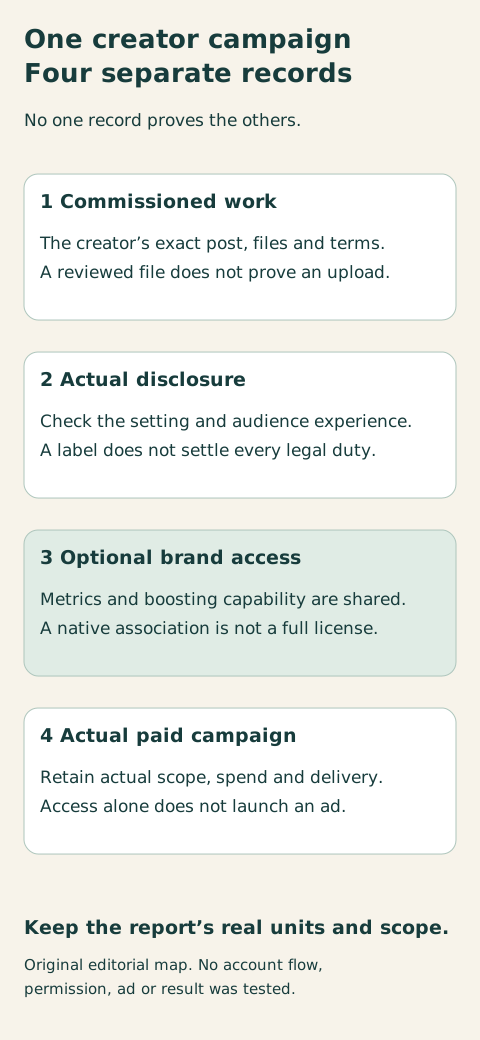
Original editorial boundary map. A sponsored upload does not itself establish optional brand access, sufficient ad-use rights or a delivered paid campaign.
Original visual by Superdirector editorial team. Creation date not recorded.
Read the video report in the right units
Before publication, agree which report the creator or brand will provide and when. At readout, keep the video, format, actual metric label, observation date, selected window and organic/paid scope. If a report is unavailable or a demographic field is limited, retain the gap. Do not substitute zero or guess a private audience distribution from comments.
YouTube’s current counting guide dates starts-based public views across Shorts, long-form and live streams to August 24, 2026. Its Shorts guide separately documents the March 31, 2025 starts/replays change and retains Engaged views for viewers who chose to continue watching. Preserve the actual field and period: a public start, engaged viewing, a unique-viewer estimate and a sale are different observations.
The counting guide also distinguishes billable Google Ads TrueView views from YouTube public views contributed by ads. Do not apply one paid-ad definition to every public count or subtract an unrelated ad-report total from a video’s public number. The linked creator-comparison worksheet gives the broader metric-matching method.
Where brand access is shared, its help page lists video-level metrics and marks which split organic from paid. That is not a promise that every field will be available, complete or comparable in your account. Retain the source report and any actual split; do not label a later mixed-distribution total as organic performance.
For the fictional roll, the decision might be whether the video explains the verified pocket-fit question and whether the agreed destination records show relevant visits. A tracked route supports an association under its actual measurement rules, not proof the creator caused every order. Reconcile the work and payment records, then decide whether to repeat, change the brief or obtain missing evidence. There is no measured result in this example.
Sources, method and limits
We read current full primary page text on November 5, 2026: the YouTube creator landing page and March 2026 announcement; Google Ads Creator Partnerships and boost help; YouTube branded-content, label, access, link, audience and view-counting help; and FTC Disclosures 101. The public Think with Google playbook landing page was also read, but its linked full guide was not. A 41-word community-shell capture was excluded.
We studied retained text and raw HTML structure, not source images, mobile layouts, private accounts or a native campaign. The format table, storage-roll example, diagram and manual card are original editorial instruction. No creator was hired, disclosure/account path tested, permission granted, ad launched or campaign result measured. Superdirector publishes the guide.