How-To Guide
How do brands pay influencers on Instagram?
Follow a creator invoice through available payment routes, U.S. form questions and actual transfer evidence, keeping labels and payment states separate.
By Bell Chen, founder of Superdirector — how the analysis works.
At a glance
How do brands pay influencers on Instagram?
For a brand-funded deal, match the actual agreement and invoice, confirm the payee/amount/currency and agreed due condition, then use an available bank/payment-service or marketplace route. Resolve applicable country/entity documentation with the responsible owner and retain the actual transaction or release/receipt evidence. A label, invoice, pending request and completed payment are different records.
- Use the real agreement and invoice; no standard fee, split or timing is supplied.
- Check route/country/entity conditions and actual quoted fees or conversion.
- Funding, invoice activity, platform release and recipient receipt remain distinct.
Match the invoice to the actual agreement
For a brand-funded Instagram collaboration, start with the actual payer, payee and accepted work. Confirm the amount/currency, invoice reference, agreed payment basis and due event/date, then the method both parties can use. The practical job is moving that obligation through a real payment route and retaining its evidence; a fee benchmark cannot perform it.
This guide covers how brands pay Instagram influencers after the work and payment basis are known. Use the real terms for amount, due condition and any split. A fee, product benefit and earned affiliate commission can coexist, but each must keep its own basis and record.
| Invoice/agreement check | What to establish |
|---|---|
| Parties | The contracting payer and correct payee, including whether a company/representative is receiving the payment |
| Work/reference | The actual content/service, campaign or agreement reference and invoice number/version |
| Money | Amount and currency, included charges, any separately agreed expenses and the fee/FX treatment that affects what is received |
| When it becomes payable | The actual agreed event/date and its evidence; do not insert a standard timing rule |
| Destination | The payee’s confirmed route and privately held payment instructions, not just their public Instagram handle |
| Owner | Who resolves a disputed invoice, changed details or incomplete tax/documentation question |
Collabstr’s sample-contract commentary separates work, payment and invoicing fields. Its sample amounts, advance, late fee and dates are not a market norm and are not adopted. Resolve the real terms first; the agreement guide supports that separate question.
The payment handoff card and blank CSV are manual indexes to existing agreement, accounting and provider evidence. They do not create invoices, calculate tax, connect to a bank or send money. Keep the actual financial records authoritative.
Choose a route the two parties can actually use
Bank transfers, payment-service invoices and marketplace orders are different routes. Check country, currency, payee/entity eligibility, verification, available funding method, displayed fees and the intended recipient amount before selecting one. A service that can email an invoice worldwide is not thereby able to settle every transaction worldwide.
| Documented example | What the current primary text establishes | What to confirm for your payment |
|---|---|---|
| Bank-funded transfer through Wise | Its guide lets you select a send amount or recipient-get amount and shows fees/arrival estimates for the funding options. | The actual country/currency route, correct payee details, who bears fees and the amount the creator should receive |
| PayPal invoice/payment | Its guide identifies who is billed and what for, supports invoice links, and says features and fees vary by market. | The actual account/market capability, currency, costs, invoice reference and correct payment destination |
| Collabstr marketplace order | Its order guide describes upfront capture, escrow and release after final content approval. | The accepted order and current platform conditions, any fees and the evidence for funding versus release; not a direct-transfer rule for every deal |
Read the actual Wise transfer guide, PayPal invoice help and Collabstr order guide for those examples. They are not a ranking or a claim that any one is universally available or cheapest. No account or payment was tested here.
Wise’s From entry deducts fees from the stated amount; its To entry shows the send amount needed to cover fees. This makes “pay the invoice amount” incomplete if one party expects a net receipt and the other enters a gross send amount. Preserve the agreed currency/amount and the actual provider quote rather than inventing a fee percentage or exchange rate.
For a marketplace order, inspect the actual order before making an additional outside payment. Paying the platform and releasing its escrow are different stages of that same route, not two creator fees. A creator-account publication, content approval and payment may also occur at different times under the actual agreement.
Resolve country, entity and required-form questions
Record the payer jurisdiction, payee’s actual legal/entity situation and the nature/location of the work for the qualified person handling tax and accounting. A mailing address, Instagram bio or chosen payment currency is not enough to decide tax status, worker classification, reporting or withholding. The examples below are specific U.S. IRS documents, not a worldwide checklist.
| U.S. document | What its IRS about-page says | Limit of this overview |
|---|---|---|
| Form W-9 | Provides a correct taxpayer identification number to a person required to file an IRS information return, including for income paid. | Do not decide that every creator or every payer must use it from this short description. |
| Form W-8 BEN — individuals | The page describes a foreign beneficial owner of an amount subject to withholding and submission when requested by the withholding agent/payer. | An overseas creator is not automatically a simple W-8 BEN case; the income, status and applicable instructions matter. |
| Form W-8 BEN-E — entities | The page describes foreign entities documenting their status for the stated U.S. provisions. | It is not interchangeable with the individual form or a conclusion that it fits a particular company. |
The W-8 BEN page itself links other forms, including Form 8233 for certain nonresident-alien personal services and W-8 ECI for effectively connected income. That is a reason to have the actual case assessed, not to make a country-only decision tree. The complete form instructions, service-source facts, treaty position, reporting thresholds and a particular worker classification were not assessed for this article.
For another tax jurisdiction, obtain the applicable authority’s current requirements for the actual parties and payment. Do not copy a U.S. form into a non-U.S. process simply because a creator lives abroad. Keep sensitive completed forms with the appropriate finance/tax owner; this card needs a private reference and completion/question status, not a tax number or a copy of the form.
Resolve required documentation and any agreed effect on the payment with the responsible person. A form request, a tax decision and a provider transfer are distinct records. This article gives no universal tax or legal advice and no deduction or withholding amount.
Record the transfer or platform release separately
Keep the provider transaction or platform order reference beside the invoice and record its exact status with a date. “Requested,” “funded,” “held,” “released” and “received” can describe different moments. Do not turn a request into proof that the creator has money, or assume that a status word has the same meaning across providers.
PayPal’s status guide makes the distinction concrete: a pending money request has not been paid by the request recipient; a pending payment can be under review/verification. A completed payment means the transaction succeeded and the money is in the recipient’s PayPal account. That is not the same as a verified later withdrawal to their bank.
PayPal’s invoice-record guidance also allows recording cash, check or another offline payment in invoice details, including a partial payment. Our practical inference is to pair that invoice activity with the evidence from the actual payment method; an invoice record alone does not prove PayPal transferred funds.
| Record | Keep it tied to | Do not substitute |
|---|---|---|
| Invoice or request | Its correct number/version, amount/currency and actual obligation | A Paid Partnership label or a social handle |
| Direct transfer | Provider/bank reference, exact dated state, fees/FX and any unresolved issue | An unsent instruction or an invoice marked by someone manually |
| Escrow funding/release | The same marketplace order and separate funding/release observations | Two expenses for the same creator fee |
| Recipient receipt | The supported amount/currency and date, or a clear unresolved question | A sender’s intention, a payout estimate or platform content approval |
A provider can place a payment on hold, return it or leave it unclaimed. Use its actual record and follow its current resolution process for the specific payment. This page supplies no automatic resend instruction: first establish what happened to the existing transaction so a missing answer does not become a duplicate payment.
Reconcile what the recipient actually received
Compare the actual receipt with the agreed obligation: correct payee, principal amount/currency, any agreed fee/FX treatment, adjustments and the source record. Keep missing evidence unknown. A completed provider payment can support a particular account receipt without proving the creator’s later banking, all related invoices or every tax obligation is complete.
Fictional exercise — no real invoice, creator, bank or payment exists: a brand owes a creator one agreed Instagram-content fee. Its internal note says “payment sent,” but the only attached item is an unpaid money request. The useful next step is to obtain the actual transaction evidence and check the provider state, not mark the fee complete. No amount, due date or payment split is invented in this exercise.
| Separate fictional branch | What the record can show | What needs a next answer |
|---|---|---|
| The invoice includes a manually recorded offline payment | Someone recorded a payment against that invoice | Which actual bank/payment record and amount support it? |
| The brand funded a marketplace order | Funds entered the platform’s documented route | Was the correct order accepted/completed and was payment released under its terms? |
| The transfer quote names a different recipient currency | The proposed conversion and fees in that specific quote | Does the actual received amount/currency match what the parties agreed, and who resolves a difference? |
| The provider shows Completed for a PayPal payment | Under PayPal’s definition, money is in the recipient’s account | Does this match the right invoice/payee/amount? A bank withdrawal remains a different fact. |
Retain the actual agreement/invoice, relevant work or payment-trigger evidence, permitted payee-instruction reference, required-form decision/reference, provider/order receipt and any adjustment. Choose record retention with the actual accounting/legal owner; no universal duration is provided here.
For affiliate compensation, use the sale-to-payout guide before treating reported sales as payable commission. Use the gift/commission component guide when both benefits exist. Those calculations and terms precede settlement; the payment method does not define them.
When enlarged, scroll horizontally to read the diagram.
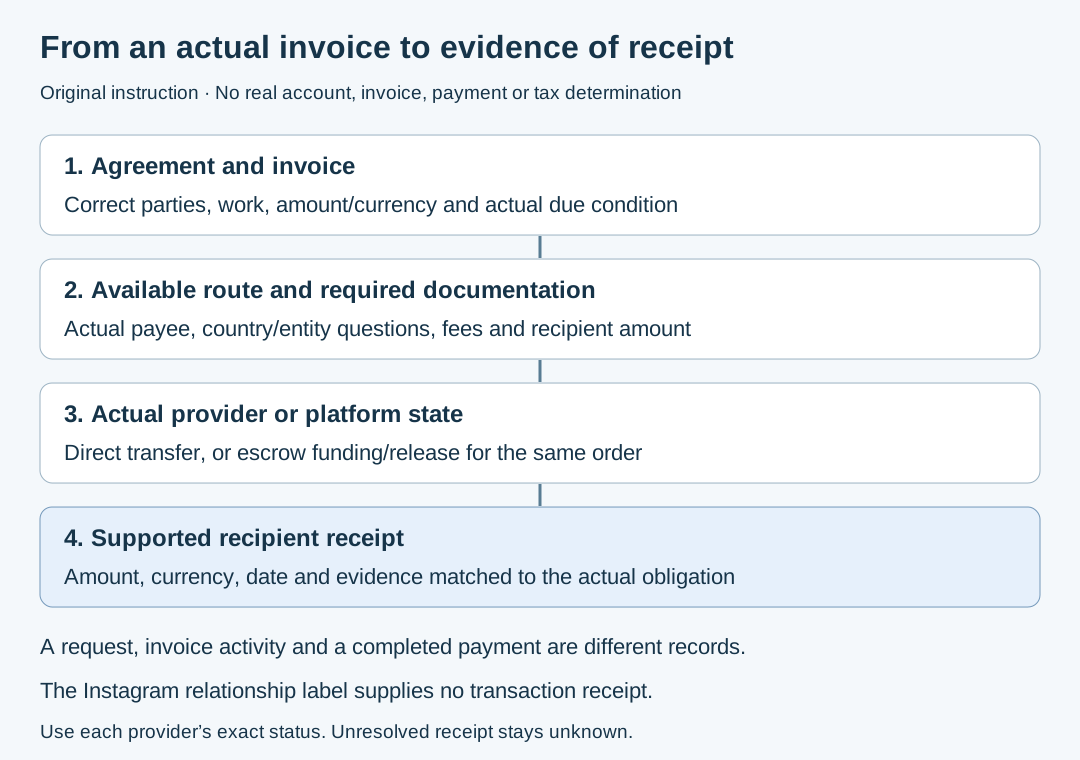
Original instructional diagram; no real creator, invoice, shipment, payment or outcome shown.
Original visual by Superdirector editorial team. Creation date not recorded.
Keep the Instagram label separate from settlement
Instagram’s creator guidance describes the Paid Partnership label for content paid in any form, including noncash benefits. It does not establish that a particular invoice was paid. A label can therefore be relevant to disclosure while supplying no transfer amount, provider reference or receipt date.
This guide concerns the brand-funded collaboration and its actual payment arrangement, rather than Meta’s separate creator monetization products. It does not make a categorical claim about every present or future Meta payment route. Ask which party owes the money and which actual provider or platform record proves what happened.
The relationship can also carry disclosure duties independent of payment completion. FTC staff’s U.S. brochure explains that financial connections extend beyond cash. Whether a post is accurate and appropriately disclosed is a separate content review, not a reason to treat the fee as settled.
Sources and limits
We read complete current PayPal, Wise, Collabstr, IRS, Instagram and FTC texts, plus complete adjacent contract/compensation reference pages, before drafting on November 5, 2026, Pacific time. Source publication/review dates remain distinct from the reading date. Upfluence’s guide discusses compensation choices; it supplies no method or price standard adopted here. Collabstr’s sample contract supplied field separation, not recommended legal clauses.
Only the IRS about-form pages were studied for the tax overview; full instructions and individual applicability were not decided. No processor fees, payment timing or country availability beyond the cited descriptions were tested. The worksheet, diagram and fictional reconciliation branches are original editorial designs. No invoice was sent, account connected, payment made or tax form filed.