How-To Guide
What should an influencer barter agreement include?
Separate gifts from product-for-post work. Use an editable terms worksheet for delivery, honest content, disclosure, rights, loss and cancellation.
By the Superdirector editorial team.
At a glance
What should an influencer barter agreement include?
State the exact product or benefit, required content, parties, delivery, timing, truthful-experience limits, disclosure responsibilities, rights, reporting and failure/cancellation arrangements. Distinguish product exchanged for required work from an unconditional gift with no post owed. Resolve the actual jurisdiction and open terms; a product parcel, label or worksheet does not supply agreement or universal use rights.
- A no-post gift and a product-for-required-post exchange are different arrangements.
- A benefit can require disclosure even without a requested post; honesty and use permissions remain separate.
- The original fictional terms note is a teaching aid with visible unresolved fields, not a ready-to-sign contract.
Decide whether any content is actually owed
An influencer barter agreement should say exactly which product or benefit is exchanged for which required work. Identify the parties, delivery, content, timing, honest-expression limits, disclosure responsibilities, use permissions, reporting and what happens if fulfilment fails. A gifted collab contract needs that clarity even when no cash changes hands.
First choose the actual arrangement. An unconditional gift means you are not requiring a post. A product-for-post exchange means the product is proposed compensation for defined work that the creator must knowingly agree to. Calling both “gifting” hides a different expectation. Write the distinction before asking for an address or shipping anything.
| Actual offer | What your note should make clear | What receipt does not establish |
|---|---|---|
| Unconditional product gift | No required content or favorable review; ask whether the creator wants to receive it | A booked Reel, agreed deadline or permission to reuse content |
| Product for required content | The specified product, actual work and remaining terms for agreement | Agreement to terms that were not disclosed before delivery |
| Product plus paid work or another benefit | Each benefit and deliverable separately, with the actual proposed compensation | That a product-only worksheet covers the extra paid arrangement |
This is an original terms-planning guide for the product-for-post case. It is a terms worksheet rather than a completed agreement. Use the general contract skeleton for the wider agreement structure and the agreement-clause review for broader questions. This page concentrates on the parcel-to-work exchange.
The disclosure question is separate from whether content is owed. FTC staff guidance says a gifted benefit followed by an endorsement can require disclosure even when the brand did not ask for a mention. That does not turn every unsolicited parcel into an agreed content commission. The UK CMA’s brand guidance likewise addresses free gifts sent without a requested return and tells brands to provide clear ad-labelling instructions.
When enlarged, scroll horizontally to read the diagram.
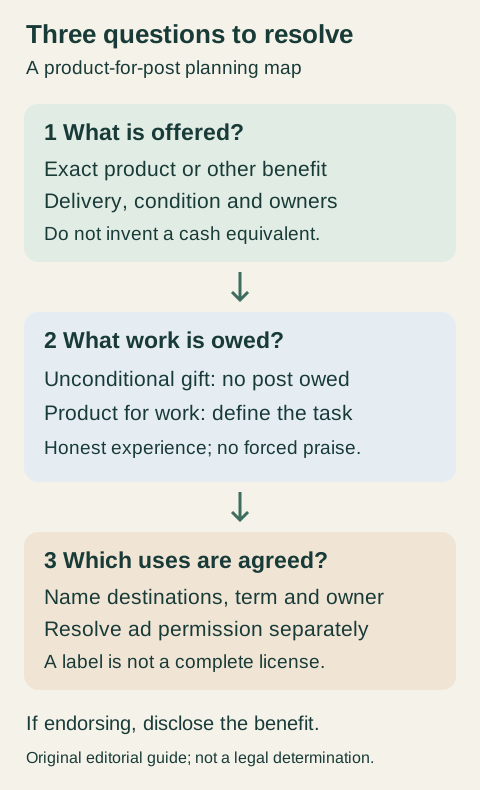
Original editorial diagram. Keep the benefit, required work and intended uses explicit; this is not a legal determination.
Original visual by Superdirector editorial team. Creation date not recorded.
Specify the product, work and decision owners
Start with facts the two parties can recognize. Name the actual parties and contacts, the exact product and condition, what is included, the shipping route and who handles delivery questions. State any cash or other benefit accurately. A retail price is not a legal conclusion about fair compensation, tax treatment or what a creator should accept.
- Describe the required account publication separately from draft files, raw footage, still images or reports. State the format, count, content task, dates or dependencies, and any agreed availability period.
- Give product facts and safe-use information to the person making the content. Ask for an actual demonstration only when the creator has received and tried the product.
- Name the creator contact and one brand feedback owner. State what is reviewed, the included revision work, and how a changed brief will be discussed.
- Write the reporting source, named fields, observation time and recipient. Product delivery, a saved draft, publication and reported audience activity are different evidence.
A useful product-for-post note does not demand that a creator “love” the product, promise a five-star review or repeat an unsupported claim. Define the requested task while preserving honest experience. If that task becomes unsuitable after receipt, the agreement needs an exception route rather than pressure to invent praise.
FTC staff says an endorser cannot describe experience with an untried product or falsely praise something they thought was terrible. Claims needing proof also need the advertiser’s support. These are U.S. endorsement principles with the scope described by the source, not a universal law of every country or a complete review of the actual product category.
Keep legal and operational owners distinct where necessary. The person scheduling a parcel may not own product claims, rights or cross-border charges. Identify who can settle each unresolved term, and retain the actual agreed version. A friendly DM, creator follow or delivered product does not answer those unknowns.
Read the fictional product-for-post terms note
Everything in the following illustration is fictional. It is a nonbinding teaching example of decisions to resolve, not an offer, accepted contract or legal instrument. FolioLoop and Ren are invented. No product was shipped, creator contacted, contract tested or result observed. The deliberately unresolved fields show why this example is not ready for actual use.
| Term | Original fictional illustration |
|---|---|
| Parties and version | Fictional brand FolioLoop and fictional creator Ren; working note v1, November 5, 2026. Actual legal identities, authority and governing jurisdiction unresolved. |
| Exchange | One specified desk tray in exchange for one agreed Instagram Reel. No cash fee in this illustration. The parties must knowingly accept that exchange; no claimed fair-market equivalent. |
| Product | One graphite desk tray, model DT-1, new and complete. Actual specifications, warnings, contents and suitability supplied by the fictional brand before agreement. No substituted item without discussion. |
| Shipping and address | Brand arranges and bears outbound shipping in the illustration. Creator supplies a delivery address privately only after agreeing to receive the product. Cross-border charges and return arrangements unresolved. |
| Receipt and safe trial | Illustrative arrival November 16, 2026; confirm actual condition and receipt. Safe-use information is required. Receipt starts the agreed trial period, not a duty to make an untried claim. |
| Required work | One 20–35 second vertical Reel on the specifically agreed creator account, demonstrating desk organization from actual use; one draft for fact/disclosure review. These are proposed creative specifications, not Instagram minimums. |
| Opinion and product claims | Creator gives an honest account of actual experience, with no promise of praise. Brand supplies support for requested factual claims. If the product cannot be used safely or does not suit the agreed demonstration, discuss a change or cancellation; do not fabricate a favorable review. |
| Proposed dates | Draft November 26, brand consolidated response November 28, intended publication December 1, all 2026 at 18:00 UTC. These fictional dates remain conditional on usable product arrival and agreement. |
| Review and changes | One named brand owner consolidates factual/disclosure feedback. A new concept, expanded deliverable or delayed product triggers a revised discussion; extra work is not silently included. |
| Disclosure | Identify the product benefit clearly in the content and apply the relevant platform label and market requirements. Actual wording, placement and reviewer to be agreed; no universal compliance formula supplied. |
| Publication evidence | The correct account and public URL, with the agreed version and timing. One Reel is one publication, not a parcel plus a draft plus a Reel counted as three posts. |
| Reporting | One creator-provided capture of the agreed Reel metrics seven calendar days after actual publication, naming capture time and native field labels. Not account login, customer data or a sales guarantee. The exact available fields must be confirmed. |
| Ownership and use | Ownership and any license remain unresolved. This illustration does not grant reposting, website, email, editing, raw-file, paid-ad or partnership-ad use. Describe each requested use, term, territory and permissions separately. |
| Lost or damaged parcel | In this illustration, brand handles the carrier inquiry for loss before delivery; discuss replacement or cancellation and new dates. No automatic creator fault or obligation to post about an unavailable product. Loss after receipt and any return costs still need agreed treatment. |
| Cancellation and remaining product | Name who notifies whom, how unfinished work is treated, and whether a received product is kept or returned at whose cost. No invented penalty, automatic repayment or universal right to terminate is stated. |
| Owners and unresolved terms | Brand contact, creator contact, rights owner and appropriate local adviser resolve identity, jurisdiction, tax/import, safety, cancellation and use questions before relying on an actual agreement. |
The schedule describes a draft ten calendar days after the illustrative arrival, two days to the proposed response and three further days to intended publication. A late, damaged or unsuitable item changes the dependency; it does not magically create the missing opportunity to try the product. Resolve the real dates together instead of retaining the fictional deadline.
The seven-day metric capture is an editorial example of a reporting term, not a universal best window or a promise that every Instagram account offers every field. Confirm what the creator can actually share. Record the public post independently; neither a metrics screenshot nor a product receipt replaces the correct published URL.
Use the editable blank terms sheet or blank CSV to replace this illustration with the questions for your own arrangement. They are manual local teaching aids. They do not send, sign, save automatically, calculate tax or determine enforceability.
Resolve disclosure and use permissions separately
Write the relationship and intended use in plain language. A content obligation, a disclosure and an advertising permission answer different questions. A product benefit can require a visible relationship disclosure; the platform label does not itself describe the deliverable or supply a complete license.
For relevant U.S. endorsements, FTC staff guidance places the disclosure with the endorsement, calls for in-video disclosure for video endorsements, and warns against vague “collab” shorthand and assuming a platform tool alone is enough. It also explains U.S. applicability when effects on U.S. consumers are reasonably foreseeable, including posts from abroad. Other laws may apply; the parties’ location alone is not a complete jurisdiction analysis.
Instagram’s branded-content guidance says content paid in any form needs its Paid Partnership label and explicitly includes non-money benefits from business partners. It separately says the creator must give permission before businesses can promote the branded-content post. Do not describe adding the label as consent to every paid use, or assume the brand can run ads merely because it sent a product.
The UK CMA brand guidance recommends clear, upfront, prominent and timely ad identification, tells brands to check content and to work promptly to correct missing labelling. It is UK institutional guidance and explicitly not legal advice. It does not supply the governing law, ownership or loss terms for your actual deal.
For each proposed reuse, name the content/version, destination, organic or paid purpose, duration, territory, editing and sublicensing expectations, and who can grant the rights. Include any necessary music, third-party appearance or other permissions in the real review. Keep unrequested uses absent from the request rather than hiding them in “all rights included.” Use the usage-rights checklist for that separate scope.
Jurisdiction, tax/import, product safety, capacity to contract and category restrictions remain case-specific. This guide does not decide them or promise that a short worksheet is sufficient. Obtain appropriate local advice when those issues affect the actual transaction.
Agree what happens when the exchange cannot finish
Walk through the failures that would otherwise turn into an argument: no delivery, wrong item, damage, unsafe use, inability to perform, late feedback, canceled launch or an expanded request. State the notification owner, evidence needed, the available discussion and how changed dates, replacement, returns or cancellation are recorded.
| Situation | Question to resolve in the actual terms | Avoid assuming |
|---|---|---|
| Lost before receipt | Who deals with the carrier; replacement or cancellation; who pays and how dates move | The creator received or can demonstrate the product |
| Damage or wrong item | How condition is reported, who arranges a remedy and whether work is paused or changed | A positive usable experience already exists |
| Unfavorable actual experience | Whether a truthful revised task is appropriate or work ends under agreed terms | The creator owes praise because the product has value |
| Cancellation after receipt | What happens to product, unfinished work, approved material and any actual costs | A universal right to keep everything, demand repayment or charge a penalty |
| New use or added content | Who can agree the revised scope and any compensation/permissions | The original product exchange buys unlimited extra work |
Finish with one clear current record: what is agreed, what remains open, who can answer it and which version the parties are discussing. Do not fill a legal or commercial blank with a made-up default. Only the actual parties and appropriate advisers can settle the terms that apply.
The most useful final test is concrete: if the parcel arrives tomorrow, does each person understand what is required and what remains unagreed? If the answer depends on a hidden expectation of praise, another post or future ad rights, rewrite that part before treating the work as arranged.
Sources and method
We read the complete retained FTC Disclosures 101, Instagram branded-content and UK CMA brand-guidance pages before drafting on November 5, 2026, Pacific time. Their benefit/disclosure, truthful-experience and separate-permission distinctions informed the structure. Source publication dates differ from the reading date. We did not adopt unsupported sales claims or a one-size-fits-all legal template.
The examples, worksheet and diagram are original editorial material based on public sources. Full text and HTML structure were read, not source images, viewport layouts or private accounts. Historical keyword research is not a current ranking or citation measurement.