How-To Guide
How to count one creator asset posted to three accounts in a deliverable report
Keep an asset ledger and a post ledger, link each post to its file on a stated basis and report assets and posts as two counts that never swap.
How should a report count one creator asset cross-posted to three accounts?
Report two counts, not one. List each delivered asset once in an asset ledger, identified by the delivery record, and list each public post in a separate publication ledger with its own address, account and capture date. Link each post to an asset only on a stated basis, and label the rest probable, variant or unlinked. Then write assets delivered and posts verified as separate lines against the clauses of the agreement. If the agreement does not define what a deliverable counts, say so and get the deal owner’s written decision.
- One file posted three times is one asset and three posts.
- Identify an asset by the delivery record, not by how a post looks.
- Never use the word deliverable in a report line unless the agreement defines it.
Direct answer
Short answer: keep two ledgers and one link table, and never let a number from one ledger stand in for the other. The asset ledger has one row for each distinct deliverable the agreement names, such as one finished video, listed once however many places it appears. The publication ledger has one row for each public post, with its own address, account, platform and capture date. The link table connects each post to the asset it carries, or marks it “unlinked” when you cannot show which asset it carries. Your report then gives two lines: assets delivered, and posts verified. It does not print “3 videos” when one file went to three accounts.
This is for an agency or brand marketer who has an executed agreement and three public post receipts for what looks like one creator asset, and who has to write a deliverable count into a client report. The decision is narrow: how many of what to report, given what the agreement counts. It does not decide whether the creator owes more work, whether a shortfall is a breach, or what anything should cost. Those belong to the pages listed in the boundary section at the end.
The risk is a quiet one. “Deliverable” can mean a thing the creator makes or a thing the creator publishes, and many agreements use the word for both. If a report adds the three posts and calls them three produced assets, the client may read a production quantity that never existed. If it reports one asset and hides the three posts, the client may think the placements were not checked. Keep the two units apart on the page and the reader can do their own arithmetic. Use the blank count card, the CSV ledger and the asset-versus-publication map to keep the records in one place.
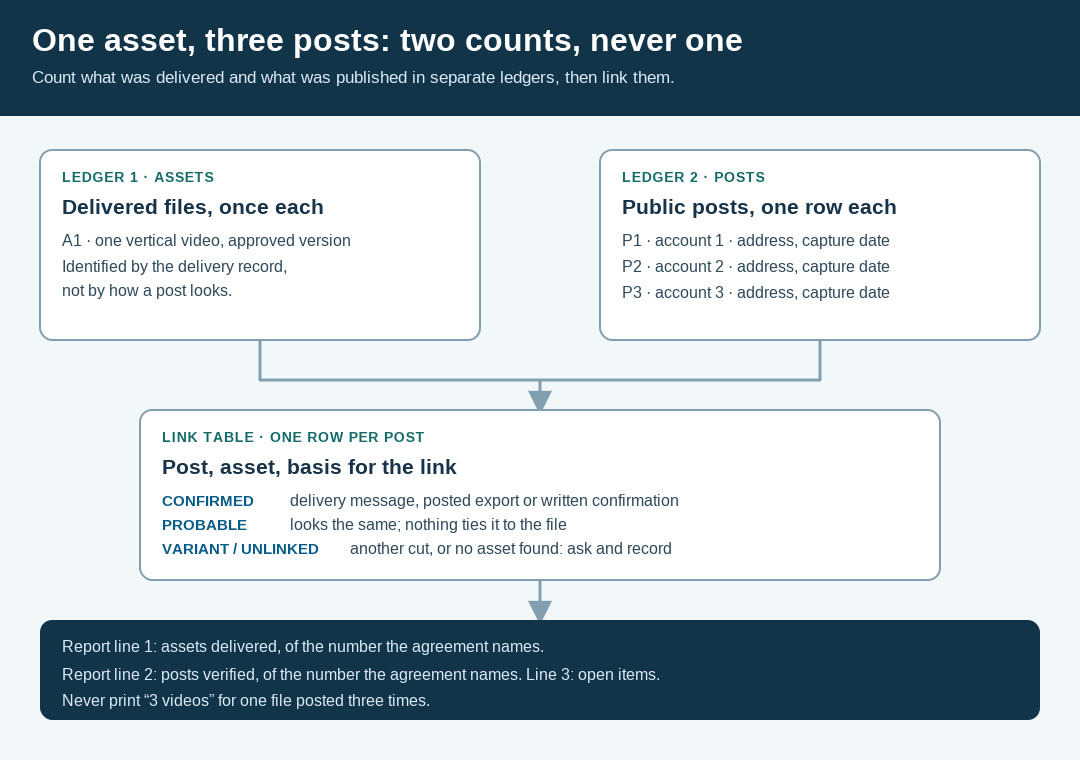
An original editorial map. One asset can have several posts, and the report counts each unit on its own line.
Open the blank count card (HTML)Download the blank count ledger (CSV)
 Superdirector
Make it work for your brand
Find it. Remake it. Post it. Superdirector turns the viral formats in your niche into your brand's carousels, X posts and video scripts, and keeps the calendar full.
Read what the agreement counts
Start with the executed agreement, not the brief and not the chat thread that preceded it. Find every sentence that contains a count and write down the exact words beside the clause number or heading. Then mark what each sentence counts. A sentence like “one 30-second vertical video” counts an asset. A sentence like “posted to the creator’s three accounts” counts posts or placements. A sentence like “three deliverables” counts nothing until you know what the parties meant by the word, and you should record it as unresolved rather than choose a reading that makes your report tidy.
Look next for the places where the two units meet. Does the agreement say the same asset may be posted on more than one account? Does it say a platform-specific edit counts as a new asset, or as the same asset in a different format? Does it name the accounts that must carry the post, or just the platforms? Does a clause pay or measure by asset, by post, or by both? Quote each answer, and write “no clause” where the agreement is silent. Silence is a finding: get the deal owner’s written confirmation before the count goes into a report.
For a deal where the scope of creator work against agency work is in question, the two-party scope table comes first, because it settles who owes which item before you count anything.
List each delivered asset once
The asset ledger holds things the creator delivered, one row each. A row needs a short asset ID that you invent and keep, a plain description (“vertical video, first cut approved”), the file name or handoff identifier from the delivery, the date it arrived, and the version approved. If you hold a fingerprint of the delivered file, record it; the approved cut receipt guide shows how to take one. The point of the row is that an asset is identified by the delivered file or version, not by what a post looks like. Three posts that look alike on screen may be one file, three exports of one edit, or three separate edits. Only the delivery record can tell you which.
Each asset gets one row, even when it appears in three places. If the creator delivered one file and later sent a differently cropped export for another platform, decide with the agreement whether the export is the same asset in another format or a new asset. Record that decision with a reason and the clause you relied on, or “no clause, confirmed in writing by [name] on [date].” Do not decide it from how different the two look.
If the raw footage or project files are in question as separate items, they have their own page: decide whether raw footage is a separate deliverable. Here we count only what the agreement already names.
List each public post separately
The publication ledger holds things that were published, one row each, and every post gets its own row even when the words and media match. Record the post address exactly as it was observed, the platform, the account name and handle it appeared under, the date and time zone of capture and who captured it, and the publication date if the page shows one. Add whether the post was signed in or signed out when you captured it, since what is visible can differ. Where the agreement names the accounts that must carry the post, add a column that says whether this account is the one named, and use the account proof guide to confirm the post is on the account you think it is.
A post receipt proves that a post existed at a captured moment on a captured account. It does not prove which file the creator uploaded, and it does not prove the post is still live. If a platform lets two accounts co-author one post, that is a different case from three separate posts, and it has its own page: verify an Instagram Collab post.
Treat the disclosure on each post as its own observation as well. The FTC’s Endorsement Guides Q&A quotes the principle that a disclosure is needed in each ad that would require one if viewed in isolation, and says the ultimate responsibility for a clear and conspicuous disclosure rests with the influencer and the brand, not the platform. Your ledger does not rule on whether a disclosure is sufficient. It only records, post by post, what you saw, so that a post with a visible disclosure is not mistaken for a sibling post where you did not look. The disclosure check is where that judgment is made.
Link every post to an asset or mark it unlinked
The link table has one row per post, with three fields: the post ID, the asset ID it carries, and the basis for the link. The basis is the important one. Allowed bases are narrow: the creator’s delivery message names the file and the accounts it was for; the delivered file and the posted file can be compared directly, for example because the creator supplied the posted export; or the agreement and the creator’s written confirmation say it. “It looks the same” is an observation about the screen. Record it as such, and mark the link probable, not confirmed until a stronger basis exists.
Give each link one of four statuses. Confirmed means a basis from the list above supports it. Probable means the post resembles an asset but nothing ties them. Variant means the post appears to carry a different cut, crop or caption of an asset, and the agreement or a written confirmation has not yet said whether that is the same asset. Unlinked means you cannot tie the post to any asset in the ledger. An unlinked post is not an error to hide. It may be something the creator posted beyond the agreement, it may carry an asset delivered outside the usual channel, or it may not be the creator’s post at all, and each of those has a different next step.
Then count. The asset count is the number of asset rows whose status is delivered or approved. The post count is the number of post rows you verified under the agreement’s named accounts. The link count by status shows how many posts rest on a confirmed basis and how many do not. If you want to say that one asset reached three placements, say exactly that, because it is a true description of the ledger and it does not turn a placement into a production. Counting a single order that appears in two reports is a similar task with a different object; compare it with counting one order once across code and link reports.
Write the report lines without crossing the units
Write the report in two separate lines, each with its unit, its count against the agreement and its evidence, and then a third line only for what remains open. A first line reads, in the shape of a template: “Assets delivered: [number] of [number named in the agreement, clause]. Posts verified: [number] of [number named in the agreement, clause], on the accounts the agreement names.” A second line lists the open items: variants awaiting a decision, posts with a probable link, posts that are unlinked, and any count the agreement leaves unresolved. Keep the word “deliverable” out of both lines unless the agreement defines it, because the word is the one that lets the two units slip together.
When the agreement counts assets and the client’s expected quantity was one, report one, even if there are three posts. When it counts posts, report three posts and say they carried one asset, because the client may care that three placements were made and may also care that no new production happened. When it counts both, report both without netting one against the other. When it is unresolved, report the two counts and say that the agreement’s own count has not been confirmed, who owns the confirmation, and by when. A report line is not the place to settle a contract question.
Mark what you could not observe as not observed, not as zero: a post that has been removed since capture is a dated observation, and a post you could not open is simply unknown. If a figure is late or missing, the same discipline is in showing missing analytics without zeros.
Walk through a fictional count
Fictional exercise: no real brand, creator, agreement or result was inspected. A made-up brand, Brand A, signs an agreement with Creator Q. Clause 2 says Creator Q delivers “one vertical video.” Clause 3 says the video is posted to “Creator Q’s three accounts” on the accounts it names. Clause 4 uses the word “deliverables” and defines nothing. The agency receives one delivered file, assigns it asset ID A1 and records the approved version. Three post receipts follow, P1, P2 and P3, each on a different named account, each with its own captured address and date.
| Row | Unit | What the record shows | Link basis | Status |
|---|---|---|---|---|
| A1 | Asset | One delivered file, approved version recorded | Delivery message and file identifier | Delivered, approved |
| P1 | Post | Captured address on the first named account | Creator’s message says A1 was posted here | Confirmed |
| P2 | Post | Captured address on the second named account | Looks the same on screen; no message | Probable |
| P3 | Post | Captured address on the third named account, with a shorter caption and a different crop | None yet | Variant |
The report line for the fictional case reads: “Assets delivered: 1 of 1 (clause 2). Posts verified: 3 of 3 on the named accounts (clause 3). Open: P2 is linked to A1 on appearance only; P3 may be a variant of A1, and clause 4 does not define ‘deliverables.’” The agency asks Creator Q two questions, which file went to the second and third accounts, and whether the third is a separate edit. It also asks Brand A’s deal owner whether clause 4 counts assets, posts or both. It writes the answers as written.
If Creator Q says P3 is a separate edit, the agency records A2 as a new row, marks its status against clause 2 with the deal owner’s written decision, and the report’s first line changes only if that decision says a variant counts as another video. If the deal owner says clause 4 counts posts, the report already shows three. The scenario predicts nothing about any real creator, agreement or post.
How this differs from nearby pages
This page counts two units in a report. It does not decide what a creator owes, whether an item is a separate paid line or whether a post meets a requirement. Whether raw footage is its own item is in the raw footage page. Who owns each work item between agency and creator is in the scope table page. Proving which file the client approved is in the approved cut receipt page. Checking an Instagram co-authored post is in the Collab delivery page. Merging two reports that share an order is in the one-order page. What is new here is the asset-versus-publication map: one ledger per unit, a link table with a stated basis, and report lines that keep the units apart.
The FTC’s Disclosures 101 for Social Media Influencers is dated November 2019 and says a disclosure should be placed with the endorsement itself and that disclosures that appear only on an About Me or profile page are likely to be missed. This page uses those two sources only to explain why each post is observed separately. It does not state that any disclosure you capture is sufficient, and it does not give legal advice. If a point turns on the meaning of your agreement or on law, send it to counsel instead of settling it in a report.
Nothing here measures how often one asset is cross-posted, how many accounts are typical, or how a cross-post performs against separate posts. Those numbers are not available to us and are not claimed. We also did not verify any platform’s cross-posting or auto-share feature, so this article says nothing about what a platform does when a creator shares a video to another account.