How-To Guide
When a small team should test in-house video instead of commissioning another creator
Write the test question, cost each route from your own records, list what each can show and check feasibility before you choose in-house video or a creator.
By the Superdirector editorial team. FTC, TikTok and YouTube pages reviewed October 30, 2026.
At a glance
When should a small team test in-house video instead of commissioning another creator?
Choose in-house when the question your next test must answer is about your own content, and commission a creator when it is about an outside person’s work. Write the question first, cost each route from your own records including team hours, list what each route can and cannot show, mark each feasible, not feasible or unknown for this month, then pick one route with a written reason and a condition that would change it. Neither route is cheaper or better by default, and this page states no cost or result.
- Write one question before you compare any cost.
- Cost both routes from your own documents and write unknown where you hold none.
- Choose one route with a dated change condition, or choose no new video.
Direct answer
Short answer: make the video in-house when the question your next test must answer is about your own content, and commission a creator when it is about an outside person’s work. Neither route is cheaper, better or safer by default. Choose by writing five things down in order: the question, the owned costs of each route, what each route can and cannot show, whether each route is feasible this month, and the one route you pick with a condition that would change it. A blank route comparison card, a CSV register and a route map hold the steps.
This page is for a small team, an agency or an in-house marketer who has a buyer objective and one more video to learn from, and who is choosing between asking someone on the team to make it and paying another creator. The decision is narrow: which feasible path gives you the next piece of evidence about the question you wrote. It does not decide which route will sell more, because no result of that kind is claimed anywhere on this page.
The reason to order the work this way is that the two routes answer different questions. A creator’s video shows how an independent person explains a task. A video your team makes shows whether you can explain it. If you compare costs before you name the question, the cheaper route quietly chooses the question for you. If you write the question first, the costs and limits that follow have something to be measured against.
Write the question the next test must answer
Start with the buyer objective and where it came from. Write it as something a buyer needs to understand or be able to do, with the source and date: a support thread, a sales call note, a product page you own. Add the decision the next test feeds, such as “whether to brief a second creator” or “whether the first-screen message is clear enough to hand to anyone.” A test with no decision attached produces a video and no choice.
Then write one question as a sentence ending in a question mark. Good questions are about a single thing you can observe, for example “Can a first-time viewer follow the steps in one short video?” or “Does an independent creator’s own framing of this task differ from ours?” A question such as “Which route performs better?” is not one question. It mixes who made the video, what it said and who saw it, and no single test can separate those.
Keep the question, the objective and the decision on the card before you open a quote or a calendar. If you change the question later, start a new card instead of editing the old one. The same discipline is used for choosing an objective you can measure; here it is applied to the route rather than the metric.
Price each route from your own records
List the cost lines for each route from documents you hold, one line per cost, each with its source and date. Write “unknown” where you have no document. Do not fill a line with a guess, and do not copy a figure from an article or a forum; a number that is not yours is not a cost of yours. This page gives no price for either route and does not say that one is lower.
The lines differ by route, and the in-house route has costs that are easy to leave out because nobody sends an invoice for them. The table shows the kinds of line to look for. Which of them apply, and what each is worth, is for your own records to say.
| Cost line | Creator route | In-house route | Where the figure comes from |
|---|---|---|---|
| Cash to the maker | The quote or agreed fee, once you have one | Usually none, unless you hire freelance help | Quote, agreement or invoice |
| Team hours | Briefing, answering questions, reviewing cuts | Writing, filming, editing, reviewing | Calendars or timesheets you already keep |
| Product or access | Sample, account or login you provide | Sample or account you already hold | Your stock or account records |
| Tools and equipment | Normally the creator’s own, which may be inside the fee | Software seats or gear you pay for or already own | Subscriptions and asset register |
| Rights and reuse | Usage terms you agree, which may carry a fee | Reuse of your own work, subject to any music or footage you licensed | Agreement, licence or policy |
| Delay cost | Time to find, agree terms and wait for delivery | Time before a team member is free | Your own schedule |
Two notes keep the lines honest. First, hours belong on the card even when they cost no cash, because they are the cost that the in-house route is most likely to hide. Record them as hours, with the person’s role, and leave any conversion to money to your own finance rules. Second, a line that is bundled, such as a fee that includes usage terms, should be written as one line that says it is bundled, not split into guessed parts. The ledger method in reporting creator campaign cost from your own ledger is for reading a finished campaign; this step is the forward-looking version that stops before any ratio.
List what each route can and cannot show
For each route, write what it can show about the question and what it cannot. This is the step that most often settles the choice, because a route can be cheap and still be unable to answer. Use only what follows from how the route works. Do not write a result, a rate or an expectation about audience reaction.
| Question type | Creator route can show | In-house route can show | Neither shows by itself |
|---|---|---|---|
| Can the task be explained clearly? | How one independent person chose to explain it | Whether your team can explain it, and where your own wording gets stuck | Whether a stranger would understand it |
| How does an outside voice frame it? | The creator’s own framing, as observed in the finished work | Nothing about an outside voice, because the voice is yours | Whether that framing suits your buyer |
| Is your product demo accurate? | What the creator shows, which you then check against your product | What you show, which you control and check | Whether viewers act on it |
| What do we learn from the analytics? | Only what the creator shares or authorizes you to see | Your own channel’s analytics, to the extent the platform provides them | Anything the platform does not report |
The last row matters for the evidence you will hold afterwards. When you post from your own account you can read that account’s analytics, although the platform may still limit some data. YouTube’s Get started with YouTube Analytics help page says some data, such as geography, traffic sources or gender, may be limited. A creator’s analytics, by contrast, sit with the creator unless they share them. So write on the card which first-party data you would hold after each route, and mark the creator route “only what they share” until you have an agreement that says more.
A short question to ask of each route is: if this video exists and the result is disappointing, what would I still know? If the answer is “nothing, because the route could not show the thing I asked,” that route cannot answer your question however low its cost. The limits of any single test are covered in what one creator post test can conclude, and they apply to both routes equally.
When enlarged, scroll horizontally to read the diagram.
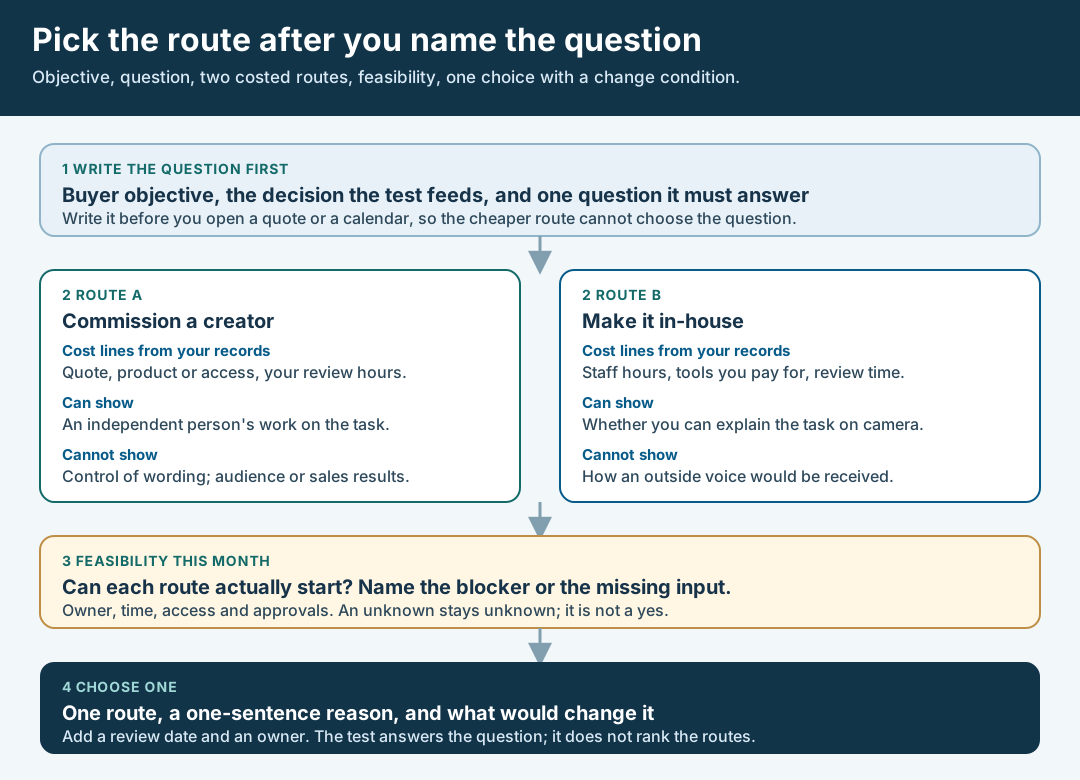
An original editorial map. The question comes first, so the cheaper route cannot choose it.
Original visual by Superdirector editorial team. Creation date not recorded.
Check what is feasible this month
Now ask whether each route can start this month, and write the answer as yes, no or unknown with the blocker named. Feasibility is about owners, time, access and approvals, not about preference. A route with a named owner, a free calendar, the product access it needs and a person who can approve the result is feasible. A route that is missing any of those is not yet, and the card should say which one.
For the creator route, the first blocker is usually a contact and an agreement, not the video: you need a candidate whose own work you have looked at, a route to reach them and terms you can write down. If that is the open question, the marketplace or manual sourcing guide is the next page. If you later want to run a creator’s post as an ad, the authorization has its own term. TikTok’s help page on Spark Ads for Smart+ campaigns lists using your own linked TikTok account as one identity option and authorized accounts or posts authorized with video codes as another, and it says a creator sets the authorization duration in the post’s ad settings, from 7, 30, 60 or 365 days. Treat that as a reminder to ask about the term before you pay for the video, not as a statement about any other platform.
For the in-house route, check who is on camera and who owns the posting. The FTC’s Disclosures 101 for Social Media Influencers, dated November 2019, says a material connection to a brand includes a personal, family or employment relationship, and advises disclosing it. The FTC’s Endorsement Guides question-and-answer page says that whether an employee may mention the company’s products on social media can depend on company policy, that an employee who does should disclose the employment relationship, and that listing the employer on a profile is not enough. So if the plan is for a colleague to post from a personal account, put “disclosure and company policy” on the card as an open question. This page does not state any rule for what a brand’s own channel must say, and it is not legal advice; send that point to counsel.
Mark unknown honestly. “Unknown” is the right entry when you have not asked, and it keeps a hopeful guess from turning into a yes. A route that is unknown on its blocker is chosen only if you add a dated step to find out.
Choose one route and write what would change it
Choose one route and write the reason in one sentence that refers back to the question. For example, “We chose in-house because the question is whether our own steps are clear, which only our own draft can show.” Write who chose it and when. If the honest result is that neither route is feasible this month, you have a third option on the card: no new video, and use the evidence you already hold. That is a valid choice, and it is cheaper in hours than a rushed test.
Then write the change condition: a fact you could observe, with a date, that would reverse the choice. “If the in-house draft cannot be followed by a colleague who has never used the product, brief a creator next” is a change condition. “If things change” is not. The condition is what stops the card from becoming a justification written after the fact.
Set a review date and an owner, and keep the card with the question, the costs, the limits, the feasibility answers and the choice together. Do not attach a forecast of results. If you run both routes on the same objective, remember that the two videos will differ in many ways at once; the post-test conclusions guide explains why you should not read them as a clean comparison. If a test already ran and underdelivered, turning a weak campaign into one next test is the better starting page.
Walk through a fictional comparison
Fictional exercise: no real brand, creator, quote or result was inspected, and no figure appears because none exists. A made-up scheduling app, Brand A, wants to know whether new users can move a booking to another day. The buyer objective comes from a made-up support note dated before the test: users ask how to rebook. The decision is whether to hand the rebooking explanation to a creator brief. The question: can a first-time viewer follow the steps to move a booking from one short video?
Route A, a creator: cost lines are the creator’s fee (unknown, no quote yet), two review rounds of team hours and a test account. It can show how an independent person explains the steps. It cannot show whether Brand A’s own wording is clear, and the analytics would be only what the creator shares. Route B, in-house: cost lines are one team member’s filming and editing hours and one reviewer’s hours, with the phone and software already owned. It can show whether the steps can be explained and followed. It cannot show how an outside voice would frame them.
Feasibility: Route A is unknown, because no candidate has been looked at and no contact route exists. Route B is yes, because a named owner has the time and the test account. Brand A chooses Route B, because the question is about whether the steps can be followed, and writes the sentence “our own draft can show whether the steps are clear.” The change condition is “if two colleagues who have never used the app cannot follow the draft, brief a creator next.” The review date is set. The scenario predicts nothing about any real route or result.
What this page does not decide
This method chooses a feasible next evidence path for a question you wrote. It does not tell you which route performs better, how much either should cost or whether a video will convert. No cost, rate, benchmark or result is stated here because none was observed, and search demand for this topic is not available to us, so none is claimed.
Other pages cover the neighbouring decisions. Finding creators once you have chosen the creator route is in the marketplace or manual sourcing guide, which compares ways of searching for creators and does not compare a creator with your own team. Adding up what a finished campaign cost is in the spend ledger guide, which reads past spend and divides by an outcome, where this page costs two candidate routes before any money moves. What one post can and cannot conclude is in the post test conclusions guide, and what a small test can teach is in the small creator test guide; both read a result after it exists, while this page chooses the route before it does.
Disclosure, rights and employment questions turn on law, platform terms and the meaning of your agreements. The FTC and platform pages cited here were read on the dates above and describe only what they state. Check creator disclosure in the caption and video for the disclosure check, and send anything that turns on law or on company policy to counsel.