How-To Guide
What a native-language creator should receive before adapting your product script
Number the script, tag each line locked, adaptable or ask, attach a source or question, and set what the creator returns before adapting it for a new market.
By the Superdirector editorial team. FTC endorsement Q&A, FTC substantiation policy statement, 16 CFR 255.1 and W3C pages reviewed October 30, 2026.
At a glance
What should a native-language creator receive before adapting a product script for another market?
Send a source packet, not a loose script. Number every line of the source script, then tag each line locked (a product fact, claim, price or disclosure whose meaning must survive), adaptable (tone, hook, example, rhythm) or ask (depends on the target market). Attach a fact, source, product version, date and owner to each locked line, and one written question to each ask line. Tell the creator what to return for every line: the adapted line, what it means in the source language, a change flag and any question. An owner reads the returns against the locked lines before filming.
- Give every sentence an address so each question and decision points at one line.
- Lock facts and claims, free the voice, and ask about market-dependent details.
- Treat the creator’s own meaning statement as a flag, not as an independent review.
Direct answer
Short answer: give the creator a source packet, not a loose script. The packet has four parts. First, the source script with every line numbered. Second, a class on each line: locked (a product fact, claim, price or disclosure whose meaning must survive), adaptable (hook, tone, example, rhythm) or ask (depends on the target market). Third, for each line, either the source behind the fact or the question for the creator. Fourth, a return sheet that says what comes back for each line: the creator’s adapted line, what it means in the source language in the creator’s own words, a change flag and any question. An owner then reads the returns against the locked lines before anything is filmed.
This is for an agency or brand marketer who has an approved script in one language and a creator who writes and speaks natively in another. The decision is narrow: what the creator needs in hand to adapt the script without silently changing a product fact, and what you need back to see what changed. It assumes you have already settled which languages the product supports. It does not teach translation craft, and it does not rank creators.
The reason for the structure is practical. “Please adapt this for our Language B audience” gives the creator no way to tell a sentence they may rewrite from a sentence that carries a promise, and gives you no way to point at the sentence that changed. Use the blank packet card, the CSV register and the packet map to keep the packet in one place.
Number every line of the source script
Split the approved source script into lines, one beat or one claim per line, and give each a short ID: L1, L2, L3. A sentence that makes two claims becomes two lines, because the two may need different treatment. Include everything a viewer will meet in words: spoken lines, on-screen text, the call to action, any price or offer wording, and the paid-relationship disclosure. If a line was only ever meant to be said aloud and never shown, note that too.
Next to each line, write what is on screen while it is said. A line can be accurate as words and wrong against the picture, and a creator adapting the words needs to know what the viewer will be looking at. If the footage shows the product, the software proof screens guide covers which states to capture. Here you only record what each line sits over.
Label the packet itself: a packet name and version, the product version the script describes, the date, the source language and the target language, named the way you will name it everywhere. Without a version, a question asked next week may be answered against a script that has since changed. Keep the original numbered script unchanged once it is sent; edits become a new packet version.
Tag each line locked, adaptable or ask
Give every line exactly one class. The class tells the creator what they may change, and it tells you what to check when the line comes back.
| Class | Test | The creator may | The creator may not |
|---|---|---|---|
| Locked | The line states a product fact, a claim, a price, an offer, an availability statement or the disclosure | Reword it so it reads naturally; flag a problem | Change what it promises, add a number, or soften or strengthen the claim |
| Adaptable | The line carries a hook, tone, example, rhythm or joke and states no fact | Rewrite it freely in their own voice, keeping its purpose | Slip a product claim or a first-person experience into it that the packet did not contain |
| Ask | The right wording depends on the target market, such as a number, date, currency or local example | Say what viewers in that market would expect, and propose a form | Decide the figure or the fact; the owner decides |
When you cannot decide between locked and adaptable, start with locked. It is cheaper to free a line later than to find that a creator’s improvisation carried a claim. Lines that express an opinion or experience need care: the FTC’s endorsement rule says endorsements must reflect the honest opinions, findings, beliefs or experience of the endorser, so an adaptable first-person line is only adaptable if the creator can truthfully say it. A creator who has not used the product should not be handed a line that says they have.
Why bother with classes at all? The same rule says an advertiser can be liable for a deceptive endorsement even when the endorser is not, and that advertisers should give guidance to endorsers, monitor their compliance and take remedial action, while stating that this is not a safe harbor. The FTC’s endorsement question-and-answer page says advertisers need reasonable programs to train and monitor the members of their network. A packet that says which lines carry facts is one concrete form of guidance. It does not decide how much monitoring is enough, and this page does not either.
The packet map shows the four steps in order, and the table above is the test to run on each line.
When enlarged, scroll horizontally to read the diagram.
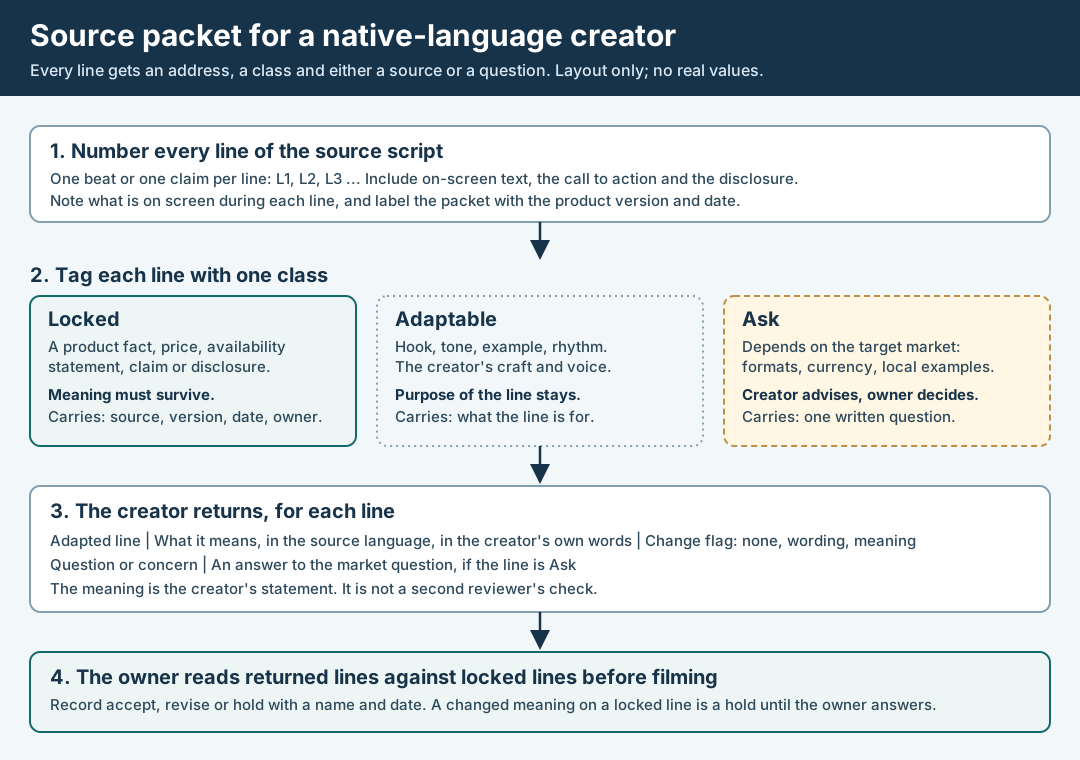
An original editorial flow. Every line has an address and a class, and every return ends in a recorded decision.
Original visual by Superdirector editorial team. Creation date not recorded.
Attach a source or a market question to each line
A class alone is not enough. Each locked line gets a short record: the fact in one sentence, the source (a screen you opened, a help page, a release note or a written answer from the owner), the product version, the date you read it and the person who owns the fact. If two people disagree about a fact, resolve it with the versioned product facts guide before the packet leaves your hands. A locked line with no source is a hope, and the creator will treat it as settled.
Each ask line gets one written question. W3C’s internationalization guidance describes localization as adapting a product, application or document content to the language, cultural and other requirements of a specific target market, and it lists conventions such as numeric, date and time formats and the use of currency among the things that vary. Those are exactly the details a creator can advise on and you cannot guess. Write the question so it has a checkable answer: “How would viewers in this market expect a monthly price to be written next to the plan name?” is better than “Does this feel right?”.
Two limits apply. A creator’s answer about their market is their knowledge, recorded as theirs; it does not tell you where a particular audience lives, and the partial audience geography guide covers that separately. And a question about the market is not permission to change a fact. If the answer is that a different figure would read better, the owner decides whether the product offers it.
Adaptable lines need only a one-phrase purpose, such as “open with the annoyance of back-and-forth emails”. The purpose is what must survive when the creator replaces the words.
Set what the creator sends back for each line
Ask for the same five things on every line, in a sheet that keeps the line IDs. First, the adapted line in the target language. Second, what it means in the source language, in the creator’s own words, written plainly rather than as a word-for-word gloss. Third, a change flag: none (same words in the target language), wording (rephrased, same meaning) or meaning (says something different or leaves something out). Fourth, any question or concern about the line. Fifth, for ask lines, the answer to the market question.
The meaning statement is what lets an owner who does not read the target language see a change. It is also easy to over-read. It is the creator’s own account of the line, so it can only show what the creator intended. It cannot show how another reader in that market would take the line, and it should not be called a review. If a line is high-stakes, such as a price, an availability statement or the disclosure, you may choose to add a second native reader who sees only the adapted line and writes what it means, then compare that with the source. That is our suggested method, not a requirement from any source we read.
Tell the creator in the packet that a flagged meaning change on a locked line is welcome, not a failure. A creator who says “this cannot be said that way here” is giving you the information the packet exists to collect. Also tell them what happens next: you will answer in writing, and nothing is filmed until the lines are decided. Ask them to keep their rejected wordings in the sheet so a discarded phrase does not come back in a later edit.
Walk through a fictional packet
Fictional exercise: no real brand, product, creator or result was inspected. A made-up scheduling tool, Product P, sends Creator Q a six-line source script to adapt into Language B. The agency numbers the lines, labels the packet with the product version and date, and tags each line.
| Line | Source line (paraphrased) | Class | What the packet attaches |
|---|---|---|---|
| L1 | Booking a meeting should not take five emails | Adaptable | Purpose: open on the annoyance of back-and-forth |
| L2 | Product P shows open times to everyone you invite | Locked | Fact, help page, product version, date read, owner |
| L3 | It works with your calendar app | Locked | Fact limited to the apps on the dated integration list |
| L4 | The monthly price shown beside the plan name | Ask | Question: how are prices written next to a plan name here? Owner supplies the figure |
| L5 | Try it before you decide | Locked | Fact: the offer as written on the sign-up page, with its date |
| L6 | Paid-relationship disclosure | Locked | Wording in the video’s language, checked by the owner |
Creator Q returns the sheet. L1 is marked wording, with a meaning statement that matches the purpose. L2 and L5 are none or wording. On L3 the creator writes: “Viewers here mostly name a different calendar app than the first one in your list; saying ‘your calendar app’ could suggest all of them work.” That is a question, not a change, and the owner now checks the integration list instead of arguing about tone. L4 comes back with the creator’s note on how prices are usually written, and the owner decides the exact displayed form. L6 returns a disclosure in Language B that the creator flags as meaning, because their first draft softened it.
The owner records accept for L1, L2 and L5, revise for L3 (name the apps on the list) and L6 (restore the original meaning), and hold for L4 until the figure is confirmed. The packet becomes a new version, and the creator films nothing yet. The scenario predicts nothing about any real creator or product.
Read the returned lines before anything is filmed
Read the return line by line, against the class. For a locked line, compare the creator’s meaning statement with the source fact. Any line flagged meaning, and any line whose meaning statement differs from the fact, is a hold until the owner answers. For an ask line, record the creator’s answer as theirs and let the owner decide the form. For an adaptable line, check that it still serves its purpose and that it has not picked up a claim, a superlative or a first-person experience the packet never contained.
Give each line one decision: accept, revise or hold, with the name of the person who decided and the date. The FTC’s policy statement on advertising substantiation, dated November 23, 1984, says advertisers must have a reasonable basis for their claims before the ad is disseminated, which is why the decision happens before filming and not after posting. The rule on endorsements also names agencies among the intermediaries that can be liable for creating or spreading endorsements containing representations they know or should know are deceptive. This page does not tell you whether any given line is deceptive.
Then check the other scripts in the same video. Captions, subtitle files, dubbed tracks and on-screen text are separate sentences in the target language, so each goes through the same packet. Check the disclosure in the language of the video: the FTC says the connection should be disclosed in whatever language or languages the endorsement is made. The disclosure check guide covers where it must appear.
Finally, re-version the packet. Write the accepted wording into the next version, keep the old version and the creator’s rejected wordings, and file the packet with the approval record. If the creator later changes a line in the cut, the packet is what you compare it with, as in the approved-cut receipt guide.
What this page does not decide
This page produces a handoff and a record: what the creator was given, what came back, and what the owner decided. It does not teach translation or humor, judge a creator’s fluency, or say whether any adapted line is lawful or persuasive. It does not decide whether a market’s law requires product information in a particular language. Ask counsel for the countries you plan to reach.
Several nearby pages answer different questions. The language-support matrix guide decides which language claims the product can back, per surface; this page starts after that and decides what to hand the creator for one script. The Japanese game-localization review packet prepares a native reviewer to check a developer’s own copy for one game; this page classifies a script’s lines for a creator who adapts it and defines what the creator returns. The Brazilian Portuguese dating-app scripts give sample scripts with English meanings for one product; this page is the reusable packet behind any such script. The versioned product facts guide settles who owns a disputed fact, which this packet then points to.
Nothing here measures whether adapted scripts perform better than translated ones, and no figure on that is claimed. We did not read any standard on translation review, and we make no statement about what one requires. The page is an editorial method for keeping a source fact, a creator’s adaptation, the creator’s account of its meaning and an owner’s decision apart, so that each line in a video rests on its own evidence.