How-To Guide
Your Japanese localization is ready: prepare this review packet before creator outreach
Prepare a native review packet for Japanese game copy, including verified product facts, terminology, playable context and approval fields.
By the Superdirector editorial team.
At a glance
My Japanese localization is ready, but I can’t write Japanese marketing copy. What should I prepare for a native reviewer before creator outreach?
Give a native reviewer a bounded set of factual messages, the playable context and the exact terminology already used in the game. Do not hand over a vague request to “make this sound Japanese.” The useful output is approved copy tied to verified game facts, plus a list of unresolved questions that must be answered before outreach.
Give a native reviewer a bounded set of factual messages, the playable context and the exact terminology already used in the game. Do not hand over a vague request to “make this sound Japanese.” The useful output is approved copy tied to verified game facts, plus a list of unresolved questions that must be answered before outreach.
This guide is for a small developer with a Japanese-localized build but no confidence writing Japanese marketing copy. It deliberately does not supply unreviewed Japanese outreach. The completed packet below uses an invented exploration puzzle game called Paper Harbor. All game facts and reviewer assignments are examples, not claims that a real localization has passed review.
Distinguish localization completion from marketing readiness
A translated build does not automatically supply an accurate store description, a natural creator email or a usable press kit. Each has a different reader and purpose. Your reviewer needs to know whether “Japanese supported” means interface, subtitles, audio or some combination. They also need the product's current state: demo, unreleased full game, paid release or test build.
For Paper Harbor, the example facts are Japanese interface and subtitles, no spoken dialogue, a public PC demo and an unreleased full game. The demo lasts approximately twenty minutes in the team's internal tests, but player times vary. The title's approved display form must come from the project, not be improvised by the copywriter.
Put those facts at the top of the packet. If any is unknown, mark it unknown. A reviewer cannot resolve product scope by choosing fluent wording, and a well-written sentence can conceal an unsupported promise more effectively than an awkward one.
The complete reviewer packet
1. Assignment and boundaries
Purpose: review a short creator-consideration email, a one-paragraph press description, a store-summary draft and on-screen captions for one gameplay clip.
Audience: Japanese-reading creators who actually cover relevant PC puzzle or exploration games. No claim is made about their country of residence or audience geography.
Requested output: final Japanese text; a plain-language explanation of material meaning changes; flagged factual questions; approved terminology list; version identifiers. The developer approves facts. The language reviewer approves language. Neither role silently substitutes for the other.
Not requested: creator discovery, sending messages, promising coverage, making new game claims or negotiating commercial terms.
2. Verified product facts
Game: Paper Harbor, fictional working title; final title form pending project confirmation. Platform: PC for this example; no console or mobile claim. Access: public demo; full game not yet released. Language: Japanese interface and subtitles; no spoken dialogue. Player action: fold paper routes to connect harbor islands, then explore the connected area. Scope boundary: the email should describe the available demo, not promise a total number of full-game levels. Content notes: supplied from the actual reviewed build before use; no assumption that a cozy visual style means no content concerns. Release date and price: unannounced in this example.
3. Terminology and context
Provide the existing approved Japanese string for each recurring object and action: fold, route, island, harbor, undo and restart. Include a screenshot showing the word in context and its internal string identifier. Do not ask the reviewer to retranslate terms from an isolated English list when an approved in-game glossary exists.
Completed decision row: English source term “route”; current Japanese string to be supplied from the approved build; meaning a foldable path between islands, not a travel itinerary; appears in tutorial and store copy; action hold until glossary value is inserted. This is a completed editorial decision even though the missing translation remains explicitly unresolved.
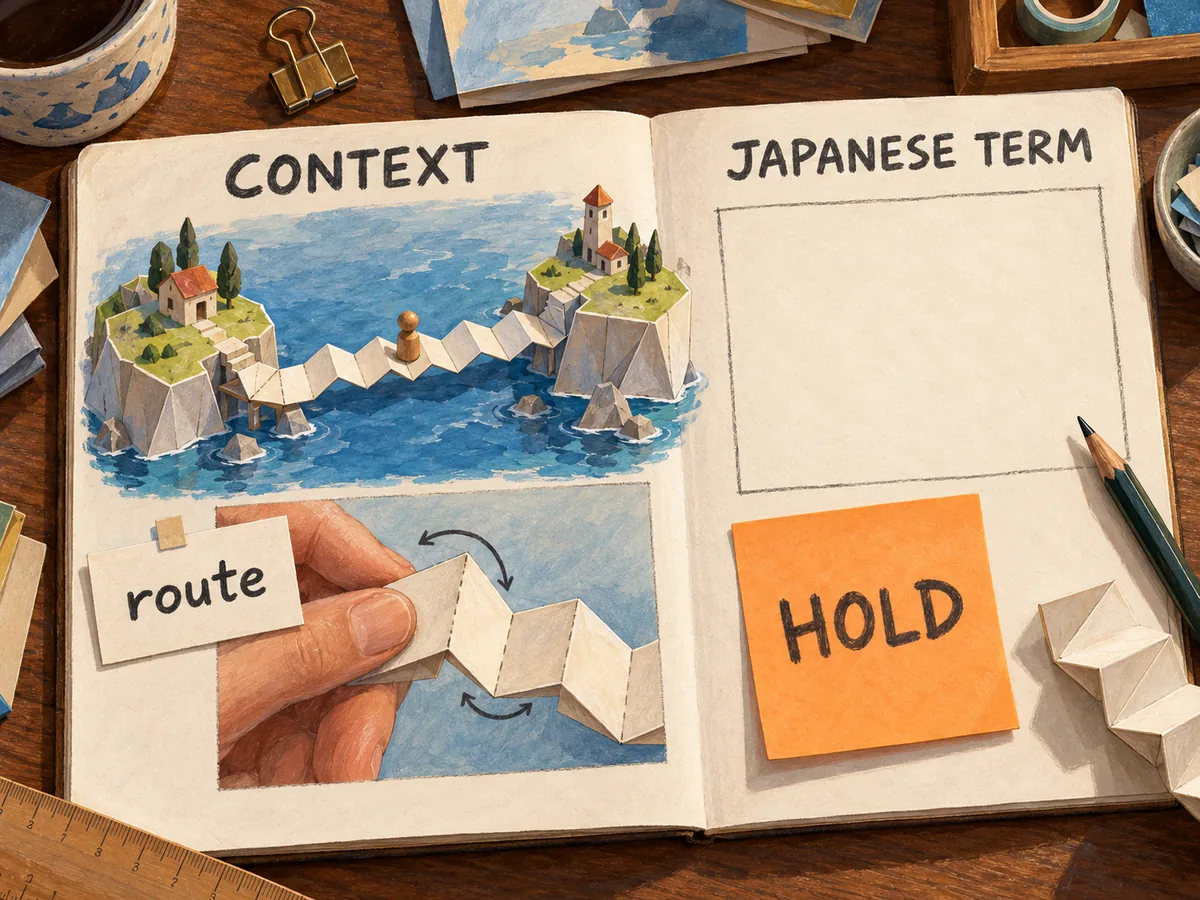
Hypothetical reviewer packet for the invented Paper Harbor example, not game footage or approved Japanese copy. Here, route means a foldable path between islands. The Japanese-term field stays blank and on hold until the approved in-game glossary value is supplied.
AI-generated teaching illustration. The Japanese-term field remains blank and on HOLD until the approved in-game glossary value is supplied.
Original visual by the Superdirector editorial team. Created 2026-10-20.
4. Assets the reviewer can inspect
Supply a short uninterrupted gameplay recording, screenshots of the Japanese interface at normal display size, the current store page, the press-kit draft and a clean text export. Give each file a version and date. Remove private player information, internal credentials and unrelated production notes.
If playable access is available, explain precisely how to reach the relevant scene. A ten-minute navigation burden can turn a language review into avoidable troubleshooting. Include the control instructions and any known limitation that affects review. Do not distribute an unstable internal build while describing it as the public demo.
Source copy ready for review
Creator email source
Subject: Paper Harbor PC puzzle demo for your consideration
Hi [verified creator name],
In your [specific inspected video], you [accurate observation about the creator's play or explanation]. That is why I thought Paper Harbor might be relevant to your channel.
I am the developer. Paper Harbor is a PC exploration puzzle game in which you fold routes between harbor islands. The public demo includes Japanese interface text and subtitles. It has no spoken dialogue.
The demo and current game details are here: [verified destination]. Press materials and content notes are here: [verified destination].
This is an invitation to consider the demo, not a request for guaranteed or positive coverage. The full game's release date and price have not been announced.
Thank you, [developer identity]
Press description source
“Paper Harbor is an exploration puzzle game about connecting islands by folding paper routes. This public PC demo introduces the route-folding interaction and a small harbor area. Japanese interface text and subtitles are included. The full game is still in development.”
Clip captions source
“Choose a route.” “Fold to connect the islands.” “Explore the new path.” “Public PC demo; Japanese interface and subtitles.”
The reviewer should shorten captions for readability without inventing speed, difficulty or scope. If a term does not match the game, resolve the glossary first rather than accepting two competing translations across the clip and build.
Make the review actionable
Use three dispositions: approve; revise for language; hold for factual clarification. A vague “looks good” is insufficient when a missing fact controls the meaning. Ask the reviewer to flag ambiguity between demo and full game, supported language and voice acting, invitation and sponsorship, planned date and confirmed date.
Completed review example: “Approximately twenty minutes” removed from the email because the estimate comes only from internal tests and is unnecessary to the pitch. Developer agrees; the press kit retains a qualified session-length note. This demonstrates a meaningful editorial change, not a claim about Japanese cultural preferences.
Another example: the reviewer asks whether the supplied footage is from the public build. Status becomes hold until the developer confirms. Fluency cannot solve that uncertainty. Record the resolution and update the relevant files together.
Final checks before any outreach
Inspect the Japanese text in the actual layout, not just a document. Check clipping, line breaks, punctuation, title display and caption timing. Have the reviewer see the final exported image or video if text was embedded after approval. A correct text file does not guarantee a correct render.
Resolve the recipient separately. Confirm relevant current coverage and a public submission route. Do not infer nationality from Japanese-language content or use a generic country greeting to replace personalization. A reviewer-approved draft is still not authorization to send it indiscriminately.
The next action is to assemble the fact sheet, glossary and one capture sequence. Send that bounded packet for review before translating a long campaign. One approved, accurate message is a better foundation than dozens of fluent variants built on unanswered product questions.
Reference and evidence boundary
This article provides an original editorial workflow, not a claim about Japanese audience behavior. The batch's source studies did not contain a task-specific Japanese-review source establishing regional conversion practices. No cultural stereotype, creator recommendation, legal requirement or platform-specific localization rule is asserted. Steam distinguishes store-page localization from in-game localization, and identifies interface, subtitles and full audio separately. That supports keeping these facts distinct in your brief. Steamworks localization documentation. The documentation does not establish that the fictional build supports any feature.