How-To Guide
Five Brazilian Portuguese dating-app launch scripts that are not translated American jokes
Start with five Brazilian Portuguese dating-app scripts, English meanings and native-review questions instead of translated American jokes.
How do I make Brazilian Portuguese launch videos for a dating app without just translating American dating jokes?
Start with a recognizable product decision, then write it in Brazilian Portuguese with a reviewer who understands the intended audience. Do not begin with an American joke and swap the words. A small launch campaign can show choosing an introduction, understanding a suggestion or deciding whether to continue without claiming that one joke represents Brazil.
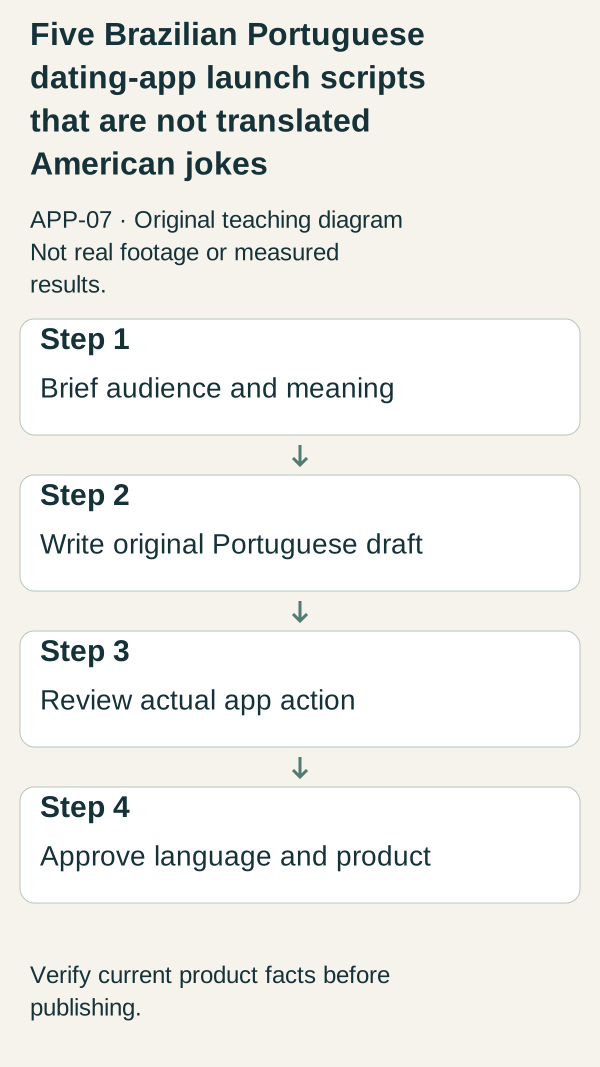
Original illustrative teaching diagram. Develop original Portuguese wording from audience meaning, then approve language and actual app behaviour. This is planning guidance, not product footage, customer evidence or measured results.
Start with a recognizable product decision, then write it in Brazilian Portuguese with a reviewer who understands the intended audience. Do not begin with an American joke and swap the words. A small launch campaign can show choosing an introduction, understanding a suggestion or deciding whether to continue without claiming that one joke represents Brazil.
The five scripts below are original working drafts, not native-approved campaign copy. They use an invented app called PrimeiroPasso only as a teaching label. The actual product’s features, membership and availability remain to be verified. Keep demonstration profiles labeled and do not present a scripted encounter as a real customer story.
 Superdirector
Make it work for your brand
Find it. Remake it. Post it. Superdirector turns the viral formats in your niche into your brand's carousels, X posts and video scripts, and keeps the calendar full.
Build a localization brief around the decision
Write down the audience, launch stage, city or region if relevant, interface language, desired action and any feature limitations. “Brazilian adults considering a waitlist for a Portuguese-language app” is different from “people who can download and match today.” The script and destination need to agree.
Give the reviewer the real product recording, not only English copy. A line can sound natural while describing an action the product does not support. Ask the reviewer to separate language corrections from product questions. Keep both visible until resolved.
Avoid importing stereotypes about dating, confidence, appearance or regional identity. You do not need a culturally sweeping punchline to show a useful control. Ordinary micro-moments can supply a small, understandable story, but their effectiveness must be tested rather than assumed.
Script one: the introduction choice
Portuguese opening: “O que você quer dizer primeiro?” Intended English: “What do you want to say first?” Show a fictional profile and one real introduction control. If the app offers prompts, record an actual prompt. If it does not, do not invent one for the advertisement.
Working narration: “Neste exemplo, eu escolho uma apresentação que combina comigo. Estes perfis são fictícios.” Meaning: “In this example, I choose an introduction that fits me. These profiles are fictional.” End with “Veja como o app funciona antes de participar,” meaning “See how the app works before joining.” Adapt the final action to the true product state.
The small tension is choosing words, not mocking someone’s awkwardness. Let the actual interface resolve the question. A text-only card can introduce the moment, but it cannot substitute for a real feature demonstration.
Script two: a suggestion is not an obligation
Opening: “Uma sugestão não é uma obrigação.” Meaning: “A suggestion is not an obligation.” Show a real suggestion and the available user choices using demo accounts. Narration: “Aqui, você vê as opções e decide o próximo passo.” Meaning: “Here, you see the options and decide the next step.”
This wording must match the actual interaction. If an action has consequences beyond the screen, explain them in the product details rather than implying everything is reversible. Close with the checked route to a longer walkthrough. The video answers control, not match quality.
Script three: what the waitlist means
Opening: “Lista de espera não é perfil ativo.” Meaning: “A waitlist is not an active profile.” Record the real waitlist form with test data. Narration: “Neste momento, a inscrição é para receber novidades sobre o lançamento.” Meaning: “At this stage, signup is for receiving launch updates.” Use that only if it is true.
Show the actual confirmation and explain whether access is available or undecided. Do not add invented member portraits, a local activity map or a countdown to make a prelaunch product feel busy. End with “Confira os detalhes atuais antes de se inscrever,” meaning “Check the current details before signing up.”
Script four: change your mind
Opening: “Mudou de ideia? Veja as opções.” Meaning: “Changed your mind? See the options.” Show the actual pause, decline or account-control flow. Choose one action; do not combine unrelated controls into a promise of effortless exit.
Narration: “Este vídeo mostra o que acontece quando eu uso esta opção na versão atual.” Meaning: “This video shows what happens when I use this option in the current version.” Keep the final status legible. If a feature is planned, replace the walkthrough with a clear status explanation instead of a simulated live control.
Script five: the honest product update
Opening: “O que já está pronto e o que ainda falta?” Meaning: “What is ready, and what is still missing?” Use two simple cards backed by actual product facts. Show one working interaction and identify one unresolved limitation relevant to prospective users.
Narration: “Este é o estado atual do projeto. Os próximos passos ainda dependem destes ajustes.” Meaning: “This is the project’s current state. The next steps still depend on these changes.” Do not promise a date you cannot support. End on the real status page or product details, not a generic hype slogan.
Review language, performance and product separately
First, ask the native reviewer whether the intended meaning is clear and whether the register fits the specified audience. Second, have the founder verify every feature and availability statement. Third, review the filmed delivery with captions and sound separately. These are different checks; a fluent narrator cannot approve the product claim.
A reusable review row includes: original intent, Portuguese line, literal English meaning, reviewer’s concern, approved wording, product evidence and open issue. Preserve rejected wording so it does not accidentally return in a shorter edit. Regional slang should be a deliberate choice supported by the audience brief, not a shortcut to “authenticity.”
What to measure and what not to borrow
Ask viewers what action they believe the app offers and whether it is open now. If the answer is wrong, fix the explanation before comparing jokes or visual styles. After publication, record actual questions and available destination measurements. Do not infer cultural fit from one positive comment or treat a global campaign as proof for a small local launch.
The PUC-SP journalism article on comedy consumption provides cultural reporting and interview context, not an effectiveness study for dating-app scripts. B9’s Tinder campaign report describes a named campaign using post-date moments. A rollout including Brazil does not prove Brazilian-only adaptation. These references support the distinction between cultural context and validated creative performance; their jokes, imagery and slogans are not reused.
Next action
Choose one script whose product action already works. Send the recording, intended English meaning and Portuguese draft to a qualified reviewer. Resolve the language and product questions before filming all five. That gives you a coherent local test rather than five polished translations of an unverified idea.