How-To Guide
How to pick a creator’s language without implying product support you do not have
Build a language-coverage matrix of what your product supports, then choose creator languages and script lines that claim no more than the matrix shows.
By the Superdirector editorial team. FTC and YouTube Help pages reviewed October 30, 2026.
At a glance
How can a campaign choose a creator’s language without implying product support in that language?
Build a language-coverage matrix before you brief anyone. List each candidate language, split the product into the surfaces a viewer would use (screens, help pages, support, billing and terms), and mark every cell supported, partial, not offered or unknown from a dated source with a named owner. Then give each language one outcome: claim it, name only the surfaces that exist, make no language claim, or hold it. Check the script, captions, dubbed tracks and landing page against the matrix before posting. Unknown never counts as supported.
- Judge support per surface, not for the product as a whole.
- Write the creator’s allowed line from the cell, and also write what they must not say.
- Review captions, dubbed tracks and the destination as separate scripts.
Direct answer
Short answer: before you choose a creator for their language, build a language-coverage matrix. Its rows are the surfaces a viewer would use after clicking: product screens, help pages, human support, and billing or terms. Its columns are the candidate languages. Each cell says supported, partial, not offered or unknown, and carries a source, an owner and a date. Then each language gets one of four outcomes: claim it, name only the surfaces that exist, make no language claim, or hold the language. A creator’s fluency decides who can speak. The matrix decides what the video may imply.
This is for an agency or brand marketer who is about to brief creators in more than one language and who has heard “we support that” from someone without a source. The decision is narrow: which language claims your campaign is entitled to make, and which creator lines follow from that. It does not teach translation, localization craft or how to write persuasive copy in another language. Those are different jobs, and the boundary section says which neighboring pages cover related questions.
The risk is quiet. A viewer who hears a product described in their own language will often assume they can use it in that language, ask for help in it and pay in it. If the product cannot do that, the creator did not need to say anything false for the video to mislead. Use the blank language-coverage card, the CSV register and the coverage map to keep the evidence in one place.
List the languages you might ask creators to use
Start with the list of languages, and nothing else. For each candidate write the language name as you will use it, the creator or creators who would speak it, and how you confirmed that they do: you heard it in their existing videos, they told you in writing, or you do not know yet. Keep these separate from product support on purpose. If you write “Creator Q, Language B, product supports B” on one line, the second half will be read as settled before anyone has checked it.
Be specific about what counts as the language. A spoken language, a caption language and an on-screen text language can differ in one video. Note which of the three you intend. Also note whether the creator would switch between languages, since a video that opens in one and explains in another has two scripts to review. Where the creator’s audience, not only their language, matters for the market, use the partial audience geography guide; language and location are different facts, and a language list does not tell you where viewers are.
Do not drop a language because you suspect the product lacks it. The matrix exists to find that out from evidence. A language that ends up as “hold” is a result you can explain, and an unlisted language is a result you cannot.
Split the product into the surfaces a viewer would use
“The product supports Language B” is not one fact. Break it into the places a viewer would actually go. A workable default is four surfaces: interface (the screens and menus the viewer would see), help and documentation (setup guides, articles, error messages), human support (a person who can answer in that language, and through which channel), and billing and terms (checkout, receipts, the agreement and the privacy notice). Add a row for any surface your product has that matters to a purchase, such as an onboarding email, a mobile app or a template library.
Name the surfaces from the viewer’s path, not from your org chart. Click through from the link the creator will use, in the order a new viewer would, and write down each place they land. If you have already rehearsed the destination, reuse that record; the software proof screens guide covers which screen states to capture, and this page only asks what language each one is in.
Decide before you fill the cells what you will do about partial coverage. A product that has a translated interface but English-only help pages is common, and the honest description is the specific mix. Agree now that “partial” always comes with the names of the surfaces that exist, so nobody rounds it up to “supported” when the campaign calendar gets tight.
Mark each cell from a dated source
Fill one cell per language and surface with one of four words: supported, partial, not offered or unknown. Next to the word, write what the source says in its own words, the source’s name or address, the date you read it and the person who owns the fact. A source can be the live product itself (you opened the screen in that language on a stated date), the published help center, a release note or a written answer from the product owner. A verbal “yes” from a salesperson is a lead, not a source. If the product team and the sales team disagree, hand the dispute to the owner using the versioned product facts guide and mark the cell unknown until the owner answers.
Use unknown freely and never convert it. It is a complete and useful entry: it tells the team which question to send to whom. The map below shows the shape of the matrix, with fictional values, and the outcome row that follows from each column.
| Cell word | What qualifies | What it allows | What it does not allow |
|---|---|---|---|
| Supported | You or the owner confirmed the surface works in that language on a stated date | A line about that surface, dated to the check | A line about other surfaces or a later version |
| Partial | Some of the surface exists in the language, and you can name which part | A line that names the part that exists | “Fully supported”, “works in” or any wording that hides the gap |
| Not offered | A source says the surface is not available in the language, or you saw it is not | Saying nothing, or saying the surface is in another language | Any wording that suggests the viewer can use it in that language |
| Unknown | No source, an expired source or two sources that disagree | Asking the owner | Treating it as supported to keep a schedule |
Sources go stale. Record when each was read and set a recheck date before the post goes live, because a language can be added, paused or removed between the brief and publication. If the creator’s video will show the product, the outdated product UI guide is the companion check for what the footage shows.
When enlarged, scroll horizontally to read the diagram.
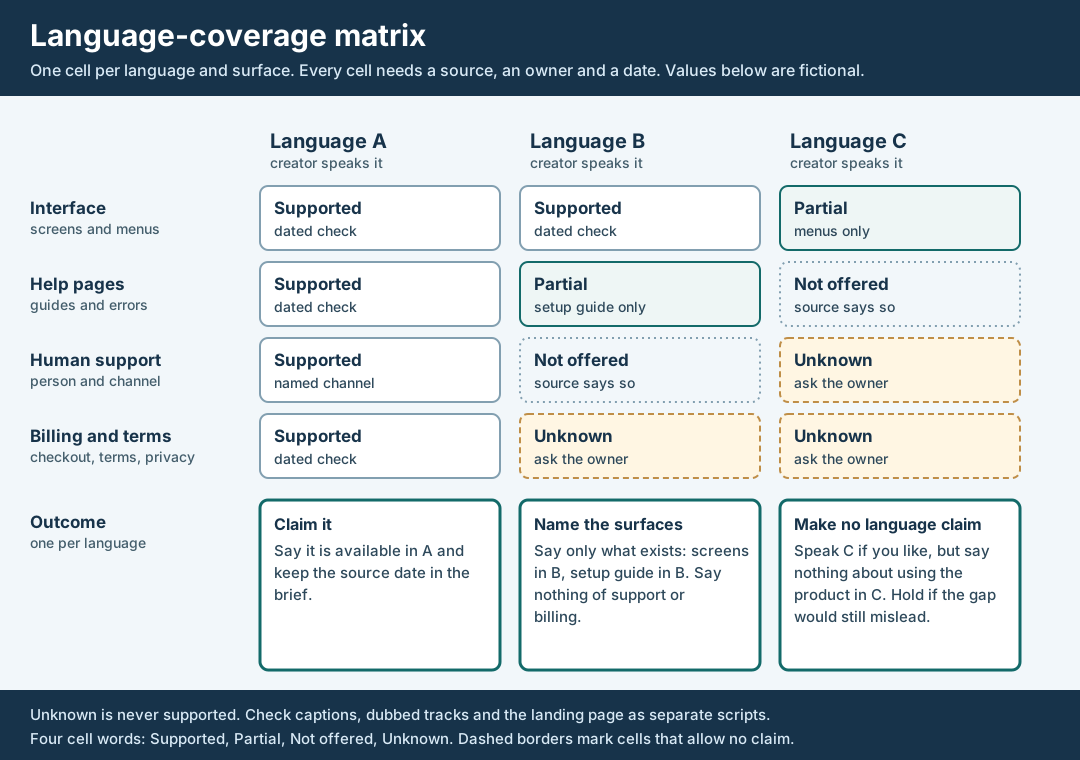
An original editorial matrix with fictional values. Each cell needs a dated source, and each language ends in one outcome.
Original visual by Superdirector editorial team. Creation date not recorded.
Turn each cell into a line the creator may say
Read the matrix column by column and give each language one of four outcomes. Claim it: every surface a new viewer would meet is supported, so the creator may say the product is available in that language and you keep the source and date. Name the surfaces: coverage is partial, so the creator may say only what exists, such as that the screens are in the language and help is in another. Make no language claim: the surface a viewer would hit first is not offered or unknown, so the creator may speak the language but must not say or show anything about using the product in it. Hold: the gaps would make the video mislead whatever the script says, or the answer is still unknown and the date is close, so pause that language until an owner answers.
Write two sentences for each language in the brief: the line the creator may say, and the line they must not say. The second sentence is the one teams skip. “Must not imply that support is available in this language” is concrete, and a creator can follow it. The rule behind this is old and simple. The FTC’s endorsement rule says an endorsement may not convey any express or implied representation that would be deceptive if made directly by the advertiser, and that rule also says an advertiser can be liable for misleading or unsubstantiated statements made through endorsements. The FTC’s 1984 advertising substantiation statement says an advertiser should have a reasonable basis for a claim before it is disseminated. A language-support line is a claim about the product, so the matrix is the basis you would point to.
If a creator’s own words go beyond the line, treat that as a script change and route it through the same review. The claim verification guide covers proof for a specific claim; here you decide which language claims exist at all.
Walk through a fictional coverage matrix
Fictional exercise: no real brand, product, creator or result was inspected. A made-up scheduling tool, Product P, plans a campaign with three creators: Creator Q speaks Language A, Creator R speaks Language B and Creator S speaks Language C. The team builds the matrix. Language A is supported on all four surfaces, each with a dated source. Language B has a supported interface, partial help (the setup guide only), no human support and an unknown billing and terms cell. Language C has a partial interface (menus only) and not offered or unknown everywhere else.
The outcomes follow. Language A: claim it, with the source date in the brief. Language B: name the surfaces, so Creator R may say the screens are in B and that the setup guide is in B, and must not say support or billing are. The team also sends the billing question to the owner and sets a recheck. Language C: the first screen a viewer would meet is only partly translated and nothing behind it is confirmed, so the team chooses hold for C and asks Creator S whether they would make the video in A or B instead, or wait. Nothing about this scenario predicts what any real campaign or audience would do.
Notice what the matrix did not require: no rating of how good the creators are, no view of audience size, no translated copy. It answered one question, which was what each language may truthfully imply.
Check the script, captions and destination in that language
Ask each creator for a script sample in the language, even a rough one, before production. Read it against the outcome for that language. Look for sentences that imply more than the cell allows: “works in your language”, “our team will help you in B”, “pay in B”, “everything is translated”. Look for implications that are not claims in words, such as a creator who greets viewers in their language and says “just click and start” about a signup that is English only. A short list of banned phrases, per language, belongs in the brief next to the allowed line.
Then check the other scripts inside the same video. Captions and dubbed audio can say different things from the cut you approved. YouTube’s Help page on multi-language audio says the feature does not create audio tracks for you and that audio tracks default to the viewer’s preferred language, which it says is determined by watch history. YouTube’s page on subtitles and captions says automatic captions are in the video’s default language only, and its steps describe adding subtitles in other languages. Read together, a single upload can put several sets of words in front of viewers, so give each added track or subtitle file the same review. We did not read matching help pages for other platforms and make no statement about them.
Finally, open the destination the way a viewer would, in the language the video used, and compare it with the matrix. Does the link land on a page in that language? If it lands on another language, does the video say so? Then check the paid-relationship disclosure. The FTC’s Endorsement Guides question-and-answer page says the connection between an endorser and a marketer should be disclosed in whatever language or languages the endorsement is made. The disclosure check guide covers where it must appear. Record what you found, fix what is wrong, and keep the sample, the review and the matrix version together.
What this page does not decide
This page produces a record of what each language may imply. It does not tell you how to translate, localize or adapt humor and tone, and it does not judge whether a creator’s fluency is good. It does not decide whether any market’s law requires product information in a particular language; if that matters, ask counsel for the countries you will reach.
Several neighboring pages answer different questions. The versioned product facts guide resolves who owns a contested fact and gives creators one dated wording packet; this page applies the idea to one dimension and adds a language-by-surface matrix and the outcome rule. The partial audience geography guide reads where a creator’s audience is, which is separate from whether your product works in their language. The Spanish-language cozy-game shortlist shows how to find creators for one language and one game, and it does not test product support in that language. The claim verification guide matches proof to a specific claim, and the software proof screens guide plans which screen states to film. Use those for their jobs and this one to decide which language claims you may make.
Nothing here measures how language choice affects reach or conversion, and no figure on that is claimed. The page is an editorial method for keeping a creator’s language, a product’s support, a dated source and a script line apart, so that each claim in a video rests on its own evidence.