How-To Guide
How to brief a physical product demonstration without asking for claims you cannot prove
Turn each demonstration shot into what the camera shows, what a viewer might infer and what evidence you hold, then brief only wording that evidence supports.
By the Superdirector editorial team. FTC pages reviewed October 30, 2026.
At a glance
How can a brand brief a product demonstration without asking the creator to make unproven claims?
Break the demonstration into shots and, for each shot, write three things in separate columns: what the camera can show, what a viewer might infer beyond it, and what evidence you hold for that inference, with its date and scope. Brief the creator on observation wording freely. Brief a result, safety or comparison idea only when the evidence on file matches it. Where there is no match, name the banned wording, change the shot or gather the proof first.
- One action per shot, with no result words in the instruction.
- Separate what the footage shows from what a viewer might conclude.
- Brief a claim only when dated evidence of matching scope is on file.
Direct answer
Short answer: turn the demonstration into a shot matrix before you write the brief. Give each shot one row. In that row keep four things apart: what the creator does, what the camera can show, what a viewer might infer beyond it, and the evidence you hold for that inference, with its date and scope. Then write the brief from the matrix. Observation wording can go to the creator freely. A result, safety or comparison idea goes in only when the evidence on file matches it. Everything else becomes banned wording, a reshot or a task to gather proof first.
This is for an agency or brand marketer who has a physical product, such as a bag, a mug, a tool or a piece of cookware, and wants a creator to show it working. The decision is narrow: which statements the brief may ask for, and which it must leave out until proof exists. It is not a ruling on whether a particular claim is lawful, whether a product is safe, or how a regulator would read a video. Those need your counsel and, for safety, the rules for your product category.
The reason to do this before the brief is that a demonstration invites conclusions. A creator tips a container over a sink, and a viewer may hear “it never leaks.” A creator uses a tool on one board, and a viewer may hear “it works on any board.” The footage itself is true to the take. The leap is where an unproven promise gets in, and a brief that says “show it doesn’t leak” has already asked for it. Use the blank shot matrix card, the CSV register and the shot map to keep the rows in one place.
Write the demonstration as one task per shot
Start with the product and its version or batch, because every later statement is about that one thing. Then write the demonstration as a list of shots. Each shot gets one action, one setting and one take: “pour the stated amount of water into the closed container, turn it on its side over a sink, hold for the stated time.” An instruction like that tells the creator what to do and leaves the outcome to the camera. An instruction like “prove the lid is leakproof” tells the creator what conclusion to reach.
Write shots in neutral verbs: pour, turn, press, cut, wear, wash, plug in. Keep these words out of the instruction column: *never*, *always*, *safe*, *guaranteed*, *works on everything*, *best*, *lasts forever*, *cures*, *prevents*. If you catch one, the shot is trying to deliver a conclusion, and it belongs further along, in the inference column. A short shot list is also easier to check. Five clean rows beat twenty vague ones.
Write down the conditions you want shown, because the viewer will take them as the conditions that apply. Room, surface, quantity, duration and who is using the product are all part of what the footage implies. If the brief leaves them open, the creator picks them, and you may not be able to say later what the take actually covered. If the product has a stated use in your own versioned product facts, take the shot's setup from there so the demonstration and the facts cannot drift apart.
List what the camera can honestly show
For each shot, fill an observation column with only what a viewer can see or hear in that take. Water stayed in the container during this hold; the lid clicked when pressed; the blade went through the item in the frame; the creator wore it for the length of the clip. Write it as a plain report of the clip, in the past tense, with no adjective that scores the result. “The lid clicked” is an observation. “The lid seals perfectly” is a conclusion.
An observation is bounded by the take. One pour over one sink tells a viewer about one pour over one sink. It does not tell them about a bag full of items carried for a day, a second unit from the same batch, or a year of use. The FTC’s endorsement Q&A makes a close point about endorsers: a person who has tried a product once cannot suggest they use it regularly. FTC Endorsement Guides: What People Are Asking. The same logic applies to a shot. Say what the take covers and stop there.
Also record what the camera cannot show. It cannot show the inside of a sealed part, a measurement nobody took, a temperature nobody read, or the state of a product at the end of a long period. If a shot would need those to support a stronger statement, note it in the same row. This column is the safe part of the brief. A creator can describe their own take in their own voice, and you can tell them so.
Mark every inference a viewer could add
Now ask, for each shot, what would an ordinary viewer conclude that the take does not show? Write each idea in an inference column and give it a type so you can see the pattern. Useful types are a result (it works), a safety idea (it is safe for a person, child, pet or food), a comparison (better than another product or method), a durability or lasting-effect idea (it keeps working), and a typical experience idea (most people will get this). A single shot often carries several. The shot map shows where this step sits.
Include implied ideas, not only spoken ones. The FTC’s policy statement on advertising substantiation says that for implied claims a firm should hold the type and amount of support the ad actually conveys, and that firms should generally anticipate reasonable interpretations of their ads. FTC Policy Statement Regarding Advertising Substantiation. So the question is not what your team meant. It is what a reasonable viewer would take from the whole shot: the words, the setup, the music, the on-screen text and the way the creator reacts.
| Inference type | What a viewer might hear in the footage | What to ask before briefing it |
|---|---|---|
| Result | “It does the job” from one successful take | Which conditions did the evidence cover, and are they the conditions in the shot? |
| Safety | “Fine around children, food or skin” from a calm demonstration | Is there a safety basis for this exact use? Send the category question to counsel |
| Comparison | “Better than the usual way” from a side-by-side | Was the other method set up fairly, and do we hold a like-for-like record? |
| Lasting effect | “It stays this way” from a fresh product | Do we hold anything covering use over time, and for how long? |
| Typical experience | “You will get this too” from one creator | Do we hold evidence of what people generally get, or must the post say otherwise? |
The last row is easy to miss. The same FTC Q&A says that when an advertiser lacks proof that an endorser’s experience represents what people will generally achieve, the ad has to make clear what the generally expected results are. One creator’s good take is an observation about that creator’s take. Do not brief it as a promise about everyone’s.
When enlarged, scroll horizontally to read the diagram.
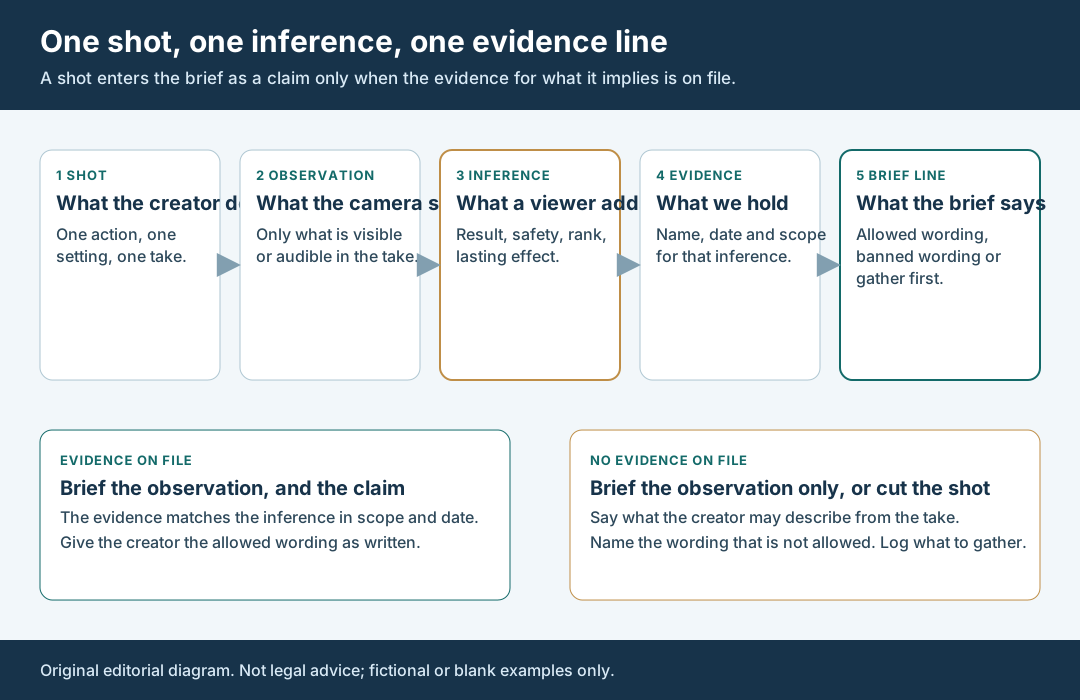
An original editorial diagram. A shot becomes a claim in the brief only when evidence for what it implies is on file.
Original visual by Superdirector editorial team. Creation date not recorded.
Match each inference to evidence you hold
For each inference, write what you actually hold: the file name, who produced it, the date, the product version or batch it covers, the method in one line and the conditions. Then write the gap between that scope and the inference. A test of one version under stated conditions supports a statement about that version under those conditions. It does not stretch to another version, a harsher use or a longer period. If you hold nothing, write “nothing on file.” That is a perfectly good entry, and it is the most useful one for the brief.
Timing matters. The FTC’s policy statement says a firm needs a reasonable basis for a claim before the ad is disseminated, and that evidence gathered afterward does not absolve a firm that lacked one, so proof gathered after a post goes live does not repair a missing basis. For an objective claim with no stated level of support, it describes the needed basis as depending on the case, with factors that include the consequences of a false claim and what experts in the field consider reasonable. Treat that as a reason to have the evidence in the file before the brief goes out, and to ask counsel how much your claim needs. It is not a threshold this page can supply.
Be careful with evidence that is not really evidence of the idea. A product page, a sales deck, a supplier’s data sheet or a past ad shows what someone said, not that it was tested for your shot's conditions. Customer reviews show opinions. A different team’s test for a different use is just that. If your claim is also in the creator’s hands, the claim verification guide covers checking an exact proposed wording against dated evidence. This step is earlier: it decides which ideas you will ask for at all.
Where the gap is large, you have four moves, in this order of cost. Reword the shot so the footage carries a smaller idea. Cut the shot. Gather evidence and hold the shot until it arrives, with an owner and a date. Or, for a claim you will not support, ban the wording and say so in the brief. Record which one you chose and who chose it.
Put allowed, banned and unknown wording in the brief
Now write the brief from the matrix, one block per shot. Each block has the shot instruction, the observation wording the creator may use, the evidence-backed wording if any (copied exactly, with its source file and date), the banned wording, and a line saying what to do if the take surprises them. Keep the creator’s voice free where you can: you are asking them to report what happened, not to read a script. Where wording is fixed, say it is fixed and why.
Name the banned wording as specific phrases and as the ideas behind them. A creator who is told “don’t say leakproof” may say “nothing will ever get out.” Give the idea (“no statements that it will not leak in any use”) alongside the example. Add an instruction for the common case where a creator, delighted, goes beyond the take: stop, tell the brand and wait. The FTC’s Q&A advises giving people in an advertiser’s network a list of what they can claim, because the advertiser is responsible for substantiating objective product claims. The matrix is that list, built shot by shot.
State the responsibility line plainly. The FTC’s page says a company is ultimately responsible for what others do on its behalf, and the endorsement rule at 16 CFR 255.1 says advertisers are subject to liability for misleading or unsubstantiated statements made through endorsements, even when the endorser is not liable. It also says a non-expert endorser can be liable for unsupported representations about a product’s performance that go beyond their experience. So the brief should not ask a creator to vouch for something only the brand can prove, and it should not leave a creator to guess what is safe to say. The rule’s full text is the place to read the exact wording.
Finally, add a review point. Ask to see the cut before it posts, and check it against the matrix, not against your memory of it. The first-cut review guide covers that comparison. If something unsupported goes live anyway, the live post correction guide covers who owns the fix. This page is about not asking for the claim in the first place.
Walk through a fictional mug demonstration
Fictional exercise: no real brand, creator, product, test or result was inspected, and none is implied. A made-up brand, Brand A, sells Mug A, a travel mug with a push-down lid. Its marketer wants a creator to show the lid. The first draft of the brief says: “Show that the lid is leakproof and the mug is safe to throw in any bag.” The marketer builds the matrix before sending it.
Shot one is “pour the stated amount of water into the closed mug, turn it on its side over a sink, hold for the stated time.” The observation is whatever the camera shows in that hold, no more. The inferences are that the lid will not leak in a bag (a result), that it will not leak ever (a lasting effect) and that it is fine in any bag (a broad result). The evidence on file for the exercise is the marketer’s own note: nothing. Brand A holds no dated test of the lid under any condition.
With nothing on file, the matrix gives a clear answer. The brief keeps the shot, because it shows an action. It allows the creator to describe what they saw in their own take. It bans “leakproof,” “never leaks” and “safe in any bag,” and the ideas behind them. The marketer also writes a task: if Brand A wants to make a leak claim later, someone must test the lid under stated conditions, record the product version and date, and add the file to the row. Until then the claim waits. The exercise predicts nothing about any real mug.
What this page does not decide
This method decides which statements to ask a creator for. It does not say whether a given claim is lawful, how much substantiation a given claim needs, or whether a product is safe. It does not provide any safety standard or rule for a category, and it does not state what a regulator will accept. For those, read the sources linked above and take the question to counsel.
It differs from nearby pages in what it produces and when. The claim verification guide checks a creator’s exact proposed wording against dated evidence and ends in a decision register. The live post claim fix handles a claim already published. The versioned product facts guide settles which product facts are current when your own teams disagree. The first-cut review guide compares finished footage to a brief. The creator claims sheet guide sorts a brief’s claims into allowed, ask-first and disallowed, each with proof; this page starts one level earlier, from the footage, and asks what each filmed action shows versus what a viewer might read into it. This page sits before all of them: it builds the shot-by-shot matrix that decides what the brief asks for in the first place. Product-specific pages, such as the guide to filming a cast-iron first use without promising nonstick results, apply the same caution to one product. This page is the reusable form.
Nothing here measures how often unproven claims reach posts, what they cost, or how a viewer responds to one. Those figures are not available to us and are not claimed. The page is an editorial method for keeping an observation, a viewer’s possible conclusion and the evidence behind it in separate columns, so that each line in a brief rests on its own support.