How-To Guide
How to film a cast-iron first-use demonstration without promising nonstick results
You can create that explanation before collecting customer results.
By the Superdirector editorial team.
A first-use video should answer what the buyer needs to do with the specific item in the box. It should not turn an optional seasoning routine into an admission fee for owning cast iron. Nor should a successful food-release shot become a promise about every buyer's cooking.
For a small cookware brand preparing its first release, the useful production task is narrower: identify the exact product, distinguish required preparation from optional maintenance, and show the approved steps clearly. You can create that explanation before collecting customer results. You cannot substitute a persuasive edit for product instructions or actual evidence.
This guide is an editorial workflow, not a universal cookware-care procedure. Manufacturer references were checked on October 24, 2026. Use the current instructions for the exact model being filmed, including its finish and handle construction.
Start with the product, not the most dramatic tutorial
Before writing the opening line, put the filmed item beside its packaging and instructions. Record the model identifier, surface type, handle material, supplied condition, and instruction revision or retrieval date. Keep that record with the footage.
These details decide whether a proposed action belongs in the video. A bare seasoned skillet, an enameled vessel, and an item with a wooden handle are not interchangeable props. Do not transfer a heating routine from one to another merely because all three are sold in a cast-iron category. If the instructions do not establish that an action applies, omit it until the manufacturer resolves the uncertainty.
The opening shot can be simple: the actual item, its identifying mark, and a short caption describing the model. Avoid a montage of several products while narrating instructions verified for only one.
Separate first use from restoration
The distinction matters because instructional pages often place these subjects close together. Lodge's seasoning guide says its seasoned cast iron is supplied ready to use without home seasoning, while also explaining a separate reseasoning procedure. A creator who jumps straight to the most elaborate section could incorrectly present that procedure as mandatory initial preparation. Lodge seasoning guide
Victoria's first-use guidance recommends handwashing and complete drying for its seasoned cast iron. It describes extra seasoning as optional and acknowledges that food can stick during early uses. Those statements support a restrained explanation, not a guarantee of immediate frictionless cooking. Victoria first-use guidance
Treat these as manufacturer-specific examples of the distinction. They are not proof that your own product arrives in the same condition or uses the same instructions. The brand responsible for the item must confirm its actual requirements.
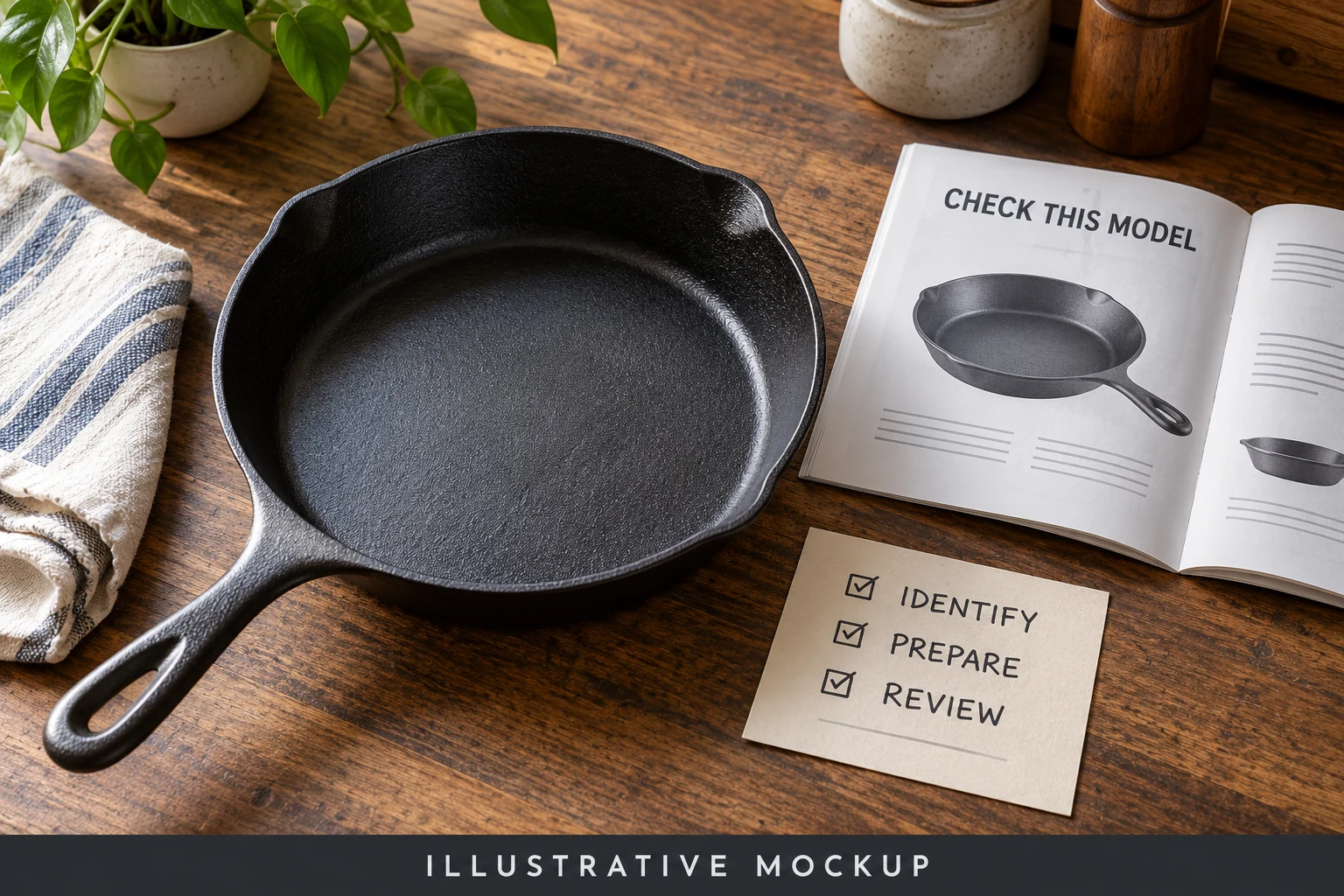
AI-generated illustrative mockup. The image supplies product context, not an executed preparation procedure or nonstick result. Fill the real demonstration from the exact model’s current manufacturer instructions.
Illustrative mockup by OpenAI image generation, editorial direction for this article. Created 2026-10-24.
Build a three-part shot list
Write one line for each action before arranging the camera:
- Required before first use: an action explicitly called for by the applicable instructions.
- Optional or later care: an action the manufacturer permits but does not require initially.
- Outside this video's scope: restoration, damaged-item diagnosis, or another model's procedure.
Only the first category belongs in the main quick-start sequence. If an optional action is genuinely useful to explain, label it on screen and keep it separate. A fast cut that visually joins the categories can undo an otherwise accurate voiceover.
An illustrative shot plan might contain an identification frame, the instructed cleaning action, a separate completion frame, and a link to the model's instructions. This is a planning example, not a report that a particular product has been tested. Fill the actions from that product's approved guidance rather than copying the example into a universal script.
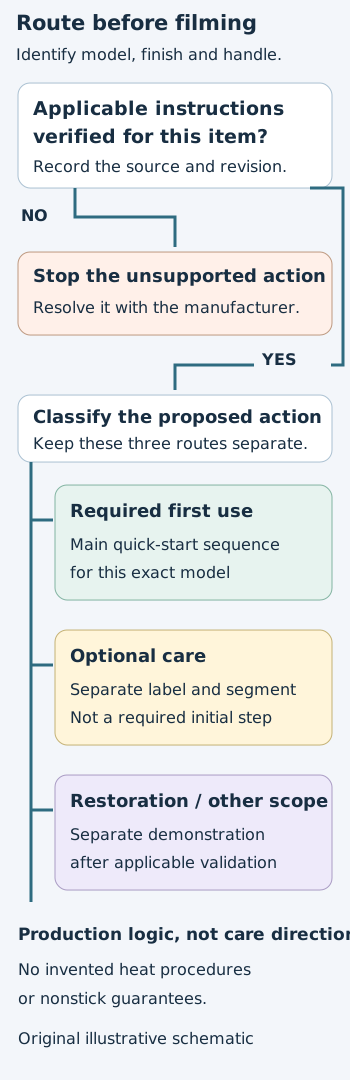
Original editorial schematic. It does not replace the manufacturer's instructions or prove a product's readiness.
Original visual by the Superdirector editorial team. Creation date not recorded.
Make the important state visible
A useful demonstration shows what changes between the beginning and end of an action. If the applicable instructions require drying, do not end the sequence at the sink and assume the audience will infer the missing step. Film the relevant completion state without claiming that a camera can establish every hidden condition.
The Lodge reference page uses an actual washing photograph with a clear view of the skillet and the action. That is a useful compositional lesson: show the object and operation together. It does not authorize copying the photograph, and the image alone does not establish water temperature, complete dryness, or later cooking performance.
Use your own footage of the released model. Keep cleaning supplies and accessories in the frame only when they are consistent with its instructions. Do not include another product as decoration if viewers could mistake it for something required or supplied.
Review the script for accidental guarantees
Compare every instructional sentence with the applicable document. Then conduct a second review for promises that the footage cannot support.
Replace broad language such as “every cast-iron pan needs this” with the actual model scope. Remove “never sticks,” “perfect every time,” and similar outcome promises unless a separately reviewed claim has suitable support. One filmed cooking outcome is not evidence about every food, heat source, technique, or future use.
A restrained illustrative script might say: “This video covers the first-use preparation specified for the model shown. Optional care and restoration are separate topics. Follow the current instructions supplied with your item.” Use that wording only after checking that the finished video genuinely matches it.
If you include a cooking demonstration, label what was actually done and keep it separate from the preparation sequence. Do not edit out a failed attempt and imply a universal result. A stronger sales explanation can be more limited and more useful than a sweeping promise.
Approve the finished edit against the same item
Before release, have someone compare the exported video with the model record, current instructions, and raw footage. Check that captions remain legible on a phone, no required action disappeared during shortening, optional steps remain labeled, and the linked instructions match the shown product.
Also inspect the thumbnail. A restoration scene or unrelated cookware can misstate the video's purpose before anyone presses play. If the product or instructions change, revisit the video rather than leaving the old edit attached to a new revision.
The deliverable is a clear, model-specific first-use explanation with traceable evidence. It is not a safety certification, a customer-results study, or a performance guarantee. Until the actual item and final edit have been reviewed, keep the work in draft rather than presenting this planning guide as completed validation.