How-To Guide
What to do when a live creator post makes a product claim you cannot support
Decide who owns an unsupported claim in a live creator post, what to ask the creator, what to record and when to escalate. Includes a blank correction log.
By the Superdirector editorial team. FTC endorsement and substantiation guidance reviewed October 30, 2026.
At a glance
What should an agency do when a live creator post contains an unsupported product claim?
Freeze the live post and the exact words on every surface, then name the claim owner who decides whether the claim is supported, qualified or withdrawn. The agency records and relays that decision. Send the creator one specific request with the quoted words, the surfaces, the change and a date, and ask where else the claim appears. Check the live post yourself and keep a dated receipt. If the creator cannot or will not fix it, escalate in writing to the deal owner or claim owner, then repair the handoff that let the claim through.
- Separate who decides the claim from who relays the request.
- A creator’s reply that it is done is not a live check.
- Escalate in writing with the address, the date and the decision needed.
Direct answer
Short answer: when a live creator post carries a product claim you cannot support, treat it as a decision with named owners, not a chat message. Freeze the exact post and the exact words people can see or hear. Name the claim owner, the person who decides whether the claim is supported, qualified or withdrawn, and keep the agency’s job separate: record the decision and relay it. Then send the creator one specific request that quotes the words, names the surfaces and gives a date. Check the live post yourself afterward and keep a dated receipt. If the creator cannot or will not fix it, or the claim appears in other placements, escalate in writing rather than letting the thread drift.
This page is for an agency or brand marketer whose creator post is already public. The decision is narrow: who decides, what you ask the creator, what you record, and when you escalate. It does not decide whether the product claim is true; the brand’s fact owner and, where the brand wants one, its legal contact do that. It also does not give legal advice. Where the law matters, this page quotes the source it came from and says what that source leaves open.
Use the blank correction card, the CSV log and the decision map. All three are blank or fictional teaching aids. None describes a real campaign, creator or result.
Where this page sits
Four neighbouring pages answer different questions, and this one starts after theirs end. The pre-posting claim guide decides whether a *proposed* claim is supported before anything goes live. The versioned product facts guide fixes the handoff so the creator receives one dated wording packet. The disclosure check covers a missing or unclear sponsorship label, which is a different fault from an unsupported product claim. The YouTube correction guide explains one platform’s edit options and the new-URL problem after a replacement upload.
Freeze the live post and the exact claim
Before anyone messages the creator, capture the post as it stands. Record the exact address and platform, the account that published it, and the date, time and time zone you viewed it. Save a screenshot or screen recording that you made yourself and note where it is stored. Keep that original capture for the life of the record. If the creator fixes the post, the capture is how you show what was there before.
Then write the claim as an audience member would meet it, one line per surface: the spoken sentence with its timecode, any on-screen text, the caption, a pinned or top comment, and the page behind any link. A claim can sit on more than one surface, and a fix to one leaves the others. Use the creator’s words. Do not summarize them into a milder or stronger version, because your summary becomes the thing you argue about later.
Next, work out where the claim came from, because it decides who has to act. There are three common origins. The creator may have departed from the approved version. The approved wording itself may have gone out, so the unsupported sentence was ours. Or the product changed after the wording was approved. Write down which one the record shows, and write “cannot tell yet” if it does not. Do not guess in the creator’s favor or against them.
Finally, be exact about the word *unsupported*. It means that nobody can point to a dated source that backs these words as an audience would read them. It does not mean the claim is false, and it does not mean the creator acted in bad faith. Keep the label narrow in every message you write, because a loose accusation in a ticket tends to travel.
Name who owns the claim and who decides
Most delays after a live problem come from nobody knowing who may decide. Settle that before the creator hears anything. The table below separates four roles. A small team may have one person in two rows. The record still names each role, so the next reader can see who did what.
| Role | Decides | Does not decide |
|---|---|---|
| Claim owner (the brand’s product or fact owner) | Whether the wording is supported as worded, qualified with new wording, withdrawn, or still unresolved | How the creator edits their own post |
| Agency lead | The text and timing of the creator request, and what is recorded | Whether an unsupported claim is acceptable, or what the brand’s evidence supports |
| Creator | What they change on their own account, and how | Whether the brand’s product claim is supported |
| Client approver or deal owner | Contract rights, paid use of the post and any decision about the relationship | The factual question the claim owner answers |
Why separate them? The FTC’s Endorsement Guides say advertisers are subject to liability for misleading or unsubstantiated statements made through endorsements, and an advertiser may be liable even when the endorser is not. The same section says endorsers may be liable for their own statements, and that advertising agencies and similar intermediaries may be liable for their roles in creating or disseminating endorsements. The FTC’s question-and-answer page adds that delegating part of a promotional program to an outside company does not relieve the advertiser of responsibility. The practical reading for an agency is modest. You cannot treat the claim as the creator’s problem alone, and you cannot treat it as settled because you are the one relaying it. That is a reading of quoted text, not a legal opinion on any particular post.
Ask the claim owner for one of four recorded outcomes. Supported as worded requires a dated source, named, with the date it was made. Qualified means the owner supplies replacement wording that the record supports. Withdrawn means the claim should come off the post. Unresolved means the owner cannot decide yet. Our editorial rule is to treat unresolved as unsupported until a decision arrives, and to set a date for that decision. It is a workflow choice, not a legal test.
Resist the shortcut of commissioning a new test or screenshot and then calling the claim supported. The FTC’s advertising substantiation policy statement says the reasonable basis doctrine requires that firms have substantiation before disseminating a claim, and that advertisers will not be allowed to create entirely new substantiation simply because their prior substantiation was inadequate. The FTC’s small-business advertising FAQ says advertisers need proof before the ad runs. A source dated after the post went live is a different fact from one that existed beforehand. Record its date and let the owner decide what it changes.
When enlarged, scroll horizontally to read the diagram.
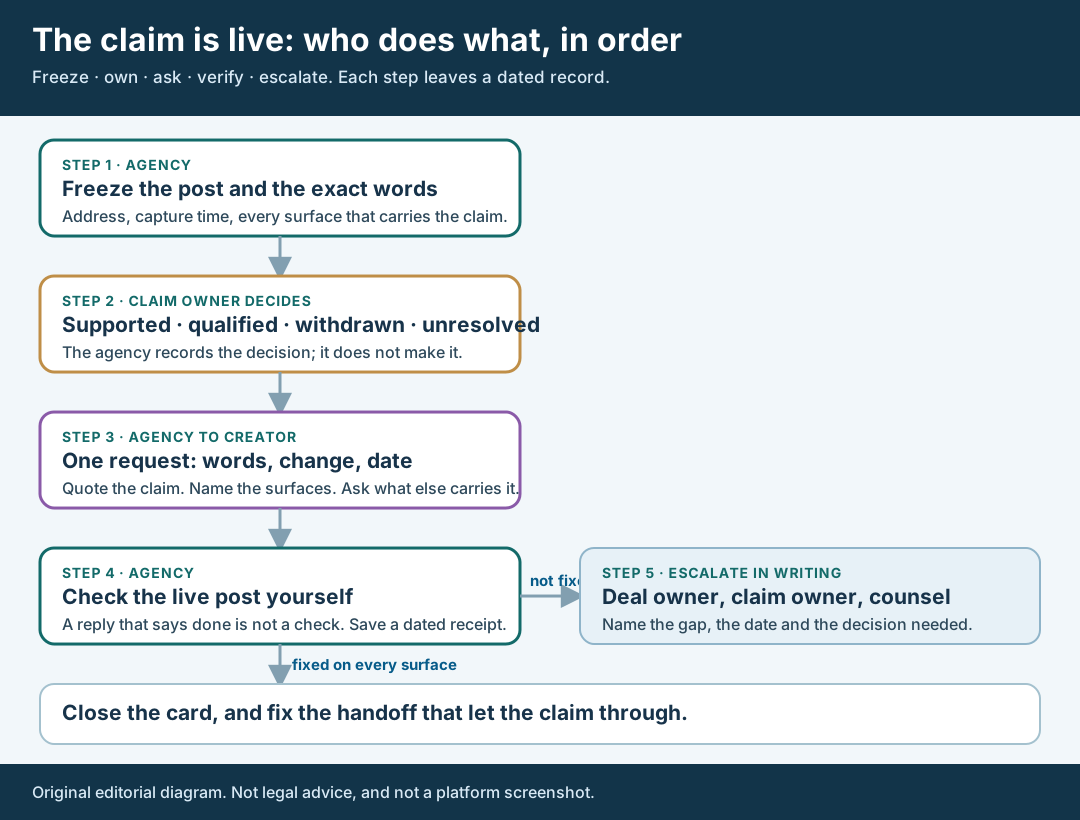
An original editorial path. Each step leaves a dated record, and the agency records the decision rather than making it.
Original visual by Superdirector editorial team. Creation date not recorded.
Ask the creator for one specific fix
Once the owner has decided, write the request. A useful message has six parts: the post address; the exact words and where they appear, with timecode or field; a plain statement that the team cannot currently support them as worded; the change needed, either removal of the sentence or segment or replacement wording the owner approved; a date; and a request that the creator reply in writing with what they changed and when.
Keep the reason short and factual. You do not need to send the brand’s private evidence, internal chat or commercial terms to explain a request. “We can’t support this sentence as worded” is enough. Do not ask the creator to prove the product. They usually cannot, and the FTC’s influencer guide says that influencers can’t make up claims about a product that would require proof the advertiser doesn’t have. That sentence explains why the request is reasonable. It is not a lever to threaten with.
Add one more question that people forget: where else did this appear? Ask whether the creator reposted the video, cut a shorter version, put the line in stories or a link-in-bio page, or reused it on another platform. The FTC’s question-and-answer page says that if an advertiser learns an influencer is making improper statements on another platform, it should not ignore it. Record every answer, including “nowhere else,” with the date.
Do not tell the creator how to edit. What a creator can change on a live post differs by platform and by post, and the options change, so ask what the app lets them do and check the platform’s own help for the route. If the contract says anything about edits, takedowns or approval of changes, quote the clause in your record. If it says nothing, that is a gap for the deal owner. Do not invent a right. The first-cut review lanes use the same discipline, where a required fix cites a clause or an outside source and everything else is an ask.
Do not demand that the whole post come down unless the owner decided that. Removing a post and removing one sentence are different remedies with different costs, and the person who bears the cost, often the creator and sometimes the client, should hear the actual request. If the request touches a sponsored post that is also running as a boosted placement, the placement owner needs the same message. The paid-use guide covers who agrees to that use.
Verify the live post and keep a receipt
When the creator replies that it is done, treat the reply as a claim about the post, not as proof. Open the exact post address and view it as an audience member would, on the surfaces you listed in step one: listen to the spoken line, read the on-screen text and caption, and follow any link. Check that the change reached every surface that carried the claim. A rewritten caption does not change a spoken sentence, and a deleted comment does not change the video.
Then write the receipt. It needs the time and time zone of your check, who checked, what the post now shows on each surface, and whether the result is *fixed on every surface*, *fixed on some* or *not fixed*. Keep the original capture beside it. Note the creator’s reply and what they said they changed, so the record shows both statements. If the claim owner approved replacement wording, compare the live words against the approved text, not against your memory of it.
Now close the other places. For each additional placement the creator named, record the owner and the date it was checked. A brand-controlled page, a scheduled brand post, an email draft or a landing-page embed belongs to the brand’s own team, who can fix them directly. Leave a row open until someone has actually looked at that placement. “Probably fine” is not a status.
Resist the urge to delete evidence. Once the post is fixed, your capture remains the proof of what was published, who knew when, and what you asked for. Store it where the claim owner and deal owner can reach it, and keep private contract or evidence documents out of anything you send to the creator. Whether a particular change was enough is the claim owner’s call.
Escalate when the fix stalls or fails
Some fixes do not finish on their own. Escalate when any of these is true: the creator has not answered by the date you set; the creator declines; the fix can only be partial; the claim is on a surface the creator does not control; or the claim owner and the deal owner disagree about the remedy. Write the escalation, with the date, to the person who can decide, and say what you need from them.
A useful escalation has four lines. What is live, with the address and your capture time. What was asked, with the date and the creator’s reply. The gap, for example “the sentence remains at 00:12 and in the caption.” The decision needed, such as whether to ask again, rely on a contract clause, pause related paid use, or take the question to counsel. Do not add speculation about the creator’s motives or about legal outcomes.
Route by the type of gap. A missing or unclear contract right goes to the deal owner. A disagreement about what the evidence supports goes to the claim owner, then to whoever the brand names for legal questions. A refusal or silence from a creator goes to the person who manages the creator relationship, with the request and its date attached. This page does not tell you what a lawyer would advise, and it does not predict how any regulator would view a given post.
The last step is upstream. The FTC’s question-and-answer page says an advertiser’s program should explain to members of its network what they can and can’t say about the products, instruct them on disclosure, periodically search for what members are saying, and take appropriate action if questionable practices turn up. It says too that it is unlikely one rogue influencer’s activity would be the basis of a law enforcement action if the company has a reasonable training, monitoring and compliance program in place. The Endorsement Guides themselves call good faith guidance, monitoring and remedial action not a safe harbor. So close the card, then fix the handoff. Note which origin applied, update the wording packet if the approved text was the problem, and schedule the next periodic look at what your creators are saying.
A fictional walkthrough
Every name, product and fact below is invented for teaching. It reports no real campaign and no real result. A fictional brand, ExampleCo, sells a fictional planner app. A fictional creator posts a video saying the app “syncs across all your devices instantly.” ExampleCo’s dated fact sheet, also fictional, says sync runs on a schedule and supports mobile only.
| Step | What the team records |
|---|---|
| Freeze | Post address and capture time; spoken line at a timecode and the same words in the caption; origin: the approved cut said “syncs across your devices,” so the creator added “instantly” |
| Own | Claim owner: ExampleCo product lead. Decision: qualified. Replacement wording from the owner: “syncs across your phones on a schedule.” Fact sheet and its date attached |
| Ask | Message quotes both surfaces, states that “instantly” cannot be supported as worded, gives the replacement wording, a date, and asks where else the line appears |
| Verify | Checked live after the creator’s reply: caption changed, spoken line unchanged. Result: fixed on some surfaces |
| Escalate | Spoken line remains. Deal owner is asked whether the contract allows a re-edit request; the claim owner decides whether a further request goes out. The wording packet is updated to say “on a schedule” |
What the sources say and what they leave open
The FTC material cited here was read on October 30, 2026. Each statement above is attributed to the page it came from. The list below shows what each source supports.
- 16 CFR 255.1, as published by Cornell’s Legal Information Institute: endorsements must reflect the endorser’s honest opinions, findings, beliefs or experience; advertiser, endorser and intermediary liability; guidance, monitoring and remedial action. Check the eCFR for the current text before relying on a quotation.
- FTC, “The FTC’s Endorsement Guides: What People Are Asking”: training and monitoring programs, outsourced promotion, and acting on questionable practices.
- FTC, “Disclosures 101 for Social Media Influencers”: influencers may not make up claims that would need proof the advertiser lacks.
- FTC Policy Statement Regarding Advertising Substantiation (1984) and the FTC’s advertising FAQs for small business: substantiation is expected before a claim is disseminated.
None of these pages says how fast a fix must be made, which kind of edit is sufficient, or whether a specific post breaks the law. Those answers depend on the facts, the platform, the contract and the jurisdiction. They belong to the brand and its counsel. This page gives a way to keep the facts and decisions straight until they are answered.