How-To Guide
Demonstrate a reusable bag's closure without inventing a leakproof test
A product video can teach someone to close a bag correctly without proving that it will never leak. Those are different claims.
By the Superdirector editorial team.
A product video can teach someone to close a bag correctly without proving that it will never leak. Those are different claims. The first concerns a visible technique on a specific model. The second can imply performance across conditions, repeated use and time that the video has not tested.
Build the asset around the action the buyer needs to understand. Show the seam, the closing path and the finished edge clearly. If you also include a performance observation, label its conditions and limits rather than allowing a dramatic shot to become a lifetime guarantee.
This article proposes an editorial approach. It does not report a laboratory test, food-safety assessment or demonstration performed on a real product. Manufacturer references were checked on October 24, 2026.
Identify the model before borrowing instructions
Reusable containers use different closures. A method that applies to one silicone bag should not be transferred automatically to a zipper pouch, rigid lid or another brand's seal.
Record the exact model, size and revision available for filming. Keep the current manufacturer's instructions with the brief. If the object on camera differs from the product page, resolve that mismatch before recording the demonstration.
Do not substitute a visually similar sample because it is easier to film. A close-up may make two closures look alike while hiding the operational difference that the tutorial is supposed to explain.
Separate manufacturer guidance from your own evidence
Stasher's care guidance advises keeping seals clean and dry, removing excess air and avoiding actions that can damage seams, including turning its bags inside out. The instructions are brand- and product-scoped, not universal reusable-container advice.
The Weekender product page describes pressing out extra air and pinching along the full seal. Its performance language is the manufacturer's assertion. Reading it does not mean this article independently tested or verified that performance.
Use the distinction in the brief: one column for documented instructions, another for observations actually collected. If the second column is empty, do not fill it with the first column's marketing claims.
Film the seam before the motion
Begin with a view that lets the viewer see the relevant closure edge. Show that the area being demonstrated is clear enough to inspect, following the manufacturer's cleaning and preparation guidance. Do not hide a corner behind the presenter's hand throughout the sequence.
Then record the complete closing path. Choose an angle where the action remains visible from one end to the other. A second close-up can help explain the final section, but it should not conceal a discontinuity in the process.
Finish with a view of the whole edge. The viewer should be able to connect the action to the part of the product that changed. Avoid editing directly from an open bag to an already closed one and calling that a technique demonstration.
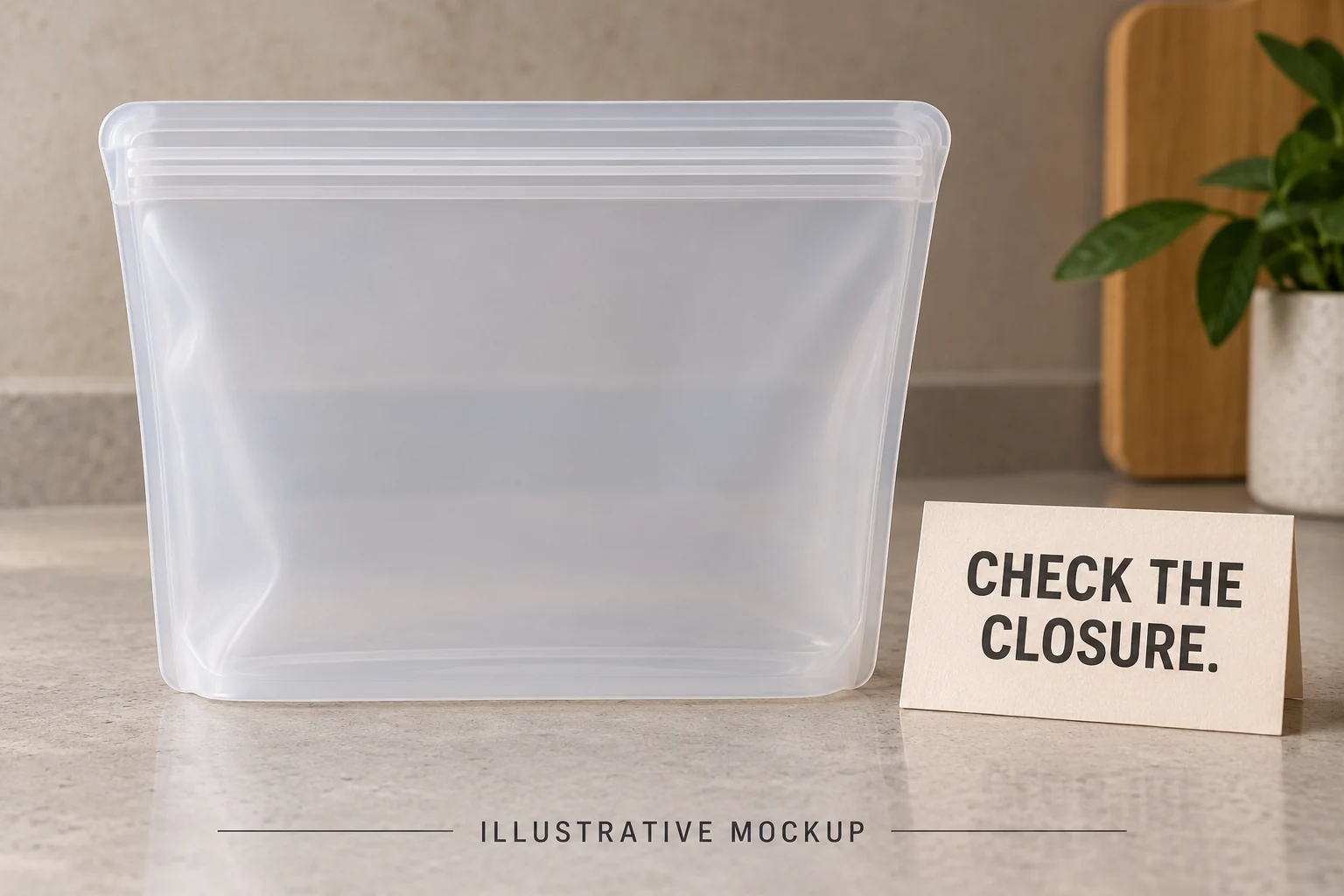
AI-generated illustrative mockup of an empty bag’s closure area. No bag was operated or inspected, and no leakproof, heating or manufacturer-certification claim is made.
Illustrative mockup by OpenAI image generation, editorial direction for this article. Created 2026-10-24.
Use the unsealed corner as an explanatory counterexample
An original schematic can show how a small unfinished section differs from the intended complete closing path. Label it as a conceptual example, not as a diagnosis of a real customer's problem.
Do not claim that every reported leak comes from user error. The video does not establish the cause of an individual failure, the condition of that person's product or the absence of a manufacturing issue. A useful tutorial can explain correct use without dismissing an unresolved complaint.
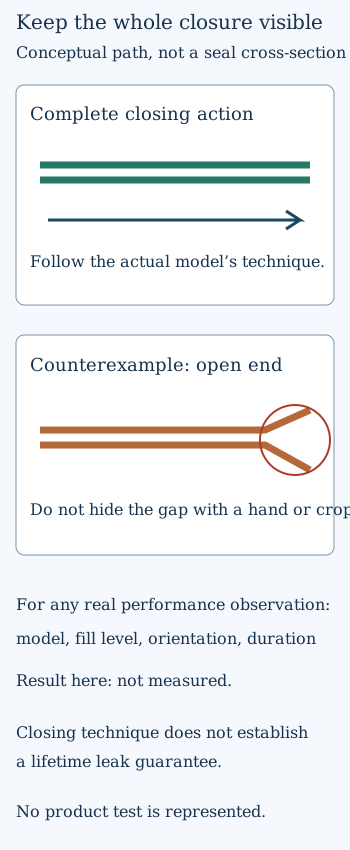
The diagram is not a technical cross-section of a proprietary seal and not evidence of liquid containment. It illustrates what the camera needs to reveal.
Original visual by the Superdirector editorial team. Creation date not recorded.
If you collect an observation, bound it
Where appropriate for the exact product and its instructions, a low-risk demonstration might use room-temperature water over a tray. Before doing so, identify the fill level, orientation, observation duration and product condition. Do not use valuable contents or place the product over electronics.
Record what happened rather than the conclusion you hoped to support. A dry exterior during one bounded observation supports a statement about that observation. It does not establish performance under pressure, during travel, after damage, over repeated cycles or for the product's lifetime.
No such observation was conducted. Leave the result field empty until evidence exists. Do not animate droplets disappearing or add a laboratory badge to imply a test that was not performed.
Keep heating and other use cases out of the shortcut
A closure demonstration at room temperature is not guidance for microwaving, cooking, freezing or transporting hazardous contents. Follow the exact current manufacturer instructions for any separate use case, including applicable venting requirements. Do not infer safe heating from a tight seal or use heat to make the demonstration more dramatic.
Likewise, do not perform destructive pressure tests or submersion demonstrations simply because they look convincing on camera. If a product claim requires formal performance testing, obtain appropriate qualified evidence rather than improvising a dangerous substitute.
This article's purpose is to keep the instructional claim narrow enough that the visual can actually support it.
Make the creative handoff explicit
Give the editor the model identifier, permitted instruction wording, full-path footage and a list of untested conditions. Ask for a visible start, complete motion and finished-edge view. Specify that a beauty shot of a packed bag is context, not proof of closure performance.
For a short social asset, the essential content is the action and the model scope. For a longer professional tutorial, include how to inspect the relevant edge and where the manufacturer's guidance can be found. Keep any observed result and its conditions together in both formats.
An internal reviewer should be able to repeat the described sequence in words and distinguish the instruction from a guarantee. If they summarize the clip as “this never leaks,” the asset is making a broader impression than its evidence supports.
Accept the demonstration, not an invented certification
Capture the complete closure path on one real sample. Review whether every part of the instruction is visible before adding any performance claim.