How-To Guide
When one missing product shot calls for a targeted creator fix instead of a reshoot
Annotate the cut against the shot list, test whether the missing shot would prove the buyer task, then ask for the smallest correction that does.
By the Superdirector editorial team. FTC and CFR pages reviewed October 30, 2026.
At a glance
When is one missing product shot enough reason for a targeted creator revision instead of a reshoot?
A targeted revision is enough when the creator's cut, with that single shot added, would show the buyer task the shot list line exists to show, and nothing else in the cut conflicts with it. Quote the line, mark the gap, check footage you already hold, and then ask for the smallest correction that passes: place an existing shot, one pickup clip, one re-recorded segment, or a reshoot. Choose a reshoot only when the problem is larger than one shot. After the revised cut arrives, recheck it against the same line.
- Judge the gap by what it fails to show, not by how large the missing clip is.
- Look in delivered footage first, then climb from a pickup clip to a reshoot only as needed.
- Recheck the revised cut against the same quoted shot list line.
Direct answer
Short answer: ask for a targeted correction when one shot is missing and the cut, with that shot added, would show the task the shot list line was written to show. Ask for a reshoot only when the problem is bigger than one shot. The way to decide is to annotate the cut against the shot list, write down the buyer task each missing shot must prove, check whether you already hold the shot, and then choose the smallest correction that passes a simple proof test: would a viewer of the revised cut see the action and its visible result?
This is for an agency or brand marketer who has received a creator’s cut for a product demonstration and noticed that a line on the agreed shot list is not in it. The decision is narrow: how much to ask the creator to redo. It does not decide whether the cut is acceptable overall, whether the missing shot breaches the agreement, or whether any claim in the video is supportable. Those questions have their own pages, listed in the boundary section.
A reshoot is the largest request you can make. It costs the creator time, can change the look of the whole video and may reopen decisions you already settled. A pickup request is far smaller, but it only works when the rest of the cut is sound. The three original assets below keep the choice honest: the shot-gap ladder, the blank gap card and the blank CSV register.
Annotate the cut against the shot list
Start with the two documents side by side: the shot list or brief version the creator was given, and the exact cut file you received, with its name, version and the date it arrived. Without both, you will compare the cut with your memory of the brief, and memory drifts toward what you hoped to see. If the brief changed after the creator started, note which version the shot list line comes from.
Go through the shot list one line at a time. Copy the line exactly as written, find it in the cut and give it one of three statuses: present, missing or unclear. “Unclear” is a real answer. A shot may be on screen for a fraction of a second, framed so the product cannot be seen, or shown in a different order from the list. Write the timecode where you expected it and a plain sentence on what the cut shows there instead. Do not write “bad” or “weak”; write what a viewer sees.
Annotate only gaps against lines that were on the list. A shot you would now like to see, but that the list never named, is a new request and belongs in the scope conversation described in the revision rounds guide, not in this correction. The same separation applies in the first-cut review guide, which sorts every comment into obligation, outside rule, brief gap or preference. This page picks up after that sorting, at the point where an agreed shot is simply not in the cut.
Name the task each missing shot must prove
A shot list line says what the camera should capture. It rarely says why. Before you decide how much to ask for, write the reason as a buyer task: the thing a viewer should see done, and the visible result. “Hand taps the export button” is a framing instruction. “A viewer sees a file go from the editor to a finished export in the folder” is a task. The task is what you are really missing, and it is what the correction has to restore.
Then run the proof test. Picture the missing shot placed at the timecode you marked, and ask one question: with this shot in, would the cut show the task, including its result? Answer yes, no or unsure, and write the reason. A yes means the gap is local: everything around the shot already supports it. A no means something else in the cut is also failing the task, and a single insert will not rescue it. An unsure means you need more evidence before choosing, which usually means looking at the footage you hold in the next step.
Why bother with the written task? Because a missing step can change what the video appears to promise. The FTC’s policy statement on deception says that, in judging an advertisement, the agency considers the entire advertisement and the net impression it is likely to make, and it describes the omission of material information as one kind of practice that can mislead. FTC Policy Statement on Deception. That statement is not about creator videos or shot lists in particular, and it does not tell you that a missing shot is deceptive. It is a reason to write down, line by line, what the finished cut actually shows a viewer.
Look for the shot in what you already hold
Before anyone shoots again, look at what has already been delivered. The shot may sit in the cut at a different timecode than the list implies. It may appear in a cutdown, a second version or an alternate take the creator sent with the main file. Search those first and update the annotation if you find it. A shot that was present but short, dark or out of order is a different request from a shot that was never filmed, and it calls for a smaller message to the creator.
Then read your agreement for what files you are entitled to receive. Many deals cover a final video and agreed cutdowns and say nothing about the unused clips. If the agreement is silent on raw files, write “no clause” and treat any request for unused clips as a favour, not an entitlement. The raw footage guide explains why a copy, a permission and a price are three separate questions. Asking for raw files to hunt for one shot can turn a small correction into a negotiation about a whole new deliverable, so ask the narrower question first: “Do you have a take of this line that you can place in the cut?”
Record the result on the card as yes, no or not checked. If you answer yes, the correction is the smallest one available: a re-export with the shot placed, which is rung one in the next step. If you answer no, the shot has to be made, and the next step helps you decide how much to make.
Pick the smallest correction that proves it
There are four corrections, and they form a ladder. Start at the bottom and stop at the first rung that passes the proof test. Going higher than you need adds cost for the creator and risk for the cut, and a rung you skip is a rung you never tested.
| Rung | Choose it when | What you ask the creator for | What stays untouched |
|---|---|---|---|
| 1. Place a shot already delivered | The shot exists in footage or a version you hold | A re-export with that shot placed at the marked timecode | Everything else in the cut |
| 2. One pickup clip | The proof test passes with the shot added, and the same setup can be filmed again | One new short clip of the quoted line, dropped into the existing cut | The rest of the cut, including the voice and the music |
| 3. Re-record one segment | The gap sits inside a continuous or spoken stretch that cannot be cut around | That stretch only, filmed again and swapped in | Segments before and after it |
| 4. Reshoot | The proof test fails even with the shot added, or several lines fail, or a fix cannot match the cut | A new shoot against a revised brief or shot list | Nothing is assumed to survive |
Two things push you up a rung. The first is a failed proof test: if the answer to “would the cut show the task?” is no even with the missing shot added, the cut is not one shot away from working, and a pickup would only hide the real problem. The second is a fix that cannot match. A pickup clip has to sit beside footage that already exists. If the setting, the light, the outfit or the product on screen has changed since the original shoot, an insert can look wrong next to its neighbours, and a longer segment or a reshoot may serve better. That is a judgment about how the pieces would look together, so let the creator tell you what they can match and record their answer.
Move straight to the top rung if the real fault is the product itself as shown. A cut that displays a retired screen or the wrong version is not missing a shot; it shows something untrue about the product. That case is covered by the outdated product UI guide. A cut that is missing an entire deliverable that the creator declined is covered by the partial acceptance guide. Neither is a single-shot gap.
Use the shot-gap ladder as the one-page version of this table. Write on the card why you did not choose the rung below the one you picked. That sentence is the part of the record that shows the correction was the smallest one that works, and it is the sentence you will need if the creator or a colleague asks why you wanted more than a pickup.
When enlarged, scroll horizontally to read the diagram.
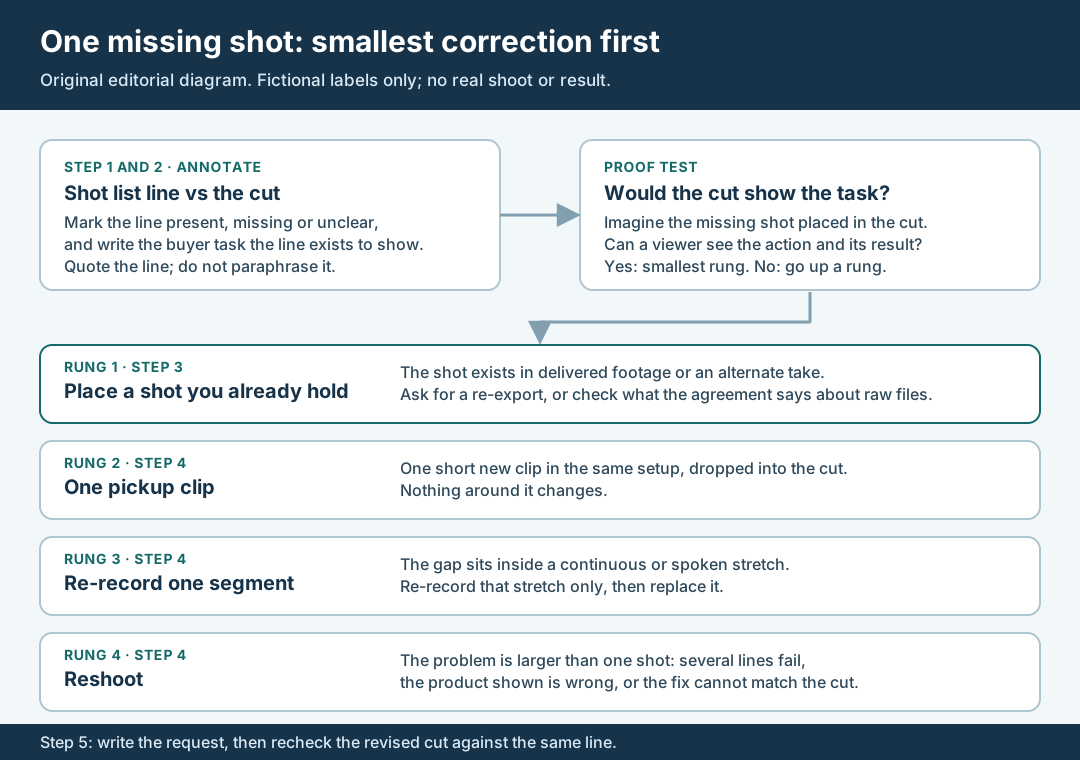
An original editorial diagram. Choose the first rung that passes the proof test, then recheck against the same line.
Original visual by Superdirector editorial team. Creation date not recorded.
Write the request and the recheck
Send one message that covers every missing line you annotated. For each line, give the creator four things: the shot list line quoted exactly, the cut file and timecode where it should appear, the task it must show in plain words, and the rung you are asking for. A request that says “can you add the export shot?” makes the creator guess what you saw. A request that says “line 4 reads X; in cut version 2 at 0:41 the video shows Y; the shot should show a viewer Z; could you send one pickup clip of it?” lets them answer in one reply.
Say what will not change. Creators worry that one fix opens a new round of notes. If you want only the insert, write that the rest of the cut is accepted as is for this purpose, and keep any wider opinion out of the message. Also say how the revised file should be named, so you can tell the new version from the old. If your agreement counts revision rounds, check whether this request uses one and say so, as the revision rounds guide describes.
Ask a question rather than issuing a verdict. The creator may tell you the shot was filmed and cut for length, or that it was never possible with the sample they received. Save the reply exactly as written with its date, time and time zone. If the answer changes the rung, for example because they cannot match the original setting, update the card and the request instead of arguing the first choice.
When the revised cut arrives, recheck it against the same quoted line and the same task, using a fresh copy of the card. Mark the line present or not, and run the proof test again on the revised file. Look at the whole cut once more for anything the insert disturbed, such as a changed order, a clipped voice line or a different product on screen. Then record the decision and who made it. The FTC’s endorsement guidance notes that it is much easier to review posts before they go live than to search for them afterwards. FTC Endorsement Guides: What People Are Asking. The same logic applies here: the cheapest time to catch a missing shot is before the video is posted, so recheck before you approve for publishing.
Walk through a fictional gap
Fictional exercise: no real brand, creator, campaign or result was inspected. Brand A briefed Creator Q on a made-up product, Tool X, with a shot list of five lines. Line 4 reads: “Hand taps Export; finished file appears in the folder.” In cut version 2, the video shows the hand tapping Export at 0:41 and then cuts to the creator talking. The folder never appears.
The reviewer marks line 4 as unclear: the tap is present, the result is not. The task is written as “a viewer sees a file go from the editor to a finished export in the folder.” The reviewer checks what is held. The cutdown sent with the main file has the same ending, and nothing else was delivered, so the answer is no. The proof test: with a shot of the folder added right after 0:41, would a viewer see the task and its result? Yes, because the tap and the explanation already sit on either side of the gap.
That passes at rung two. The reviewer writes why rung one fails (nothing is held) and asks for one pickup clip of the folder, filmed in the same room. The message quotes line 4, names version 2 and the timecode, states the task, and says the rest of the cut is accepted for this purpose. Suppose Creator Q replies that they can film the folder again but have since moved their desk. That is the creator’s statement, saved as written. The reviewer records it and asks whether a tight shot of the screen alone would match. The scenario predicts nothing about any real creator, product or outcome.
What this page does not decide
This page helps you choose how much to ask for when a single agreed shot is missing. It does not decide whether the creator did something wrong, whether the video is acceptable, or whether the final cut’s statements are true. The FTC’s endorsement rule says an endorsement may not convey any express or implied representation that would be deceptive if made directly by the advertiser, and that advertisers are subject to liability for misleading or unsubstantiated statements made through endorsements. 16 CFR 255.1 holds the exact text. A shot-gap record is a note of what you saw and what you requested; it is not a legal opinion, and questions about liability belong with counsel.
How this differs from the closest pages. The revision rounds guide fixes what a round is, before production; this page begins after a cut exists and asks how big one correction should be. The first-cut review guide sorts every comment by its source; this page handles one kind of finding, an agreed shot that is absent, and gives a ladder for the response. The outdated product UI guide is about shots that are present but show the wrong product; this one is about shots that are not present. The claim-safe demo brief shapes the shot list before filming; this one audits a delivered cut against that list. The raw footage guide prices unused clips; this one only asks whether a held clip can fill the gap.
Nothing here measures how often cuts miss a shot, how long a pickup takes, what it costs or how a correction affects results. We hold no such data and claim none. We also have not reviewed any platform’s rules on replacing a video after it is posted, so this method assumes the correction happens before publishing.