How-To Guide
Find Spanish-language cozy-game creators without treating Spain and Latin America as one audience
Build a Spanish-language cozy-game creator shortlist with separate evidence for game fit, language and audience geography.
By the Superdirector editorial team.
At a glance
My cozy game is fully playable in Spanish. How do I find Spanish-language creators without treating Spain and Latin America as one audience?
Search for creators who cover the kind of game you made, then record language and geography as separate facts. Spanish speech establishes a language match. It does not establish where viewers live, which regional wording they prefer, when they watch or whether your game is available to them.
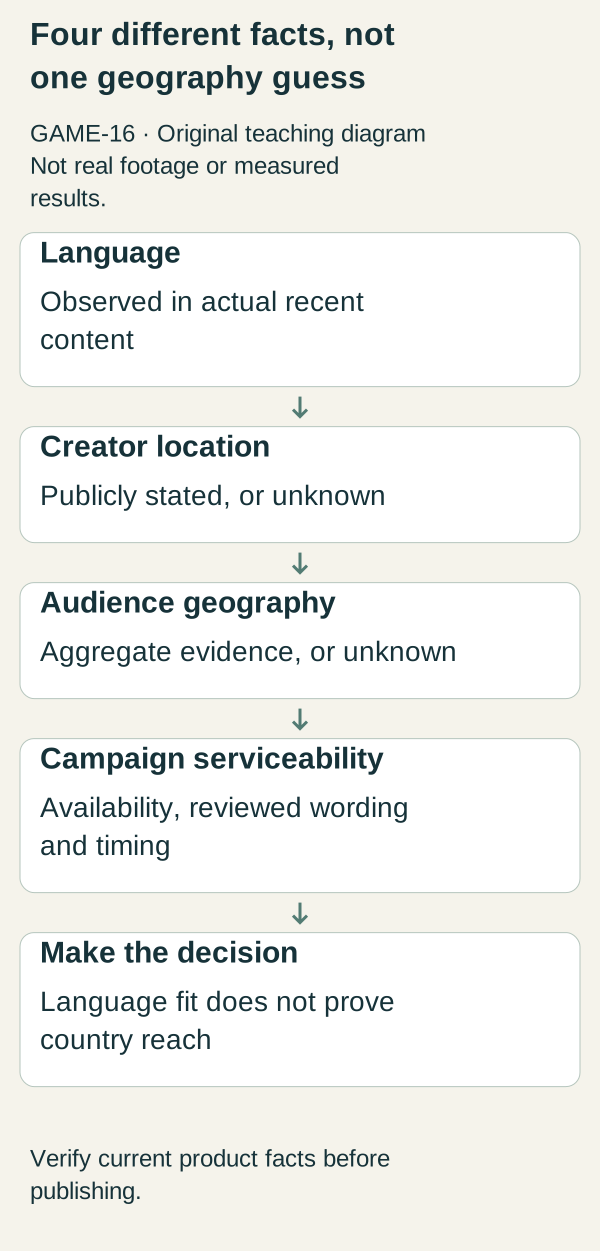
Original illustrative teaching diagram. Keep language, creator location, audience geography and campaign serviceability as separate evidence questions. This is planning guidance, not product footage, customer evidence or measured results.
Original visual by Superdirector editorial team. Created 2026-10-20.
Search for creators who cover the kind of game you made, then record language and geography as separate facts. Spanish speech establishes a language match. It does not establish where viewers live, which regional wording they prefer, when they watch or whether your game is available to them.
A useful shortlist can contain “audience country unknown.” It should not contain a country guessed from an accent, surname or flag. This guide supplies a research method and a completed fictional decision sheet, not a list of vetted creators or country-level market estimates.
Start with the game's actual Spanish support
“Playable in Spanish” can mean interface and subtitles without Spanish voice acting. Write down what is translated, which variant the team reviewed, whether the store page is localized and where players can actually obtain the build. If the game contains untranslated tutorial images, that matters more than a polished Spanish pitch.
Our fictional cozy game, Patio de Nubes, has Spanish interface text and subtitles, no spoken dialogue, and a Spanish store description reviewed by a named language professional. Its promotional campaign has not yet established audience-country data. The example's first goal is to find relevant Spanish-language coverage, with separately researched opportunities in Spain and Mexico. Mexico is an example research lane, not shorthand for all Latin America.
The completed brief reads: peaceful rooftop gardening; PC demo; interface and subtitles in Spanish; no voice-language promise; public store destination; build checked against the reviewed terminology list; creator audience geography to be verified. That brief prevents the researcher from quietly changing a language task into a nationality assumption.
Build searches around comparable play
Choose actual comparable games whose interaction, pace or audience overlaps your own. Search their names with Spanish terms for gameplay, first impressions or demo. Inspect results rather than assuming a query term determines the language of the video. A Spanish title can accompany an English stream, and an English title can accompany Spanish commentary.
For each promising channel, watch enough of recent coverage to understand the format. Does the creator explain quiet systems? Do they cover unfinished demos? Is their usual format long enough for the experience? A broad “gaming” category or a database's language tag is only a lead.
Record two relevant pieces of content when possible, with URLs and dates. Choose a review window suited to the channel's publishing cadence. An infrequently publishing creator may justify looking further back, but write down that exception. Do not call a years-old cozy-game video evidence of the channel's current focus without checking what it now publishes.
Keep four different geography fields
- Content language: observed in the video or stream; note mixed-language formats.
- Creator location: explicitly stated by the creator in a current public business profile, or unknown.
- Audience geography: creator-provided aggregate information or other clearly identified evidence, or unknown.
- Campaign serviceability: the game's actual availability, language experience and relevant event timing for the proposed audience.
The second field does not fill the third. A creator living in Spain can have viewers elsewhere. A creator based in Mexico can reach a mixed international audience. Do not request individual viewer data to resolve this; aggregate information is sufficient for a planning discussion when geography materially affects the collaboration.
Keep Latin American markets as individual research lanes when you have an operational reason to distinguish them. Availability, event timing and reviewed wording can justify that work. A country label added solely to generate more SEO pages or more spreadsheet rows does not improve the shortlist.
Completed shortlist decisions
All three candidates below are invented. They demonstrate the evidence fields without recommending real people.
Candidate A: Example Garden Channel. Observed language in the teaching scenario: Spanish. Content fit: two narrated cozy PC demo videos in the selected window. Public creator location: Spain. Audience geography: unknown. Contact: explicitly published game-submission route. Decision: eligible for a language-fit draft, not eligible to claim a Spain-heavy audience. Next step: review stated submission requirements and personalize from the inspected videos.
Candidate B: Example Quiet Play. Observed language: Spanish. Content fit: a recent gardening-game series with calm explanation. Public creator location: Mexico. Audience geography: aggregate breakdown supplied by the creator in a hypothetical media kit, requiring freshness verification. Decision: research further for a Mexico-specific event only if the relevant audience information and schedule support that goal. A Mexico location by itself is not enough.
Candidate C: Example Night Stream. Observed language: Spanish. Content fit: recent videos only cover competitive shooters; an old cozy-game clip appears in search. Creator location and audience geography: unknown. Decision: reject for this cozy-demo campaign because current content fit is missing. Do not keep the row just to balance country quotas.
These decisions are more useful than a numerical “fit score” assembled from unverified inputs. Unknowns stay visible, and a strong language match need not be discarded merely because the team cannot yet prove a country-specific audience.
Prepare a regional review brief, not three stereotyped pitches
Give a fluent reviewer the exact gameplay premise, platform, access instructions, terminology list and recipient context. Ask them to check natural wording, variant-sensitive terms and whether the tone matches the creator's public communication. Do not ask them to sprinkle slang into an otherwise generic message.
Completed review instruction: “This draft is for an unpaid editorial consideration request to a Spanish-speaking cozy PC creator. Preserve the factual statements about interface and subtitles. Do not imply Spanish voice acting. Keep the request low-pressure. Check that the gardening terminology matches the game. Mark phrases that need a market-specific decision rather than guessing the creator's audience.”
A compact English source draft for translation is: “Your recent video about arranging small spaces showed why I thought Patio de Nubes might fit your channel. It is a cozy PC gardening demo with Spanish interface text and subtitles. Here are the playable build and content notes. We are offering it for editorial consideration, with no obligation to cover it.” Replace the personalization with an observed detail and verify the destination before any send.
For scheduling, ask for the actual date, time and time zone. Avoid “Spanish evening” or “Latin American prime time.” Even a real country does not always imply a single time zone or a stable audience schedule.
Track what the campaign establishes
The reusable row is: channel identity; comparable-game evidence; inspected language; stated creator location and source; aggregate audience geography and date; availability check; reviewed message variant; verified submission route; prior contact; next decision. Separate research state from contact state and coverage state.
If coverage later appears, record its URL and actual language. Do not label every wishlist arriving that day as a Spain or Mexico acquisition. A localized campaign can teach you about creator fit without supporting country-level attribution.
Your next action is to complete the support brief and inspect three comparable-game videos. Create separate geography fields before collecting more leads; retrofitting them after outreach is where assumptions often become invisible.
Sources and important limits
The inspected StreamersDB Spanish-language page is a commercial discovery lead, not proof of audience country or cozy-game fit. The ICEX Games from Spain directory was only partially visually reviewed in the supplied study. It concerns Spain's industry and can suggest comparable-game research, not a pan-Spanish creator list. No directory count, current contact claim or regional performance benchmark is adopted here.