How-To Guide
How to benchmark a creator’s quote when published rate reports give you three different ranges
Turn one creator quote into a like-for-like number, set it against rate reports and your own past quotes, and note what the result does not prove.
By the Superdirector editorial team. Rate-report, platform and TikTok pages reviewed October 31, 2026.
At a glance
How do you benchmark a creator’s rate when published rate reports disagree?
Rewrite the quote as one standard deliverable with paid use, exclusivity and extras on separate lines. Choose one view measure and a median of recent comparable posts. Plot at least three published ranges side by side with their method notes, instead of averaging them. Set the quote beside your own like-for-like agreed fees, then write a short finding: where the quote sits against your set and against the reports, what is unknown, and the next question for the creator. A benchmark supports a question or a scope conversation. It does not prove a fee is fair.
- Published per-post ranges for micro creators differ about fivefold at their low ends, and the pages we read disclose no sample or statistic.
- Compare a base fee for organic posting with a base fee, never a bundled total with a base fee.
- Your own agreed fees for the same deliverable are the benchmark with a known basis.
Short answer
Short answer: treat a benchmark as a range with a stated basis, never as the price. Work in five steps. Rewrite the quote as one standard deliverable with rights priced apart. Choose one view measure and one window. Read three published ranges together, with what each says about its method. Set the quote beside your own like-for-like quotes. Then write down what the comparison supports. The output is a sentence such as “above our median, inside two of three published ranges, reason unknown, so ask what the fee includes”. It is not the word “fair” or the word “overpriced”.
The reason not to look up one number is that the published numbers disagree. For micro creators on Instagram we read three reports on October 31, 2026. Influencer Marketing Hub lists $100 to $500, open-ended, per post. Elev8or’s Creator Rate Report 2026 gives a baseline of $250 to $1,500 for an average-demand niche. Later’s 2026 pricing guide gives $500 to $2,500 for a micro tier and does not name the platform. The lowest stated figures sit five times apart, and none of the three pages we read states a sample, a collection period or whether its figures are medians or means. The spread diagram plots them on one axis, and the blank benchmark register holds the rows for the steps below.
This page is for someone who has a creator’s quote in hand and has to say whether it sits inside the market. It does not set your fee, value a creator or give a rate. Those decisions belong to your brief, your budget and the people who sign. The method only makes the comparison honest: the same deliverable, the same rights, the same kind of view count and a visible basis for every number.
Why three reports give three answers
Before you use any report, read what its own page says about itself. The table records what we found, no more. A blank in the right-hand column means the page did not say, not that the report is wrong.
| Source | Per-post figures we read | What the page says about method |
|---|---|---|
| Influencer Marketing Hub (page updated October 6, 2026) | Instagram: nano $10 to $100+, micro $100 to $500+. Micro TikTok $200 to $800 per video, micro YouTube $200 to $1,000+ per video. | Calls them planning benchmarks, not fixed rate cards. Credits its own research and benchmarks; gives no sample, respondent count or fieldwork dates. Defines nano as under 10,000 followers in one place and 1,000 to 10,000 in another. |
| Elev8or Creator Rate Report 2026 (published June 2026) | Instagram baseline for an average-demand niche: nano $50 to $250, micro $250 to $1,500. Other niches and platforms are scaled with indices. | Calls the figures directional planning ranges, not quotes. Does not disclose its data source, sample, collection period or whether values are medians or means. Licensed CC BY 4.0. |
| Later, 2026 pricing guide | Nano (1K to 10K) $100 to $500, micro (10K to 100K) $500 to $2,500. The tier table does not name a platform. | Calls them baseline ranges. No sample or period, and no statement of median or mean. The page ends by promoting Later’s own tool, which it says draws on verified campaign data; we could not check that. |
| Aspire, How Much to Pay Influencers 2026 | Not on the public page. The figures are in a downloadable report that we did not open. | Describes a survey of nearly 1,200 creators about their sponsored-content rates, plus its own staff’s insight. Fieldwork dates are not on the page. |
Several things can produce the gaps, and the pages let you test only some of them. Tier edges differ: the same account can be nano in one report and micro in another. The platform may be missing: Later’s tier table does not say which platform it prices. The statistic is unknown: a mean is pulled up by a few very expensive deals, while a median is not, so a report that does not say which it uses cannot be held against a median of your own. The kind of price differs: a creator survey records what creators say they charge, a marketplace records quotes, and your own file records what you agreed. The scope differs: a base fee for organic posting is not a fee that includes paid use.
Do not average the reports to settle the question. Three undisclosed methods averaged give a number with no basis, and it will look more precise than any of them. Keep the ranges separate, note where they overlap and write down which questions about each you could not answer. The overlap is information; the average is not.
Step 1: rewrite the quote as one standard deliverable
Start by copying the quote as sent: the amount, currency, date, the version if there is more than one, and the creator’s own list of inclusions. Then sort every line into either the base fee for one named deliverable posted organically on the creator’s account or something else: paid use, exclusivity, raw footage, revisions, an agency fee, a gifted product. Published base-fee ranges are, at best, ranges for the first group. If the quote is one lump, the comparison is not ready.
The reports say the second group matters. Influencer Marketing Hub says standard fees generally cover organic publication on the creator’s own account, and that adding paid ads, landing pages, email or retail media for macro creators can raise budgets by 30% to more than 100%. Later gives a 30% to 50% premium for whitelisting on Instagram and says usage-rights cost rises with duration and placement. Elev8or lists usage rights and exclusivity among the factors that move a final number. Aspire’s page says its report includes usage-rights and exclusivity benchmarks, but not what its flat-fee figures include. None of these is a rule for your deal. Together they say one thing: ask for rights as separate lines. If the quote does not itemize, ask in writing what the total becomes without paid use. The bundle-quote guide shows how to open a lump quote into stated, inferred and missing lines, and the paid-use term guide covers choosing a term before the fee is discussed.
Terms need numbers too. TikTok’s Content Suite help page says Spark Ads authorization requests sent from Content Suite default to 365 days. A quote that offers “Spark rights” and says no more could therefore mean a year, so ask for the period in writing. We found no statement on that page of which periods a creator can choose, so the page cannot tell you what to expect. Finally, mark each number as asked or agreed. An ask is where a conversation starts. An agreed fee is a price both sides accepted, and only agreed fees belong in the middle of your own benchmark.
| Field | What goes in it | If you cannot tell |
|---|---|---|
| Deliverable | Platform, format, count, length | “Not stated”; ask before comparing |
| Base fee | Amount, currency, quote date and version | Do not infer it from a total |
| Paid use | Platforms and term, as written | “Not itemized”; ask for the total without it |
| Exclusivity | Category covered and term | “Not stated” |
| Extras | Raw footage, revisions, agency fee, gifted product | List each as present, absent or unknown |
| Status | Asked or agreed, with the date | Treat as asked |
Step 2: choose one view measure and one window
Follower tiers are a blunt guide to price, so many teams add a per-view figure: the base fee divided by the creator’s typical views, usually per 1,000. It helps only if the views are comparable, and platforms keep changing what a view is. TechCrunch reported that from March 31, 2025 YouTube counts a Shorts view each time a Short starts to play or replay, where it used to wait for a set number of seconds, and that the earlier measure stays available as “engaged views”. YouTube’s help page now says that beginning August 24, 2026 views are counted the moment a video starts to play across all formats, and that Partner Program earnings still rest on engaged views and engaged watch hours. Social Media Today reported in August 2024 that Instagram had moved to a single “Views” metric across content types. We did not read Instagram’s own help pages, so treat that as press reporting.
The practical rule has four parts. Stay inside one platform. Use posts published after the latest counting change that applies to that platform, because a history that straddles a change is not one series. Write down the metric name the platform shows. Use a median of the creator’s recent comparable posts, not the best post; one viral video lifts a mean and hides the usual result. How many posts to include is your call, because we found no sourced standard, so choose a number, write it on the register and use it for every creator in the set.
Step 3: read three published ranges for their method
Pick at least three published ranges for the same platform and tier, and write the answers to six questions on the register for each. Does it name the platform? Does it define the tier by followers and does that definition match yours? Does it name the statistic, median or mean? Does it disclose a sample and period? Is it asked, quoted or agreed prices, or creator-reported rates? Does it say what rights the figure includes? Add the date you read it, because pages change: the Influencer Marketing Hub page we read was marked as updated on October 6, 2026, and Elev8or’s report is dated June 2026.
Then plot the ranges on one axis, as in the figure, and look at three things. Where do they overlap? Which one is an outlier and does its method note explain why? Where does your normalized base fee fall? A fee that is inside the overlap tells you little. A fee outside every range tells you the quote may be for something different from what you think, which is a reason to reopen Step 1 before you reopen the price. A report that answers fewer than half of the six questions stays on the chart but is marked as unchecked.
When enlarged, scroll horizontally to read the diagram.
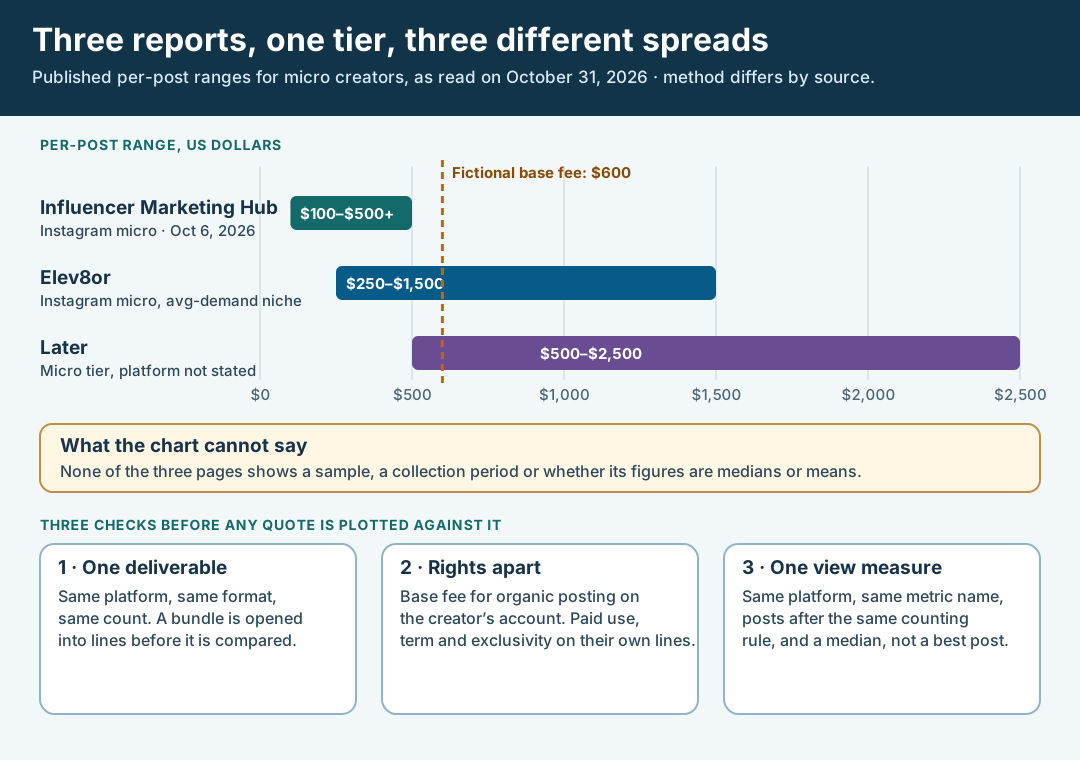
An original editorial chart of figures as published and read on October 31, 2026. The $600 line is a fictional example, and the sources use different methods.
Original visual by Superdirector editorial team. Creation date not recorded.
Step 4: build a set of your own like-for-like quotes
Your own agreed fees for the same deliverable are the only benchmark whose basis you know. Put each one on the register with the same fields as the quote you are testing, and keep asked and agreed apart. Leave out any row whose rights, exclusivity or deliverable differ from the quote’s, and record the reason on the row, because a reader should be able to see what you excluded. Marketplace data that separates what creators asked from what brands paid is discussed on our how much to pay influencers page; this method applies the same distinction to your own file.
Say how many rows you have. With fewer than five comparable rows, show the rows themselves rather than a median or a range. That threshold is an editorial rule for this page, not a statistical standard. A new brand with no history can build a first set quickly: send several creators the same written brief for the same deliverable and rights, and enter each reply on the register. A written brief is also what makes the quotes comparable, because each creator prices the same job.
Walk through a fictional quote
Fictional exercise: no real creator, brand, quote or result was inspected, and the dollar figures are invented for the arithmetic. Brand B wants one Instagram Reel from a micro creator, C1. C1 quotes $900 and says it includes 30 days of paid use. Brand B asks in writing what the price is without paid use, and C1 replies that paid use is $300 of the total. The base fee is therefore $600. C1’s median views over their last six comparable Reels, all published under the same counting rule, are 12,000. Brand B’s own file holds five earlier agreed fees for a similar Reel.
| Row | Base fee | Median views | Base fee per 1,000 views | Counted? |
|---|---|---|---|---|
| K1 (agreed) | $350 | 10,000 | $35.00 | Yes |
| K2 (agreed) | $400 | 8,000 | $50.00 | Yes |
| K3 (agreed) | $450 | 15,000 | $30.00 | Yes |
| K4 (agreed) | $500 | 20,000 | $25.00 | Yes |
| K5 (agreed) | $900 total, paid use included | Not used | Not computed | No: rights differ and the base fee is not itemized |
| C1 (asked, normalized) | $600 | 12,000 | $50.00 | The quote under test |
Brand B has four counted rows, fewer than five, so it shows the rows and reads the median only as a reference. The median base fee of K1 to K4 is $425, and $600 is about 41% above it. The median of the four per-1,000 figures is $32.50, and C1’s $50.00 is about 54% above it. It equals K2’s figure, so it sits at the top edge of what Brand B has actually agreed, not outside it. Against the published ranges for an Instagram micro creator, $600 is above the $500 that Influencer Marketing Hub states (its range ends in a plus sign, so it is open-ended), inside Elev8or’s $250 to $1,500 and just above the bottom of Later’s $500 to $2,500.
The finding Brand B writes is: “Base fee is above our agreed median and at the top of our per-view spread. It is inside two of three published ranges, whose methods are undisclosed. We do not know why it is higher.” That supports one next move, a question about what the fee reflects, such as audience, format or turnaround. It does not support “reject” or “accept”. If Brand B cannot meet the fee, the guide to closing a quote you cannot meet covers saying so without promising more.
Step 5: write what the benchmark supports and what it does not
End every comparison with a short note in four parts: the normalized quote, its position against your set with the row count, its position against the published ranges with the unchecked ones marked, and what is unknown. Then name the next question. The position decides which question, not the price.
| Position | What it can support | What it cannot support |
|---|---|---|
| Inside your set and the overlap of the reports | Moving on to scope, rights and timing | A claim that the fee is good value for your brief |
| Above your set | Asking what the fee includes and what drives it; the budget-reply guide shows how to ask without naming a number first | A claim that the creator is overcharging |
| Below your set | Checking what is missing: rights, exclusivity, deliverable, audience fit | A claim that it is a bargain |
| Cannot be normalized | Asking for the missing line | Any comparison at all |
Store the read date next to every published figure and read the reports again before each campaign. The pages we saw carry dates, October 6, 2026 for Influencer Marketing Hub, June 2026 for Elev8or and a September 3, 2026 date in Aspire’s page metadata, and a figure carried over from last quarter is a figure of unknown age. Keep your own register as the long-term record. Each agreed fee you add makes the next comparison sturdier than any outside page.
Where Superdirector fits
For a handful of quotes this is a spreadsheet job, and the blank register is enough. Superdirector does not publish a market rate, and the ranges on this page come from the third-party reports cited, not from Superdirector data. Where it can help is upstream, with the campaign the quote sits inside. Bring your campaign goal and the deliverables you intend to ask for to a campaign brief in Superdirector, so every creator you contact is pricing the same job. Check the available workflow and usage before requesting work.
How this differs from nearby pages, and what we could not verify
This page teaches one skill: testing a single quote against outside and internal benchmarks without fooling yourself. Our valuation method works out what a deliverable is worth to a brand. The nano and micro rate bands list bands for those tiers. The rate card template is what a creator or agency fills in to state their own prices. The bundle-quote guide opens one lump quote into lines. Here those are inputs, and the new decision is how much weight a benchmark can bear.
Limits of what we checked. We tried to read the Collabstr 2026 influencer marketing report and its price calculator for this page and the site returned an access error, so nothing here relies on them. Aspire’s tier and platform figures are in a download we did not open. We did not read Instagram’s or TikTok’s own definitions of a view and relied on press reports for Instagram. The 365-day TikTok default comes from one help page that does not list the periods a creator can choose. Later’s claim about verified campaign data is unchecked. We found no published CPM benchmark or minimum sample size that we could trust, so this page gives none. The dollar figures in the walk-through are invented, and nothing here measures how often benchmarking changes a deal.