How-To Guide
Can a brand get influencers to promote a product for free?
Plan an honest no-cash creator proposal: product fit, real costs, optional gifts, product-for-work and commission, without promising free promotion.
By Bell Chen, founder of Superdirector — how the analysis works.
At a glance
Can a brand get influencers to promote a product for free?
A creator may voluntarily share a product received without a cash fee, but an unconditional gift cannot guarantee a post. If content is required, propose a clear product-for-work arrangement the creator can accept or decline. Commission is contingent compensation, and product, fulfilment, staff work and any agreed costs remain real.
- No cash fee does not mean zero product, fulfilment or staff cost.
- An optional gift, product-for-work request and commission offer create different expectations.
- Actual relevance and product usefulness matter; no acceptance or promotion outcome is promised.
Define what you mean by free promotion
You can invite a creator to receive a product without a cash fee. You cannot make an unconditional gift into a guaranteed post. Before searching for “free promotion,” decide whether you can accept no content, need an agreed product-for-work exchange, or can support a real commission arrangement. Each choice uses resources and asks something different of the creator.
| What you offer | What the creator owes | What still costs something |
|---|---|---|
| Unconditional product or access | No content obligation under that proposed offer; any later endorsement is voluntary | Product/access provision, fulfilment, support and your time |
| Product for specified work | Only the work the creator knowingly agrees to, with actual terms | The benefit, shipping/support, production effort and any other agreed costs |
| Affiliate commission | The accepted program rules determine what earns money; content requirements need separate clarity | Commission, applicable fees/discounts, tracking and administration |
| Exposure or a future opportunity | No obligation or measurable value can be assumed from the label alone | Any actual promised distribution or work; a future paid project remains unagreed |
This page helps a small brand decide whether a no-cash proposal makes sense before writing a message or shipping a sample. The gifting-versus-paid overview compares the broad arrangements; the barter agreement guide handles terms when required work is the choice. This is not another contract or a set of DM scripts.
Shopify’s October 2025 business article describes seeding as free product with no obligation to post, then discusses separate affiliate relationships. Its anecdotes and reported survey results do not establish your likely coverage or sales. No creator-acceptance percentage or free-promotion success rate is supplied here.
Find a real reason this creator would use the product
Start with the product problem and the people who face it. Read the creator’s actual relevant work: a demonstration, review, repeated audience question or use context that connects with that problem. Save the exact example and explain the connection in your own words. A follower count or a flattering profile description cannot establish that the audience buys your category.
- Name the buyer task, such as repairing a small tear in outdoor clothing, rather than a broad category such as lifestyle.
- Identify a real piece of work that shows the creator can explain that task or engages with people asking about it. Keep missing audience evidence explicit.
- Check whether the proposed product is actually useful in that setting: relevant size/version, language, safe-use conditions, compatibility and availability.
- Make the reason recipient-specific. If the only argument is that a small account should work without cash, the proposal has no demonstrated product fit.
This is an original selection exercise, not proof that a particular tier accepts gifts or converts better. Upfluence’s compensation discussion distinguishes the requested content and compensation model; we do not adopt its follower-price rule, performance assumptions or suggestion that audience size guarantees reach.
Use the manual micro-influencer search guide for the bounded search itself. This page decides whether the product-and-request combination is worth proposing. Neither a search result nor a relevant post means the creator wants the product or has accepted work.
Make the product practical to receive and show
A useful item can still be an unsuitable collaboration if the creator cannot receive, use or demonstrate it. Confirm what you can actually supply before asking anyone to invest time: the exact product/access, its condition, required setup, supported facts and the help available if something fails. A software account without the required feature or a physical item that cannot reach the destination is not a finished offer.
| Planning question | Write the actual answer | Avoid assuming |
|---|---|---|
| What can be shown honestly? | A specific action and the current facts behind it | A positive testimonial, clinical result or unsupported performance promise |
| Can the creator use the benefit? | Version/size/compatibility, availability and any genuine restrictions | A retail price means the item is useful to this person |
| What does fulfilment require? | Shipping/setup, packaging, support, possible cross-border or return questions | The recipient must absorb an undisclosed cost |
| What can the brand afford without a post? | Product on a declared cost basis, fulfilment, tools and staff work in scope | No creator cash fee means no campaign cost |
| Is required content feasible? | Actual task, effort, timing dependencies and requested use to discuss | A product parcel buys editing, posting, raw files and future ad rights |
Write costs in their actual currencies and keep unknown charges unresolved. Separate a product’s retail ticket from the cost basis you use for your own planning, and do not double-count a fee already included elsewhere. You can record staff time without inventing a monetary value for it. The point is to know what you can commit, not manufacture a favorable return calculation.
Some platforms also require money even when a proposal includes gifts or commission. For example, Collabstr’s order guide says a $0 order cannot be created. That is a specific platform constraint, not evidence that every creator route is paid or that a different platform promises free work. Check the actual route before presenting it as available.
Use the no-cash proposal card or separate blank CSV to retain fit evidence, the proposed benefit, obligations and real costs. These manual aids do not find, contact, ship to or enroll anyone.
State the benefit, request and next question plainly
Choose the arrangement before writing the opening message. An unconditional gift should remain optional. If you need content, say that the product is proposed compensation for specified work and ask whether the creator wants to discuss it. If commission is offered, have the actual qualifying-event, rate/basis, adjustment and payment rules ready; “you can earn lots” is not a substitute.
For a combined gift and commission, use the component guide. It keeps the benefit and contingent payment distinct. Do not call the commission free, deduct a product from earnings without an actual agreed rule, or imply every referred order produces a payout.
HypeAuditor’s gifting-note guide separates contact details and actual collaboration expectations. We adopt those useful questions, not its promotional claims that a note transforms campaign results. A note enclosed after shipping is too late to reveal work that the recipient never agreed to do.
- State your real identity and the recipient-specific reason the product may fit.
- Describe exactly what is offered, any material recipient cost or restriction, and whether content is optional or a proposed exchange.
- Keep additional uses explicit: a brand repost, website asset or paid ad is a different request from the creator’s own post.
- Ask one answerable next question through the creator’s appropriate business route; do not demand a personal address or finished concept as the first response.
- Accept a decline or stated contact limit. If a creator wants a cash proposal you cannot fund, say so rather than suggesting a paid opportunity exists.
Possible reasons for declining include an unwanted product, unsuitable audience, workload, conflicting commitments or a preference for paid work. These are considerations to respect, not a measured ranking of why creators say no. The Instagram message templates and first-contact guide cover the actual writing and route choice.
Compare two fictional plans before sending a sample
Original fictional exercise: a small brand makes a repair-patch kit for outdoor jackets. No product, creator, audience, shipment or result was verified. Product instructions and suitability would need actual evidence; this example supplies no weatherproofing, durability or safety claim.
| Decision | Plan A: optional gift | Plan B: required demonstration |
|---|---|---|
| Why this person? | A real repair-focused work example would be needed; the teaching scenario invents no recipient | The same relevance evidence is needed; requiring work does not create audience fit |
| What is offered? | A specified kit if the recipient wants it, with no post required | A specified kit proposed in exchange for a defined demonstration, subject to actual acceptance and terms |
| What can be planned as content? | Nothing committed; no launch slot depends on a voluntary post | Only the real agreed output, after the parties resolve scope, effort, timing, disclosure and uses |
| What must be funded? | Actual product, packaging/shipping, support and staff work, even if no content appears | Those costs plus any other accepted work/use charges; no cash amount or fair-value equivalence is invented |
| What if the creator wants a fee? | Keep the gift optional or decline the extra commission of work | Reconsider scope and available funds; a no-cash constraint does not oblige the creator to accept |
| What next? | An honest invitation to receive the item, then actual fulfilment if accepted | A clear exploratory work-and-benefit proposal, then the appropriate barter/commissioning terms if both want it |
Neither plan predicts a post or sale. If the brand needs committed campaign output but cannot fund or agree a workable arrangement, that plan is not ready merely because stock is available. A smaller truthful request or a different owned-content plan may fit the resources better; there is no entitlement to a creator’s labor.
When enlarged, scroll horizontally to read the diagram.
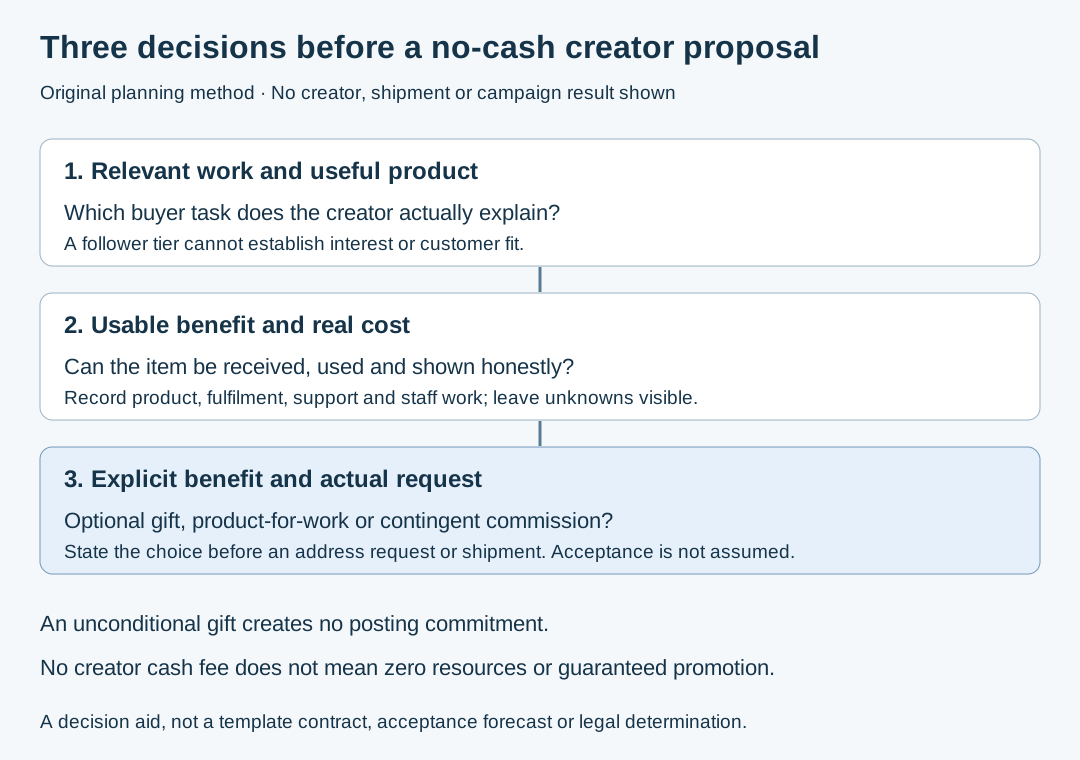
Original instructional diagram; no real creator, invoice, shipment, payment or outcome shown.
Original visual by Superdirector editorial team. Creation date not recorded.
Review what happened without changing the promise
Keep invitations, accepted gifts, shipped items, agreed work and observed posts separate. A delivery confirmation does not establish content. An optional gift that produces no post has not failed a posting obligation that never existed. For agreed work, use the actual terms and the hiring handoffs, not an invented penalty or a public complaint.
No-cash does not mean no disclosure. FTC staff’s U.S. guidance says free products or perks followed by an endorsement can require disclosure even without a requested mention; it also prohibits invented experience and proof-requiring claims the advertiser cannot support. Instagram separately describes its Paid Partnership label for paid-in-any-form content, including noncash business benefits. Other intended markets and platforms need their own applicable checks.
At your chosen review point, record actual costs, any agreed/observed content and the uncertainty that remains. Decide whether the product fit, fulfilment and offer justify another bounded proposal. Do not turn gift acceptance, a flattering reply, views or attributed orders into proof of incremental sales.
Sources and limits
The complete current FTC, Instagram, HypeAuditor, Upfluence, Shopify business and Collabstr order texts were read before drafting on November 5, 2026, Pacific time. FTC staff’s brochure dates to November 2019, Shopify’s article to October 2025 and Upfluence’s guide to February 2023. Vendor statements and anecdotes are not neutral evidence of free-promotion results. No benchmark rate or claimed performance benefit is adopted.
The Shopify Collabs creator-payment help page refused access and was not used; the short Insense capture was not eligible as a full anatomy read. The fit exercise, fictional plans, card and diagram are original instruction. No outreach, shipment, creator agreement, native account or campaign trial occurred. This page supplies no legal determination, income forecast or guarantee that a no-cash proposal will be accepted.