How-To Guide
How can a brand find micro-influencers manually?
Find micro-influencers manually with five discovery routes, dated candidate records, a three-post view check and clear limits on audience and outreach claims.
By the Superdirector editorial team.
At a glance
How can a brand find micro-influencers manually?
Write the buyer, content job, platform and practical bounds first. Look through public brand mentions and customers, comparable collaborations, task/tag/place searches, native marketplaces and relevant referrals or lists. Save the exact route, profile and work, check a few comparable recent posts, then ask only for missing evidence that would change your next step. A found name is not a verified audience, accepted offer or booked post.
- Define your own search band; sources use micro and nano labels differently.
- Treat tags, locations, recommendations and generated lists as leads, then inspect the actual account and work.
- Keep public views, private audience evidence, availability and agreed work separate.
Write the search note before opening profiles
To find micro-influencers manually, choose a buyer, a content job and a platform, then look in several places where relevant work is already visible. Keep the discovery route and a specific piece of work beside each name. Your first output is a list of people worth checking, not a roster of booked partners.
This guide covers finding candidates without buying a creator database. The micro-influencer platform comparison is the separate decision about software, fees and operating limits. If you already have a long list and need to judge the work in depth, use the buyer-task shortlist method.
The label has no single band across the sources read: Social Hire calls about 1K–10K followers micro, while Jem Social uses roughly 10,000–100,000. Record the band you intend to search, if size matters to the brief. Neither label establishes relevant viewers, the quality of an explanation or a likely fee.
| Input | Write down | What it prevents |
|---|---|---|
| Buyer and market | Who should understand the product; where the offer is available | Choosing a nearby creator and assuming the audience is nearby too |
| Content job | The action, question or demonstration the work must address | Collecting everyone with the same category in their bio |
| Platform and format | Where the agreed audience post would appear, or whether you need files only | Mistaking an attractive portfolio for a proven posting route |
| Practical bounds | Your search time, optional follower band, product/shipping readiness and real compensation proposal | Promising work or gifts the team cannot support |
Original fictional example: a brand makes a repairable everyday tote. It wants an adult creator who can show an ordinary carry setup and explain the replacement strap using verified product instructions. It can ship only to its stated market. No creator, search result or campaign is described here.
Try five discovery routes and keep the trail
Modash’s guide and Jem’s guide both describe several manual routes. We turn them into a route-and-evidence register below. This is our editorial search plan; we did not test how many suitable creators each route returns. Account menus, results and available filters can differ.
| Route | What to do manually | Keep as evidence | What remains unknown |
|---|---|---|---|
| 1. Customers, followers and public mentions | Read public posts that tag or mention your brand; ask willing customers for creator recommendations | The particular post, profile and discovery date | A customer’s willingness to take paid work, posting terms and audience makeup |
| 2. Comparable brands and collaborations | Look at public brand tags, visible sponsorships and creator credits in your category | The work itself and the exact comparable product or task | Exclusivity, availability, compensation and whether the creator wants another competitor |
| 3. Task, niche and place searches | Try the buyer’s language, product-use terms, relevant hashtags and locations where search supports them | The query, platform, date and specific result you opened | Complete market coverage or verified audience location |
| 4. Native creator marketplaces | Use the filters and portfolios available to your actual brand account | The profile and the fields actually returned | Eligibility for every account, response or permission to use the work |
| 5. Referrals, community lists and directories | Ask a relevant professional contact for a name, or inspect public event/specialist lists | Who suggested the name or the exact list page | Whether the listing is current, paid placement, a fit or even the right account |
For the tote example, “bag creator” is a broad seed. Try the intended use: “everyday carry repair,” “replace a bag strap,” or a buyer-specific commute setup. These are invented search ideas, not queries we ran or evidence of current demand. Open the resulting work before adding someone. A profile that says sustainable fashion might never show a repair; a practical repair channel might show exactly the skill you need.
Treat a competitor’s sponsored post as a lead. It does not establish that the creator is free to accept your proposal, reveal their terms or grant you reuse of the footage. Ask about any relevant exclusivity in the professional conversation; do not infer it from the absence of a visible label.
YouTube’s search help documents filtering results by content type, including channels. Use the search options actually present on your device. On other platforms, try the account’s available keyword, tag and place search, without assuming an old article’s exact buttons or “recent” tab still exist.
Meta’s February 2024 marketplace explanation describes brand access through Business Suite, creator/audience filters and portfolios. That is a documented discovery route. Check current access in the accounts involved; this article did not inspect a logged-in marketplace, and a missing result does not mean no suitable creator exists.
Co-follow overlap can be a clue: several people in a community may independently mention or follow the same creator. Ask for recommendations or inspect only public, available relationships in context. A handful of visible connections is not a measured audience-overlap percentage, permission to collect private following lists or proof that the creator reaches your buyers.
Use the manual discovery register or blank CSV. Record a route even when it produces no usable lead in your own session. The files are local manual aids; they do not connect to accounts, search, message or save changes automatically.
When enlarged, scroll horizontally to read the diagram.
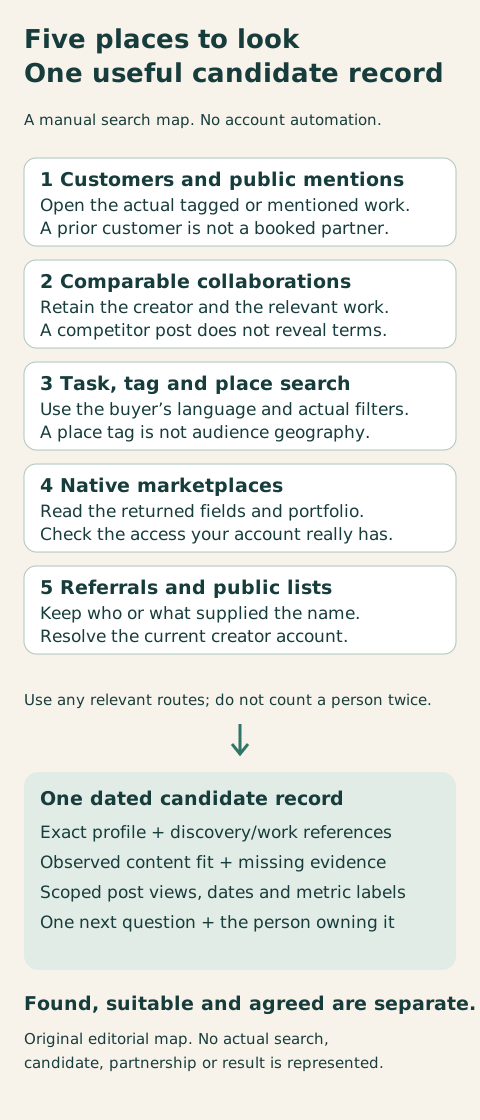
Original editorial search map. Discovery routes produce leads; they do not verify an audience, grant rights or establish a booked collaboration.
Original visual by Superdirector editorial team. Creation date not recorded.
Check the person behind the result
Open the actual profile and the work that made the name interesting. Keep a canonical profile URL and note any public business-contact instruction. A copied directory entry, display name, recommendation or search summary can point to the wrong account. If you cannot resolve the identity, keep the record as unresolved instead of sending a proposal to a guessed contact.
- Watch or read the relevant work. Note the visible product handling, explanation and format; do not evaluate only its thumbnail.
- Look for enough recent examples to see whether the requested work appears again. A single successful-looking clip is one observation, not a production history.
- Read the actual public discussion for questions and context. Do not convert a comment’s language or location claim into a demographic report.
- Use the stated business email, manager or allowed contact route. Do not infer private addresses or bypass an account’s messaging restrictions.
A creator can enter through more than one route. Keep one candidate record and add the additional discovery reference to it. Five route sightings of the same person are not five creators. Retain declined or unresolved names in your own record so another search session does not erase why they were set aside.
For the fictional tote, one video might show a complete strap replacement while two others show unrelated styling. The repair example is a reason to investigate. It is not proof of repeatable repair instruction, relevant audience geography, current availability or willingness to endorse your particular product. The linked shortlist method is where that detailed content-fit decision belongs.
Read three recent posts without predicting the next one
As a manageable editorial first pass, inspect three recent posts in the proposed format when available. Record the exact URL, publication date, capture time, visible metric label and count. If fewer comparable posts exist, record fewer and say why. Three is a workload choice, not a validated sample size or a threshold for good creators.
| Fictional same-format post | Visible count at one invented observation | Age at that observation | What the row supports |
|---|---|---|---|
| A | 2,300 public views | 2 days | That displayed count at that time |
| B | 2,800 public views | 16 days | A different-aged observation |
| C | 14,500 public views | 54 days | One much older, higher-count observation |
All three rows are invented teaching numbers, not a creator report. Their ages differ, so the table cannot rank equal-window reach or forecast the next post. It also leaves paid distribution unknown. Do not select only C, call the mean “expected views,” or compare these with another creator’s seven-day private report as if the observations were equivalent.
A creator’s own relevant post history tells you what those posts visibly did; follower count tells you the size of a subscription or follow relationship. Keep both under their actual names. Neither public post views nor a follower badge establishes unique viewers, watch depth, where the audience lives or future sales.
When a missing field would change the decision, request the smallest useful creator-provided report. YouTube’s audience guide warns that some geography, traffic-source and gender data can be limited; its monthly audience is a rolling 28-day unique-viewer measure, while Top geographies is watch-time based. An unavailable field stays unknown. Use the YouTube metrics worksheet for like-for-like comparison and media-kit verification guide for supplied evidence.
Choose one next question for each candidate
Finish the search round with a candidate-specific next step: invite a conversation, request one material missing sample or report, or stop pursuing this fit. Write the reason beside the work you inspected. Do not turn a table’s complete cells into an automatic decision to hire.
| Record status | Useful next step | What it does not mean |
|---|---|---|
| Relevant work observed; key audience evidence still missing | Ask for the specific dated format/report that would change your choice | The audience has been verified |
| Fit plausible; account or contact unresolved | Resolve the public professional route or leave it unresolved | A similarly named email belongs to this creator |
| Different task or market | Record the mismatch and set the candidate aside for this brief | The creator is poor quality in general |
| Enough relevant evidence for a first approach | Send a truthful, bounded offer through the stated route | Availability, price, rights or posting are agreed |
Your first approach should name the real brand, a specific observed reason for the fit, the actual paid/gift/affiliate proposal and one easy question. The outreach email template helps with the wording. A gift with no required content and a product-for-post offer are different arrangements; make the expected work explicit.
For endorsements affecting U.S. consumers, FTC staff guidance explains that free products can create a material connection and a later product mention may need disclosure even when no mention was requested. It also says not to describe experience with an untried product. Finding someone who already tags a brand does not remove the need for truthful terms, real experience and the applicable disclosure.
Record your own time and the useful next-step candidates from each route if you want to compare future searches. Those are observations about your work, not a universal route ranking. If the unresolved problem is managing an offer, shipment or payment, more names will not fix it; address that handoff before expanding the search.
Sources, method and limits
We read the complete current text of the Modash, Social Hire and Jem discovery guides on November 5, 2026, plus the Meta marketplace explanation, two YouTube Help pages and FTC Disclosures 101. The practitioner pages supplied discovery-route structures. We did not adopt claims that smaller creators are always cheaper, more authentic, higher-engagement or guaranteed to accept gifts.
Full source text and raw HTML structure were studied, not source images, phone layouts or private accounts. The search ideas, tote example, view table, diagram and manual register are original editorial instruction. No creator was found, contacted or hired for this guide, and no search speed, response rate or campaign result was tested. Superdirector publishes it.