How-To Guide
Decide what a candle discovery offer should help a shopper learn
Before adding a sample product, name the question it is meant to answer.
By the Superdirector editorial team.
An unfamiliar shopper can see a candle's container online without knowing whether they will enjoy its fragrance. A discovery offer might address that uncertainty, but a small sample should not silently promise the same experience as a full-size candle in the shopper's room.
Before adding a sample product, name the question it is meant to answer. Is the buyer choosing between fragrances, judging strength during use or selecting a gift for someone whose preferences they do not know? Those are different uncertainties. A sample may help with one without resolving the others.
This guide is about offer design and truthful creative, not candle formulation, safety certification or a recommendation to buy materials. Sources were checked on October 24, 2026. No sample was produced, sent, burned or tested for this article.
Separate fragrance preference from performance in use
A discovery experience can help a shopper form a preference. It does not automatically establish how a different-sized product will perform in a different setting. Keep that boundary next to the promise rather than leaving it for support to explain after purchase.
Underdog Candles' discovery-set page provides a concrete example: it lets customers select scents while explicitly distinguishing its mini samples' scent throw from its larger candles. This is one merchant's description of its own products, not a universal rule about every sampling format.
CandleScience's educational guide distinguishes fragrance strength before a candle is burned from fragrance strength while it is burning. Those definitions are useful when writing the offer. They are not evidence that a particular sample accurately predicts a shopper's experience with a larger product.
For a fictional brand with two fragrances, the discovery promise might be to compare those two scent choices. It should not become “find out exactly how the full-size candle will fill your living room” unless the brand has appropriate evidence for that separate claim. A photograph of a miniature beside a larger jar cannot supply it.
Choose a selection that leads to an available decision
Write down the exact fragrances the shopper can discover and the corresponding full-size options they could consider afterward. A seasonal surprise assortment may be an enjoyable product, but it does not necessarily help someone choose between the two current core fragrances they were initially considering.
Mala's discovery-kit page explicitly addresses the difficulty of choosing a scent online and distinguishes collection options. That demonstrates an existing offer structure, not proof that sampling increases purchases or that the same structure fits another brand.
For the fictional two-fragrance brand, keep the sample names, listing names and subsequent product choices consistent. If a fragrance has no available larger version, make that limitation visible rather than relying on a shopper to discover it after selecting a favorite. The task is not simply to send something scented; it is to make the next product decision understandable.
An identifiable sample matters too. A buyer should not need to reconstruct which seller or fragrance it came from. The exact packaging and required product information need the responsible maker's verification. This article does not prescribe a legal label or a safe sample format.
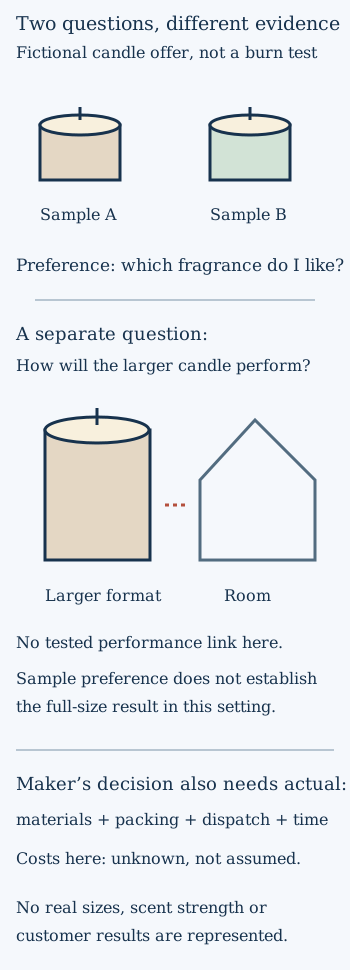
The original illustration represents two evidence questions, not a burn test, measured size or scent-strength comparison.
Original visual by the Superdirector editorial team. Creation date not recorded.
Make the no-sample option a real option
A discovery offer is not mandatory merely because other brands have one. A maker may have understandable scent descriptions but no verified sample format, packing process or workable fulfillment cost record. In that situation, defer the new offer rather than make a promise the operation cannot support.
The alternative can be clearer descriptive content about the existing range, using actual product images and accurate fragrance terminology. A description can help someone understand the intended scent character; it does not let them smell through the screen. Avoid pretending that elaborate mood language eliminates sensory uncertainty.
In the fictional brand, the decision could remain open until the maker can explain what the sample represents and how it would be supplied. That is different from declaring sampling ineffective. It is a decision not to launch an unverified offer yet.
Count the work without borrowing future revenue
Prepare a factual cost record before deciding whether to include samples with an order, sell a discovery set or not offer samples. Separate the actual materials, container or other verified format, identification, packing, preparation labor, dispatch and expected support work. Use the maker's own applicable records, not another brand's sample price.
The decision also needs the exact distribution route. An extra item in an existing parcel and a standalone discovery order have different operational requirements. Do not treat the former's dispatch situation as evidence that the latter is inexpensive to fulfill.
Leave unknown amounts blank until the owner can establish them. Do not make the economics appear favorable by adding assumed repeat purchases or lifetime value. A sample that attracts interest still has costs, and a later purchase is not automatically caused by the sample.
This is a planning record, not a recommendation to offer a discount or redeemable credit. Either would create another offer with its own scope and cost to verify.
Explain discovery without staging a performance result
A useful product sequence can show the actual discovery contents, the corresponding fragrance names and the available larger options. Place the sample's limitation beside the part of the creative that invites the shopper to try it. Do not hide it after several unrelated lifestyle frames.
For an Instagram carousel or a professional YouTube demonstration, separate “what is supplied” from “what this helps you decide.” Show the physical format honestly. Do not use an animation of fragrance filling a room as if it were measured evidence, or present a reaction from a friend as proof every unfamiliar buyer will enjoy the scent.
A creator can describe their own experience accurately, but that remains an individual experience. A brand still needs to decide which claims it can support about the specific product being promoted. No creator contact or sample distribution is included in this framework.
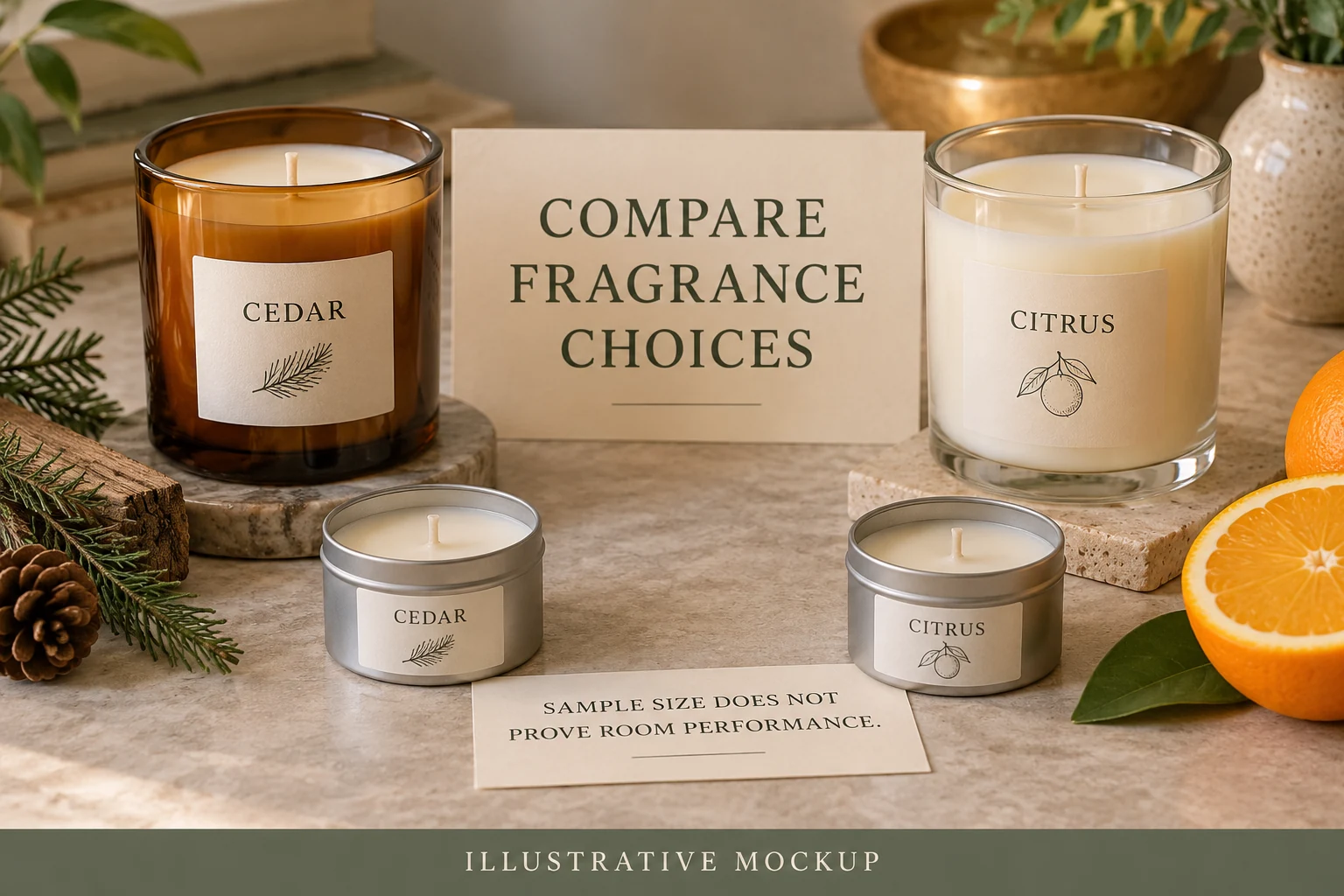
AI-generated illustrative mockup. These fictional formats explain a fragrance-choice task. A miniature does not establish the larger candle’s scent throw, burn performance or the economics of a discovery offer.
Illustrative mockup by OpenAI image generation, editorial direction for this article. Created 2026-10-24.
Keep acquisition and repeat-purchase questions apart
A sample sent to someone who has never bought from the brand tests a different offer from a surprise sample included with an existing customer's order. Pooling those situations can make a promising-looking number answer no clear question.
Before any authorized trial, define which group would receive which offer and what observation would inform the next decision. For an unfamiliar shopper, useful questions include whether they understood the discovery purpose, could identify the fragrances and could find the corresponding product. For an existing customer, the question might concern interest in another fragrance, not first-time trust in the brand.
Record actual purchases separately from expressions of preference. If a later purchase occurs, retain the observation window and other material offer changes. Without a suitable comparison, describe the result as observed behavior, not an incremental lift caused by sampling.
What the maker questions support
One maker with two signature scents asked how unfamiliar people could buy without smelling them and whether samples were feasible. The maker later reported buying smaller jars; that is not a reported completed sampling test or a sales result.
A separate historical maker discussion asks whether the effort of adding samples is worthwhile. Its replies include experiences and legal assertions that are not adopted here as general evidence. The post's borrowed Pinterest picture is not rights-cleared for reuse.
Treat merchant-site reviews as customer accounts, not independent proof that a discovery offer improves sales or predicts full-size candle performance.
The next small action is to write one discovery promise and its limitation, map it to the actual available scent choices, and fill the operational record with known costs. If either the sensory promise or the fulfillment plan remains unsupported, keep the offer in preparation. A small format is not automatically a small decision.