How-To Guide
Track a creator’s public post and a TikTok Spark Ad on two clocks
Record when a creator post was first verified public, how Spark use was authorized, and the earliest paid-delivery interval supported by an ad report.
By the Superdirector editorial team. TikTok sources reviewed October 28, 2026.
At a glance
Why should a creator's publish time and a brand's ad launch time be tracked separately?
A creator’s public post and a brand’s Spark Ad are separate events with different evidence. Record when the exact post was first verified public, the grant and ad setup, and the earliest interval in which a matching ad report shows impressions.
- A first public observation does not establish the exact upload time.
- Authorization, sync, status and scheduled start do not prove a first impression.
- A positive daily report row supports delivery within that day, not a precise start or incremental effect.
Direct answer
A creator’s public post is evidence about the publishing part of a promised deliverable; the post still needs to be checked against the agreed content and window. A brand’s Spark Ad is a later, separately authorized use of that post. Record the two on separate clocks because the people responsible, the rights window, the evidence and the reporting period can differ. For an already public creator post, save the exact post identity and when you verified it was public. Then save the authorization, the matching Ads Manager ad, its planned schedule, and the earliest interval in which an ad-level report shows delivery. Neither an authorization code nor an ad submitted for review proves an impression happened.
If your report groups impressions by day, say “paid delivery was evidenced during this day.” Do not turn that day into a fictional first-impression minute. The public post may have gathered organic exposure before the ad; TikTok says paid Spark engagement is attributed to the original organic post, so the visible post count is not a clean organic-only counter after amplification. TikTok’s Spark Ads overview describes that behavior. The need for two evidence records is our operational inference from it.
This guide covers a creator post that was already public before the brand obtained Spark authorization. TikTok also supports pushing a new post from Ads Manager; its Manual and Search creation guide describes that different route and warns that a private video can become public when used in a campaign. Do not apply the example chronology below to a pushed or ad-only post.
Give every event its own name
The phrase “ad launched” can mean “someone clicked Publish all,” “the planned start time arrived,” “Ads Manager showed Active,” or “a report contains impressions.” Those statements have different evidence. Use the narrowest one your record supports.
| Event | Record to keep | What it supports | What it cannot prove |
|---|---|---|---|
| Agreed creator publish window | Accepted brief or creator confirmation with time zone | The deadline or window the creator agreed to | That a post became public |
| Public post observation | Exact creator handle, post ID and URL, dated public-page observation or platform receipt | The post was publicly reachable by the observation time | The exact second it first went public, unless a separate reliable timestamp proves it |
| Spark authorization | Creator grant or post code, authorized post identity, route and displayed expiry | Permission for the specified post and period | That an ad was built, approved or delivered |
| Ads Manager setup | Ad account, ad ID, matched post, configured schedule, status and saved change time | What the brand submitted or configured | That the first impression happened at the planned start |
| Paid delivery observation | Matching ad-level report with positive impressions, report window, granularity, time zone and export time | Delivery somewhere within that reported interval | The exact first impression time or incremental impact |
TikTok’s Content Suite sequence explicitly separates requesting authorization, reviewing authorized videos, syncing to Ads Manager and launching an ad. TikTok’s ad-status definitions further distinguish Under Review, Scheduled, Active, Partial delivery and Not delivered states. A submitted ad can still be under review or scheduled for a future date. Status is useful context; a matching performance record is stronger evidence of delivered impressions.
Clock one: verify the promised public deliverable
Start with the agreed creator obligation, not the ad account. Record the creator account, exact post ID and URL, format, agreed public window and time zone. Open the post from a public or otherwise declared observer context and save a dated observation that ties the URL to the account and visible content. If a creator or platform receipt supplies an actual publish timestamp, keep that receipt and its time zone alongside the public observation. A scheduled slot, a draft link and a private preview are plans or preparation, not proof of public delivery.
The first time a reviewer sees a post is an upper bound on publication, not automatically its publication timestamp. “Public by 14:20 UTC” is honest when the team first checked at 14:20; “published at 14:20 UTC” would need a separate trustworthy source. If the post was inaccessible from the declared observer context, record the failed observation and ask for a verifiable post receipt rather than marking it delivered by assumption.
Keep the creator’s agreed window as a separate field. A post first observed after a deadline may have gone live earlier. To claim it was late, use an actual publish receipt or a bounded observation history that supports that conclusion. Preserve corrections: if the creator replaced the post, keep both IDs and URLs and explain which one the paid ad later used.
Clock two: distinguish configuration, plan and delivery
For the brand’s ad, record the ad-account identity, campaign and ad ID, the exact authorized post selected, when the ad was configured or submitted, the scheduled start and end, and the account time zone. Save later edits as dated revisions. TikTok says its Ads Manager account time zone affects both delivery settings and reported data; never compare a creator’s local posting window to a brand report without naming and converting both zones.
Then inspect a matching ad-level performance view or export. Select a time range that includes the planned start and identify the earliest available interval with positive impressions. Keep the source, export time, report time zone and grouping. TikTok’s Campaigns reporting guide describes ad-level views and Day, Week or Month breakdowns; its custom-report guide describes selecting dimensions, metrics and time ranges. The guide does not promise a universal first-impression timestamp. A daily row with positive impressions means at least one impression is reported in that day, subject to the report’s definition and completeness. It does not identify the minute it began.
If all accessible rows show zero or no data, write “paid delivery not evidenced in the available report as of [export time].” That is not the same as proving no delivery occurred; the available range or ad identity may be wrong, and TikTok notes that a new campaign may not yet show meaningful data in its campaign-data guidance. Check those specific gaps before drawing a conclusion. An Active status can be preserved as an observation but does not narrow a daily positive-impression row to an exact instant.
When enlarged, scroll horizontally to read the diagram.
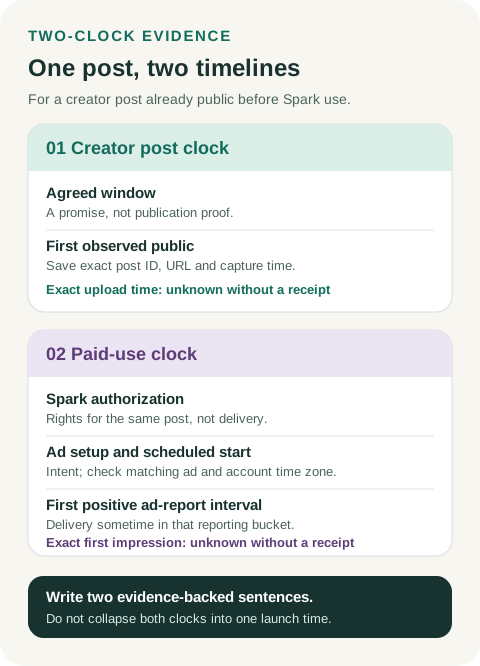
Original two-clock diagram. Keep the post ID, authorization and ad report as separate evidence before describing the launch.
Original visual by Superdirector editorial team. Creation date not recorded.
A fictional two-clock example
Fictional teaching example, not a Superdirector campaign or TikTok Ads Manager receipt. Every ID, URL, date and metric in this paragraph and its two-clock timeline is illustrative. The reserved example.invalid URL is deliberately nonfunctional.
A fictional creator agrees to post during 14 October 2026, 13:00–15:00 UTC. A reviewer first verifies the exact demo post is public at 14:20 UTC. The defensible sentence is “public by 14:20,” not “published at 14:20.” On 15 October, a fictional Content Suite request is accepted for that post; its example record displays an authorization period ending 15 October 2027. The brand syncs the authorized post on 16 October, configures a matching Ads Manager ad on 17 October and sets a planned start for 18 October, 09:00 UTC. An exported ad-level daily report later shows the first positive-impression row available to this example for 19 October 00:00 through 20 October 00:00 UTC. The planned ad end is 25 October; an actual last-delivery time is not evidenced.
| Creator clock | Bridge | Brand clock |
|---|---|---|
| Public post first verified 14 Oct, 14:20 UTC | Content Suite authorization accepted 15 Oct; example expiry 15 Oct 2027; synced 16 Oct | Ad configured 17 Oct; planned start 18 Oct, 09:00 UTC; earliest available positive daily row is 19 Oct, 00:00–20 Oct, 00:00 UTC |
The gap between the planned start and that positive row is not a proven one-day delay, because the example has not established a complete earlier impression history or an exact first-impression receipt. It is a follow-up question for the ad operator. The post’s first public observation and the paid report are also different kinds of time: one is a point-in-time observation; the other is a full-day reporting bucket. The blank CSV card and fictional example CSV preserve those labels.
Report the difference without rewriting either clock
Use wording that carries the limits into the client report:
Creator deliverable: the specified post was publicly verified by 14 Oct 2026 at 14:20 UTC (first check; exact publication instant not evidenced). Spark authorization for that post was recorded on 15 Oct. Ad
DEMO-AD-056was configured on 17 Oct with an 18 Oct 09:00 UTC planned start. The earliest available ad-level daily row with positive impressions covers 19 Oct 00:00–20 Oct 00:00 UTC. Exact first-impression time and any delivery before that reported row remain unverified. All details in this paragraph are fictional examples.
When the creator post appears after the promised window, retain the original window and the first-public observation, then investigate whether a platform or creator receipt can bound the actual publish time. When the post is replaced, link the old and new IDs and check which post the ad selected. When authorization expires or is revoked, preserve the event and check ad status and subsequent reports; do not silently extend the permission in the ledger. When the ad’s first evidenced delivery is later than planned, keep both times and investigate review status, schedule edits and report completeness. A correction adds a dated fact; it does not move the original clock backward.
Finally, do not subtract a visible post’s later view total from an earlier total and call the difference “paid views.” TikTok says Spark promotion attributes paid engagement to the original post. A valid organic-versus-paid or incremental-effect claim needs a measurement design and definitions that support that split. This timeline only establishes which event is evidenced when.
Use the record on the next campaign
Complete the two-clock timeline before writing a client launch sentence. Have the creator-side owner attach the public post evidence and the ad-side owner attach the matching authorization, configuration and delivery report. If either owner cannot supply a record, label that time unknown. Superdirector can help plan creator content and campaign briefs; this article does not imply it reads TikTok Ads Manager, pays creators, or automatically posts to a third-party TikTok account.
Editorial source note
Editorial source note: TikTok’s help pages linked above support Spark post attribution, authorization routes, the authorize–sync–launch sequence, ad statuses, report grouping and account time-zone effects. The two-clock ledger, evidence hierarchy and fictional example are original editorial methods, not a TikTok product feature or a real customer result. Source text was checked on 2026-10-28. Search volume and difficulty are unavailable; the working phrase is a reader-intent hypothesis, not a measured keyword opportunity.