How-To Guide
What are the best influencer platforms for micro-influencers?
Choose a platform for 10 to 50 micro-influencers: gifting limits, affiliate fees, paid-post costs and billing commitments from retained vendor sources.
By the Superdirector editorial team. Vendor sources captured November 4, 2026; retained texts re-read November 5, 2026. No hands-on platform test.
At a glance
What are the best influencer platforms for micro-influencers?
For a brand working with 50 micro-influencers or fewer, shortlist by the offer. Shopify Collabs suits Shopify gifts plus commission, subject to creator access. GRIN Free can cover a first 10-gift test; recurring gifts change the plan. Collabstr Free fits direct flat-fee hires. Compare Insense for recurring posted briefs and Stack Influence for product-led coordination, after checking their commitments. Heepsy or Modash fit discovery plus tracking when you retain operations.
- A $0 subscription is not a free campaign. Count product, fulfillment, creator compensation and the platform’s fee base separately.
- This guide compares one-off and recurring programs of 10 to 50 creators. Asset-only UGC procurement and enterprise programs are different buying tasks.
- Vendor terms below are retained November 4, 2026 snapshots, re-read November 5. We did not purchase or test these tools. Superdirector is the publisher.
Set the job for your first 10 or 50 creators
Write one sentence before comparing vendors: “We need [10 or 50] creators, [once or each month], to [post to their audience or deliver files], in [market/network], paid by [product, commission, flat fee or a stated mix].” Add your store, product cost, fulfillment cost and the operator who will handle replies and exceptions. These are your requirements, not assumptions a platform can fill in.
A micro-influencer program buys access to the chosen creators’ audiences when posts are part of the agreement. A UGC brief can buy files without that distribution. Do not count a delivered video as a published audience post. Our UGC versus influencer marketing guide explains that distinction. If you already have suitable creators and can manage their agreements, your first option is the existing sheet and workflow.
Shopify’s guide, dated March 2023, uses 1,000–100,000 followers and sometimes calls the bottom 1,000–10,000 nano; it also says the terms have no strict definition. Set your own follower band and audience requirements. A database of millions of profiles is not evidence that 50 suitable micro-influencers are available, willing to accept product or ready to post next month.
| Your requirement | What it changes |
|---|---|
| 10 gifts once | A small free allowance may cover the trial. Track which accepted gifts actually lead to the agreed deliverable. |
| 10 gifts every month | A lifetime 10-gift allowance runs out after the first cohort, even though no creator cash changes hands. |
| 50 creators at once | Check active tracking capacity as well as search volume. Fifty search results, 50 profiles, 50 posts and 50 hired creators are different units. |
| Commission plus product | Budget earned commission and gifts separately. Payment processing applies to commission, not automatically to sales revenue or gift value. |
| Flat fee plus product | Budget cash and fulfillment; some gifting allowances count the product inside a paid deal too. |
Choose a shortlist by how you pay
The order below follows the offer: gifts, commission, flat fees, then the tools that help you find or manage creators. These are editorial shortlists based on published terms, not measured rankings of creator quality or results. For a broader comparison across enterprise teams and other workflows, use the influencer marketing platforms comparison.
| Your offer and operation | Shortlist to investigate | Why it enters; what could remove it |
|---|---|---|
| Product only; you run the relationships | GRIN or Shopify Collabs if you use Shopify | GRIN needs no wallet deposit for gifting-only campaigns, but Free is 10 gifts total. Collabs sends and tracks gifts inside Shopify; verify merchant and creator access. |
| Product-led posts; you want coordination handled | Stack Influence | Its self-serve description coordinates opt-ins, purchases, posts and reimbursement. Ask for a written plan sized to 10–50 posts; neither the name of this model nor a credit allocation proves 50 unique creators will post. |
| Commission on sales, optionally with gifts | Shopify Collabs or GRIN | Collabs is Shopify-specific; GRIN pays commissions from a funded wallet. Store eligibility, creator access, gifting limits and the commission-versus-deposit fee base change the decision. |
| Named creators, one-off flat-fee posts | Collabstr Free | Direct profile hires need no subscription and carry a 10% brand hiring fee. Confirm that the purchased package includes a post, its destination account and the deliverables you need. Free does not include posted campaigns for applicants. |
| Recurring briefs for audience posts, possibly alongside UGC | Insense | It explicitly separates Influencer Post from UGC. Follower filtering helps specify micro creators, but an asset-only price is not a post quote. Trial covers at most 10 hires; Brand has a larger billing commitment. |
| You already manage offers, shipping and payouts | Heepsy or Modash | Both include discovery and management/tracking features. Compare the plan’s active tracking capacity, store integration and any payment module rather than treating them as just lists of names. |
| A specific workflow remains unmet by these plans | Aspire or Upfluence | Request a scoped quote for that missing job. The retained Aspire pages show no price; Upfluence is custom-quoted and states a 12-month minimum. A demo alone is not a reason to take on that term. |
A product offer is a proposal a creator may decline. A promise to post needs an agreed deliverable; shipping a gift alone does not establish one. Use the gifting versus paid offer guide to decide what to ask for before choosing software. If the actual deliverable is only content for your ads, make that the buying question instead of paying for an audience you will not use.
Check the limits that change your shortlist
The following are terms from vendor pages captured November 4, 2026, not checkout quotes or hands-on observations. Dollar amounts are displayed as the vendors present them; confirm invoice currency, taxes, processing charges and cancellation terms. Monthly equivalents of annual or quarterly subscriptions are not one-month offers.
| Platform | Price and fee base in the retained source | The limit or condition that matters at 10–50 creators |
|---|---|---|
| Shopify Collabs | Free to install; app listing says a 2.9% processing fee on automatic commission payments may apply. | Gifts, affiliate links/codes and commission payouts through Shopify. Shopify Help says new creator self-signups are paused, but direct invites and merchant applications continue. It also requires Shopify Network Intelligence enabled. Confirm your chosen creator can accept the actual invitation. |
| GRIN Free / Starter | Free $0/month +20% on wallet deposits; Starter $200/month +10% on deposits. Fee is added on top; it does not reduce creator earnings. | Free: 2 live campaigns, 10 gifts total. Starter: unlimited live campaigns, 100 gifts/month. A gift counts when a $0 order or shipment is created, including product in a paid deal. Paid/affiliate campaigns require at least $250 in the wallet; gifting-only campaigns need no deposit. Every plan includes Shopify or custom/headless store connection through its API; confirm the setup work for your store. |
| Collabstr | Free: 10% on paid orders. Pro $249/month equivalent billed annually +10%; Premium $333/month equivalent billed annually +5%. | Direct hires on Free; applicant campaigns on Pro (1/month) or Premium (unlimited). Pro tracks 5 posts at once, Premium 15, each for up to 3 weeks. Fifty hired creators do not imply 50 simultaneously tracked posts. The creator pays a separate 15% fee on their payout. The gross order before the brand hiring fee is therefore not a promise of the creator’s take-home. Do not add that deduction again as a brand hiring fee. |
| Insense | Trial from $650 for 1 month +20% on creator payments. Brand from $1,500/quarter +10%, or $4,800/year +10%. Creator pay is extra. | Trial: 1 campaign, up to 10 hires. Brand lists unlimited campaigns/hires. Trial upgrades to quarterly Brand unless canceled at least 48 hours before it ends. Its starting $100/video is UGC and $125/post is nano, neither a verified micro-influencer quote. |
| Stack Influence | A fee per completed post plus reimbursement of the creator’s product purchase, including taxes/shipping if any; weekly billing. No unambiguous numeric self-serve quote in this retained text. | One credit means one post, not one unique creator. Creators opt in and buy from your listing first. Unused credits do not roll over, pausing leaves the billing cycle running and full usage is not guaranteed. Verify a <=50-post commitment and the resulting creator count. |
| Heepsy | Free; Starter $69/month annual or $89 monthly; Plus $149/month annual or $199 monthly. | Free: 10 advanced profiles/month and 1 project, plus CRM/content gallery/store integration. Starter: 5 tracked creators. Plus: 100 tracked creators and creator payments. A 50-creator tracking requirement removes Starter even though its search allowance is larger. Confirm payment fees; the retained page does not settle them. |
| Modash | Essentials $2,388 paid yearly ($199/month equivalent); Performance $5,988 yearly ($499/month equivalent). Flexible monthly quote not established here. | Essentials: 100 actively tracked creator profiles, 300 opened profiles/month, 150 unlocked emails/month, Shopify gifting. These are separate limits, not promised hires. Affiliate management is Performance Annual/Enterprise. Performance Annual shares a $10,000/year fee-free limit across Payments + Affiliates; 5% applies above it. Confirm exact payout access for your plan. |
| Aspire | No price on the retained platform overview or Shopify integration page. | These pages describe product fulfillment, affiliate links and agency services; the integration page also names WooCommerce. Ask which parts of a 10–50-creator program the quote includes, rather than infer an enterprise price from a list. |
| Upfluence | Custom fixed platform fee; no percentage of sales. FAQ states a 12-month minimum contract. | Retained table places ecommerce/affiliate features in Scale and above, and Upfluence Pay in Autopilot. A discovery quote does not include every operation shown on the site. Ask for the exact modules and total contract price. |
Two source cautions affect the shortlist. Modash’s plan cards place Payments under Performance, while a later FAQ mentions payment fees for Essentials and Performance. We therefore do not claim Essentials cannot pay, or derive unlisted $299/$599 flexible-month prices from its annual-savings sentence. Heepsy labels annual prices but also says there is no annual lock-in; check the actual billing and refund terms before treating that as a one-month trial.
Coverage also differs: Modash’s page names Instagram, TikTok and YouTube; Heepsy’s names those networks plus LinkedIn; Insense describes TikTok and Instagram creators. For other vendors, confirm the exact network and post type in your offer. A follower filter, creator account and payment route all need to fit the same person.
Calculate the full cost of your month
Keep four amounts separate: subscription for the term, platform fees, the order or creator-payment base, and product/fulfillment. A wallet deposit is prepaid creator money, not another cost to add after spending that same money. The fictional $100 amounts below are gross orders or funded creator-payment allocations, not guaranteed net earnings. Replace them with actual quotes using the rate-benchmark comparison method.
Flat-fee illustration. Use ten or 50 assumed $100 base amounts: $1,000 or $5,000. On Collabstr, the base is gross order value before the brand hiring fee. On GRIN, it is wallet funding allocated to creator payouts, assuming no opening balance or unused funds. On Insense, it is the creator-payment amount before the added marketplace fee. Fee overhead = subscription equivalent + that platform’s base × its stated rate.
Equal base amounts do not guarantee equal creator take-home. Collabstr says creators pay a separate 15% fee on their payout; GRIN says it takes nothing from creator earnings. Insense describes its marketplace fee as added to the creator payment; we have not established every possible creator-side charge. If your agreement promises a net amount, confirm the exact deduction base and payout charges before grossing up the budget. Do not assume a $100 Collabstr order leaves the creator $100, or derive a universal net-to-gross formula from the brief fee statement.
| Plan | Fees above a $1,000 base | Fees above a $5,000 base | Billing/operation difference |
|---|---|---|---|
| Collabstr Free, 10% | $100 | $500 | Gross orders before the brand hiring fee; creator payout has a separate 15% fee. |
| GRIN Free, 20% | $200 | $1,000 | Assumed $1,000/$5,000 wallet funding; only 2 live campaigns, 10 gifts lifetime. |
| GRIN Starter, $200 +10% | $300 | $700 | Monthly subscription; 100 gifts/month. |
| Collabstr Premium, $333 +5% | $383 | $583 | $3,996 annual subscription, calculated as 12 × $333; 15 posts tracked at once. |
| Collabstr Pro, $249 +10% | $349 | $749 | $2,988 annual subscription, calculated as 12 × $249; 5 posts tracked at once. |
| GRIN Growth, $500 +7% | $570 | $850 | Monthly; adds multiple brands and 300 gifts/month. |
| Insense Brand quarterly, $500 equivalent +10% | $600 | $1,000 | $1,500 subscription each quarter; unlimited hires. |
Add the base amount back once to get the brand outlay before product, tax or processing. Ten assumed $100 gross Collabstr orders cost the brand $1,100 on Free. Funding $1,000 of GRIN wallet principal costs $1,200 on Free. Those outlays do not establish equal creator take-home. With $5,000 of GRIN funding, Starter is $5,700 versus $6,000 on Free. The two GRIN plans have equal fee overhead at $2,000 of funding; above that, Starter costs less on these fees. A gifting limit can force the plan change earlier.
GRIN’s deposit fee is charged when you fund the wallet and is not refunded if you later withdraw unspent money. Card deposits may add processing charges. Starter’s 30-day trial changes to $200/month unless you switch first, and trial deposits still carry its 10% fee. That makes a free trial different from a free funded campaign.
Annual or quarterly prices change cash due. Insense Brand’s first 10-hire cohort would require $1,500 subscription +$1,000 creator-payment base +$100 marketplace fee = $2,600, before product or other charges. The 50-hire equivalent is $7,000. The table’s $600/$1,000 overhead allocates one third of the quarterly subscription, so it must not be read as the first invoice. Do not choose an annual Collabstr plan only for its lower percentage: Premium saves $250 of order fees on the assumed $5,000 month but adds a $333 monthly equivalent and an annual commitment.
Product-only illustration. Assume your product costs $30 to supply and fulfillment/shipping adds $8, with no cash creator fee. Ten gifts cost $380 before software; 50 cost $1,900. GRIN Free’s 10 total gifts could cover the first cohort for $380; recurring 10-gift months no longer fit that lifetime allowance. Starter makes a recurring 10-gift month $580 and a 50-gift month $2,100. These are assumed direct-gifting costs, not Stack’s invoice model.
Commission illustration. On Shopify Collabs, use earned commission as the fee base, not creator count or gross sales. If an assumed cohort earns $500 of commission paid automatically and the listed 2.9% applies, processing is $14.50 and commission plus processing is $514.50. Add gifts separately. On GRIN Free, a $500 wallet deposit adds $100; Starter adds $50 plus its $200 subscription. Deposit timing and remaining balance can differ from earned commission in that month.
Stack cash flow needs a separate worksheet. Its creators purchase through your listing, then Stack bills the post fee plus purchase reimbursement. Record the gross invoice, net merchant proceeds from the original sale, product cost, fulfillment and marketplace/payment fees. Reconcile each once. Do not compare the gross reimbursement invoice directly with the $38 direct-gift assumption, or assume sale proceeds equal retail price. Obtain the per-post quote and <=50-post term before comparing total cost.
When enlarged, scroll horizontally to read the diagram.
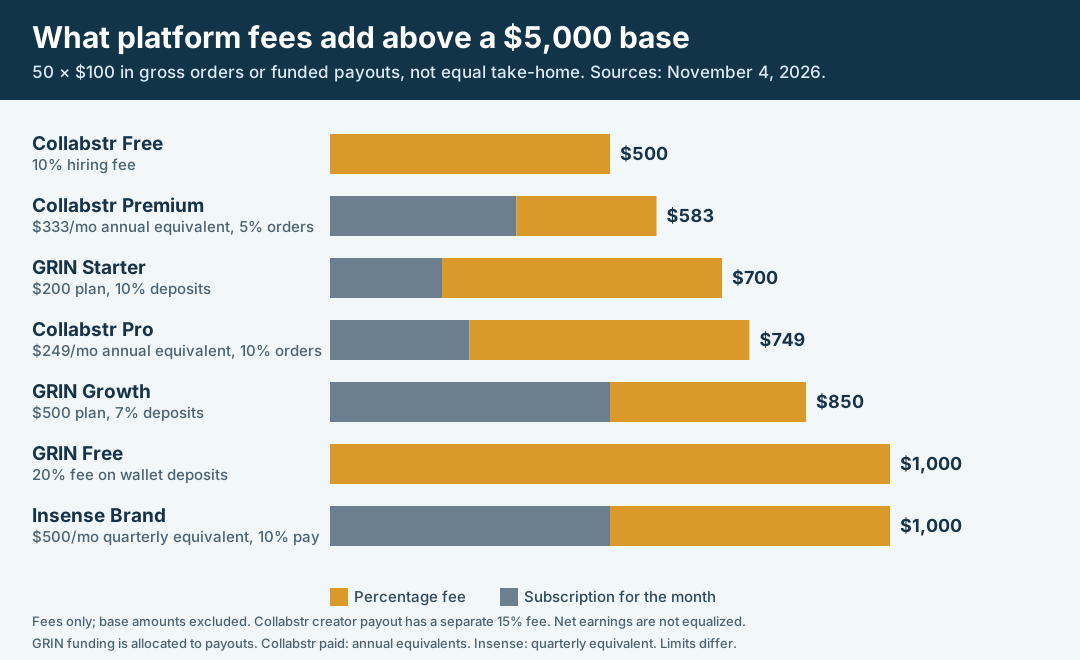
Original illustration: 50 assumed $100 base amounts, excluded from the bars. Collabstr uses gross orders before the brand hiring fee; GRIN uses wallet funding fully allocated to payouts; Insense uses creator payments before its added marketplace fee. Equal bases do not guarantee equal creator take-home. Collabstr paid plans use annual monthly equivalents; Insense Brand uses a quarterly monthly equivalent. Limits differ. Vendor snapshots: November 4, 2026.
Original visual by SuperDirector editorial team. Creation date not recorded.
Run a small batch and record what happened
Use 5–10 creators as an editorial starting point if that fits your product and budget, not as a claimed performance threshold. Keep the same offer for the cohort. For each person record the accepted compensation, product order, promised deliverables, destination account, dates, usage terms, proof of delivery and final invoice. Someone on your team owns missing shipments, changed briefs and payment exceptions even when software automates part of the work.
- Gifts: distinguish invitations, accepted offers, created gift orders, deliveries and posts. A gift sent is not a post received.
- Commission: reconcile attributable sales under the agreed rules, earned commission, hold/return adjustments, payout and processing fee. Do not use attributed sales alone as proof of incremental sales.
- Flat fees: reconcile the ordered package and agreed post with the delivered file or live account post. Track a license separately from permission to run ads through a creator’s account.
- Operations: record your own time spent, relevant creators found, accepted offers and completed deliverables. The platform’s database size or subscription activity is not the result.
For creator selection, use our evidence-based vetting rubric. Before repurposing a post, settle the scope described in paid use of organic creator posts. Insense’s retained feature text says full digital copyright, while its FAQ says the creator retains copyright and grants usage rights; obtain the actual license rather than resolve that conflict by assumption. Stack’s broad rights language also needs to match the agreement you accept.
How we compared. We fully re-read the retained primary pricing/product/help pages and five third-party guides on November 5; their captures are from November 4, 2026. We compared fee bases, billing terms, small-cohort limits and workflow scope. We did not buy subscriptions, recruit creators, inspect logged-in accounts or test payment, support, content quality or results. Native social-network marketplaces were not assessed. This is a documented procurement comparison, not a performance test.
Third-party guides were leads, not price authority. Toolradar’s list describes GRIN around $2,500/month, unlike GRIN’s retained free and $200 Starter terms. Influencer Marketing Hub shows different Modash starting prices in its summary and detail. Launchpoint argues that work becomes difficult past about 20 creators; it sells a managed service and supplies no test of that threshold. Measure your own administrative work instead.
The next decision: expand only after the cohort gives you a reconciled cost and the deliverables you actually ordered. If recruiting is the unresolved job, use the marketplace versus manual sourcing guide. If briefing is the gap, the micro-influencer brief page helps you specify the work. Superdirector publishes this guide; that link does not buy a vendor subscription, book a creator or accept a content license.