How-To Guide
Using AI for organic social media: which jobs to hand over, which to keep, and what to check before posting
Sort your organic social work into jobs AI can draft, jobs a person must own and jobs it should never do, using current YouTube, Meta, TikTok and FTC rules.
By the Superdirector editorial team. Platform and FTC pages reviewed October 31, 2026.
At a glance
Which parts of organic social media should you use AI for?
Give AI the jobs where it works from material you supply and a person can check the result quickly: summarizing comments and competitor posts, first drafts of captions and scripts, repurposing your own footage and planning variations. Keep a person on replies, approval and anything that depicts or quotes a real person. Before any AI-assisted post goes live, ask three questions: does it show realistic media of something that did not happen, is it templated or reused, and does it state an experience no real person had. Then save a one-line record with a named approver.
- Platform rules turn on what a post shows and whose it is, not on whether a tool helped write it.
- Never let AI invent a customer result, review or quote; the FTC treats AI-generated fake reviews as fake reviews.
- Judge AI-assisted posts against your own earlier posts, because no source we found measures the effect on reach.
Direct answer
Short answer: use AI for the preparation and first-draft jobs, keep a person on the jobs that speak to or about real people, and put every AI-assisted post through three questions before it reaches the calendar. The jobs that suit AI work from material you supply and can be checked in seconds: summarizing comments and competitor posts, drafting caption and script options, repurposing your own footage and planning variations. The jobs that need a person are replies, final approval, and anything that shows, voices or quotes someone who exists.
The three questions come from the rules the platforms and the FTC have actually published. Is it real? Does it show realistic media of something that did not happen. Is it yours? Is it templated, repeated or reused from someone else. Did a person have that experience? Does it state a result, review or opinion that nobody gave. A post that clears all three, with a named approver, is ready. The original gate diagram and the blank register hold the method; both are blank of any account, post or result.
This page is for a founder, an in-house marketer or a small team who already post on Instagram, TikTok, YouTube, Facebook or X and want to know where AI saves time without creating a problem later. It is not a tool ranking, and it does not say AI posts perform better or worse. Where a statement below is our own judgment and not a published rule, the text says so.
Sort the work into eight jobs
“AI for organic social” is too broad to decide anything. Break it into the jobs you do in a normal week and decide each one separately. The table below is a starting sort. The last column says whether the position rests on a published rule or on our judgment; keep that distinction when you adapt it.
| Job | Let AI do | Keep with a person | What the position rests on |
|---|---|---|---|
| 1. Reading comments and competitor posts | Group repeated questions and objections; draft a summary | Check each claim in the summary against the original comment or post | Our judgment |
| 2. Captions, scripts, hooks, titles | Offer options from a brief and your past posts | Choose, rewrite and add the specific fact | YouTube lists scripts, outlines, titles, thumbnails, captions and idea generation as production help that needs no disclosure |
| 3. Repurposing your own footage | Suggest cut points, draft on-screen text and captions | Pick the moments and confirm the words match what was said | Meta says on Facebook that Pages and profiles get the most distribution when they mainly post what they filmed or created themselves |
| 4. Calendar and variations | Propose a week of topics and format variations | Decide what runs, and remove near-duplicates | YouTube publishes a monetization rule against mass-produced, templated content, and Meta one against repeated, uncredited reuse |
| 5. Realistic generated images, video or voice | Only where no real person, place or event is misrepresented | The decision to use it, and the disclosure | YouTube, Meta and TikTok each publish disclosure or labeling rules |
| 6. Replies to comments and messages | Draft a reply from facts you provide | Send it, and own what it says | Our judgment; the FTC’s Q&A on responsibility for promoters is related but not about replies |
| 7. Testimonials, reviews, customer stories | Nothing that invents one; tidy a real quote you have permission to use | Sourcing, permission and the final wording | FTC final rule on fake reviews and testimonials |
| 8. Performance notes | Draft a plain-language summary of numbers you supply | Check every number against the dashboard before it goes in a report | Our judgment |
Read the sort as a default, not a ceiling. If your team already has a content style guide, job 2 gets better because the AI step has a voice to match. If you have no approval step, the content approval process guide is the thing to set up before you widen AI use, because every row above ends with a person.
What the platforms and the FTC actually say
The published rules fall into three groups. None of them bans using AI to help make a post. They concern what the post shows, whose it is and what it claims.
Disclosure of realistic synthetic media. YouTube asks creators to disclose realistic content that is generated or meaningfully altered with AI, such as making a real person appear to say or do something they did not, altering footage of a real event or place, or generating a realistic scene that did not occur. It says disclosure is not needed for non-realistic content, minor aesthetic edits, or production assistance such as AI help with a script, outline, title, thumbnail, infographic, captions or idea generation, and it says disclosure alone does not limit a video’s audience or monetization eligibility. Creators who repeatedly do not disclose may face penalties. YouTube Help: disclosing altered or synthetic content. Meta says a label may be required on Facebook, Instagram and Threads for photorealistic video or realistic-sounding audio that was digitally created or altered, including with AI; images do not carry that requirement but may still be labelled if Meta’s systems detect AI involvement; and there may be penalties for content shared without a required label. Content made with Meta’s own AI tools may be labelled automatically. Meta: how to identify AI content. TikTok’s newsroom says creators must label realistic AI-generated content, that it labels content made with its own AI effects, that it reads C2PA Content Credentials to label AI content from some other platforms, and that it prohibits harmfully misleading AI-generated content whether or not it is labeled. TikTok Newsroom: AI transparency.
Templated, repetitive and unoriginal content. YouTube’s monetization policy covers content that is “mass-produced, generic, repetitive, or manipulative” and not made for the enjoyment or education of viewers, and its examples include AI-generated content made with generic or unoriginal templates that gives an impression of mass production without adding the creator’s original insights or perspective. Reusing the same intro and outro is fine if the bulk of the content differs. YouTube Help: channel monetization policies. That is a monetization rule for the YouTube Partner Program, so it does not by itself decide organic reach. Meta’s July 2025 post on Facebook describes unoriginal content as reusing or repurposing another creator’s content repeatedly without credit, says accounts doing so lose monetization for a period and get reduced distribution, and says stitching clips together or adding a watermark is not meaningful enhancement, while adding creative editing, voiceover or commentary can be. Meta for Creators: combating unoriginal content.
Endorsements that nobody gave. The FTC’s endorsement Q&A says an endorsement must reflect the honest opinion of the endorser, calls fake likes from people who do not exist or never used the product clearly deceptive, and says a company is ultimately responsible for what others do on its behalf. FTC: Endorsement Guides, what people are asking. The FTC’s 2024 announcement of its final rule says it bans creating or selling fake or false consumer reviews and testimonials, names “AI-generated fake reviews” among the reviews that misrepresent they are by someone who does not exist, and bans buying or selling fake social media indicators such as bot-generated followers or views in certain cases. FTC press release: final rule banning fake reviews and testimonials.
Run the three questions on every AI-assisted post
Turn those three groups into a short gate you run on each post. Ask them in this order, because the first is the cheapest to answer and the last is the hardest to repair after posting.
- Is it real? Does the post show realistic video, audio or imagery of something that did not happen: a person saying words they never said, a scene that never occurred, footage of a real event that was altered? If yes, use the disclosure control each platform provides and record that you did. A caption, script or title the AI helped draft does not trigger this question on YouTube’s published list. Check each platform you post on, because the wording differs.
- Is it yours? Is the post templated, near-identical to your last few, or built from someone else’s material with only a watermark or a stitch added? If yes, add something only your account has before it goes out, as the next section describes.
- Did a person have that experience? Does the post state a customer’s result, a review, a before-and-after or an opinion? If a real, identifiable person did not give it and agree to its use, take it out. An AI draft may suggest wording for a real quote. It must not supply the quote.
Two cautions keep the gate honest. First, a label is not a safe harbor: TikTok says it prohibits harmfully misleading AI-generated content whether or not it is labeled, and a label does not make a fabricated endorsement genuine. Second, the rules change. The TikTok newsroom post we read is older than the other pages and we could not load TikTok’s current Support Center article, so open the current page for each platform before you rely on a detail from this one. If your campaign involves a paid creator, the creator disclosure review covers the separate question of advertising disclosure, which this page does not.
When enlarged, scroll horizontally to read the diagram.
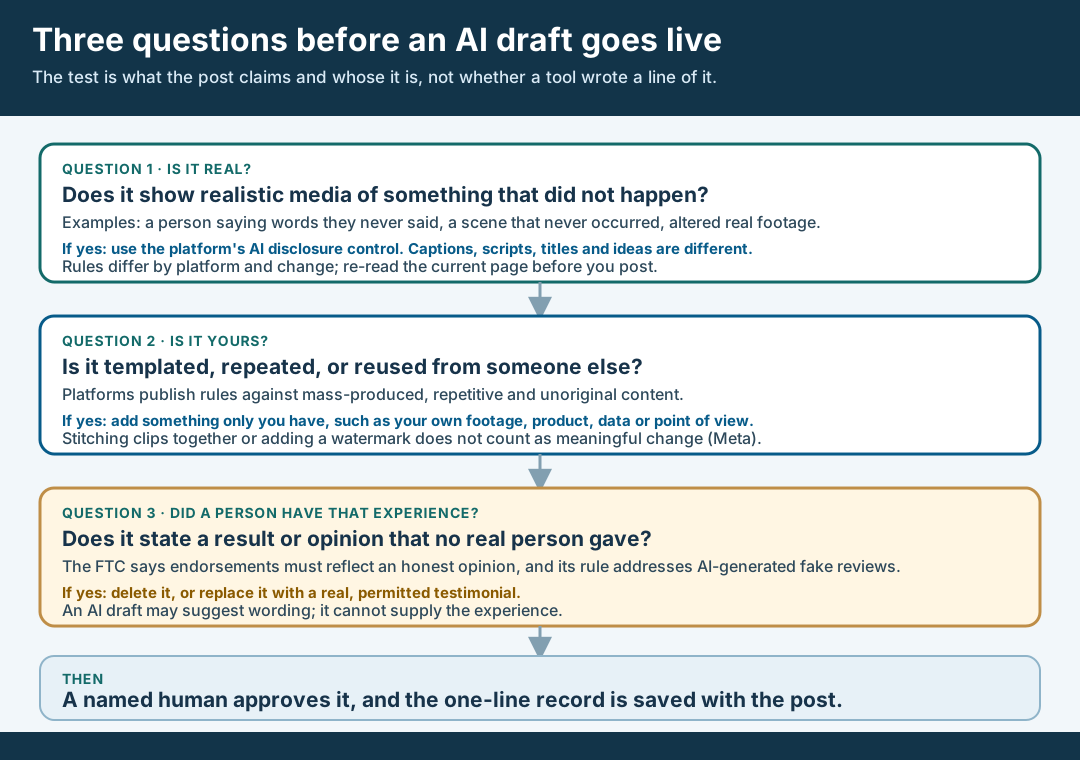
An original editorial diagram. The test is what a post claims and whose it is, not whether a tool wrote part of it.
Original visual by Superdirector editorial team. Creation date not recorded.
Add the one thing only your account has
The second question is where most AI-assisted accounts drift, because AI drafts are fluent and similar. Two posts built from the same prompt differ in wording but not in substance. The platform rules above all point the same way: material you made yourself, or changed in a way that adds something, is treated better than material that is generic, repeated or lifted. Meta’s own wording is that Pages and profiles get the most distribution when they mainly post content they filmed or created themselves.
So make the “what only we added” field part of the draft and not an afterthought. It can be your own photo or clip, a fact from your product or your sales calls, a number from your own records, a customer’s real question and your answer, or an opinion you will stand behind. If you cannot name the added thing, the draft is not ready, and no amount of rephrasing fixes that. This is also where repurposing your own long-form material beats generating from nothing: the footage already carries what only you have, and the AI step only trims and captions it.
Name an approver and save a one-line record
Every row in the sort ends with a person, so name that person for each post before it is scheduled. Then write one line in the blank register: the job, what the AI step was, the answers to the three questions, what only your team added, who approved it and when, and which disclosure control, if any, was applied. The line lets you answer a later question about a post without relying on memory. It is our suggested practice, not a platform or FTC requirement.
Walk through a fictional week
Fictional exercise: no real account, post, customer or result was inspected. Harbor Row Candle Co. is an invented two-person brand posting on Instagram and TikTok. Its owner uses AI for drafts and keeps approval. Here is one week as it would run through the gate.
| Day and job | AI step | Gate result | What the owner did |
|---|---|---|---|
| Mon: caption for a new scent (job 2) | Three caption options from the owner’s brief | Q1 no, Q2 passes with the owner’s own photo, Q3 no | Rewrote option two with the scent notes she chose; approved |
| Tue: lifestyle scene (job 5) | A generated image of a candle in a room that does not exist | Q1 yes: a realistic scene that did not occur | Used her own product photo instead; for any realistic generated scene she would use the platform’s label |
| Wed: customer quote (job 7) | Drafted a glowing quote “from a customer” | Q3 fails: no person gave it | Deleted it; asked a real buyer for permission to quote her message |
| Thu: calendar (job 4) | Five posts from one hook template | Q2 fails: five near-identical posts | Merged them into two posts, each with a different photo and fact |
| Fri: comment summary (job 1) | Grouped repeated questions from the week | Not applicable to the three questions | Opened three of the original comments to confirm the summary before using it |
Nothing in the week was blocked because AI touched it. Two items changed because of what they claimed, and one because it repeated itself. The scenario predicts no outcome for any real account.
Where Superdirector fits, and where it does not
Superdirector can take part in researching references (job 1, for public posts and competitors you add), drafting scripts, carousels and posts (job 2), planning (job 4) and reading dated account numbers (job 8). You add sources such as your own account’s available public posts, product pages and references; it does not see private data or accounts on its own. It keeps what it learns as a brand summary you can read and correct, and the brand information guide says to check that summary against your own customer knowledge before using it. From that context it prepares scripts, carousels and posts that you review and save, and the calendar guide shows where planned and published content sit. The performance guide covers reading dated account numbers and setting up the next experiment.
It does not replace the gate. The approver is still a person on your team, and the three questions are still yours to answer. Publishing is narrow: the publishing guide says it sends a saved Instagram image carousel or single X text post to one account you own, that your first post is reviewed manually, and that Auto-post is a separate authorization. Check what your plan and the panel currently allow. The publishing guide does not describe applying a platform’s AI label, so job 5 and the disclosure decision stay with you; check the panel for what it offers. For a longer description of the product category, see the AI social media marketing tool page.
Compare like with like before you scale
Whether AI-assisted drafting helps your account is an empirical question, and we found no authoritative source that answers it in general. The platform pages describe rules, not average results, and any statistic about AI and reach that we could not trace to a primary source is left out of this page. Answer it for your own account instead.
- Pick one content pillar and one platform so the comparison is not muddied by format.
- Mark each post as AI-assisted for drafting, or not, in the register. Mark the job, not just the tool.
- Compare similar posts, the same format, topic and posting window, against your own earlier posts rather than against another account.
- Write down what you cannot tell. A single post is one observation, and a post can differ for reasons unrelated to how it was drafted. The ROI tracking guide and the content calendar guide are the right places to set the measures and the cadence.
- Decide in advance what would change your mind, such as the AI step saving time but your replies or saves falling on those posts.
How many posts make the comparison worth reading is a judgment call, and this page gives no number. A small account will need a longer window than a large one to see anything beyond ordinary variation, and the honest finding after a few weeks may be “no difference we can see.” That is a fine result: it means AI saved you time without visibly costing you anything.
What this page does not cover
This page covers the rules we could read on October 31, 2026: YouTube’s disclosure and monetization pages, Meta’s AI-content page and its post on unoriginal content, TikTok’s newsroom post on AI transparency, and two FTC pages. We could not load Instagram’s Help Center pages on originality, X’s synthetic and manipulated media policy, or TikTok’s current Support Center article, so we state nothing from them. We also did not review LinkedIn, Pinterest, any Threads policy beyond what Meta’s page says, or any law outside the United States. The FTC material concerns US advertising and is not legal advice.
It also does not decide whether your brand should use AI-generated people or voices in its posts, whether your use of a creator’s likeness is permitted, or how to disclose a paid partnership. Those need your own agreements, current platform tools and, where money or likeness is involved, counsel. And it makes no claim about how often AI-assisted posts are labeled, removed or penalized, because none of the pages we read give a figure.