How-To Guide
What is influencer marketing, and what must you decide before your first campaign?
Influencer marketing means brands working with creators to reach their audience. Pick one outcome, a deal type, creators by recent posts, and disclosure.
By the Superdirector editorial team. Influencer Marketing Hub and FTC pages read October 31, 2026.
At a glance
What is influencer marketing, and how do I start?
Influencer marketing is a brand working with creators to promote a product to the creator’s own audience, paid in cash, product, a share of sales or a mix. You do not need to master the whole field to run a first campaign. Make five decisions in order: the one outcome you want to move, the deal type, a shortlist of creators chosen on their last 12 to 20 organic posts, the disclosure and approval rules in the brief, and the date and number you will judge the result by.
- Follower tiers are loose labels: the same trade publication gives two different ranges for the same tier.
- A deal can pay a flat fee, product, a commission on tracked sales or a combination, and that choice follows from the outcome.
- In the U.S. the FTC treats payment or a free product as a connection to disclose, and puts responsibility on the brand as well as the creator.
Direct answer
Short answer: influencer marketing is a brand working with a creator so the creator promotes something to the audience that already follows them. Influencer Marketing Hub, a trade publication, words it as “a marketing strategy where brands collaborate with creators to promote products or services to their audience.” What makes it a plan, and not a favour, is that you write down five things first: the one outcome you want to move, the deal type, the creators and how you chose them, the disclosure and approval rules, and the date and number you will judge by.
This page is for someone in a brand or small team who has to explain the field to a colleague or run a first campaign. It defines the terms, shows where sources disagree, and turns the field into the five decisions above. It does not tell you what any creator charges, what return to expect, or which platform is best for your product, because we found no neutral data that answers those for brands in general.
Use the original five-decision diagram to hold the order and the blank campaign plan sheet to record your answers; the sheet contains no creator, fee or result.
What influencer marketing is, and what it is not
Two things separate it from ordinary advertising. The message comes from a person the audience already follows, and the audience sees it in the same feed as that person’s other posts. That is also why it carries a legal duty that a banner ad does not: the FTC’s Endorsement Guides treat a message as an endorsement when consumers are likely to believe it reflects the opinions or experiences of someone other than the advertiser, and then ask for disclosure of any connection viewers would not expect.
It is also not the same job as buying a video you will run yourself. When a creator hands you a video to post on your own channels or use in ads, the rights are part of the price, and the UGC price guide covers that quote. When the creator posts on their own audience, the fee pays for access to that audience, which the influencer rate method covers. Many campaigns use both, so name which one you are buying in each line of the brief.
Finally, it is not a guarantee of sales. Influencer Marketing Hub’s 2026 benchmark report surveys marketing professionals (it cites 600-plus respondents) and reports what they say, not what a controlled test found. Among brands increasing their budgets, it lists brand awareness as the most selected goal at 89%, followed by engagement at 51% and content quality at 39%, with conversions at 35% and attributable revenue or sales at 25%. Read that as what practitioners say they aim for. It does not say how often a campaign reaches those aims.
When enlarged, scroll horizontally to read the diagram.
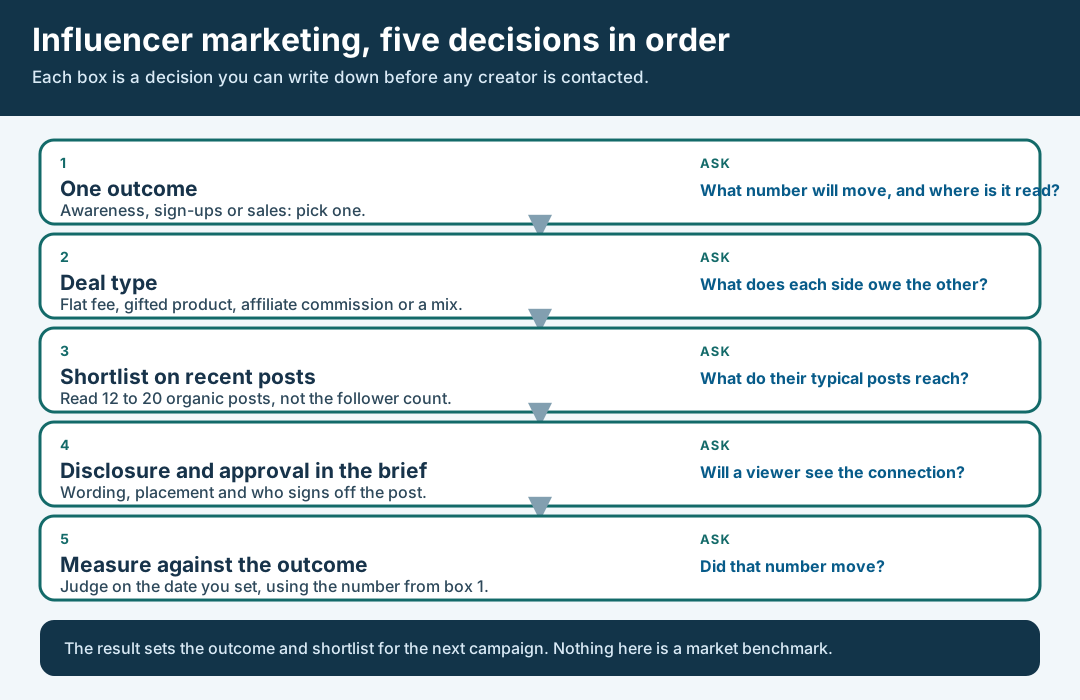
An original editorial diagram. It shows the decisions to write down, not a market benchmark.
Original visual by Superdirector editorial team. Creation date not recorded.
Write down the one outcome the campaign must move
Choose one of three outcomes for the first campaign: awareness (more people see the product), sign-ups or trials (people take a step you can count) or sales (a purchase you can trace). Then write the single number that will show it and the place you will read it, for example the creator’s view count from their insights screen for awareness, or orders carrying the creator’s tracked link or code for sales. A campaign with three goals will be judged on whichever number happens to look best.
The survey figures above show why this matters: brands increasing budgets mostly pick awareness, yet only a quarter of them list attributable sales. Neither is wrong. They need different deals and different measurement, so pick before you contact anyone. If you pick sales, ask now how a sale will be tied to a creator, because a link or code set up after the post goes live cannot be applied to the sales already made.
Choose the deal type before the creator
Influencer Marketing Hub’s page lists four common payment models. Each puts the risk in a different place:
- Pay per post. A fixed fee for each piece of content. You carry the risk that the post underperforms, because the fee is owed either way.
- Pay per campaign. A bundled rate for several deliverables. Ask for the lines inside the bundle so you can see what each deliverable and each right costs.
- Affiliate or commission. A share of sales. The creator carries more of the risk, and you need a working way to track sales to the creator before the post goes live.
- Product gifting. Free product or service in exchange for content. It costs you the product and shipping, and under the FTC’s guidance a free product is still a connection that should be disclosed.
Match the model to the outcome: a commission suits a sales goal you can track, a flat fee suits a reach goal, and gifting suits a product the creator would plausibly use anyway. The same survey reports how many brands put each format among their top three most effective: long-form video at 83%, short-form video at 80% and live shopping at 62%. It uses a different measure for the last two, with 31% of brands ranking UGC as highly effective and 5% for whitelisting. Those are opinions about formats and carry no information about price. Whichever model you choose, write what each side owes the other, including the dates and channels where you may use the content. The paid usage term guide shows how to state those as dates.
Shortlist creators on recent posts, not follower tiers
Tier names are where beginners start and where sources disagree most. Influencer Marketing Hub’s main table and its answer on cost give different ranges for the same labels:
| Tier | Main article range | Cost answer on the same page |
|---|---|---|
| Nano | 1,000–10,000 followers | Under 10,000 |
| Micro | 10,000–100,000 | 10,000–50,000 |
| Mid-tier | Not defined in the table | 50,000–500,000 |
| Macro | 100,000–1 million | 500,000–1 million |
A tier label therefore tells you roughly how big an account is and nothing about what a post reaches. The better evidence is the creator’s own recent organic posts. List the last 12 to 20 public posts in the format you would buy, leave out paid and giveaway posts, and take the median views. The average views guide shows the method and why the median holds up better than the mean. Then check that the audience is real with the fake-follower check, and use the shortlisting guide to keep the evidence beside each name.
Your own plan sets how many creators to shortlist. Two or three on the same spec is enough to see whether their quotes and recent results differ, which is more useful than a long list you cannot read. To turn a quote into a budget line, the budget calculator does the arithmetic once you have your own numbers.
Put disclosure and approval in the brief
Disclosure is the part of this field a beginner is most likely to get wrong, and the FTC’s pages are specific about it. In the Endorsement Guides Q&A and its influencer disclosure guide the FTC says:
- A connection viewers would not expect should be disclosed, and the same is usually true when the endorser has been paid or given something of value. A free product counts, however it reaches the creator.
- The disclosure should be placed where it easily catches attention and is difficult to miss. A disclosure only in the comments is not clear and conspicuous, and neither is a link or button labelled “disclosure.”
- In video, put it in the video, spoken or on screen, not only in the description. In Stories, overlay it long enough to read.
- Clear words such as “ad,” “advertisement” or “sponsored” work. Vague terms such as “sp,” “collab,” or a bare “ambassador” or “gifted” are likely to be unclear.
- Tagging a brand is an endorsement but not a disclosure of a connection, and a platform’s built-in label is no guarantee on its own that the disclosure is effective.
The same FTC page says a company is responsible for what others say on its behalf, that handing part of the program to an outside company does not remove that responsibility, and that you should train and monitor those promoting for you. It suggests that requiring pre-approval of paid posts is the easier route. So the brief should carry three lines: the disclosure wording and where it goes, who approves the post before it goes live, and what happens if a post goes up without that approval. The disclosure review guide shows what to check on the first cut. Rules differ outside the United States and this page is not legal advice; ask counsel how it applies to you.
Measure against the outcome you wrote down
Set the date you will judge the result at the start, long enough after posting for the views or orders to settle, and use the same number you wrote in step one. If the goal was awareness, compare the post’s views with the creator’s median from your shortlist. If it was sales, count orders carrying the creator’s link or code. Write the result in the same sheet as the plan so the next campaign starts from evidence rather than memory.
Fictional example, not a result. A small skincare brand writes: outcome, 200 tracked orders; deal, a commission on tracked sales plus a free product; shortlist, three creators whose last 15 organic posts have the highest median views; brief, “#ad” spoken in the first ten seconds and the brand approves each post; judge on the 30th day after posting. At the review date, compare the recorded orders with the written target and retain which link or code associated them with a creator or post. These records alone do not explain why an order happened or establish the effect of a particular wording. The numbers are made up to show the structure; no brand or creator was inspected.
Superdirector’s creator research flow helps you read the posts and accounts behind a shortlist; it does not know what a creator will accept, and it does not run the deal. The quotes, the contract and the payment stay between you and the creator.
Where the definitions stop
Every figure above is a trade publication’s survey or definition, or a regulator’s guidance, read on October 31, 2026. We could not confirm how the survey was weighted, how respondents were chosen, or whether the platform and format ratings reflect measured results. The vendor’s tier ranges conflict with each other on the same page. We make no claim about market size, typical fees, return on spend, or rules outside the United States, and we could not load TikTok’s branded content help page or Instagram’s paid partnership help page, so we say nothing from them.
Sources read on October 31, 2026: Influencer Marketing Hub: what is influencer marketing, Influencer Marketing Hub: influencer marketing benchmark report, FTC: Endorsement Guides, what people are asking and FTC: Disclosures 101 for social media influencers.