How-To Guide
Types of UGC videos: choose the format your brief needs
Choose UGC video formats by the viewer’s question, available evidence and required shots. Includes original brief examples and an editable format-choice card.
By the Superdirector editorial team. Reference texts reviewed November 5, 2026.
At a glance
Which types of UGC videos should a brand choose for its brief?
Choose a UGC video format by the job it must do: reveal contents, show a task, teach steps, answer a doubt, describe an actual experience or compare a defined choice. Check that the available product, speaker and records can support that job. Then write the required shots and truthful limits before choosing the camera style or publishing account.
- A format is not proof that a product claim is true.
- Faceless, voiceover and AI-assisted are production choices, not automatic new buyer tasks.
- Use the original choice card to turn one format into a concrete brief.
Choose the question before the format name
A list of UGC video types is useful only if it helps you ask for the right footage. A buyer wondering what fits inside a pouch needs a different video from someone who understands the pouch but cannot work out its closure. Write the question first; otherwise a familiar label such as “lifestyle” can conceal an unclear assignment.
This guide uses UGC broadly for customer-created or commissioned creator-style video. That wording does not settle who posts it, whether the speaker is paid, or what the brand may reuse. The UGC versus influencer guide handles those different purchasing cases. Here, the decision is the communication format of one video.
The editable format-choice card and blank CSV are original planning aids. They contain no customer, creator, fees or results. The HTML is editable for printing; it has no automatic saving or import. Keep the actual product evidence and agreement in their existing records.
Match the question to visible evidence
The following is an editorial selection matrix, not a standardized taxonomy or a ranking of conversion performance. A video can combine two structures, but name its primary job so the required footage stays clear.
| Viewer question | Format to consider | What the brief must make visible | What it cannot establish by itself |
|---|---|---|---|
| What arrives, and what is included? | Unboxing / first inspection | The actual supplied package and contents; identify separately supplied items | Durability, long-term satisfaction or a result not yet experienced |
| Can it perform this particular task? | Demonstration | Starting condition, relevant action and visible end state on the actual product/version | How every buyer or condition will perform |
| How do I do this correctly? | Tutorial / walkthrough | An ordered sequence with prerequisites, decision points and a checkable finish | That a viewer completed the steps or got the same result |
| Will this specific constraint be a problem? | Objection answer / FAQ | The constraint and the evidence that answers it, including an honest limitation | A general guarantee from one favorable case |
| What changed for someone who actually used it? | Honest experience account | The speaker’s real basis, use conditions and qualified opinion | A scripted experience the speaker never had or a typical result for everyone |
| Which option suits this defined task? | Comparison | Same declared task, versions and conditions, with both options represented fairly | Overall superiority from a selectively staged difference |
| How could this solve a recognizable inconvenience? | Problem and fix | The inconvenience, relevant action and observable change; mark any dramatization | A measured before/after study when none was performed |
| Where does it fit in an ordinary activity? | Routine / day-in-context | The product’s actual role in a task or sequence, without burying required facts | That a staged scene is the creator’s usual life or an observed customer outcome |
Use the lists without adopting their promises
Flockler groups reviews, usage tips, before-and-after, vlogs, tutorials, education and unboxing. Veel gives a creator-portfolio list that includes review, unboxing, lifestyle, how-to and educational work. Those structures help name assignments; their promotional claims do not establish which one will work best for your brand.
A broad educational explanation may be useful when the viewer needs a concept before a product demonstration makes sense. State the concept and its evidence; do not turn it into a disguised product claim. A reaction or first impression can show a genuine immediate response. It cannot become a long-term review merely because the creator speaks confidently.
The matrix deliberately separates a demonstration from a tutorial. “Show the pouch holding the items” is a proof-oriented scene. “Teach someone to load and close it” is an instruction sequence. They may share footage, but their acceptance questions differ.
Keep camera treatment and distribution separate
Faceless, talking-head, voiceover, screen recording and close-up describe production treatments. They do not replace the communication job. A hands-only tutorial still has to show the right steps; a talking head still needs the product evidence behind a factual claim.
The publishing account is another choice. A commissioned asset for a brand ad does not automatically include a post to the creator’s followers. An existing customer post does not automatically supply a new edit or a reuse licence. Put the actual account, placement and agreed permissions beside the format.
TikTok’s performance-ad guidance presents its creative advice as a starting point and recommends continued testing. We use its broad structure—opening, product proposition and next action—as a planning prompt. This is ad-specific guidance, not proof of an organic ranking effect or a universal seconds-long recipe.
When enlarged, scroll horizontally to read the diagram.
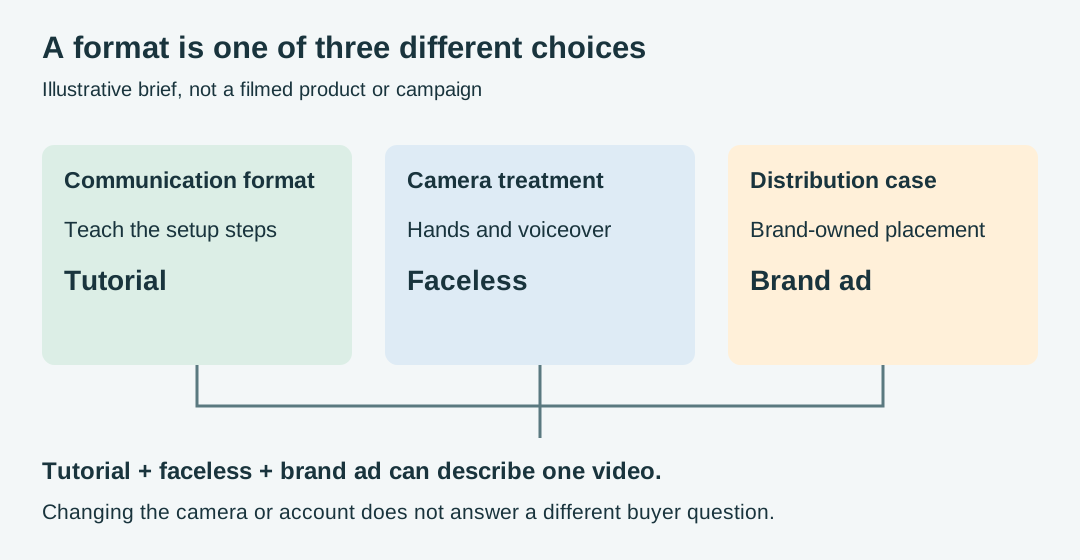
Original editorial decision diagram. One video can have all three labels; none proves a product claim or a campaign outcome.
Original visual by Superdirector editorial team. Creation date not recorded.
Fictional brief fragments for one product
These products, scenes and briefs are invented teaching material. No pouch was filmed, customer interviewed or result observed. Imagine a fictional Foldline cable pouch whose current product facts have been checked by its owner. The task is to help a viewer judge whether its layout suits the items they carry. The actual product facts would have to replace these assumptions before a real brief.
| Possible brief | Required scene | Reject or revise if… |
|---|---|---|
| Unboxing: show exactly what the supplied package contains. | Open the supplied package, lay out included pieces and label an adapter brought only as a prop. | The edit implies the prop is included, or claims everyday durability on first opening. |
| Demonstration: show how the actual pouch accommodates the declared example items. | Name the example items, show loading and closure, then show the resulting shape without hiding a failed closure. | A different pouch, smaller prop or concealed cut changes the apparent fit. |
| Tutorial: teach loading and retrieving the example items. | Identify the starting items; show the order of loading, closure and retrieval in understandable steps. | A necessary step is omitted or the final state cannot be traced to the shown actions. |
| FAQ: answer whether a bulky adapter prevents closure. | Use the actual stated adapter and pouch version; show the attempt and disclose a limitation if it does not close. | The answer is scripted as yes despite the visible result, or generalized to every adapter. |
Choose one of these jobs for the first asset. If you commission variants, record which communication job changes and which product facts, placement and conditions remain the same. A revised hook can be a new edit without becoming a new verified product test.
Do not invent the speaker’s experience
An experience account requires a person who actually has the relevant experience. The FTC’s U.S. disclosure guidance says an endorser cannot describe trying a product they have not tried, misstate their opinion or invent proof-requiring claims unsupported by the advertiser. Check the claim and the speaker’s basis before asking them to sound more enthusiastic.
If you brief an actor, describe the observed action or illustrative scene rather than presenting a fictional role as a satisfied customer. A synthetic face does not create a real customer history. The FTC’s August 2024 rule announcement specifically addresses fake or false reviews and testimonials, including fabricated reviewers and misrepresented experience. This is a narrow source reading, not legal clearance for a particular script or a statement of every jurisdiction’s rules.
For a before-and-after scene, retain the conditions, timing and any relevant intervention. Do not present a staged reset, retouch or changed lighting as a measured product effect. If you lack the evidence needed for a claimed transformation, choose a task demonstration or explain the concept without making that transformation claim.
Turn the choice into a brief someone can film
- Write the viewer question and the one action or understanding the video should support.
- Name the chosen format, the product/version and the evidence available now.
- Specify the necessary actions or shots, then say what the footage must not imply.
- Record the speaker’s actual experience basis and supported claim wording; remove unsupported claims.
- Choose camera treatment, account and destination separately. Include actual permissions, disclosure, technical delivery and review owner.
- Review the finished sequence for continuity and understanding. Can another person answer the original question from what is shown, without supplying missing steps in their head?
Use the UGC brief guide for the full assignment and the usage-rights record guide for channel, term and territory. The format-choice card is a small input to that brief, not a replacement agreement.
Evaluate the version you actually receive
First ask whether the video communicates the chosen task truthfully. Then evaluate its actual placement under the measurement plan you set. Comprehension, a usable delivered asset, a reported view and an associated order are different observations. A format can be clear yet reach the wrong audience; an unclear scene can attract views without answering the buyer’s question.
If the footage leaves a gap, name it: contents hidden, prerequisite omitted, conditions changed or experience unsupported. Repair that gap before deciding that the whole format is ineffective. If you use Superdirector to explore creative directions, carry this question, evidence and shot requirement into the planning work; the product record, agreement and actual video remain the evidence.
Sources and limits
The complete retained texts of five external references were read on November 5, 2026: the two vendor lists, TikTok’s performance-ad guidance and the two FTC pages linked above. The retained November 3 keyword answers supplied dated citation examples, not a current census of formats or buyer demand. No source videos or native account tools were watched or tested here. The matrix, fictional brief fragments and card are original editorial designs. No conversion, retention, price, creator performance or customer outcome is presented as our observation.