How-To Guide
What are the best alternatives to ReelFarm for brands?
Choose ReelFarm alternatives by the workflow you need to replace: TikTok slideshows, account publishing or synthetic presenter video, with dated plan units.
By the Superdirector editorial team. Vendor pricing and product pages read November 4, 2026. We did not buy from or test any option.
At a glance
What are the best alternatives to ReelFarm for brands?
Keep ReelFarm in the comparison if TikTok slideshow creation and publishing already fit your work. Investigate Genviral when the missing job is creation plus distribution across more networks; price the plan with the automation you need. Investigate MakeUGC when the output must change to a synthetic presenter video, while separately checking how that file will be published. A different content format or lower entry price does not by itself replace the whole workflow.
- ReelFarm’s current homepage and API documentation explicitly describe TikTok scheduling and direct publishing.
- Genviral Creator’s $29 monthly plan excludes autopilot; Professional lists one automation at $49 monthly.
- MakeUGC’s displayed Starter and Growth prices are billed yearly, and generation credits do not equal a fixed number of usable videos.
Name the handoff you need to replace
Start with the failed job: the slideshow is wrong, the publishing destination is missing, the approval process does not fit, or you now need a person speaking on screen. Those are different reasons to change tools. Write the format, number of assets, publishing accounts, review owner and intended action for one ordinary month.
If you already make suitable files and only need scheduling, the TikTok and Reels calendar comparison is the relevant buying question. If you need a wider comparison of synthetic video creation, use the AI UGC ad-tool guide. This article stays with the narrower decision of what a ReelFarm replacement must preserve.
Publisher disclosure: we sell Superdirector, an upstream content-planning product, and do not rank it here. Primary pages were freshly captured and read November 5, 2026. No account connection, generation, trial, purchase or publication was performed. The recommendations below are conditional on published product descriptions, not measured output or results.
Check ReelFarm’s current publishing scope
The current ReelFarm homepage explicitly describes automated slideshow creation, scheduled posts and direct publication to TikTok. Growth is listed at $49/month for 100 slideshows and Scale at $95/month for 250; the cards include TikTok publication and scheduling. It also advertises three free TikToks and unlimited connected TikTok accounts and team members. Confirm the free offer’s actual access and charge conditions; no signup was tested.
The official API reference documents automatic recurring TikTok publication and separates direct posting from sending content as a TikTok draft. A draft still needs its own completion path. The documentation also ties analytics to a published post identity. This supports a published TikTok workflow, not a claim that a specific account connected or a post succeeded.
ReelFarm’s homepage describes repurposing its content on other platforms. That does not establish native scheduling of every format to Instagram, LinkedIn or X. Keep file export or repurposing separate from a connected publishing destination. If TikTok publishing is the only alleged missing feature, inspect the current route before switching.
The page now also lists AI UGC selfie images and videos, so do not treat ReelFarm as incapable of any generated video. Decide whether its actual output meets your brief. For sourced imagery, the same page warns that advertising requires rights in the images; discovering a picture is not an inspected license for your use.
Choose between broader distribution and presenter video
| The job that changed | Candidate to investigate | What must remain explicit |
|---|---|---|
| Your TikTok slideshow and posting workflow already fits | Keep ReelFarm in the comparison | Check the actual account, format, review and publication route before adding another subscription. |
| You need generated content scheduled across additional networks | Genviral | Its homepage names ten networks and slideshow/video/text publishing; verify the exact network, account type and format you need. |
| You need a synthetic presenter delivering a script | MakeUGC | Its product page describes actor-led video generation and editing. Confirm the file, resolution, credits and your publishing route separately. |
Genviral’s required plan depends on automation. Its pricing page lists Creator at $29/month with 200 generation credits, five social accounts and one team member. The explicit plan summary excludes autopilot. Professional is $49/month with 500 credits, ten accounts and one autopilot automation. Both list scheduling/posting; scheduling alone and recurring generation on autopilot are different requirements. The page gives annual amounts of $290 and $490 respectively, rather than a one-month purchase at the rounded annual monthly equivalent.
The Genviral homepage names TikTok, Instagram, YouTube, LinkedIn, Pinterest, Facebook, X, Bluesky, Telegram and Mastodon. It describes drafts and review before publication. Confirm your chosen format on each destination and the intended human review behavior. A broad network list does not prove the same media, music, caption or account permissions everywhere.
MakeUGC changes the output. Its product page describes selecting an AI actor, providing a script or product input, then generating and editing video. Its pricing displays Starter at $29/month billed yearly with 500 monthly credits and 480p/720p exports; Growth is $39/month billed yearly with 1,000 credits and HD/2K/4K options depending on the selected model. Those equivalents imply $348 or $468 over twelve months by our multiplication, before other charges; they are not flexible one-month prices.
MakeUGC offers a $1 start, with trial duration and renewal amount shown at checkout. Generation cost depends on model, duration and resolution, and credits do not roll over. Its Enterprise card explicitly offers brand review/approval workflows; do not budget that complete team requirement on Starter from a flattened feature row. The reviewed pages do not establish a replacement account-publishing route for your ReelFarm posts.
A synthetic presenter can illustrate a script, but cannot acquire real experience with your product. Keep the claim basis, product depiction, voice/likeness permissions and required disclosures in the brief. No actor realism, conversion advantage or equivalent-output ranking was tested here.
When enlarged, scroll horizontally to read the diagram.
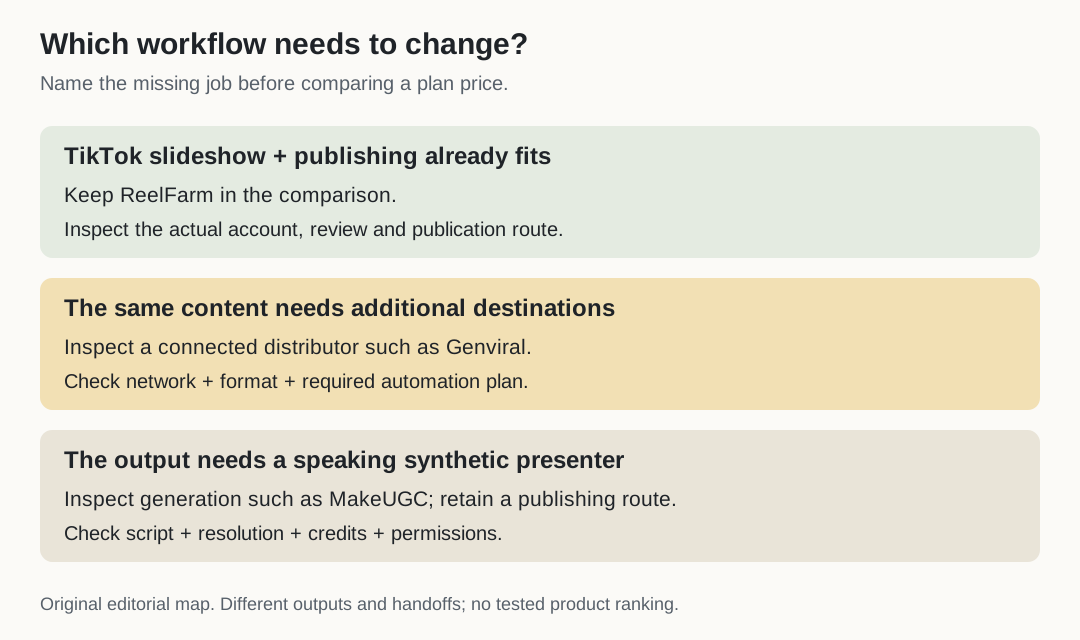
Original editorial workflow map. Format, generation and publication are separate buying requirements; no product or outcome ranking is shown. Primary descriptions read November 5, 2026.
Original visual by Superdirector editorial team. Creation date not recorded.
Calculate the month in each vendor’s units
Count created assets, accepted files and live publications separately. A six-image slideshow is one planned post, six images to generate under an image-credit meter, and a separate publication event. Do not compare a slideshow allowance with a credit balance as if the units matched.
Fictional workload: twenty slideshows in a month, each with six newly generated images, with no video, retries or additional assets. Genviral’s pricing page states one to three credits per image and no generation-credit charge for scheduling or publishing. That gives 20 × 6 = 120 images, or 120–360 generation credits for this limited scope.
| Option | Published unit applied to this illustration | What the calculation does not settle |
|---|---|---|
| ReelFarm Growth | Twenty creations fit within the listed 100-slideshow allowance. $49 ÷ 20 = $2.45 per creation at this usage; $0.49 requires all 100. | Accepted output, actual publication and the cost of any other required work. |
| Genviral Creator | 200 credits cover the 120-credit image case, but not 360. Creator excludes autopilot. | Actual image models, retries, agent usage and whether the workflow needs recurring automation. |
| Genviral Professional | 500 credits cover this 120–360 image calculation; the plan lists one autopilot automation. | Complete workflow consumption, destination support and successful publication. |
| MakeUGC | No fixed video count is derived from 500 or 1,000 credits. | Specify actor, duration, model and resolution; ask for the generation cost and inspect the output. |
Genviral also meters its agent separately: the plan lists its own token allowance. This exercise prices the image-generation scope only, not every agent action or revision. Use the actual plan and usage record before concluding that a lower entry price covers the same month. Dollar signs follow the displayed vendor prices; confirm invoice currency, tax, term and all required charges.
Inspect one post before moving the account
- Use the same buyer question, supported product facts, original copy and licensed media when comparing candidate outputs. Keep a slideshow and a presenter video labeled as different outputs.
- Inspect a draft for the correct account, complete slide order, readable text, caption and required disclosure. Confirm how a person reviews it before the selected publishing action.
- During a trial or demonstration, distinguish a generated file, a queued post, a TikTok draft and a publicly available post. Use a post authorized for that account if testing publication.
- Retain the exact destination post identity and status. A schedule entry or successful render is not evidence of a public post.
- Record actual generation/agent consumption, paid term, cash charged, repair work and usable output. Confirm renewal/cancellation terms before accepting a trial charge.
Keep ReelFarm when the existing TikTok route fits. Choose a broader distributor when the demonstrated account/format handoff solves a real gap. Add a presenter generator only when that output is needed and its publishing route is covered. A second tool can complement the first without replacing it.
The script preparation guide helps define an actor-video assignment. Superdirector can support upstream planning; your owned accounts, actual publishing tools and source records supply the operational evidence. No Superdirector video-posting or ad-management capability is asserted here.
Sources and limits
All five retained anatomy texts were read in full: Relay, Fastlane, Flayr, Dora and Superscale. They are vendor-authored comparisons, useful for the questions they raise but not neutral product tests. The current ReelFarm publishing and free-offer statements above use fresh primary text and documentation rather than a rival’s characterization.
The remaining unknowns are hands-on: exact trial terms, format-specific destination behavior, human approval on the chosen plan, usable output, actual generation cost and successful account publication. No testimonials, account-warming advice, view counts or sales claims were adopted. Historical panel observations remain dated evidence, not current exact-query search volume or a market-wide ranking.