How-To Guide
What should influencer posting guidelines include?
Adapt an influencer posting guideline card for claims, disclosure, tags, timing and corrections, with fictional skincare and app examples.
By Bell Chen, founder of Superdirector — how the analysis works.
At a glance
What should influencer posting guidelines include?
Write a short instruction for one creator, account and placement: supported product facts, do/don’t examples, disclosure and platform setting, exact tags/destination, timing, review contact, use boundaries and the route for changes or corrections. Link the actual brand guide, evidence and agreement. Keep creative freedom and honest opinion separate from factual requirements.
- Use one concrete placement and version, not a universal social-post checklist.
- State the basis for a rule: product evidence, actual terms, platform instruction or applicable jurisdiction.
- The skincare and app examples are fictional teaching adaptations, not tested claims.
Write the instruction for one real placement
Influencer posting guidelines should answer the questions a creator meets while finishing and publishing a particular item. Give them the supported facts, the required disclosure and tags, the timing and review contact, and the route for a change or correction. Keep enough room for their own delivery and honest opinion.
A brand style guide describes the brand across many pieces. An agreement settles the actual scope and commercial terms. This posting card is the short instruction a creator can use beside the final cut. Link the brand kit, content style guide, current product evidence and actual agreement instead of pasting every document into it.
Start with the creator account, platform/format, current version and intended market. A Reel, Story, TikTok and YouTube integration do not expose the same surfaces or platform settings. Choose the particular placement before writing a supposedly universal rule such as “put the disclosure in the caption.”
Fill the one-page posting guideline
Use this original compact layout as an instruction draft. Fill it from the real campaign and get unresolved commercial or legal questions answered by the appropriate person. A blank field stays an open question; this card supplies no acceptance, payment, removal right or new deliverable.
| Card line | What to write |
|---|---|
| Identity and version | Creator/account, platform/format, intended market, product/version and guideline date/revision. |
| Purpose and creative freedom | One thing to explain or demonstrate; what the creator can choose themselves. |
| Product evidence | Current source for each required factual statement, including limits and conditions. |
| Do / do not say | A supported example and a specific unsupported claim to avoid; never a compulsory positive opinion. |
| Disclosure | The actual connection, intended wording/language and where it belongs in this placement; identify the applicable market guidance. |
| Platform setting | The particular commercial-content/paid-promotion route to confirm, separately from the creator’s message. |
| Tags and destination | Exact public handle, link or code and the current destination; a brand tag is not your disclosure instruction. |
| Music and other assets | The permitted files/tracks and applicable uses, with the actual rights reference. |
| Timing | Draft/review/publication window with time zone and any genuine dependency. |
| Review contact | One consolidated feedback contact, response route and agreed revision scope; say what to do if an answer is late. |
| Use boundaries | Pointer to the agreed publication/reuse scope and any separate paid-use permission; no new grant hidden here. |
| Changes and corrections | Who to contact, which version or URL to name, and how the actual agreement/platform process governs edits or removal. |
The editable posting card has a blank form and two separately labelled teaching examples. Its blank CSV carries the same fields for your own application. It is a compact layout intended for a short instruction sheet; final page count depends on entries and print settings. Neither file saves automatically or connects to an account. The CSV is separate and does not populate the HTML.
Superfiliate’s briefing guide usefully separates product information, creative direction, approval ownership and dates. We adopt that separation, not its claims that a briefing approach improves performance or reduces revisions. In a posting guideline, replace “follow all brand rules” with the few exact decisions needed for this item.
When enlarged, scroll horizontally to read the diagram.
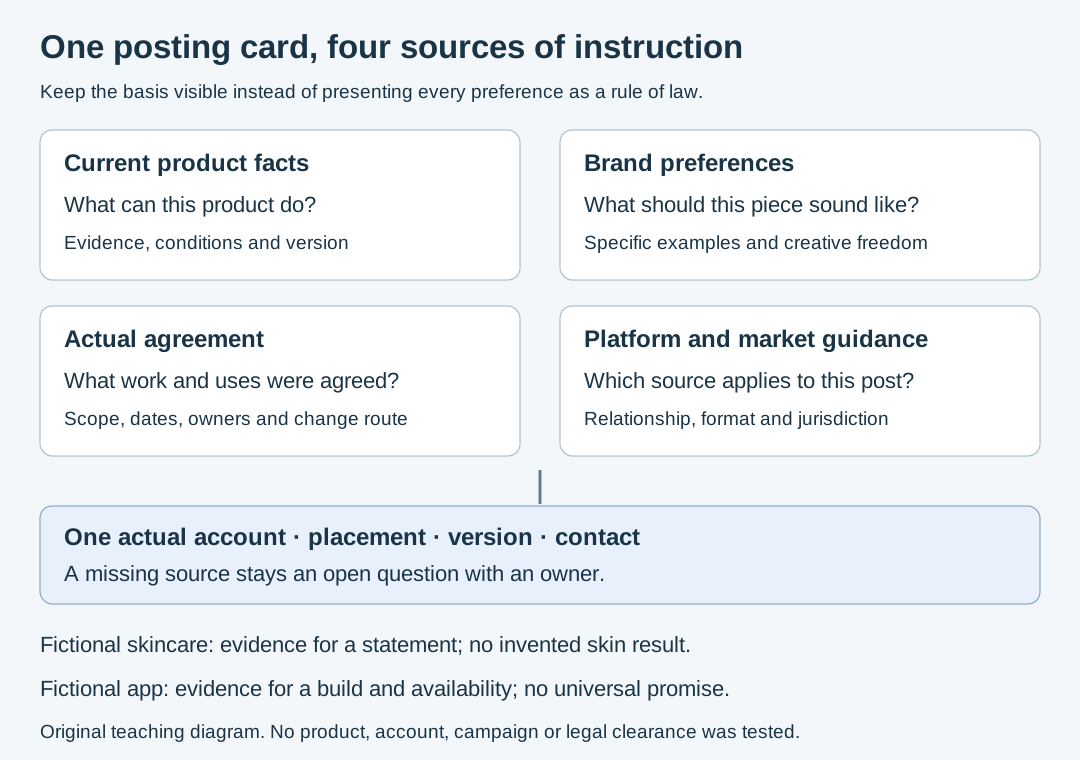
Original instructional diagram. No real campaign, product test, account or legal clearance is shown.
Original visual by Superdirector editorial team. Creation date not recorded.
Separate source rules from brand preferences
Write the basis beside an important rule. “Use our preferred product name” is a brand instruction. A platform’s disclosure setting is a platform requirement. A legal disclosure or claim question depends on its jurisdiction and facts. Mixing these labels can make a creative preference look like a universal law or a legal duty look optional.
| Named source and scope | What the current text says | How to use it in the card |
|---|---|---|
| FTC staff Disclosures 101 — U.S. endorsements; foreseeable U.S.-consumer effects can include posts from abroad | Disclose relevant relationships, put the disclosure with the endorsement, and do not assume the platform tool alone is enough. | State the actual connection and location/language for this placement. Do not offer a magic hashtag as universal clearance. |
| Instagram creator guidance — its branded-content route | Paid-in-any-form content needs the Paid Partnership label; its FAQ includes gifted products and other noncash benefits. | Name the Instagram setting and the creator’s own disclosure separately. Paid promotion permission is another question. |
| YouTube Help — its commercial relationship setting | Select paid promotion for the described relationships; the setting adds a label at the video’s start. Creator and partners still have applicable legal responsibilities. | Name the actual video and setting; do not carry an Instagram instruction into YouTube. |
| TikTok Branded Content Policy — its current platform/market scope | Enable commercial disclosure for branded content, identify the promoted product clearly and avoid false or misleading claims. | Use the TikTok-specific handoff for relationship, label, sound and optional Spark use. |
Read the actual FTC brochure, Instagram guidance, YouTube help and TikTok policy for the route you use. This table is a bounded summary, not a worldwide legal standard. For video, FTC staff specifically says disclosure should be in the video and not just its description, use the endorsement’s language, and avoid hiding it behind more or among hashtags. It also says creators cannot invent experience or proof-requiring product claims.
Keep brand preferences concrete without scripting a false testimonial. For example, request that the product name be pronounced correctly and that the demonstrated action be visible. Do not require “I loved it” or a dramatic before-and-after result regardless of what happened. The product-claim review is the deeper evidence task.
Adapt the skincare example
Fictional U.S.-audience teaching example: a brand wants a short creator video showing a moisturizer’s texture and application. The assumed input is the actual current product label and a product supplied for the creator to try; neither exists as a verified product in this exercise. There is no clinical evidence or measured skin outcome. The lines below are instructions, not a prepared testimonial or medical advice.
| Guideline part | Example adaptation |
|---|---|
| Show | Dispense and demonstrate the actual product as directed by its current label. Let the creator choose their setting and describe only their genuine experience. |
| Supported wording | Use factual product details only when the brand supplies their current source. Any opinion about feel must be the creator’s true observation, not text the brand requires them to repeat. |
| Do not add | Do not turn a texture demonstration into “cures eczema,” “treats acne” or an invented before-and-after improvement. No proof for those claims is assumed. |
| Disclosure and labels | State the real gift/payment relationship for this actual placement and its applicable U.S./platform route; the example supplies no universal approved phrase. |
| Assets and review | Use the agreed product/version and permitted audio. Send a product-claim question to the named facts owner and a timing question to the campaign contact. |
| If the request changes | A new efficacy statement needs its evidence and appropriate review; it is not a small word choice the editor can quietly add. |
FDA’s U.S. cosmetic-labeling explanation says disease-treatment/prevention or structure/function marketing can make a product a drug, with drug requirements. It also distinguishes FDA’s cosmetic-labeling role from the FTC’s advertising role. Do not read this narrow source as a list of preapproved social-ad claims, or as an individual product classification. For the advertisement and endorsement itself, use the actual evidence and applicable guidance.
Adapt the app example
Separate fictional app example: a note-taking app’s owner supplies an authorized screen recording for a named build/device and says the intended demonstration is exporting a note. These are invented teaching inputs, not Superdirector features or a real release. No install, timing or success-rate test was performed.
| Guideline part | Example adaptation |
|---|---|
| Show | Use the supplied build/device context and the exact export path that the product owner verifies for that context. Keep sample notes free of real personal data. |
| Supported wording | Describe what this demonstrated version does under its actual conditions. If feature availability depends on plan, operating system or release status, obtain and state that scope. |
| Do not add | Do not turn one recorded example into “works on every phone,” “exports instantly” or “free forever.” No such evidence or offer is supplied. |
| Tag and destination | Use the real public account/store destination supplied for this campaign, then check that it represents the intended app and offer. Placeholders in this example are not live destinations. |
| Review and timing | Ask the product owner to confirm the current screen/fact source and the campaign owner to confirm the posting window. Keep a changed build tied to a new guideline version. |
| If the request changes | If the actual app differs from the recorded steps, resolve the mismatch and review the replacement footage. A prior approval does not establish a new feature or price. |
The app example uses the same guideline layout but a different evidence problem: version and availability, rather than an unsupported skin outcome. The useful pattern is a precise instruction tied to its actual source, with the missing answer assigned to a person. It is not a claim that all apps need the same screen sequence.
Name the owner for changes and corrections
Before sending the card, name who answers product facts, who consolidates creative feedback and who can decide the actual commercial or permission question. One person can cover more than one role, but the creator should not have to guess which inbox owns a changed claim or delayed publication.
Write agreed response dates and time zones rather than borrowing an arbitrary “24-hour” rule. If feedback or a required input is late, state who should be contacted and how the publication date is revisited under the actual arrangement. The agreement guide handles those terms; a posting card should not quietly rewrite them.
For an already-public issue, identify the exact account/URL, the statement or asset affected, what was observed and who needs to act. An inaccurate product statement, a missing disclosure, an expired paid-use permission and an obsolete app screen ask different questions. Decide the correction, paid-use pause or removal through the applicable account and agreement process; this template grants no automatic takedown power or new keep-live period.
After any actual change, retain the updated version and check the result rather than treating “we asked” as “it is fixed.” Use the video/caption disclosure review for the finished-post observation. For TikTok, the branded-content handoff keeps labels, music and optional paid use distinct.
Sources, design and limits
The complete FTC brochure, TikTok policy and Superfiliate briefing text were studied for their structure before writing. Current full Instagram, YouTube and FDA primary texts were also read on November 5, 2026, Pacific time. FTC staff’s brochure is dated November 2019; FDA’s page identifies November 21, 2022 as its content date. Reading those documents today does not make their original publication dates new.
The one-page layout, two fictional scenarios, manual assets and diagram are original editorial designs. They do not report a creator campaign, approved legal language, a product test or a platform-account trial. No universal approval turnaround, correction deadline, claim permission, posting cadence or performance improvement is established. A brand’s real terms, current evidence and applicable jurisdiction remain necessary.