How-To Guide
What should a brand verify about Instagram’s paid partnership label?
Check the relationship, accounts, actual request and published label. Keep payment, promotion permission and disclosure evidence separate.
By the Superdirector editorial team.
At a glance
What should a brand verify about Instagram’s paid partnership label?
Confirm the actual relationship, intended creator and brand accounts, and the content or scope involved. Have the authorized owner check the particular request/action available in their account, retain its actual result, and inspect the published label separately. Keep the label distinct from payment, agreed rights, promotion permission and the full disclosure review. Detailed current Help Center menus, eligibility and brand-approval behavior were unavailable in this research.
- A label concerns a brand relationship, including noncash benefits; it is not a cash-payment receipt.
- Current detailed Help Center approval, menu and eligibility behavior was unavailable, so the guide supplies no universal click sequence.
- Use the compact record for a particular request/item; the existing guides handle full disclosure and paid-ad setup.
Identify the relationship and intended accounts
Start with the relationship your team can explain, rather than the word “paid.” Instagram’s public creator guidance says content paid for in any form needs a Paid Partnership label, and its FAQ includes benefits such as gifted products or trips. A visible label therefore does not establish that a cash invoice has been settled. It is a disclosure signal to examine alongside the actual agreement and content.
This page is for the brand-side person checking a proposed label or a labeling-related request. Its job is to connect the right relationship, accounts, content and account-owner action. The native Instagram campaign guide maps the broader campaign; the disclosure review guide inspects the finished video and caption. Do not repeat those whole processes to resolve one account mismatch.
| Identify | Keep the actual reference | Question to resolve |
|---|---|---|
| Relationship | The accepted work, gift or other benefit and its owner | Does someone on the brand team recognize this collaboration? |
| Creator account | Exact handle/profile and the person communicating for it | Is this the account intended to publish, rather than a similar name or an unrelated message? |
| Brand account | Exact intended partner profile and its owner | Is the proposed identity the brand account the parties actually mean? |
| Content or scope | The proposed format/version and any identified post | Is the action about this item, another item or a broader permission? |
Use private references to the agreement and correspondence, not confidential terms pasted into a public checklist. If the people or item do not match, ask the relationship owner to resolve that mismatch. An authentic-looking request is not evidence of a business agreement, and a familiar creator name does not identify which account will publish.
Read the particular action before authorizing it
Ask the authorized account owner to read the exact wording shown in their account and the current official help available to them. Record the requesting identity, the affected content or scope where shown, the action being requested and the result actually returned. This is an editorial verification method, not a verified Instagram menu sequence.
The detailed Help Center pages linked from Instagram’s creator page were blocked during this research. We could not establish a current universal path for adding a label, which accounts qualify, how a brand approves a tag, or what declining, editing or removing a request does. Do not substitute a dated tutorial for evidence of the action now in front of the account owner.
| Question the team is answering | Evidence to obtain | Do not substitute |
|---|---|---|
| Which relationship should the content disclose? | Actual benefit/work and the intended accounts | A new or unfamiliar notification by itself |
| What action does this request authorize? | The actual request wording and scope, checked by the account owner | A different permission accepted for a previous campaign |
| Did that account action complete? | Its actual result, account and checked-at time | A planned instruction or a message saying someone will do it |
| What does the audience see? | The identified published item in the observed viewing context | Only a settings selection or unpublished draft |
Where the current account exposes an approval or request state, record its words rather than translating everything into “approved.” If access is missing or the scope is unclear, name that missing evidence and the person who can obtain it. This guide makes no claim that approving a creator always causes a named label to appear, that approval is automatic, or that one account action covers every future post.
A caption mention or proposed coauthored post may be part of the work, but neither answers this request-scope question. If a Collab is actually contracted, use the Collab delivery check for that separate deliverable. Do not change the campaign scope just because another control appears beside the label task.
Keep labeling, payment and promotion evidence separate
Instagram tells creators that they must give permission before businesses see the option to promote their branded-content posts. Its label guidance and promotion guidance answer different questions. Meta’s February 21, 2024 announcement likewise describes boosting organic labeled content as a partnership ad, or creating a new partnership ad. That dated explanation supports the distinction; it does not establish today’s account navigation or eligibility.
| Record | What it can establish within its scope | What still needs its own evidence |
|---|---|---|
| Label observation | The wording/identity visible on the particular item when checked | The agreement, actual benefit, payment status and other disclosure surfaces |
| Accepted agreement | The work and uses the parties actually agreed | Whether the platform action completed or a post/ad exists |
| Promotion permission | The specific permission actually evidenced in the authorized account | The agreed use, ad creation and actual paid delivery |
| Payment record | The supported settlement state for the particular transaction | Content publication, permission or results |
For optional paid use, settle the intended use with the creator and have the ad owner verify the appropriate platform permission. The partnership-ad setup guide covers that deeper task. This page does not prescribe an ad code, account-level grant, flight or advertising budget.
Product truth remains separate too. FTC staff guidance says an endorser cannot describe experience with a product they have not tried or invent proof-requiring claims the advertiser cannot support. A label cannot supply that missing experience or product evidence. Read the actual claim against the available support rather than treating labeled content as already reviewed.
When enlarged, scroll horizontally to read the diagram.
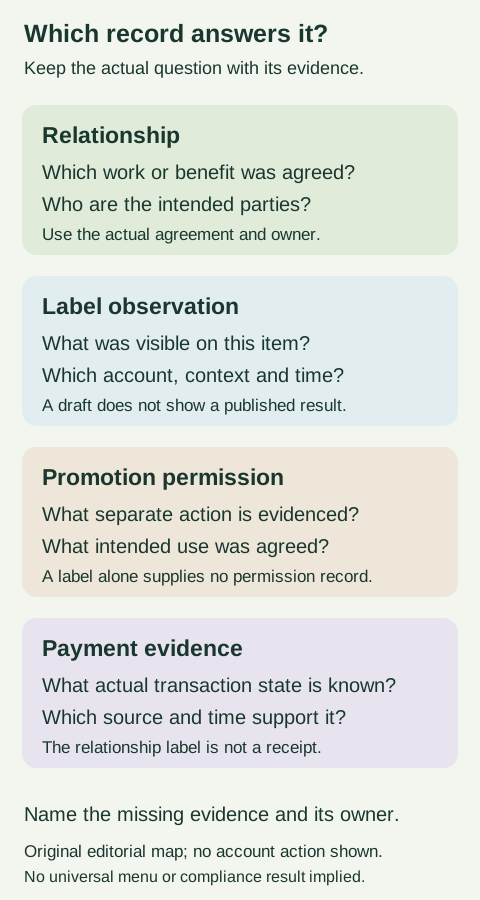
Original editorial map. No real account, parcel, carrier timeline or result is represented.
Original visual by Superdirector editorial team. Creation date not recorded.
Check the published item and name the next correction
Once the item is published, inspect that exact post and record what you can actually see: account, URL or item reference, label wording, any named partner, viewing context and time. Keep a private capture reference where appropriate. If the available view does not show the label, record that limited observation and ask the account owner for the relevant evidence; do not infer the creator’s setting or intent from a view you could not inspect.
A draft and a settings screenshot can help prepare a post, but they do not show the published version. Conversely, a published label observation is not proof of which internal approval steps preceded it. Keep each observation tied to its source and time. If the account, content or wording changes, add the new observation instead of overwriting what was seen earlier.
For relevant U.S. endorsements, the FTC’s Disclosures 101 says the disclosure belongs with the endorsement and warns against assuming a platform tool is good enough. It also addresses in-video disclosure and language. Use the video-and-caption review for those surfaces; this label record is not a legal compliance decision or a universal instruction to use one hashtag.
Give a correction to the owner of the missing fact or action. An account mismatch goes to the relationship/account owner; a question about the creator’s available labeling control goes to the creator and current official help; an unclear intended use goes to the agreement owner; missing promotion permission goes to the ad owner. After a change, inspect the relevant new result rather than marking the earlier version corrected by assumption.
Use the record to resolve four fictional handoffs
Original fictional decision fragments. No account, request, label or campaign was inspected or operated. These cases illustrate which evidence to obtain, not what a particular Instagram screen looks like or how its controls behave.
| Fictional situation | What remains unresolved | Useful next action |
|---|---|---|
| A creator accepted a no-obligation product gift and later chooses to mention it. | The gift is a benefit, but no post was promised. | Use Instagram’s benefit guidance and the applicable disclosure review if content is made. Do not turn the gift into a newly owed deliverable. |
| The brief names one publishing account; a labeling-related request appears from a different handle. | Whether the second identity belongs to the intended creator and the action matches the arrangement. | Have the relationship owner confirm the exact identity and obtain an accurately scoped request or explanation. A similar display name is insufficient. |
| An organic item shows a label and the marketing team now wants to promote it. | Whether the creator agreed to that use and the appropriate promotion permission exists. | Send the additional-use question to the agreement and ad owners. Keep label observation and actual permission evidence separate. |
| A labeled post is visible while the invoice record is still unresolved. | Whether the particular payment was completed. | Ask the payment owner for settlement evidence. Preserve the publication observation without converting it into a paid-invoice status. |
The manual label handoff record and blank CSV keep the identities, actual request wording, observed action and next evidence together. They are blank local editorial aids with no Instagram connection, permission changes, automatic saving or payment verification. Keep private captures and agreement details in your authorized records; use references in the worksheet.
Close the task with a specific statement: what relationship and accounts were identified, what action the owner actually completed or could not complete, what was observed on the published item, and who owns any remaining question. “Label checked” is too vague to distinguish an unfamiliar request from an observed post. The record should let another person continue from the evidence, without granting a broader permission or inventing a completed action.
Sources and limits
Before drafting on November 5, 2026, Pacific time, we read the complete retained Instagram creator page, FTC Disclosures 101 and Meta’s February 2024 announcement. The announcement is historical context, not a current interface walkthrough. The three detailed Help Center links supplied by the creator page were robots-blocked; no current label menu, eligibility, tag-approval behavior, automatic approval, edit/removal effect or private-insights entitlement was verified.
The account/request record and fictional cases are original editorial methods. No creator or business account, post, permission, payment or native interface was tested. Historical adjacent query observations are not exact-question current demand, ranking or citation evidence. The legal source is U.S. FTC staff guidance; the actual market and circumstances need their own assessment.