How-To Guide
How should an early-stage startup do social media marketing with no marketing team?
Choose one channel and business goal, turn customer questions into useful posts, and measure results alongside the time and oversight required.
By the Superdirector editorial team. Revised November 9, 2026.
At a glance
How should an early-stage startup do social media marketing with no marketing team?
Treat social as a small, repeatable customer-learning and publishing process—not a contest to post everywhere. Choose one plausible channel, one business goal, and a pace you can sustain. Use questions customers actually ask to make helpful content, approve what goes out, and review relevant actions and founder time together. The right channel and workload depend on your audience and capacity; the sources do not establish a universal best platform or guaranteed outcome.
- Begin with one audience, one channel hypothesis, and a business goal you can observe.
- Use real customer questions and your own expertise as source material; check facts and approve posts before publication.
- Review useful audience actions, publishing effort, and human oversight before deciding whether to continue, change, or delegate.
Start with a small, measurable job
A startup without a marketing team does not need to imitate a large brand’s content calendar. It needs a manageable way to learn whether social activity helps a particular audience take a useful next step. Choose one business goal, one channel hypothesis, and a process the founder can sustain. Then use customer questions—not a generic posting quota—as the raw material.
A social strategy connects audience, platform, content, and measurement; a schedule alone does not do that. Buffer’s strategy guide recommends auditing what exists, defining an audience and goal, choosing platforms, planning content, and reviewing results. For a tiny startup, keep that logic but shrink the workload: inspect the accounts you already have, write down what you need to learn, and avoid adding channels until you can explain why.
No supplied evidence identifies the best platform for your specific startup or promises reach, leads, or sales. Start with what you know about customers and the work you can actually do. Treat the first stretch as an experiment, not a verdict on social media as a whole.
Choose a goal and channel hypothesis
Write a one-line decision brief before making content: “We want [audience] to [business-relevant action], and we think [channel] may help because [evidence].” Choose one observable signal that bears on the action—such as relevant inquiries, visits to a specific page, or questions from prospective buyers. Record a baseline if you have one; if you do not, mark it unknown rather than inventing a target.
Pick a channel by looking at customer interviews, support conversations, existing account activity, or places where your intended customers discuss the problem. Then ask whether the founder can make a useful contribution there in a format they can sustain. Audience presence alone is not enough: the channel should fit both the business purpose and the work available. YouTube’s schedule guidance, for example, asks creators to consider long-term sustainability, production time, and cost. That is useful planning advice, not a universal publishing rule.
If the startup already has social accounts, do a brief audit: list them, check whether their profiles explain the product, and review recent posts and responses. Note what you can genuinely learn from those observations. A handful of posts is not enough to establish a dependable performance pattern, and competitors’ activity is inspiration—not proof that their approach will work for you.
Build posts from actual customer questions
Use customer language as your starting point. Pull a few recurring, non-sensitive questions from onboarding conversations, support messages, or sales calls. Pick one the founder can answer accurately and helpfully without disclosing private details. Give it a simple recurring topic—such as setup, product decisions, or common workflow obstacles—so ideas connect without forcing every post into a slogan.
Make the answer native to the chosen channel. A written post can explain one decision and its trade-off; an image carousel can break a process into clear stages; a video script can support filming, if you choose to film. Adapt the format and tone rather than copying another account’s words or distinctive creative. AI can help organize notes or draft alternatives, but the person who knows the product should verify claims, remove unsupported promises, and approve the final version.
| Worksheet field | Hypothetical SaaS example |
|---|---|
| Audience and question | A small operations team asks how to keep appointment requests from being overlooked. |
| Goal and channel hypothesis | Learn whether a clear explanation prompts relevant follow-up questions; test one existing company channel. |
| Useful post idea | A short illustrated sequence showing how a request moves from inbox to assigned owner, using fictional names and clearly labeled sample details. |
| Evidence to check | Publication confirmed; relevant replies or attributable visits; founder minutes spent preparing, checking, and responding. |
| Decision | Compare observed actions and effort with the goal; retain, revise, or stop the experiment without assuming a result. |
This is a hypothetical workflow, not a customer result. The example does not claim that a post generated interest. Replace its question, channel, and measures with evidence from your own customers.
Run a small publishing and review loop
Keep the routine short enough to repeat: collect questions, choose one, draft a useful answer, verify it, publish, and note what happened. Set a schedule only after estimating the time available for writing, checking, publishing, and responding. A weekly post may suit one founder; a different pace may be more realistic. Buffer suggests one weekly post as a starting point, but that is practitioner advice, not an optimal rate established for every startup.
- Capture customer questions in a simple document. Remove identifying or confidential details before using them.
- Choose one question that fits your goal and that you can answer credibly. Record what the post should help the reader understand or do.
- Draft in the format you can sustain. Check product facts, links, tone, and any claim that could imply a result you cannot substantiate.
- For this manually reviewed experiment, publish only after a person has reviewed it. Confirm it appears as intended; a scheduled or pending status is not evidence that an audience can see it.
- Log the post, the relevant response or action, and the time spent creating, approving, publishing, and following up.
Review the same measures each time, but do not overread a single post. A useful reply may reveal a question to answer next; weak response may mean the topic, presentation, channel, or timing needs investigation. It does not by itself establish which explanation is right. Meta’s 2024 announcement described Instagram creator guidance across creation, engagement, reach, monetization, and guidelines. Because that page is historical, check the app directly for current resources rather than assuming its announced details remain unchanged.
Decide what to keep, change, or delegate
A startup considering a customizable AI-run channel at about $200 a month should test which work it can actually delegate. Superdirector Growth costs $199/month for two accounts, with no trial. Its research, saved brand context and drafting can support this planning work. Publishing currently covers eligible Instagram image carousels and single X text posts, through individual approval or an enabled account Auto-post rule; fully autonomous channels and finished video are upcoming. Customer conversations and judgments about which problem to pursue remain work to assign explicitly.
The publishing guide explains connecting the destination account and selecting source cards. Enable Auto-post only after a hand-approved account post is verified live; turning it off stops unsent posts, and Pause posting holds the queue. Record your actual review effort and goal-related observations before deciding whether the package is worthwhile. Those outcomes are not promised.
When enlarged, scroll horizontally to read the diagram.
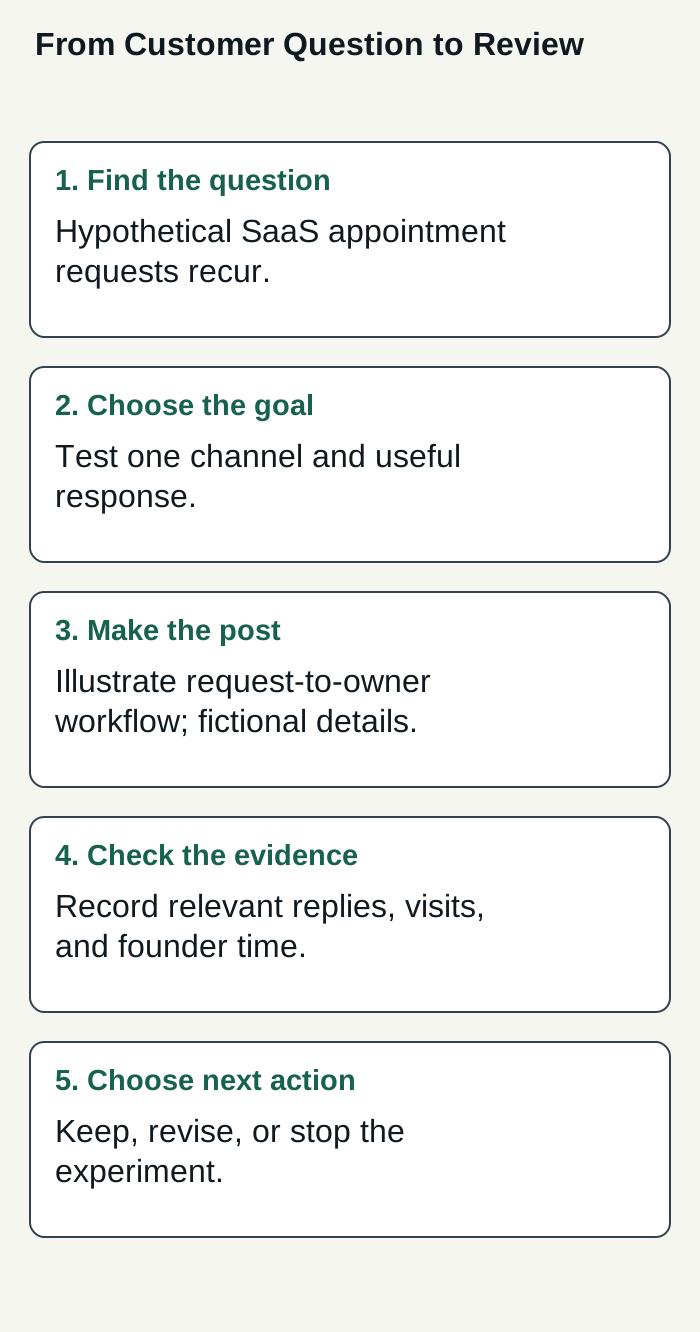
Decision flow for a hypothetical SaaS example using fictional workflow details; it implies no customer result.
Condensed original editorial illustration. Read the surrounding guidance for qualifications and the complete procedure; any example is fictional and shows no verified customer outcome or product screen.
Illustrative worked example by Superdirector editorial team. Created 2026-11-09.