How-To Guide
What should you post when you have no followers yet?
Turn one customer question into useful posts that make sense to a stranger. Includes an original bike-shop example and a learning plan.
By the Superdirector editorial team. The article includes an explicitly hypothetical example. The cited practitioner advice is qualitative, not evidence of results for brand-new accounts.
At a glance
What should you post when you have no followers yet?
Start with a useful answer, observation, or demonstration for one clearly defined reader. Make the post understandable to someone who has never seen your account. You can also join a relevant conversation with a helpful reply. These are sensible starting experiments, not proven ways to guarantee reach or followers.
- Write for a specific person with a specific question.
- Use genuine knowledge, work, or discussion as the source of the idea.
- Compare the quality of responses over time; do not mistake a small sample for proof.
The short answer: be useful before you are known
When you have no followers, post something a stranger can understand and use: answer a question, explain a small process, share a narrow lesson, or add a helpful response to a relevant discussion. Start with one kind of reader and one topic, rather than trying to sound interesting to everyone.
You do not need an audience before you can begin. But no format in the supplied evidence is proven to work best for accounts starting from zero, and no post can promise reach or followers. Treat your first posts as useful attempts to communicate, then pay attention to what people ask, save, share, or discuss.
A practical source of ideas is work you already do. In a Buffer interview with founder Josh Ho, he describes turning questions he hears repeatedly into notes and later content. That is a practitioner example, not a measured study of new accounts. The useful takeaway is simple: keep a record of questions and explanations worth making clearer.
Choose one reader and a topic you can genuinely help with
Complete this sentence before drafting: “I help [kind of person] understand or do [specific thing].” Keep it narrow enough that you can judge whether an idea belongs. For example, “I help local cyclists understand routine bike care” is more useful as a planning filter than “I post about bikes.”
Now list questions that person actually asks, steps you can explain from experience, and common choices you can compare fairly. Prefer details you can verify. A small, specific answer is more credible than a sweeping claim, and you do not need to invent a dramatic story to make a post worthwhile.
A useful post can also begin with a conversation rather than a blank page. The older Buffer guide to finding an audience and building community describes reaching out and participating in relevant discussions. Its named tools and recommendations are dated; use the general idea, not its old platform-specific tool list. Read the room, follow community rules, and contribute an answer before promoting yourself.
Worked example: turn one bike-shop question into three posts
The following is a hypothetical example, not a real business or customer result. Imagine a neighborhood bicycle-repair shop starting a social account. A customer asks, “What should I check before a short weekend ride?” The shop can answer from its own routine knowledge, keep the advice within its competence, and avoid pretending one checklist covers every bike or situation.
| Starting point | Possible post | Why a stranger might care |
|---|---|---|
| The repeated question | A concise answer naming a few routine checks the shop commonly explains | It addresses a recognizable need without requiring shop history |
| The work behind the answer | A short explanation of how staff inspect one component during ordinary service | It shows the reasoning behind the answer rather than merely asserting expertise |
| A relevant discussion | A helpful reply in a local cycling conversation, answering the question before mentioning the shop | It contributes in the place where the question already arose |
These are different treatments of one subject, not three copies of one caption. The shop should use only details it can stand behind, avoid implying a particular result, and adapt the presentation to the platform. If it cannot make the explanation clear and accurate, it should choose a question it can answer confidently instead.
This approach gives you a repeatable worksheet: write the question in the reader’s words; draft the shortest complete answer; identify one step or reason worth showing; then find a relevant conversation where that answer would genuinely help. Keep the drafts distinct, and do not claim that hypothetical engagement or customer outcomes occurred.
When enlarged, scroll horizontally to read the diagram.
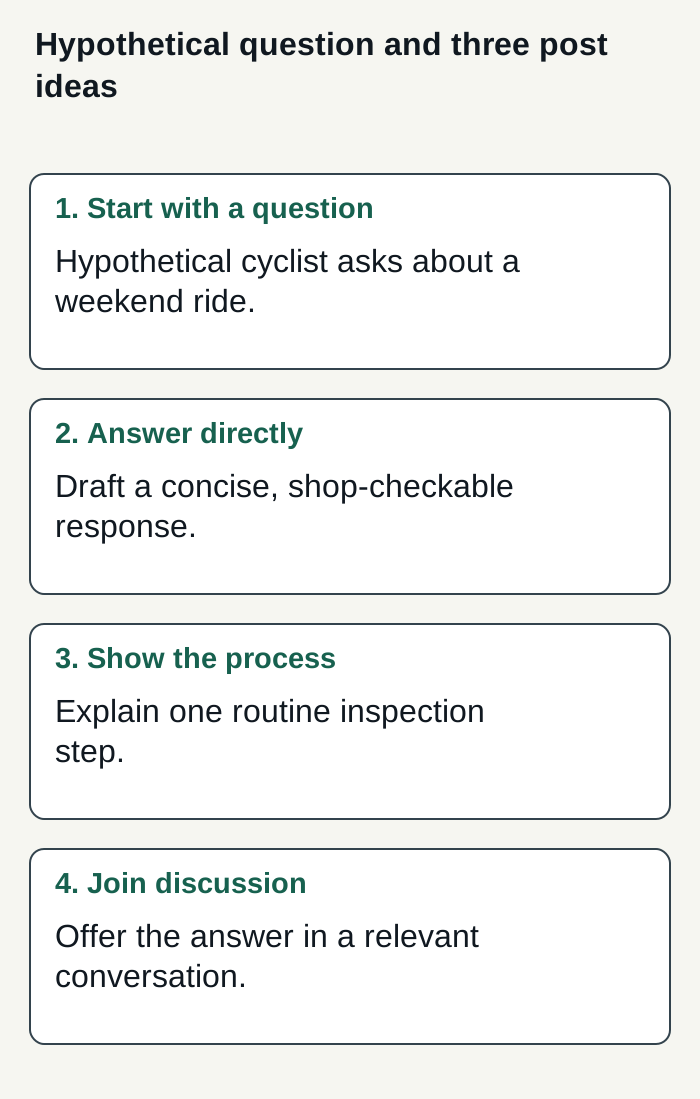
Hypothetical bicycle-shop example: one customer question becomes three distinct post ideas, with no claimed customer results.
Condensed original editorial illustration. Read the surrounding guidance for qualifications and the complete procedure; any example is fictional and shows no verified customer outcome or product screen.
Illustrative worked example by Superdirector editorial team. Created 2026-11-09.
Shape each post for its platform, then learn from it
Choose the format you can make clearly and consistently on the platform you intend to use. TikTok’s Creative Tips Finder presents creative prompts including hooks, scripts, visual assets, and product showcases. It is a resource for developing creative work, not evidence that a particular format will perform for a new account.
For a text-led platform, make the point understandable in the post itself. For a carousel, organize the explanation into a sequence that earns each slide. For video, plan what the viewer should understand before deciding whether filming and editing are practical for you. These are editorial recommendations, not platform ranking rules.
- Check the reader: Can the intended person recognize the question or situation?
- Check the substance: Is the answer accurate, specific, and based on something you know?
- Check the first impression: Can a newcomer understand it without seeing an earlier post?
- Check the conversation: If replying elsewhere, are you contributing rather than dropping an unrelated advertisement?
- Record what happened: Note questions, thoughtful replies, saves, or other available signals, along with the post’s topic and format.
Review posts in comparable circumstances and look for repeated patterns, not a single surprising response. If a question prompts follow-up discussion, consider answering that next. If a format takes too much effort to make well, simplify it or try another. There is no evidence here for a fixed posting cadence, a universal evaluation window, or a number of posts that proves an idea works.
When a managed channel may fit
With no followers, first decide which customer question deserves an accurate answer; buying more output is not evidence of demand. If you want to delegate channel work, Superdirector Growth is $199/month for two accounts, with no trial. The offer to evaluate is a customizable AI-run channel working toward your business goal, but today its publishing scope is eligible Instagram image carousels and single X text posts. Each requires approval unless an enabled account Auto-post rule covers it. Full autonomy and finished video are upcoming.
Use the publishing setup instructions to connect the chosen account and source cards. A first manually approved post must be verified live before Auto-post can be enabled. Turning it off stops unsent work; Pause posting holds the queue. Keep track of the replies you handle yourself, review effort and customer-defined results, rather than assume delegation will deliver customers or minimal oversight.