How-To Guide
Organic vs paid social: how should a brand that runs ads split time and budget?
Organic vs paid social for brands already buying ads: what organic compounds, a split rule by stage, and how to boost organic winners as ads.
By the Superdirector editorial team. Sources read November 6, 2026.
At a glance
Organic vs paid social: how should a brand that runs ads split time and budget?
Keep paying for the ads that already pay back, and give organic a fixed, small share of the team's week. Organic is where you find which hooks and formats people share; paid is where you buy more reach for the ones that worked. So run them as one loop: post organically, put budget behind posts that beat your own median, and retire ad creative that no longer matches what your organic audience responds to. Shift more time to organic only when it starts producing winners you can boost.
- Organic compounds: posts, followers and creative lessons stay after the spend stops; paid reach ends with the budget.
- Platforms built tools for this: TikTok Spark Ads keep the engagement on your original post; YouTube Promote says it does not hurt organic reach.
- Instagram says it does not suppress posts to make you buy ads; paying buys speed and targeting, not permission.
The short answer
If you already run ads that pay back, do not switch them off to "go organic". Add organic beside them as a fixed, small part of the week, and connect the two: organic finds what people share, paid buys more reach for it. The top-ranking explainers for this question, from Cloud Campaign to Holland Adhaus, conclude that brands need both. This page is for a founder or small team that already buys ads and needs to decide where the next hour and the next dollar go.
Know what each one buys
| Paid social | Organic social | |
|---|---|---|
| What you pay | Media spend plus creative | Time, production, sometimes samples |
| What you get | Reach you can switch on and target | Posts, followers and comments that stay |
| When it stops | When the budget stops | Old posts keep being found and seen on your profile |
| What it teaches | Which offer and audience convert | Which hooks and formats people share and save |
| Main risk | Rising costs, creative fatigue | Weeks of work with little to show |
Both columns have a cost. Our own paid ads alternative page puts it plainly: organic "still costs attention, founder time, samples, creator fees, and production effort", and it "should not be sold as an automatically cheaper channel or a shortcut to revenue". Inflow's 2022 guide makes the same point from the other side: with organic "it’s possible to put in a lot of time and see little or no return".
One claim to drop: that platforms bury organic posts to sell ads. Inflow writes that paying "is often the only way to reach your full audience of followers". Instagram's ranking explainer says the opposite, "we don’t suppress content to encourage people to buy ads", and adds that it grows reach for the most engaging content and sells ads to others. Agency figures for average organic reach, such as Holland Adhaus's 3.50% of followers on Instagram, are averages across all accounts; a post people share can travel far past your followers, because most of what Instagram shows in Explore comes from accounts people do not follow.
Split time and budget by stage
Split the two resources separately. Time is the scarce one for organic; money is the scarce one for paid. A starting rule, to adjust to your own numbers:
| Your stage | Organic time | Paid budget | Move to the next stage when |
|---|---|---|---|
| Ads pay back, no organic yet | One person's half-day a week: three posts | Unchanged | You have posted for 8 weeks and have 2 posts that beat your own median |
| Organic finds occasional winners | About a day a week | A small test line for boosting organic winners | Boosted organic posts match your ads on cost per sale |
| Boosted organic beats new ad creative | Two days a week, or a tool that does the making | Shift new-creative budget to boosting proven posts | Organic sign-ups or sales are measurable without ads |
| Organic carries part of acquisition | Steady | Cut only the ad sets organic has replaced | Review quarterly |
The rule moves money only on evidence you can see in your own accounts. It never asks you to cut spend on a promise. The split worksheet holds the stages, the weekly numbers to record and the move rule.
Turn organic winners into ads
This is where organic pays for itself if it pays at all: every post that beats your median organically is ad creative you did not have to brief. Holland Adhaus states the rule in one line: when a post "performs well, put paid dollars behind it". The platforms built tools for exactly that.
- TikTok. Spark Ads run your own organic post, or a creator's with their authorization, as the ad. TikTok credits everything the promotion earns, from views to follows, to that original post, and lists objectives running from reach to conversions and sales.
- YouTube. Promote sets up a simple campaign in Studio's Promotions tab, and YouTube says it grows a channel "without negatively affecting your organic reach".
- Instagram and Facebook. Boosting a post is the quick version. Holland Adhaus notes that boosted posts "offer limited control compared to full ad campaigns", so move a winner into a proper campaign once it has proved itself.
Go the other way too. When an ad's hook stops working, check what is getting shared in your organic posts and in your niche this month, and brief the next ad from that. A post that works as a native post usually needs fewer changes to work as an ad than a studio ad needs to look native.
When enlarged, scroll horizontally to read the diagram.
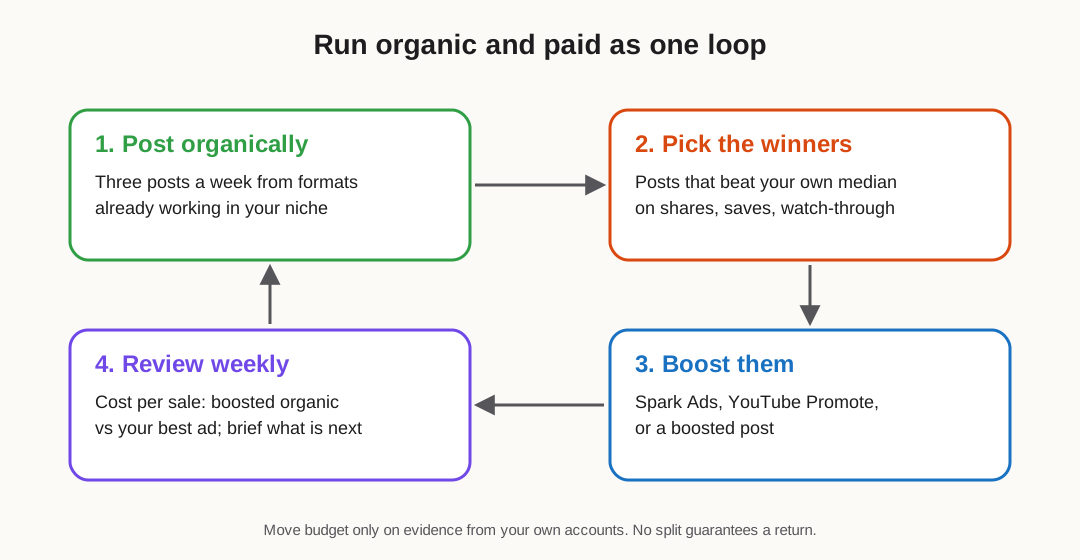
Original editorial diagram. The loop is a method, not a measured result.
Original visual by Superdirector editorial team. Creation date not recorded.
Measure both in the same weekly review
- Organic, per post: shares, saves, watch-through and comments, against your own median for the last ten posts. Instagram ranks Feed posts partly on how quickly people like, comment, share and save, so read the first 24 hours.
- Paid, per creative: cost per sale or sign-up, and how fast that cost rises as the creative ages.
- The bridge: for each boosted organic post, the same cost per sale next to your best non-organic ad.
- Once a month: sign-ups or sales from organic links and profile visits, with ads paused on that audience if you can.
No split guarantees a return. Treat every stage change as a test with a start date, a number to beat and an end date.
Where our product sits in this loop
Superdirector, which we build, covers the first two boxes of the loop. It follows the competitors and niche accounts you name, notices which formats are pulling ahead, and drafts your own versions as carousels and X posts that borrow the hook and shape but not the content, then lays them out across the month. The $199 Growth plan (two accounts; see the pricing page) publishes the Instagram carousels and single X posts for you, with your sign-off on the first or a standing Auto-post. The $29 Starter plan, which has a 7-day free trial with 100 credits (card required), makes the drafts but does not publish.
Boosting and ad buying stay in your ad accounts; it does neither, and its AI video and full autopilot have not shipped yet. The pricing page's own line is "We sell business growth, not guaranteed results." Every post still goes out under your name and responsibility. Founders deciding what to hand to software can read which organic social jobs to give AI; teams weighing whether to lean less on ads can read the paid ads alternative page.