How-To Guide
How does a founder build a personal brand on social media from scratch?
Connect a business goal to an audience, choose one channel, make useful founder posts and review what people respond to.
By the Superdirector editorial team. Recommendations are attributed to their sources; the worked example is hypothetical.
At a glance
How does a founder build a personal brand on social media from scratch?
Connect a business goal to a specific audience, choose one channel that suits both that audience and your working style, and make useful posts based on your expertise and real experience. Respond to relevant questions and review activity against your goal before changing the plan. There is no supplied evidence that a particular channel or posting routine guarantees audience growth, leads, or revenue.
- Choose your audience and goal before choosing a platform.
- Make your profile specific, accurate, and easy to understand.
- Use audience questions and relevant conversations to shape future posts.
Choose the business goal and audience
A personal brand is the impression people form of your expertise, point of view, and way of working. Starting from scratch does not mean you need a clever slogan or a large audience. It means making it easier for the right people to understand what you do and why your perspective may be useful.
Begin with a business-relevant purpose. You might want prospective customers to understand a problem you solve, potential partners to know your area of expertise, or peers to recognize the work you are building. Choose one priority for now; a broad aim such as “be more visible” gives you little to guide content or evaluation.
- Name the people you want to reach in terms that describe their work or situation, not just a broad demographic.
- Write the recurring problem or question you can discuss from experience.
- State what you want a relevant person to understand or do after encountering your profile or posts.
Harvard Business School advises defining social-media goals before choosing platforms or presentation, and aligning content with those goals and what the audience wants to consume. That is useful sequencing, not proof that a given goal or tactic will generate business results. Keep your first goal narrow enough that you can tell whether the material is relevant.
Select one channel and complete your profile
Choose a channel by asking three practical questions: can the people you want to reach encounter your work there; can you communicate your expertise in a format that fits; and can you make that format without turning the channel into an unsustainable obligation? Harvard Business School recommends prioritizing platforms that connect you with your intended audience. A Forbes Coaches Council contributor similarly recommends focusing on one platform rather than trying to master many.
Neither recommendation identifies a universally superior platform, and the supplied sources do not compare founder outcomes across channels. Treat your choice as a working hypothesis. If you sell to professionals, a professional discussion space may be a sensible place to test. If your work is best explained visually, a visual channel may be more natural. Confirm your assumption through conversations with customers and peers rather than relying on broad platform demographics.
Make the profile legible to someone who has never met you. Harvard Business School recommends, at minimum, a profile picture and a short About Me section. Add a concise description of whom you help and what kind of problem you address, plus a relevant link if the platform offers one. Use your own accurate experience; do not imply credentials, results, or customer relationships you do not have. The goal is clarity, not a polished persona.
Before publishing, read the profile as a prospective customer: can they tell what you do, who it is for, and what sort of perspective they can expect? If not, replace abstract claims such as “visionary founder” with a plain description of your work.
Build a useful, sustainable content loop
You do not need to invent a new identity for every post. Build a small loop from work you already understand: explain one recurring problem, describe how you think through it, or share a lesson from building the business. Forbes Coaches Council contributors recommend documenting the process of building a business and using audience questions to refine a niche. Use those ideas as prompts, not as a requirement to share private details or manufacture drama.
- Teach: answer one question you hear from the people you want to reach.
- Explain: show the reasoning behind a decision or trade-off, while protecting confidential information.
- Ask: invite a specific question that could clarify what your audience finds confusing.
Choose a pace based on the time and material you actually have. Do not treat a prescribed weekly count as a platform rule or a guarantee of results. YouTube's creator advice, published in 2024 and specific to YouTube, discusses balancing consistency with a sustainable workload; that caution is sensible, but it is not evidence for a universal cadence on other platforms. A repeatable, lower workload is preferable to a schedule you abandon.
Listen after you publish. Reply to relevant comments, answer honest questions, and note which terms people use to describe their problems. YouTube's 2024 community guidance recommends responding and asking questions in its own setting. The broader practical lesson is that social media need not be one-way broadcasting: conversations can supply ideas for clearer explanations. Protect your time by choosing when you will check replies rather than assuming you must be present constantly.
Work through a hypothetical bookkeeping example
The following is a hypothetical planning exercise, not a customer story or a prediction. Imagine a founder who runs a bookkeeping service for independent design studios and wants social media to help prospective clients understand what the service handles. The founder has not yet established an audience on any channel.
| Decision | Hypothetical founder's choice | Why it is useful |
|---|---|---|
| Audience | Owners of small design studios who find monthly bookkeeping hard to keep up with | A defined audience makes examples and language more specific. |
| Goal | Help a prospective client recognize the bookkeeping questions they should bring to an introductory conversation | This is a communication goal, not a promise of inquiries or sales. |
| Channel | LinkedIn, as a hypothetical candidate because the founder already reads discussions from studio owners there; the founder will test whether those discussions reach the intended audience and whether the format and workload fit | The founder will test whether the audience is present rather than assuming it. |
| Profile | “I help small design studios organize their bookkeeping and understand their monthly numbers.” | It describes the service and intended audience without claiming a result. |
| Teach post | “Three records I ask a studio owner to gather before a bookkeeping handoff” | A concrete educational topic rooted in the founder's work. |
| Explain post | “Why I separate a studio's project expenses before reviewing the month” | Shows the founder's reasoning without disclosing client information. |
| Conversation prompt | “Which part of preparing records for your bookkeeper takes the most explaining?” | Invites a useful answer the founder can learn from. |
| Review signal | Relevant replies and profile visits, considered alongside whether the audience seems to match | These are learning signals, not evidence of revenue or causality. |
To use the worksheet, replace the studio audience with your own, then check every example for truthfulness and confidentiality. If you have no client examples you can share, use a general process explanation or a clearly labeled hypothetical scenario. Do not call a hypothetical outcome a result. After trying the plan, record what you learned and what you still do not know; a few reactions cannot establish that the channel caused business outcomes.
When enlarged, scroll horizontally to read the diagram.
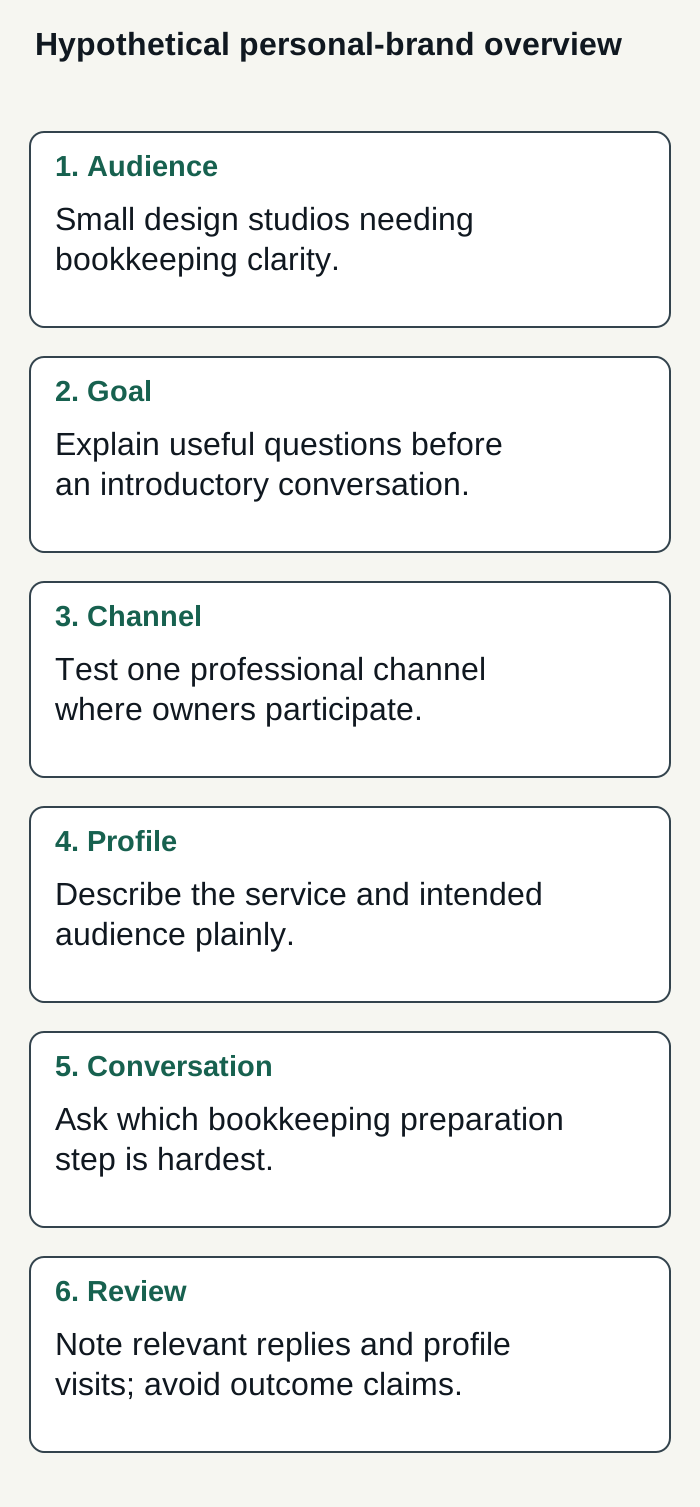
Hypothetical bookkeeping founder's planning flow; the example illustrates decisions, not customer results.
Condensed original editorial illustration. Read the surrounding guidance for qualifications and the complete procedure; any example is fictional and shows no verified customer outcome or product screen.
Illustrative worked example by Superdirector editorial team. Created 2026-11-09.
Review signals and adjust one thing
Choose a small set of signals that connect to the goal you wrote down. If the goal is to explain your work to potential customers, relevant comments, profile visits, or questions from people in your intended audience may help you judge whether your message is being encountered and understood. If the goal is to connect with peers, the relevant signal may be the quality of professional conversations. Platform metrics describe activity; they do not, by themselves, establish business impact.
Review at an interval that leaves enough time to make and discuss material without turning measurement into a second job. Look for specific patterns: which topic prompted a substantive question; which wording seemed unclear; whether the people responding resemble the audience you chose. Then change one element, such as the profile description, topic framing, or format, and observe what happens. Changing several elements at once makes it harder to learn what mattered.
HBS recommends choosing metrics that match goals and tracking them over time. This is a useful discipline, but the supplied references provide no controlled evidence that following their recommendations causes follower growth, leads, or revenue. Keep an offline note of meaningful conversations as well as platform counts, and distinguish an encouraging signal from a demonstrated result.
Decide whether to manage or delegate
Self-managed posting gives you direct control and avoids a service fee, but uses your time for research, writing, editing, publishing, and review. A contractor or agency can take on agreed tasks; define who supplies expertise, who approves claims, and what the work includes. An AI-assisted managed channel may combine research, brand memory, creation, and publishing, but it still needs evaluation: is delegating worthwhile at the price, and what level of approval and oversight are you comfortable providing? Measure those questions rather than assuming the workload disappears.
For a business considering a customizable AI-run channel around $200 a month, Superdirector’s current Growth plan is $199 per month for two accounts, with no trial; check the pricing page for current terms. Growth supports publishing eligible Instagram image carousels and single X text posts, with per-post approval or an enabled account Auto-post rule. Finished AI video, fully autonomous channels, and publishing finished TikTok, YouTube, or Reels videos are outside the current scope; the video methods discussed here are not publishable finished videos. Publishing depends on connecting an account and selecting the source cards that can feed it. Before enabling Auto-post, hand-approve the account’s first post and verify it is live. Turning Auto-post off stops unsent posts; Pause posting holds the queue. See the publishing setup for setup and controls. Treat delegation as a way to take on parts of this article’s research, drafting, and eligible publishing work—not as guaranteed results or zero oversight. Assess your review effort and results against goals you define.
Keep the work connected to the business
A personal brand is useful when it helps people understand your expertise and approach, not when it turns every post into a pitch. Start with a narrow audience, offer real help, invite conversation, and revise your message as you learn. A clear profile and a few thoughtful explanations are a more defensible starting point than an elaborate content machine built before you know what your audience needs.
For related practical guidance, see the personal brand builder role guide, brand profile and content strategy guide, and weekly content plan.