How-To Guide
How do you use influencer marketing for a product launch?
Plan a product launch with influencers as an agreed publication window: readiness checks, early seeding, post dates, disclosure and staggered posts.
Treat the launch as a publication window you agree with each creator, not a switch you flip on launch day. Fix the date and work backwards: product page, stock and tracked links ready, product delivered early enough to be used, post dates, embargo and disclosure in writing. Then let posts arrive in a planned order and put paid spend behind the ones that already work.
- Shopify's reverse timeline starts the creative brief 12 weeks before launch; Beinfluence starts creator outreach six to eight weeks before.
- The FTC says creators cannot talk about experience with a product they have not tried, so shipping sets the earliest honest review date.
- Gifted products are a material connection: gifted creators disclose too.
A launch is a window you agree with creators
Use influencer marketing for a launch by agreeing a publication window with each creator before you ship anything. Fix the launch date, then work backwards: product page and stock ready, product in creators' hands early enough to use it, posting dates and disclosure in writing, tracked links tested. On the day, posts should arrive in a planned order across the window, and paid spend goes behind the posts that are already working.
The common failure is treating launch day as a switch. A creator who receives the product three days before launch cannot honestly review it, a link that points at an unpublished page wastes the best attention you will get, and twenty posts on the same morning look staged. The plan below is the order of checks that prevents those problems. It suits a brand launching a physical or digital product with between a handful and a few dozen creators.
Who it is not for: a brand with no launch date yet. Pick the date first, or run a smaller test with one or two creators and learn from it before you plan a window.

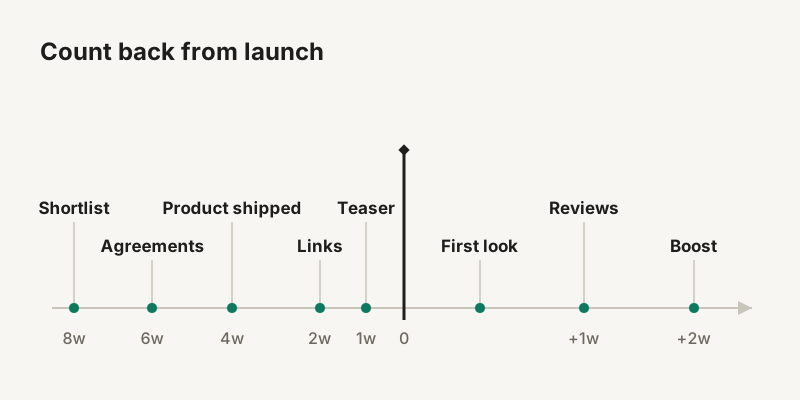
Phases sit at the week they must finish before launch day. Original diagram drawn from this article's reverse timeline and the Shopify and Beinfluence week counts it cites.
 Superdirector
Make it work for your brand
Find it. Remake it. Post it. Superdirector turns the viral formats in your niche into your brand's carousels, X posts and video scripts, and keeps the calendar full.
Set the window and work backwards
Write down three dates: the first day a creator may post a teaser, launch day, and the date by which all launch content should be up. Everything else is counted back from launch day.
Two practitioner guides put the start well before the date. Shopify's launch guide starts its reverse timeline at T minus 12 weeks to finalize positioning and the creative brief, and approves product assets and copy at T minus 4 weeks. Beinfluence puts the start of creator outreach at six to eight weeks out. These are advice, not measured rules, but they agree on one thing: the creator part starts a month or more ahead, not in launch week.
| Weeks before launch | What should be true | Why it matters for creators |
|---|---|---|
| 8 to 6 | Shortlist agreed, rates or gifting terms settled, window dates chosen | Creators plan their own calendars weeks ahead |
| 6 to 4 | Agreements signed with post dates, embargo and disclosure | Nothing ships before the terms are written |
| 5 to 3 | Product delivered to every creator | They need time to use it before they talk about it |
| 2 to 1 | Product page, stock, links and codes tested | The first post sends people somewhere that works |
| Launch to +2 | Posts go live in the agreed order; paid spend follows results | Attention arrives in waves, not one spike |
The launch window timeline shows the same plan as a picture you can share with the team.
Check readiness before any creator posts
A creator post sends attention to a page. Before the first teaser, someone on your side should confirm each item below. Our readiness checklist (CSV) lists them with an owner column and the date it was checked.
- The product page is published and loads on a phone. Shopify's guide advises checking sales pages on both mobile and desktop before and during launch.
- Stock is in place, or the page takes preorders with a clear shipping date, which is the form Shopify describes.
- Every creator has a link of their own and a code if you use codes, and both were clicked through to a working page.
- Every product claim in the brief can be backed up. The FTC says creators cannot make up claims that would require proof the advertiser does not have.
- Disclosure wording is agreed for each platform, in the same language as the post.
If any item fails, move the teaser date, not the checks. Later's campaign guide lists launching without tracking systems among the common campaign pitfalls; a broken link on launch day is the same mistake with worse timing. Our guide to tracking influencer links in GA4 covers the link setup.
Ship product early enough to be used
The FTC's Disclosures 101 is plain on this: you can't talk about your experience with a product you haven't tried. So the shipping date sets the earliest honest review date. Allow for delivery, a few days of real use and filming time before each creator's post date.
Gifting is a material connection. The FTC counts free or discounted products as a financial relationship, and a gifted creator should disclose even if they were not asked to mention the product. TikTok's Branded Content Policy (effective 30 October 2026) also treats a gifted product as branded content.
Gifting without a fee does not buy a post. InfluencerFee's launch guide estimates that 20 to 35 percent of gifted nano creators post, which is its own estimate, not a measured rate. Plan the launch on the creators who agreed to post, and treat gifted posts as a bonus. Our page on whether influencers will promote a product for free covers what gifting can and cannot ask for.
Put dates, embargo and disclosure in the agreement
Every creator who posts in the window should have the following in writing before the product ships:
- The embargo: the earliest moment they may post, with date, time and timezone. InfluencerFee says embargoes usually end at midnight going into launch day, and that the contract should name the timezone.
- Their own post date or range inside the window, and the format for each date (teaser, first look, review, tutorial).
- Disclosure for each platform: on YouTube, the paid promotion setting, which puts a label on the opening of the video; on TikTok, the commercial content disclosure toggle. The FTC warns that a platform's label may not be enough by itself, so the creator's own clear disclosure belongs in the video as well.
- How you may reuse the content later. Later's guide says to settle ad usage rights at the start if creator content will run in ads.
- Exclusivity, only if you need it. InfluencerFee calls a 30-day category clause standard; that is its view, and exclusivity usually costs more.
For gifted creators who have no contract, InfluencerFee suggests a written acknowledgment of the embargo before you send the product. Our agreement clauses guide lists the clauses in more detail.
Stagger the posts across the window
Plan the order of formats, then give each creator their slot. A common sequence is a teaser before launch day, first-impression or unboxing posts on launch day, then reviews and how-to posts in the following days. Beinfluence's advice is to spread the posts over the whole window and mix platforms and formats, since twenty near-identical posts on one morning look coordinated.
Teasers are where launches most often go wrong. Under TikTok's policy the product being promoted must be clear without viewers going to the profile or a link, so a mystery teaser that names nothing may not meet the platform's rule once it is paid content. A teaser can hold back the price or the date; it should still say whose product it is.
Keep one creator as the anchor: the first public post you can confirm before others follow. If the anchor slips, everyone else's slot moves with it, so tell creators which slot depends on which.
Put paid spend behind posts that already work
Do not decide in advance which creator post to boost. Beinfluence watches the organic posts for their first six to twelve hours and boosts the ones with the strongest engagement. On Instagram that means partnership ads and on TikTok Spark Ads. You are running ads with the creator's content, so the permission and usage rights belong in the agreement before launch, not in a message on launch day.
Retarget people who watched or clicked during the window with the same creator content in the weeks after. The setup for running ads through a creator's handle is in our partnership ads guide.
Measure the window, then decide who comes back
Later's guide gives every creator a tracked link, their own discount code and UTM tags, so each sale or visit can be credited to someone. Read the results per creator and per format, not only as one launch total. Then answer three questions for each creator: did they post in their slot, did the post send people to the page, and would you book them again for the next launch.
Write down what you would change about the window itself: whether product arrived in time, whether the teaser date was too early, and which slot did the most work. That note is the start of the next launch plan.