How-To Guide
What should a Black Friday influencer campaign timeline look like if I start in November 2026?
A dated plan from November 2 to December 14, 2026: book creator days, brief and ship, preflight links and codes, disclose, run ads, then reconcile.
By the Superdirector editorial team. Statute, FTC, Adobe, NRF and platform pages read November 1, 2026; vendor plans and agency data are labelled as such.
At a glance
What should a Black Friday influencer campaign timeline look like if I start in November 2026?
Work back from Black Friday, Friday, November 27, 2026, and Cyber Monday, Monday, November 30. Freeze the offer and book the Thanksgiving-week posting days first, because sponsored posts peaked on the Monday to Wednesday of that week in one 2025 dataset. Send briefs and ship product in the week of November 9, approve drafts in the week of November 16, and run a link-and-code preflight 72 hours before each wave. Put the ad permission in the contract and make sure the code or authorization runs past your last flight day. Read results on seven-day windows and reconcile before paying.
- Thanksgiving is November 26, Black Friday is November 27 and Cyber Monday is November 30, 2026; Cyber Monday was December 1 in 2025.
- Thanksgiving Day was the lightest day for sponsored posts in the 2025 vendor data, and the Monday to Wednesday before it was the busiest.
- The FTC counts free product and early access as material connections, and the brand can be liable for a creator’s missing disclosure.
Direct answer
Short answer: count back from Friday, November 27, 2026. Book the posting days and freeze the offer in the week of November 2, brief and ship in the week of November 9, approve drafts in the week of November 16, and check every link and code on the morning of Friday, November 20 and again on Tuesday, November 24, 72 hours before each wave. Then run the posts, read them on fixed seven-day windows, and reconcile in the week of December 14.
This is for a brand or agency marketer who has creators in mind or already booked and wants a dated plan, not a general guide. The dates are real, the weekdays are checked, and the weekly plan is a vendor’s that we adapted for a start in November. Where we adapted it, we say so.
What this page does not claim: it gives no forecast for 2026 creator-post volume, no guaranteed cost change for ads, no carrier shipping cutoffs and no legal advice. The numbers about 2025 are last year’s measurements from named sources and are not predictions.
The 2026 dates to plan around
Federal law makes Thanksgiving the fourth Thursday in November (5 U.S.C. 6103), which is Thursday, November 26, 2026. Klaviyo’s BFCM calendar puts Black Friday on Friday, November 27 and Cyber Monday on Monday, November 30, and defines Cyber Week as Thanksgiving through the following Monday.
| Day | 2026 date | Note |
|---|---|---|
| Thanksgiving | Thursday, November 26 | Fourth Thursday in November |
| Black Friday | Friday, November 27 | The day after Thanksgiving |
| Cyber Monday | Monday, November 30 | It was Monday, December 1 in 2025 |
| Cyber Week | November 26 to November 30 | Thanksgiving through Cyber Monday |
Demand is not confined to those days. The National Retail Federation (NRF) forecasts that November and December 2026 retail sales will grow 4.2% over 2025 to $1.013 trillion, and its survey says 43% of holiday shoppers plan to start before November (NRF, October 2026). Last year Adobe measured $6.4 billion in US online spend on Thanksgiving, $11.8 billion on Black Friday and $14.25 billion on Cyber Monday, out of $44.2 billion for the five days (Adobe, December 2025). The three days sum to $32.45 billion, which is about 73% of the five-day total, by our arithmetic. Adobe also reported that 61.6% of Thanksgiving sales and 57.5% of Cyber Monday sales came through a mobile device, so every creator link and code has to work on a phone.
Freeze the offer and book the posting days
One vendor, Streamforge, counted sponsored posts per day by US creators who post in English, across TikTok, Instagram, YouTube and Twitch, in November 2025. The Monday to Wednesday of Thanksgiving week averaged about 4,938 posts a day, 47% above the first week of the month (3,356 a day). Thanksgiving Day fell to 2,345. Black Friday had 3,888 and Cyber Monday, December 1 that year, had 4,005. Three caveats: it is one vendor’s dataset, it undercounts ads that are only spoken, and these were 2025 weekdays and not 2026 ones.
Read it as a rule about the week and not about the calendar date: the three days before Thanksgiving were crowded and Thanksgiving itself was quiet. A late starter might therefore consider Thursday, November 26, Friday, November 27 and Monday, November 30, when fewer sponsored posts compete. That is our adaptation, not a finding.
On availability, Stack Influence cites a 2026 Modash survey of 53 marketers who said planning began in late July on average and almost all creators were hired by the end of September (Stack Influence). It is small and vendor-reported. Treat it as a warning that the best-fit creators may already be booked, and plan to widen the list or to use creators who already hold the product.
Brief, ship and approve on a week-by-week timeline
The weekly structure comes from Streamforge’s 2026 plan: choose posting days five weeks out, book and sign four weeks out, brief and deliver product three weeks out, and approve drafts and grant ad permissions two weeks out. We placed it on the 2026 calendar for a brand starting on Sunday, November 1, which is 26 days before Black Friday, and marked the late-start changes.
| Date | Action | Basis |
|---|---|---|
| Sun, Nov 1 | Freeze the offer, the code format, one hero product, a fee ceiling and a template contract | Streamforge, week five |
| Mon, Nov 2 to Fri, Nov 6 | Book posting days: the crowded Monday to Wednesday first if you want them, otherwise Thursday, Friday and Monday. Sign contracts and ask for ad rights in them | Streamforge, week four; our adaptation for a late start |
| Mon, Nov 9 to Fri, Nov 13 | Send briefs. Ship product with tracking and tell the creator at shipment that the connection has to be disclosed. Creator confirms receipt | Streamforge, week three; FTC Example 7 |
| Mon, Nov 16 to Fri, Nov 20 | Approve drafts within one business day, one revision round. Request the partnership code or Spark code | Streamforge, week two |
| Fri, Nov 20, 9:00 | Preflight one, 72 hours before Monday, November 23 | Stack Influence preflight, our date arithmetic |
| Mon, Nov 23 to Wed, Nov 25 | Early-announce posts. One named owner per posting day | Streamforge |
| Tue, Nov 24, 9:00 | Preflight two, 72 hours before Friday, November 27 | Stack Influence, our date arithmetic |
| Thu, Nov 26 | Thanksgiving: check stock and links, light posting | 2025 vendor volume data |
| Fri, Nov 27 | Black Friday wave. The owner checks each post for code, link and disclosure | Streamforge |
| Sat, Nov 28 to Sun, Nov 29 | Reminder posts. Boost the best creator posts only if the authorization covers the flight | TikTok and Meta documents below |
| Mon, Nov 30 | Cyber Monday wave with a new angle | Stack Influence |
| Fri, Dec 4 and Mon, Dec 7 | Read the Black Friday posts on a seven-day window, then the Cyber Monday posts on theirs | Streamforge fixed window |
| Mon, Dec 14 | Reconcile codes, links, orders and returns, pay creators and collect source files | Our suggestion; no source gives these steps |
The fixed windows matter. Seven days from Friday, November 27 ends on Friday, December 4, and seven days from Monday, November 30 ends on Monday, December 7. If you read a Friday post and a Monday post on the same calendar day, you reward whoever posted first.
When enlarged, scroll horizontally to read the diagram.
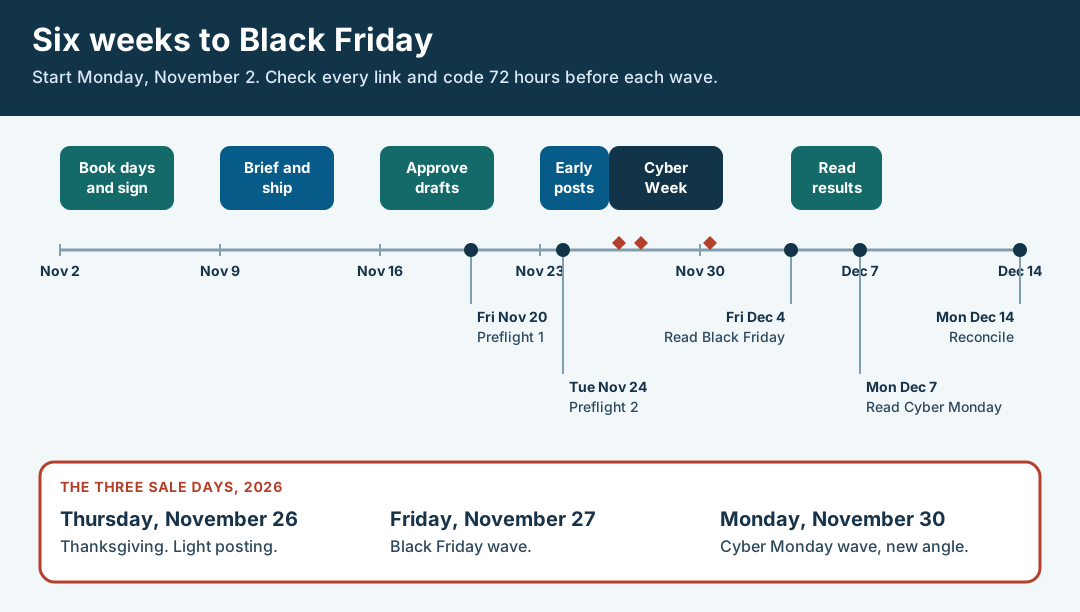
An original editorial diagram. Dates are the 2026 calendar; the weekly steps are one vendor plan adapted by us.
Original visual by Superdirector editorial team. Creation date not recorded.
Run a preflight 72 hours before each wave
Give every creator a tracked link and one code. Keep every UTM value lowercase because GA4 treats Instagram and instagram as different values; UTM tracking for influencer campaigns covers the naming sheet, where links can be clicked and how to read the result.
https://shop.example.com/products/hero?utm_source=tiktok&utm_medium=influencer&utm_campaign=bfcm2026&utm_content=ana_post1
https://shop.example.com/products/hero?utm_source=instagram&utm_medium=influencer&utm_campaign=bfcm2026&utm_content=ben_reel1
The example above is invented. Codes ANA20 and BEN20 follow a plain convention: the creator’s name and the discount.
Before each wave, Stack Influence recommends a preflight 72 hours ahead: open every link on a mobile device, enter every code in the live checkout, confirm the exact time zone for activation and expiry, and verify inventory and substitution rules. We put two of them on the calendar above, on November 20 and November 24. A vendor guide (Streamforge) adds that whoever owns the day checks that each post went live with the right code, a working link and a visible disclosure.
Stack Influence lists a discount that starts after the post, a link to the wrong product, stock that runs out after the first wave and paid use that was never licensed as the ways a campaign loses its sale day. Two more problems follow from the same mechanics, and we found no source for either: a creator code that stacks with a sitewide discount, and an offer that ends at midnight Pacific while the creator tells followers midnight their own time.
Put disclosure and price claims in the brief
A Black Friday brief can pile several benefits on one creator: free product, early access, a code and a commission. The FTC Endorsement Guides, 16 CFR Part 255, treat a free or discounted product as a material connection and list early access as one. They also treat a commission on sales through a link as a connection to disclose (eCFR).
- Tell the creator at shipment. The FTC’s example of a manufacturer that ships free product says it should advise the influencer, when it provides the product, that the connection should be disclosed, and should have a way to monitor.
- Make it visible. The Guides define clear and conspicuous as difficult to miss and easily understandable, and tie where it goes to how the claim is made: at least the visual portion for a visual claim, at least the audible portion for a spoken one, and both for both. FTC staff say it should be in the video and not only in the description (Disclosures 101).
- Do not rely on a tag or a tool. The FTC Q&A says tagging a brand is an endorsement but not a disclosure (FTC Q&A). Staff also say not to assume a platform’s disclosure tool is good enough, and that #ad is fine but not required wording.
- Know who is liable. An advertiser may be liable for a deceptive endorsement even when the endorser is not. The Guides say an advertiser should provide guidance, monitor the endorsers’ compliance and take action to remedy non-compliance, and say this is not a safe harbor.
Platform tools add their own rules. TikTok says commercial content that is not properly disclosed may lose For You feed eligibility (TikTok help, April 2026). YouTube says selecting the paid promotion button in YouTube Studio adds a label at the beginning of the video and that creators and partners remain responsible for legal compliance (YouTube Help).
On price claims, the FTC’s pricing guide says a former price in a sale ad must be the actual price at which the article was offered to the public on a regular basis for a reasonably substantial period (16 CFR 233.1). Check the “was” price in the brief before any creator repeats it. The disclosure review guide covers the caption and video check. This page is not legal advice.
Cover the ad permission before you boost
Paid use has two parts: the right in the contract and the permission on the platform. Stack Influence recommends separating organic repost, paid advertising, editing, duration, territory and identity as distinct permissions, decided before production. The permission mechanics for both platforms are in the whitelisting setup guide; three points matter for a sale window.
- TikTok authorization can end mid-flight. TikTok’s error list includes an authorization that expired and one that ends before the ad’s end time, and the fix is that the creator extends or adjusts it (TikTok help). Content Suite help says video-level authorization lasts 365 days and account-level authorization lasts until turned off, and TikTok’s Spark Ads creation guide says up to 20 video codes can be batch authorized at once.
- Meta uses two levels. A partnership ad code is used under post-level permission, which applies when no account-level permission exists, and account-level permission lets the brand run partnership ads without content-level permission each time (Meta developer docs).
- A brand repost is not the creator’s disclosure. The Guides’ example of a clinic reposting an athlete’s post says the clinic should disclose the relationship itself if the original disclosure is missing or unclear. Applying that to a paid ad is our inference.
On cost, no source isolates creator ads and the figures disagree. GeistM, an agency, reported Meta CPMs up 3% at the beginning of November 2025 and 11% in the second half of the month, without naming its panel (GeistM). Logical Position reported CPCs up 6% collectively over the BFCM weekend, with Cyber Monday up 11% year on year and the most expensive CPCs on Thanksgiving (Logical Position). Google Ads help says seasonality adjustments suit short events of 1 to 7 days, and may not work well beyond about 14. Do not plan on a fixed percentage.
Read results on fixed windows and reconcile
Read each post on its own seven-day window, as above. Then put four numbers side by side: orders with the creator’s code, GA4 sessions from the creator’s tagged link, orders credited to the link, and returns. Code use without a matching tagged visit and a tagged visit without recorded code use are different observations. Check the order and available path evidence; neither alone proves which post caused an order or why a signal is missing. We found no source for the reconciliation steps, so treat them as our suggestion, and agree in the contract when a creator’s commission is locked, because returns can arrive after the read.
Collect the source files only if the contract promised them, and update the register of every code, permission and end date so the next sale starts from facts and not from memory. For the weeks after Cyber Monday, see the Christmas influencer campaign plan, which works back from your last order date.
Failure modes to design out
- The contract is still with legal, the product is still in a warehouse, or the creator is booked. The campaign usually fails in the second week of November and not on the day (Streamforge).
- Approvers are out for Thanksgiving. Set one business day as the turnaround and name a backup.
- The creator posts on time but the discount starts later, the link points to the wrong product, or the paid use was never licensed (Stack Influence).
- An authorization ends before the flight and delivery stops.
- A brand repost drops the creator’s disclosure.
- A post relies on the platform label alone.
Limits and nearby pages
Limits of what we read. The creator-post counts come from one vendor and cover 2025. The 2026 plan is one vendor’s, adapted by us. The survey on hiring is small and vendor-reported. We found no 2026 Adobe forecast, no carrier shipping cutoffs, no creator-ad cost data and no FTC penalty data, so we say nothing about them. Check the dates and every platform screen yourself.
For pricing the paid window, see usage rights fee calculation. For per-video quotes, see UGC price per video.