How-To Guide
How do you brief a UK parent creator for UGC without filming children?
Brief a UK parent creator to keep children out of shot and sound: a child-free shot list, an Ad label upfront, and what happens if a child appears.
By Bell Chen, founder of Superdirector — how the analysis works.
At a glance
How do you brief a UK parent creator for UGC without filming children?
Say in the first line of the brief that no child may appear, be heard or be identifiable in any footage, and then make that easy: give a shot list built around the parent, their hands and the product in the home, list the background details that can identify a child, and agree that any take with a child in it is reshot, not edited. Add the UK disclosure requirement (a clear "Ad" label upfront) and what the brand will do if a child appears in delivered files. If you ever do want a child on camera, treat it as a separate project and ask the child's local council whether a performance licence is needed.
- Make "no child seen, heard or identifiable" a written condition, not a preference.
- Replace the shots that usually show children with shots that show the parent's experience.
- Check backgrounds, audio and captions as carefully as the main shot.
Put the no-children rule in the first line
A parent creator's audience follows them for family life, so their usual content often includes their children. If your brand does not want children in its UGC, say so before anything else in the brief, in plain words: "No child may be seen, heard or identifiable in any footage, photo, audio or caption you send us or post for this collaboration." Put it in the agreement too, not only in the creative notes.
Explain the reason so the creator does not feel judged. Common reasons are the children's privacy, being able to reuse the content without asking about a child later, and the legal steps that filming children for paid work can bring. On that last point, GOV.UK says a child under school leaving age may need a licence for paid modelling assignments and certain performances, and that the person running the event applies to the child's local council. Newham Council's guidance lists performances recorded for later broadcast or public showing, including live streaming and uploads to social media such as YouTube, among those that need one. Councils apply the rules, so this article cannot tell you whether a particular post would need a licence. Keeping children out of the content avoids commissioning a child's performance at all.
Ask the creator before you sign whether they can make content without their children for this deal. Some parent creators already work this way; others may decline. Both answers are fine, and it is better to know before the product ships.
Give a shot list built around the parent
The hard part of a child-free brief is that many family-product videos rely on the child's reaction. Give the creator other ways to show the same moment.
| Usual shot with a child | Child-free alternative |
|---|---|
| Child using the product | The parent's hands setting it up, using it or packing it away |
| Child's reaction | The parent to camera describing what happened, in their words |
| Morning or bedtime routine | The routine from the parent's side: the kitchen counter, the bag, the clock |
| Before and after a mess | The room or surface before and after, with no one in shot |
| Child talking about it | A voiceover from the parent over product close-ups |
| Unboxing with the family | A solo unboxing at a table, product and packaging only |
Let the parent speak as a parent. "First breakfast all week without the bowl hitting the floor" said to camera is still a parent's real experience, and it needs neither a child in the frame nor the child's age in the script. Do not script the child's reaction for them; ask them what actually happened.
List the details that can still identify a child
A child can be in content without their face being shown. Give the creator a checklist for every take and every caption:
- Voices: a child talking or crying in the background, even off screen.
- Reflections: mirrors, windows, oven doors, a dark TV or phone screen.
- Names: on artwork, lunch boxes, name labels, bedroom doors, birthday cards.
- School details: uniforms, logos, book bags, letters on the fridge.
- Photos: framed pictures, a fridge collage, a lock screen in shot.
- Body parts: a small hand reaching in, feet on a sofa, the top of a head.
- Captions and voiceover: names, ages, school year or nursery names.
- Location: house numbers, street views from windows, the school run route.
The checklist is also a printable sheet the creator can keep beside the camera. Ask them to film when the children are out or asleep, which removes most of these problems at once.
When enlarged, scroll horizontally to read the diagram.
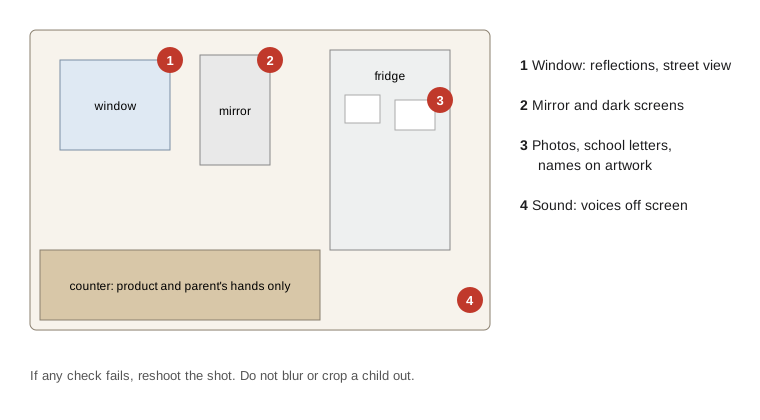
Original illustration of the frame check; no real home or child shown.
Original visual by Superdirector editorial team. Creation date not recorded.
Add the UK ad label and the content rules
If the creator posts the content on their own account, UK disclosure rules apply. Section 2 of the CAP Code requires that marketing communications are obviously identifiable as such, and when a brand gives a creator a payment or any other incentive, including a gifted product, content about the brand needs to be identifiable as advertising. The CAP Executive's advice says the ASA is likely to expect a prominent "ad" label upfront, visible on whichever device the post is viewed on. When the ASA finds that an influencer ad the brand paid for and controlled breaches the Code, its ruling names both the creator and the brand. The ASA's influencers' guide, written with the CMA, has visual examples to share with the creator.
If children may be among the viewers, check the script against the CAP Code's children's rules. For the Code, a child is anyone under 16, and rule 5.4.2 says marketing must not directly appeal to children to buy a product or to persuade their parents to buy it for them. A line such as "Kids, ask your mum for this" breaks that rule whether or not a child is on screen. If the content is directed at under-12s, the advice says it is likely to need more than an "ad" label.
This article draws on CAP Executive and GOV.UK guidance and is not legal advice. For a specific campaign, use the ASA's disclosure self-help tool or ask a lawyer.
Agree what happens if a child appears
Write the fallback into the brief so nobody has to negotiate it after the footage arrives:
- If a child appears in any take, the creator reshoots that shot. The brand does not blur, crop or edit a child out of footage.
- The brand does not keep or use any frame, photo or audio clip that includes a child, and deletes those files when the creator sends them by mistake.
- The review checklist includes the identifying details above, so the brand checks for them before approving.
- If the brand ever wants a child on camera, that is a new project with its own agreement, consent from the parent, and a question to the child's local council about whether a performance licence and a chaperone are needed.
Add the usual brief items alongside this: the product facts, the deliverables, the posting date, usage rights and payment. A child-free brief still needs everything any other UGC brief needs.